
Is CVS a Compounding Pharmacy? The 2026 Direct Answer
Is CVS a Compounding Pharmacy? The Short Answer
No. Standard CVS Pharmacy locations are not compounding pharmacies in the true, custom-formulation sense.
One detail confuses many patients. Some individual CVS store listings show “Compounding” as a checked service. In almost every case, this refers to basic or simple compounding: reconstituting an antibiotic powder into a liquid suspension, splitting a tablet, or combining two commercially manufactured products. It does not mean the store creates custom, patient-specific formulations of the kind associated with traditional 503A compounding.
In practical terms, a patient who needs any of the following will typically not be able to get it at a standard CVS:
- A non-standard strength that is not commercially manufactured
- An allergen-free formula without certain dyes, fillers, or preservatives
- A flavored liquid for a child or a patient who cannot swallow pills
- A discontinued dosage form or strength
This article explains the regulatory distinction most online content skips, connects the question to the 2026 GLP-1 compounding controversy, and outlines concrete steps for finding a legitimate compounding pharmacy.
Why This Question Is Confusing Patients Right Now
The search usually starts the same way. A patient leaves a prescriber’s office with a prescription for a compounded medication, perhaps bioidentical hormones, a pediatric liquid, or a topical pain cream. The natural first move is to check the neighborhood pharmacy they already use. For millions of Americans, that is CVS.
Store locator pages and third-party directory listings make things murkier. When a CVS location shows “Compounding” as a service category, it reasonably suggests full compounding capability. Patients often discover otherwise only after dropping off a prescription and being told it cannot be filled.
The 2026 news cycle around GLP-1 medications has added another layer. Shortage resolutions, a new FDA proposal affecting outsourcing facilities, enforcement actions against compounders, and a federal appeals court ruling have left many patients unsure whether any pharmacy, chain or compounder, can legally provide semaglutide or tirzepatide today.
Basic Compounding vs. True Custom Compounding: The Distinction CVS Content Glosses Over
The word “compounding” covers a wide range of activity. Understanding the two ends of that range resolves most of the confusion.
Basic (simple) compounding involves minor, low-risk manipulations of commercial products, such as:
- Adding water to a powder to make an antibiotic suspension
- Crushing a tablet and preparing it as a suspension
- Combining two commercially manufactured products without significantly altering the formulation
True custom compounding is what the FDA defines as a practice in which a licensed pharmacist or physician combines, mixes, or alters ingredients of a drug to create a medication tailored to the needs of an individual patient. This can mean changing the strength, the dosage form, or the inactive ingredients (excipients) to meet a specific clinical need.
Most retail CVS pharmacists are trained and licensed to handle basic preparations. A typical retail counter, however, is not staffed, equipped, or specialized for custom compounding. That work requires dedicated equipment, controlled environments that meet USP 795 (non-sterile), USP 797 (sterile), and USP 800 (hazardous drug) standards, and pharmacists with specialized compounding training. A busy retail pharmacy built around dispensing manufactured drugs serves a different purpose entirely.
The Two Federal Tracks of Compounding: 503A vs. 503B
Federal law, specifically the Food, Drug, and Cosmetic Act, divides compounding into two pathways:
- Section 503A: Traditional compounding pharmacies that prepare patient-specific medications based on an individual prescription. These pharmacies are regulated primarily by state boards of pharmacy. For a deeper look at how this works, see this 503A compounding pharmacy regulatory guide.
- Section 503B: Registered “outsourcing facilities” that may compound in larger batches. They must follow FDA Current Good Manufacturing Practice (CGMP) standards and are subject to FDA inspection.
CVS retail stores do not operate as 503A compounding pharmacies or 503B outsourcing facilities in the way a dedicated compounding pharmacy does. Their core business is dispensing FDA-approved, commercially manufactured medications.
What About “CVS Specialty”? Separating Fact from Marketing
CVS Specialty is a separate division, and it is the source of much of the “yes, CVS compounds” confusion online.
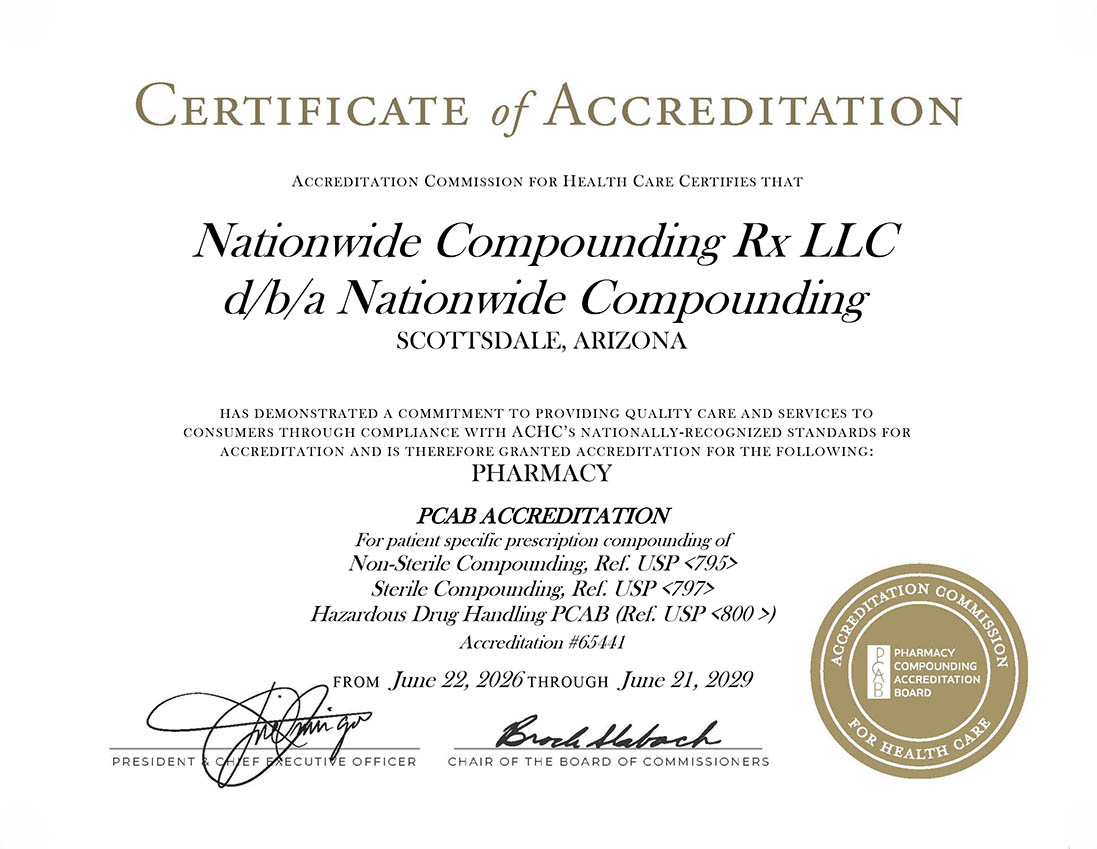
CVS Specialty holds ACHC accreditation for specialty pharmacy services and PCAB (Pharmacy Compounding Accreditation Board) accreditation. These are legitimate credentials. The question is what they cover.
CVS Specialty’s core function is dispensing commercially manufactured, FDA-approved specialty drugs: biologics, injectables, and therapies for complex conditions such as cancer, multiple sclerosis, and rheumatoid arthritis. It is not set up as a custom compounding service for the general public.
PCAB accreditation tied to a limited internal compounding capability is not the same as operating as a full-service compounding pharmacy that routinely handles:
- Individualized bioidentical hormone therapy
- Weight-based pediatric dosing in flavored forms
- Allergen-free reformulations
- Recreations of discontinued strengths
This is exactly why “Is CVS a compounding pharmacy?” has no simple yes or no answer without context. Content that mentions CVS Specialty’s accreditation at a surface level, without explaining its actual scope, leaves patients without a usable answer.
The 2026 GLP-1 Compounding Landscape: Why Timing Matters
GLP-1 medications such as semaglutide and tirzepatide have become the center of the compounding debate, and 2026 has brought several significant developments.
The backdrop. When these drugs were officially in shortage, federal law allowed compounders to prepare copies. The FDA declared the tirzepatide shortage resolved in December 2024 and the semaglutide shortage resolved in February 2025. Once those shortages ended, mass compounding of these drugs became restricted outside narrow exceptions.
April 30, 2026: The 503B bulks proposal. The FDA proposed excluding semaglutide, tirzepatide, and liraglutide from the 503B bulks list. If finalized, this would further limit outsourcing facilities’ ability to compound these medications from bulk ingredients.
August 27, 2026: The Fifth Circuit ruling. A federal appeals court upheld the FDA’s decisions ending the tirzepatide and semaglutide shortage exemptions. The ruling confirmed that routine, mass-compounded copies of these drugs are no longer broadly legal outside individualized-need exceptions.
September 18, 2026: The Empower Pharmacy warning letter. The FDA issued a warning letter to Empower Pharmacy, a major compounder, over GLP-1 products with added ingredients that the agency deemed “essentially a copy” of approved drugs. The message was clear: adding a vitamin or other ingredient to a GLP-1 does not automatically make it an individualized preparation.
Taken together, this regulatory turbulence explains why so many patients are searching “can CVS compound my GLP-1 medication” and getting inconsistent answers online.
What This Means for Patients Seeking GLP-1s or Other Compounded Drugs Today
- CVS has never been a primary source for compounded GLP-1 medications. As a retail chain, it dispenses the FDA-approved branded products. Under current regulatory tightening, it is even less likely to become a source of compounded versions.
- Legitimate individualized compounding remains legal. When a patient has a documented clinical need, such as an allergy to an excipient in the commercial product, a properly licensed 503A pharmacy can still prepare a tailored medication based on that individual prescription.
- Pharmacy selection matters. Patients should work with a pharmacy that stays current on FDA guidance rather than assuming any pharmacy, chain or compounder, can simply provide these drugs.
What a True Compounding Pharmacy Actually Does
Under the FDA definition, a compounding pharmacy is where a licensed pharmacist combines, mixes, or alters ingredients to create a medication tailored to an individual patient. Common, legitimate reasons patients need this service include:
- Allergies or sensitivities to a dye, filler, gluten, lactose, or preservative in the commercial version
- A different strength that no manufacturer produces
- Difficulty swallowing pills, requiring a liquid, topical, troche, or suppository instead
- Pediatric dosing, where a child needs a precise weight-based dose in a palatable flavor
- Veterinary dosing for animals that need human-derived medications in adjusted forms
- Discontinued medications that a patient still relies on
- Permitted drug-shortage situations, within the limits federal law allows
Patients should also understand an important limitation. Compounded drugs are not FDA-approved. The FDA does not review their safety, effectiveness, or quality before they reach patients. That is not a reason to avoid compounding when it is clinically appropriate, but it is a strong reason to choose an accredited, licensed compounder carefully.
Demand for this kind of personalized care continues to grow. Industry estimates value the global compounding pharmacy market at roughly $17 to $22 billion in 2025, with steady growth projected into the early 2030s, driven largely by hormone therapy, pain management, dermatology, and pediatric care.
How to Verify a Legitimate Compounding Pharmacy
Most online content says “look for accreditation” and stops there. These are the concrete steps patients and providers can take.
- Confirm state licensure. Search the pharmacy’s name directly on the state board of pharmacy website for the state where it operates, and for the patient’s state if the pharmacy ships medications. Every compounding pharmacy must hold a valid state license.
- Check PCAB accreditation independently. Look up the pharmacy in the ACHC online directory at achc.org rather than relying on a logo on the pharmacy’s website.
- Ask about USP compliance. Confirm the facility meets USP 795 for non-sterile preparations, USP 797 for sterile preparations, and USP 800 for hazardous drugs, as relevant to the medication.
- Recognize why PCAB matters. PCAB accreditation is a meaningful trust signal precisely because it is rare. Only roughly 68 of more than 7,500 U.S. compounding pharmacies hold it.
- Ask about testing and sourcing. A quality compounder should explain its third-party testing practices and confirm that raw ingredients come from FDA-inspected and cleared vendors.
Red Flags to Watch For
- Reluctance to share credentials. A pharmacy unwilling to disclose state license numbers or accreditation details should not be trusted.
- No verifiable physical address or pharmacist oversight. Legitimate compounding happens in a licensed facility supervised by licensed pharmacists.
- GLP-1 “copies” marketed like branded products. Promotions that closely resemble FDA-approved drugs, rather than individualized formulations tied to a documented need, are a direct red flag, especially given the 2026 Empower warning letter precedent.
Where Nationwide Compounding Rx Fits as a Trustworthy Alternative
For patients and prescribers who need true custom formulation, a dedicated compounding pharmacy is the right destination. Nationwide Compounding Rx®, based in Scottsdale, Arizona, is PCAB accredited and USP 800 compliant, the kind of facility built specifically for individualized compounding rather than retail dispensing.
Its capabilities span both sterile and non-sterile preparations, including:
- Bioidentical Hormone Replacement Therapy (BHRT), with formulas that can be adjusted at each refill based on updated lab results
- Pain management topicals (creams, gels, and ointments) designed to localize treatment and reduce systemic side effects
- Dermatology formulations for acne, rosacea, eczema, psoriasis, scarring, and aging skin
- Pediatric medications in age- and weight-specific doses, with flavors ranging from cherry and bubblegum to piña colada
- Sports medicine formulations supporting recovery and inflammation management
- GLP-1 and peptide support, delivered within current regulatory boundaries
Quality practices include sourcing high-grade chemicals from FDA-inspected and cleared vendors and independent third-party testing. The pharmacy offers a 1 to 2 business day turnaround, same-day pickup for some medications, and nationwide shipping where state licensure and medication type allow.
The process is designed to be transparent. Separate secure Provider and Patient Portals allow prescribers to submit and track prescriptions and patients to manage refills and support requests. The pharmacy’s provider partnership framework, Connect → Collaborate → Create → Care, reflects a collaborative working relationship with healthcare teams rather than a black-box transaction.
Conclusion
CVS is not a custom compounding pharmacy. When a standard CVS location lists “compounding” as a service, it refers to basic preparation, such as reconstituting a suspension, not individualized 503A formulation. CVS Specialty holds PCAB accreditation, but its core purpose is dispensing commercially manufactured specialty drugs.
The 2026 regulatory environment makes this distinction more important than ever. The FDA’s April proposal on the 503B bulks list, the Fifth Circuit’s August ruling on shortage exemptions, and the September warning letter to Empower Pharmacy have all narrowed what compounders can legally provide, particularly for GLP-1 medications.
The safest path to a legitimate compounded medication is verification through official channels: the state board of pharmacy for licensure and the ACHC directory for PCAB accreditation. Marketing claims are not a substitute.
Find a Verified Compounding Partner
Patients and providers looking for a verified starting point can review Nationwide Compounding Rx®’s PCAB accreditation and USP 800 compliance, then confirm both through official directories.
- Providers can explore the Connect, Collaborate, Create, Care partnership process and use the secure Provider Portal to submit and manage prescriptions.
- Patients can reach out through the Patient Portal or the website contact form, with email inquiries answered within one business day.
To discuss a specific prescription need, contact Nationwide Compounding Rx® at (480) 499-8379 or visit nationwidecompounding.com. The pharmacy is open Monday through Friday, 7:00 AM to 3:30 PM, at 14000 N. Hayden Rd., Suite 104, Scottsdale, AZ 85260.
Related Posts

Lumicera Specialty Pharmacy markets transparent, cost-plus drug pricing, but that promise only applies to select conditions and stocked drugs. This article examines the data behind Lumicera's coverage limits, prior authorization denials, and what patients can do when they fall outside the model.

Searching for the right Optum Specialty Pharmacy phone number can lead to outdated or conflicting results. This 2026 verified list breaks down each legitimate contact line, what it's used for, and why the old BriovaRx name still causes confusion today.
Kentucky's 2026 crackdown on compounded peptides has left many Lexington patients searching for answers and legal alternatives. This guide breaks down what changed under 201 KAR 2:076, what it means for existing prescriptions, and how a PCAB-accredited compounding pharmacy can still legally fill compliant formulations.
As GLP-1 use surges in 2026, not all tirzepatide compounding pharmacy options are equally safe. This article breaks down FDA's 2026 adverse event data and shows exactly how PCAB accreditation—not facility type—prevents dangerous dosing errors.