
Central Ohio Compounding Pharmacy Demand: The 2026 Growth Story
Introduction: Why Central Ohio’s Compounding Demand Is Becoming a 2026 Story
Central Ohio has quietly become one of the most dynamic growth regions in the United States. The Columbus metro area is adding residents faster than both the state and national averages. At the same time, its population is aging rapidly, and its major health systems are committing well over $1 billion to new towers, campuses, and expansions. Together, these forces are producing a steady rise in demand for personalized medications.
This article does not review accreditation checklists. It looks at central Ohio compounding pharmacy demand as a demographic and healthcare infrastructure story: who is moving to the region, how its age profile is changing, and what hospital investment says about the prescriptions that will follow.
There is also a complication. Just as demand accelerates, Ohio’s 2026 regulatory environment is narrowing the list of pharmacies that can legally serve the region, especially out-of-state pharmacies shipping into Ohio. Growth, aging, and regulation are reshaping central Ohio’s compounding landscape at the same time, which makes quality-assured access more important than ever.
Central Ohio’s Population Boom: The Foundation of Rising Demand
The numbers are striking. Between 2024 and 2025, the Columbus metropolitan area grew by roughly 1% to 2,242,028 residents, accounting for 53% of Ohio’s total population growth. In a state where many regions are flat or shrinking, central Ohio is absorbing more than half of all new residents.
The City of Columbus has grown about 3.5% since 2020 and reaches roughly 944,402 residents in 2026. That growth reflects job creation in technology, logistics, advanced manufacturing, and healthcare, along with a steady stream of families relocating from more expensive metros.
Population growth matters for pharmacy demand in a simple way: more people means more prescriptions. Every new household brings routine medication needs, and a predictable share of those households will need something a standard retail pharmacy cannot provide. That includes a child who cannot swallow tablets, a patient allergic to a common dye or filler, someone whose medication has been discontinued, or a person who needs a non-standard strength. As the baseline grows, so does the specialty slice, including compounding.
Suburban Growth Corridors: Dublin, Worthington, New Albany, and Delaware/Union County
Much of central Ohio’s expansion is happening outside downtown Columbus. Dublin, Worthington, and New Albany continue to attract professionals and families, while Delaware and Union counties have become some of the fastest-developing exurban areas in the Midwest.
These communities tend to be affluent, well-insured, and health-conscious. Residents are more likely to seek specialized care such as bioidentical hormone replacement therapy (BHRT), customized dermatology treatments, and pediatric formulations for young children. Compounding infrastructure has not always kept pace with residential growth, though. A new subdivision in Union County may sit a long drive from a compounding pharmacy that has the right specialty focus.
This produces pockets of underserved demand spread across a wide area. A nationally shipping, accredited pharmacy can fill those gaps by delivering patient-specific medications directly to homes across the region, provided it holds the proper Ohio licensure.
The Aging of Central Ohio: A Demographic Shift Driving Specialty Medication Needs
The region is not only growing but also getting older. According to Central Ohio Hospital Council data, the area’s 65-and-older population grew 11.6% over four recent years, compared with 1.9% growth for the population overall. Older residents are increasing at roughly six times the rate of the general population.
The long-term outlook points the same way. The region’s 65+ population is projected to rise 40% by 2050, from 162,300 in 2020 to about 226,000. That shift will shape healthcare utilization, workforce planning, and medication needs for decades.
The clinical connection is well established. Aging brings hormonal changes, chronic pain, arthritis, mobility limitations, and a higher burden of chronic disease. These conditions account for a large share of prescriptions, and many of them respond well to individualized therapy.
From Aging Trends to Prescription Needs
Several of the most common aging-related conditions map directly to established compounding categories:
- Menopause and andropause lead many patients to explore hormone therapy, including BHRT.
- Chronic pain and mobility issues create demand for localized pain relief, often through topical preparations.
- Swallowing difficulties (dysphagia) make standard tablets and capsules hard to take, so liquids, troches, lozenges, and topicals become practical alternatives.
- Polypharmacy, the use of multiple medications at once, raises the value of formulations that reduce systemic exposure or remove unnecessary inactive ingredients.
National trends confirm the momentum. HRT prescriptions are up 86% since 2021. Testosterone prescriptions rose from 7.3 million in 2019 to over 11 million in 2024. An estimated 7 million patients now use compounded bioidentical hormone therapies, and a National Academies consensus review has noted significant increases in both the supply of and demand for these products. Central Ohio’s fast-aging population places the region firmly within this national curve.
Billion-Dollar Bets on Growth: What Hospital Expansions Reveal About Demand
The most telling indicator of future healthcare demand may be what health systems are building. Across OhioHealth, The Ohio State University Wexner Medical Center, Mount Carmel, and Nationwide Children’s Hospital, combined investment in expansion projects is well over $1 billion.
Health systems do not commit capital of this size casually. These projects rest on detailed modeling of population growth, patient volume, and service-line demand. In effect, they are the region’s largest data-driven bets on sustained growth.
Hospital investment is also a leading indicator for outpatient and specialty prescriptions. More beds and clinics bring more physicians, specialists, discharges, and follow-up care. Each of those touchpoints produces prescriptions, and a portion will require compounded solutions.
OhioHealth’s $1 Billion Construction Response to Regional Growth
OhioHealth has publicly tied roughly $1 billion in construction projects to population growth across its service area. That investment expands inpatient capacity, outpatient facilities, and access points in growing communities.
As patient volume rises, so does the number of people who need individualized medication after discharge or in ongoing outpatient care. Patients recovering from surgery, managing chronic pain, or dealing with intolerance to commercial formulations are among those most likely to need a compounding partner.
OSU Wexner’s 26-Story Tower and the Scale of Future Patient Volume
Ohio State’s new 26-story, nearly 2-million-square-foot hospital tower is one of the largest healthcare construction projects in the Midwest. Its size alone reflects the expected patient growth.
Academic medical centers also tend to treat more complex cases. Specialty clinics, research programs, and tertiary referrals generate prescribing patterns that often call for non-standard strengths, alternative dosage forms, or formulations unavailable commercially. As OSU’s capacity grows, so will the complexity of the prescriptions coming out of it.
Mount Carmel and Nationwide Children’s Hospital: Rounding Out the Growth Picture
Mount Carmel’s expansion adds to overall regional care capacity, particularly in communities seeing rapid residential development. More access points mean more patients connected to ongoing care and more prescriptions.
Nationwide Children’s Hospital’s growth is especially relevant to compounding. As one of the country’s leading pediatric institutions, its expansion signals rising demand for pediatric care across central Ohio. Children often need weight-based dosing, liquid formulations, and palatable flavors that commercial products do not offer, so pediatric compounding demand tends to follow pediatric care capacity closely.
Mapping Demand to Specialty: Where Central Ohio’s Needs Are Concentrated
The broad trends of population growth, aging, and hospital expansion lead to specific needs. Four compounding categories line up most closely with central Ohio’s demand drivers: BHRT, pain management, pediatrics, and dermatology.
Bioidentical Hormone Replacement Therapy (BHRT)
BHRT demand is tied directly to central Ohio’s expanding 65+ population and to the large number of residents in their 40s and 50s entering perimenopause, menopause, and andropause. National growth in hormone therapy prescriptions reinforces the trend.
Hormone optimization is individualized by nature. Two patients with similar symptoms may need very different doses. For that reason, formulas that can be adjusted at each refill based on updated lab results offer real clinical value. Nationwide Compounding Rx® builds its BHRT approach around this adjustability, allowing prescribers to fine-tune therapy over time.
BHRT is relevant to both women managing menopause and men experiencing andropause, and demand is especially visible in suburban communities such as Dublin, Worthington, and New Albany.
Pain Management Compounding
Chronic pain and mobility problems increase with age, and central Ohio’s growing older population is driving demand for alternatives to oral pain medications. Topical creams, gels, and ointments deliver treatment directly to the affected area.
Localized delivery can reduce systemic side effects and addiction risk, which matters for older adults managing multiple conditions and medications. It also supports broader efforts to limit opioid exposure.
Drug shortages add structural pressure. The American Society of Health-System Pharmacists counted 227 active national drug shortages in Q2 2026, the third consecutive quarterly increase, and 48% of new 2026 shortages involve sole-source drugs made by a single manufacturer. When a sole-source product becomes unavailable, compounded alternatives are often among the few remaining options.
Pediatric Compounding
Nationwide Children’s Hospital’s expansion points to broader pediatric demand throughout the region. Children’s medication needs differ from adults’ in ways commercial products often do not address:
- Age- and weight-specific dosing that tablets cannot easily provide
- Allergen-free formulations without dyes, fillers, or preservatives
- Kid-friendly forms and flavors such as flavored liquids, popsicles, and suckers
Nationwide Compounding Rx® offers flavors including cherry, strawberry, bubblegum, marshmallow, tutti frutti, and piña colada, which can make the difference between a child accepting a dose and refusing it. Since growth in suburbs like New Albany, Dublin, and Worthington leans heavily toward families with young children, pediatric prescription volume in these areas is likely to keep climbing.
Dermatology Compounding
A growing and increasingly affluent population is fueling interest in custom topical treatments for acne, rosacea, eczema, psoriasis, atopic dermatitis, scarring, dark spots, and signs of aging. Compounding lets prescribers combine ingredients, adjust strengths, and choose bases suited to specific skin types.
Dermatology compounding also serves patients who need allergen-free or preservative-free formulations that are not available commercially. For people with sensitive skin or ingredient allergies, these options can be essential.
A Narrowing Field: How Ohio’s 2026 Regulatory Landscape Is Reshaping Who Can Serve This Demand
Rising demand is meeting a tighter regulatory environment, and that combination could leave some central Ohio patients with fewer options than they expect.
Ohio and Washington are the only two U.S. states that specifically require verifiable PCAB accreditation as a condition of nonresident compounding pharmacy licensure. Under Ohio Administrative Code 4729:5-8-04, a nonresident pharmacy that compounds for Ohio patients must name an Ohio-licensed pharmacist as its Responsible Person and prove compliance through PCAB accreditation, a Joint Commission medication compounding certification, or a Compliance Team certification. Ohio rules also require that compounding generally be tied to a patient-specific prescription.
Enforcement has increased as well. Through 2025 and 2026, the Ohio Board of Pharmacy has pursued nonresident 503A pharmacies over investigational GLP-1 and peptide dispensing, using summary suspensions against pharmacies it considers unsafe or noncompliant.
The GLP-1 Compounding Shift and What It Means Locally
The legal landscape for compounded GLP-1 medications narrowed considerably in 2026. Tirzepatide and semaglutide shortages were declared resolved in December 2024 and February 2025. On April 30, 2026, the FDA proposed excluding semaglutide, tirzepatide, and liraglutide from the 503B Bulks List. On August 27, 2026, the Fifth Circuit upheld the FDA’s shortage determinations.
As a result, legal GLP-1 compounding is now largely limited to documented, patient-specific clinical-need cases under 503A. Central Ohio providers and patients should approach GLP-1 requests with clear clinical justification and work only with compliant pharmacies.
There is still a nuance. IQVIA data shows that more than 80% of compounded semaglutide and tirzepatide prescriptions included supplemental ingredients such as B vitamins or levocarnitine, which some cite as a rationale for continued individualized compounding when it is properly justified.
Why This Matters for Patients and Prescribers Choosing a Pharmacy
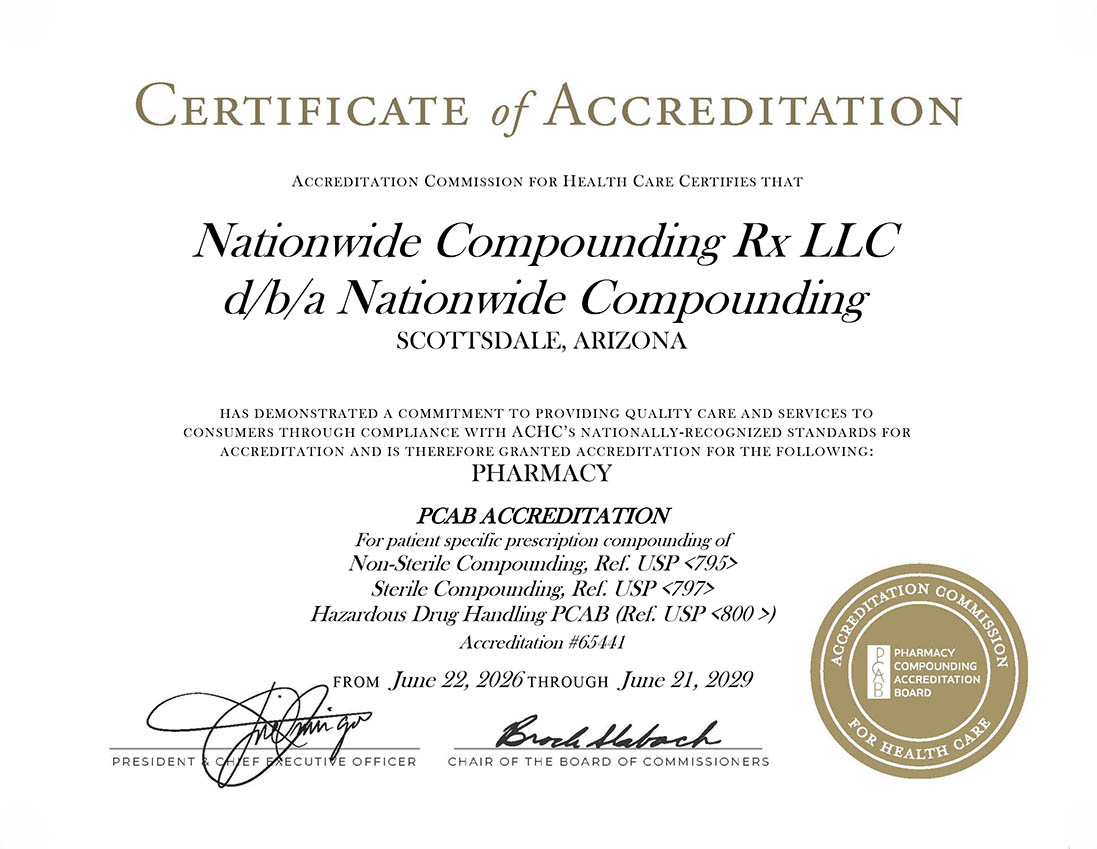
PCAB accreditation is rare. Of roughly 3,000 U.S. compounding pharmacies, fewer than 200 hold it. PCAB, administered by ACHC, evaluates quality systems, personnel competency, facility standards under USP <795>, <797>, and <800>, and third-party potency testing, with recurring re-audits rather than a one-time certificate. The American Medical Association formally recommends that prescribers use only PCAB-accredited compounding pharmacies.
For central Ohio, this scarcity is a real concern. Demand is growing quickly, often in underserved suburban areas, while the pool of pharmacies that can legitimately serve Ohio is small. Without careful selection, patients could face delays, interruptions, or quality risks.
Meeting the Moment: The Case for a PCAB-Accredited, Nationally Shipping Pharmacy
Nationwide Compounding Rx® is structurally suited to central Ohio’s growth story. The pharmacy is PCAB accredited and USP 800 compliant, and it is built for nationwide shipping through a tiered state licensing system that reflects each state’s requirements.
Its core specialties match the region’s main demand drivers:
- BHRT, with formulas adjustable at each refill based on lab results
- Pain management, using topical creams, gels, and ointments
- Pediatrics, with age- and weight-specific dosing and kid-friendly flavors and forms
- Dermatology, including allergen-free and preservative-free custom topicals
Practical features fit a region that stretches from downtown Columbus to Dublin and out to Delaware and Union counties. These include a 1–2 business day turnaround and secure Provider and Patient Portals for submitting prescriptions, tracking orders, and managing refills.
Quality assurance carries more weight as enforcement increases. The pharmacy sources high-grade chemicals from FDA-inspected and cleared vendors and uses independent third-party testing to confirm quality and consistency.
For health systems and independent prescribers handling more patients, the pharmacy’s “Connect, Collaborate, Create, Care” partnership framework provides a structured, relationship-based model in place of a purely transactional one.
A Practical Note on Verification
Before choosing any compounding pharmacy, local or out of state, patients and providers can confirm its standing with three quick checks: the Ohio Board of Pharmacy license lookup for active nonresident status, the NABP e-Profile and safe.pharmacy tool, and the ACHC PCAB directory for current accreditation. A few minutes of verification helps ensure that a pharmacy meeting the region’s demand is also meeting Ohio’s standards.
Conclusion: Central Ohio’s Growth Story Is a Compounding Demand Story
Central Ohio’s trends point in one direction. A booming population, a fast-aging demographic, and more than $1 billion in health system investment are combining to drive demand for personalized medications that many local options may have trouble fully meeting.
The regulatory tightening of 2026 makes accreditation and legitimate nonresident licensure essential considerations, not optional extras. For residents of Columbus, Dublin, Worthington, New Albany, and Delaware and Union counties, PCAB-accredited, nationally shipping pharmacies are a necessary complement to local options, helping the region’s healthcare capacity keep up with its growth.
Connect With a PCAB-Accredited Compounding Partner Today
Central Ohio patients and prescribers looking for BHRT, pain management, pediatric, or dermatology compounding can contact Nationwide Compounding Rx® to discuss their needs.
- Providers can use the secure Provider Portal to submit and manage prescriptions, track orders, and connect with the pharmacy team.
- Patients can use the Patient Portal to access account information and manage refill and support requests.
- Phone: (480) 499-8379
- Website: nationwidecompounding.com
- Hours: Monday–Friday, 7:00 AM – 3:30 PM (Arizona time)
Email inquiries receive a response within one business day. As central Ohio continues to grow, Nationwide Compounding Rx® offers quality-assured, personalized compounding backed by PCAB accreditation, independent testing, and a commitment to working closely with prescribers and patients.
Related Posts

Partell Specialty Pharmacy officially became National Health Rx after a 2025 ownership change approved by the Nevada State Board of Pharmacy. This guide helps patients and prescribers decide whether to stay or transfer, with a capability checklist and a clear five-step pathway to a PCAB-accredited compounding pharmacy.

BioPlus Specialty Pharmacy has long been known for high-touch specialty infusion services, but its 2026 status under Carelon ownership raises new questions for patients and providers. This guide breaks down what changed, what stayed the same, and how BioPlus's dispensing model compares to specialty compounding pharmacies.

Curious what bioidentical hormone replacement therapy actually means? This 2026 guide breaks down BHRT in plain terms, clarifies the FDA-approved vs. compounded distinction, and walks through what a typical patient journey looks like. Get clear, evidence-based answers beyond the marketing hype.

Can't access your CVS specialty pharmacy log in? You're not alone—CVS Specialty, Caremark, and CVS.com use separate credentials entirely. Discover the fast fix and the deeper PBM ownership structure driving this friction.