
Compounded Weight Loss Medication for Clinics: 2026 Compliance Guide
Introduction: Why Supplier Selection Is Now a Liability Decision, Not a Vendor Decision
Most guidance on choosing a compounding pharmacy treats the decision like selecting a shipping vendor. Clinics compare price, turnaround time, packaging, and branding. In 2026, that approach is outdated. For clinic owners, medical directors, and med spa operators, choosing a pharmacy partner is now a decision about regulatory exposure.
The shift has a specific cause. On April 30, 2026, the FDA proposed permanently excluding semaglutide, tirzepatide, and liraglutide from the 503B Bulks List. If finalized, the proposal would close the last broad legal pathway for large-scale compounding of these agents.
The stakes are significant. At the 2024 peak, nearly one in three Americans taking a GLP-1 reported sourcing it from a compounding pharmacy. FDA enforcement changes are projected to eliminate roughly $3.6 billion in compounding pharmacy and telehealth revenue during 2025 and 2026, disrupting an estimated 1.5 million patients who relied on non-branded compounded GLP-1s.
This guide translates FDA rule changes, litigation, and recall exposure into practical underwriting criteria that clinic owners can apply when vetting a pharmacy partner.
The 2026 Regulatory Timeline: How We Got Here
The current environment is the result of a clear sequence of events:
- Tirzepatide shortage resolved: The FDA declared the shortage over in October 2024 and reaffirmed that decision on December 19, 2024.
- Semaglutide shortage resolved: The FDA declared the shortage over on February 21, 2025.
- Grace periods ended: 503A pharmacies had to stop compounding between February 18 and April 22, 2025, depending on the drug and facility type. 503B outsourcing facilities had deadlines between March 19 and May 22, 2025.
Once the shortages ended, so did the shortage-based exemption that had allowed mass compounding.
The April 30, 2026 proposal goes further. As reported by STAT, the FDA stated there is “no clinical need” for compounded GLP-1s because Novo Nordisk and Eli Lilly can now meet demand. Permanent exclusion from the 503B Bulks List would effectively end the remaining pathway for outsourcing facilities to produce these drugs at scale.
The FDA also sent a parallel signal that clinics often misread. In April 2026, it removed twelve peptides from its restrictive Category 2 list and scheduled Pharmacy Compounding Advisory Committee meetings on others. Removal from a restricted list does not equal authorization to compound. Clinics that treat these changes as permission to expand peptide offerings risk moving ahead of the actual legal status of those substances.
What Is Still Legally Compoundable for Clinics in 2026
The surviving pathway is narrow. Patient-specific 503A compounding of GLP-1s remains legal only when there is documented, individualized clinical necessity. Examples include:
- A documented allergy to an excipient in the commercial product
- A need for a different dosage form not commercially available
- A need for a strength that the approved product does not offer
Several practices are clearly prohibited:
- Bulk compounding or office-use stock
- General marketing of compounded semaglutide, tirzepatide, or liraglutide as alternatives to branded drugs
- Any messaging that implies a compounded product is interchangeable with an FDA-approved drug
Documentation is the clinic’s responsibility, too. “Individualized necessity” must appear in the patient chart as a specific clinical rationale tied to that patient. A generic template stating “patient prefers compounded medication” does not qualify. When documentation is missing or boilerplate, the clinic carries exposure alongside the pharmacy.
Marketing language is an equally serious trap. FDA warning letters in 2026 have targeted clinics and telehealth companies for phrases like “same active ingredient as Ozempic” or “generic Zepbound.” These letters implicate the clinic’s own advertising, not only the pharmacy that filled the prescription.
The Liability Landscape: Litigation and Enforcement Patterns Clinics Must Understand
Much of the relevant litigation is covered in pharmaceutical trade press rather than clinic-facing resources. The following patterns translate directly into clinic risk.
Strive v. Eli Lilly/Novo Nordisk: The Antitrust Wildcard
In January 2026, a compounding pharmacy filed a federal antitrust lawsuit against Eli Lilly and Novo Nordisk in the Western District of Texas. The suit alleges the manufacturers used exclusive telehealth agreements and disparagement tactics to suppress competition from compounders.
Clinics are not named parties, but the case matters. It shows that the legal environment remains unsettled and that the viability of individual pharmacy partners is itself contested. A clinic tied to a pharmacy engaged in manufacturer litigation inherits reputational risk and potential supply-continuity disruption.
Manufacturer Enforcement Actions Against Compounders
Eli Lilly has sued multiple compounding pharmacies over unauthorized tirzepatide compounding. Lilly has also referred more than 200 individuals and entities to the FDA, the Department of Justice, and state attorneys general over illicit GLP-1 sales.
Federal enforcement infrastructure is active. U.S. Customs intercepted more than 1,400 illicit GLP-1 shipments in July 2026 alone, building on more than 690 interceptions in fiscal 2025.
Lilly is also acting on pipeline drugs. The company has sued multiple companies over unapproved retatrutide sales. Clinics should expect similar enforcement to extend to newer molecules as they approach approval.
The B12-Impurity Recall Exposure
Some compounders and telehealth brands add ingredients such as B12, niacinamide, L-carnitine, or glycine to create “personalized” formulations that differ from FDA-approved drugs. The strategy is meant to distinguish compounded products from commercial ones.
The risks are now documented. According to eMarketer’s reporting, Lilly’s testing detected “significant levels” of a reaction-related impurity in all 10 samples of compounded tirzepatide-B12 mixes obtained from compounding pharmacies, telehealth companies, and med spas. Lilly called for a nationwide recall.
For clinics, the implication is direct. A clinic dispensing an additive-based formulation from an unvetted pharmacy faces product-liability and recall fallout even though it did not manufacture the drug. An additive formulation is not a marketing differentiator; it is an underwriting red flag.
FDA Warning-Letter Patterns in 2026
FDA warning letters in 2026 consistently cite language that suggests equivalence to, or substitution for, approved brand-name drugs. Clinics should audit their websites, intake forms, social media, and provider scripts for the following:
- “Same active ingredient as Ozempic” or “same as Wegovy”
- “Generic Zepbound,” “generic Mounjaro,” or “generic semaglutide”
- “FDA-approved” used to describe any compounded product
- Claims that compounded products are “just as safe and effective” as branded drugs
- Price comparisons that frame compounded drugs as cheaper versions of branded products
- Promotions offering compounded GLP-1s to anyone without an individualized clinical evaluation
A clinic can become a warning-letter target on its own, regardless of its pharmacy partner’s compliance.
Translating Risk into Underwriting Criteria: How to Vet a Compounding Pharmacy Partner
This is the practical core of the guide: a due-diligence framework clinic owners can apply immediately.
PCAB Accreditation as an Inspection-Gap Proxy
Roughly half of U.S. states conduct no routine inspections of 503A compounding pharmacies. As a result, state licensure alone is not a reliable signal of quality.
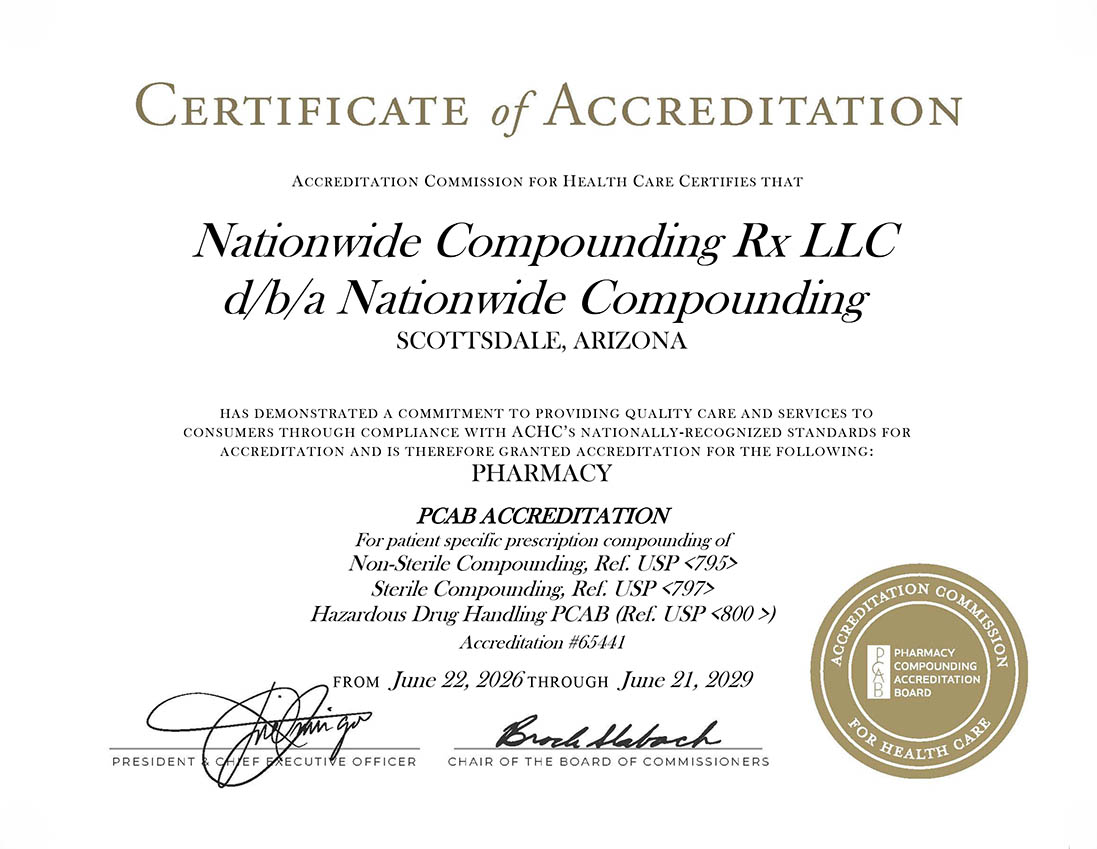
PCAB accreditation, administered through ACHC, fills that gap. It requires independent, on-site verification rather than self-reporting, and fewer than 1% of U.S. pharmacies hold it. Clinics should treat PCAB not as a marketing badge but as a compliance proxy: the closest available substitute for a state inspection regime that may not exist in the pharmacy’s home state. Accreditation status should be verified directly with the accrediting body.
USP 800 Compliance and Sterile Compounding Standards
USP 800 sets standards for handling hazardous drugs, including containment, engineering controls, and personnel protection. It works alongside USP 797, which governs sterile compounding environments such as ISO-classified cleanrooms. For injectable GLP-1 formulations, a pharmacy that has invested in these controls shows the facility maturity and contamination-prevention discipline that sterile injectables require.
According to Town & Country Compounding, a PCAB-accredited 503A pharmacy must meet many of the same core quality standards as an FDA-inspected 503B facility, including ISO-classified cleanrooms. This closes much of the perceived quality gap between the two categories.
Verifying 503A Status and Patient-Specific Compounding Practices
Clinics should ask prospective pharmacies specific questions:
- Do you require individualized clinical necessity documentation for every GLP-1 prescription?
- Do you compound only against verified, patient-specific prescriptions, or do you compound in advance? (Compounding in advance is a red flag.)
- How did your protocols change after the shortage resolutions?
- Will you reject a prescription that lacks adequate necessity documentation?
Verbal assurances are not enough. Clinics should request the pharmacy’s written compliance protocol, sample documentation requirements, and evidence of how noncompliant orders are handled.
Additive and Formulation Transparency
Clinics should ask directly whether a pharmacy’s formulations include B12 or other additives. Given Lilly’s findings, they should request third-party impurity testing data for any such product. Independent third-party testing should be a non-negotiable vetting item, along with documentation of where the pharmacy sources its active ingredients.
Operational Benchmarks: Turnaround, Volume, and Multi-State Licensing
Median 503A benchmarks give clinics a useful reference: roughly 350 compounded prescriptions per week serving about 150 prescribers. A turnaround of 1 to 2 business days is considered the high-performance standard.
Licensing must be mapped against the clinic’s patient geography. Pharmacies typically operate under three tiers:
- Fully licensed states (sterile and non-sterile)
- Non-sterile-only states (sterile licensure pending)
- Pending or unlicensed states
Because GLP-1 injectables are sterile preparations, a multi-location or telehealth-adjacent clinic with patients in non-sterile-only states faces a continuity-of-care gap. Same-day pickup and nationwide shipping should be evaluated as operational resilience factors, not just conveniences.
The Exclusive Partnership Model as Compliance Architecture
Instead of shopping among pharmacies case by case, some clinics choose an exclusive, single-partner relationship. This consolidates compliance oversight into one vetted, accredited relationship instead of spreading risk across several vendors with different standards.
This model works well when a clinic partners with a PCAB-accredited, USP 800-compliant pharmacy, such as Nationwide Compounding Rx® in Scottsdale, Arizona, and relies on proprietary, patient-specific formulations rather than generic bulk stock.
Proprietary, patient-specific formulations protect a clinic in two ways. They reduce dependence on brand-name supply during shortages, and they avoid the regulatory exposure that comes with marketing “generic” GLP-1 alternatives.
The model also supports retention. GLP-1 patients spend roughly 63% more with med spas and are about four times more likely to become new clients. A compliant, reliable supply relationship functions as a recurring revenue engine rather than just a supply-chain fix.
Nationwide Compounding Rx® frames provider relationships around a Connect → Collaborate → Create → Care process. Clinics should expect this kind of approach from any compliant partner: documentation-first, collaborative with providers, and not transactional.
Future-Proofing: What’s Coming Next in the Pipeline
New molecules will reshape demand and raise new questions about what can be compounded:
- Retatrutide: 24.2% body weight reduction in Phase 2. Lilly plans to submit it for approval as a biologic in Q1 2027.
- CagriSema: 22.7% weight loss in the Phase 3 REDEFINE-1 trial.
Lilly’s lawsuits against multiple companies over unapproved retatrutide sales show that enforcement will not wait for approval. Each new molecule will need to be evaluated with the same framework: bulks-list status, patient-specific necessity, and litigation exposure. Clinics should build pharmacy vetting as a repeatable process, not a one-time decision.
A Practical Compliance Checklist for Clinic Owners
- [ ] PCAB accreditation verified independently with the accrediting body
- [ ] USP 800 compliance confirmed, with sterile compounding standards documented
- [ ] Written patient-specific necessity protocol in place for every GLP-1 prescription
- [ ] No compounding in advance of individual prescriptions
- [ ] Additive disclosure and third-party impurity testing data provided
- [ ] Active ingredients sourced from FDA-inspected, registered vendors
- [ ] Multi-state licensing mapped to the clinic’s patient base, including sterile status
- [ ] Turnaround (1 to 2 business days) and volume benchmarks met
- [ ] Clinic marketing language audited against FDA warning-letter patterns
- [ ] Pharmacy’s litigation and enforcement history reviewed
Clinics should request this documentation in writing before finalizing any exclusive or primary pharmacy relationship, and revisit it periodically as FDA rules change.
Conclusion: Compliance Is the New Competitive Advantage
The U.S. medical weight loss clinics market is valued at $11.8 billion in 2026 and is projected to reach $37.18 billion by 2035. The clinics that capture that growth while withstanding enforcement scrutiny will be the ones that treated supplier vetting as risk underwriting from the start.
The legal room to compound weight loss medications has narrowed sharply, but it has not disappeared. Patient-specific 503A compounding with rigorous documentation, paired with an accredited and transparent pharmacy partner, remains a defensible path. With manufacturers actively litigating and the FDA actively enforcing, accreditation and documentation are not red tape. They are the clinic’s liability shield.
Partner With a Pharmacy Built for 2026 Compliance
Nationwide Compounding Rx® is a PCAB-accredited, USP 800-compliant compounding pharmacy based in Scottsdale, Arizona. It works with providers through its Connect → Collaborate → Create → Care framework, offering the documentation-first, patient-specific approach clinics need now that the shortages have ended.
Key differentiators for compliance-focused clinics include:
- Independent third-party testing to verify quality and consistency
- High-grade chemicals sourced from FDA-inspected and cleared vendors
- 1 to 2 business day turnaround, with same-day pickup available for some medications
- A secure Provider Portal for submitting prescriptions, managing documentation, and tracking orders
- A transparent multi-tier state licensing map that lets clinics plan around their patient geography
Clinic owners and healthcare providers can contact Nationwide Compounding Rx® at (480) 499-8379 (Monday to Friday, 7:00 AM to 3:30 PM) or through the website contact form to evaluate a compliant, exclusive pharmacy partnership suited to their patient population and state-licensing footprint.
Related Posts
Searching for Marty's Compounding Pharmacy but not sure if a local Mississippi storefront fits your needs? This guide compares Marty's Pharmacy & Compounding Center to nationwide compounding options using a five-point credential checklist covering accreditation, testing, and shipping licenses in 2026.

The term 'board of specialty pharmacy' actually refers to four distinct organizations, each serving a different purpose. This article breaks down BPS, SPCB, state boards, and PCAB to reveal which body truly governs compounding pharmacy quality in 2026.

Many patients assume CVS Pharmacy Specialty Services can compound custom medications simply because it holds PCAB accreditation—but the reality is more nuanced. This article breaks down what the accreditation actually covers, how the FDA's 503A/503B rules apply, and what it means for prior authorizations on oncology, MS, and RA prescriptions in 2026.

Many patients land on Accredo after a physician, insurer, or PBM directs them there. This guide breaks down what specialty pharmacy Accredo actually does—and the critical compounding limitations you need to know about in 2026.