
Minnesota Personalized Medicine: The 2026 Legal Backbone
Introduction: The Question Minnesota Patients Are Actually Asking in 2026
When someone in Minnesota searches for “personalized medicine” in late 2026, the question is often practical rather than academic. Many patients already know what personalized care looks like. They are using bioidentical hormone replacement therapy (BHRT), a compounded peptide, or a custom formulation built around an allergy or a discontinued drug strength. What they want to know is simpler: Is this medication legal and safe right now?
Most available content does not answer that question. Articles about personalized medicine in Minnesota usually focus on research, such as Mayo Clinic’s genomics programs and the University of Minnesota’s pharmacogenomics work. That research matters, but it skips the regulatory layer that determines whether a personalized prescription can legally reach a patient’s door.
This article covers that layer. It explains the January 1, 2026 start of enforcement for USP <795>, <797>, and <800>; how HF 2779 ended med-spa peptide retailing; the difference between 503A and 503B compounding; how to verify a pharmacy’s Minnesota Board of Pharmacy license; and why PCAB accreditation now carries more weight.
First, a definition. The U.S. Food and Drug Administration describes precision medicine, sometimes called personalized medicine, as an approach that tailors disease prevention and treatment to differences in people’s genes, environments, and lifestyles. The goal is to match the right treatment and dosage to the right patient at the right time. Delivering on that goal depends on a sound legal structure.
Minnesota’s Personalized Medicine Ecosystem: Where the Science Meets the Prescription
Minnesota has a strong research base for personalized care. The Mayo Clinic Center for Individualized Medicine in Rochester was established by the Mayo Clinic Board of Trustees in 2010. In 2011, it became a strategic priority to bring genomics into patient care across the institution. The University of Minnesota College of Pharmacy runs the Institute of Personalized Medicine, where researchers build pharmacogenomic tools and algorithms that use a patient’s genetic profile to guide drug therapy.
Research alone does not treat anyone, though. There is a bench-to-bottle gap between the two. A genomic insight or a pharmacogenomic dosing recommendation becomes treatment only after a prescriber writes an individualized prescription and a licensed pharmacy turns it into a dispensed medication. For many personalized therapies, such as a hormone cream adjusted to lab results or a dye-free pediatric suspension, that pharmacy is a compounding pharmacy.
The research explains why personalized medicine is growing in Minnesota. The rest of this article explains how it can legally reach patients in 2026.
The 2026 Turning Point: USP <795>/<797>/<800> Enforcement Begins
Starting January 1, 2026, the Minnesota Board of Pharmacy began enforcing the updated 2022 revisions to three United States Pharmacopeia (USP) chapters that govern compounding. These chapters set the practical standards for how custom medications are prepared, stored, labeled, and handled. Each one covers a different area.
USP <795>: Non-Sterile Compounding Standards
USP <795> applies to non-sterile preparations. These include many of the most common personalized medications: BHRT creams, troches and lozenges, oral capsules, flavored liquids, and topical pain formulations. The chapter covers facility conditions, ingredient handling, documentation, and beyond-use dating.
It also addresses who does the work. According to the Minnesota Board of Pharmacy’s July 2026 newsletter, USP <795> requires all personnel who compound non-sterile preparations or supervise compounding to complete training. Experience by itself does not satisfy the standard. Training has to be documented.
USP <797>: Sterile Compounding Standards
USP <797> applies to sterile preparations. That includes injectable peptides, hormone injections, and any other compounded product that enters the body without passing through the digestive system’s natural defenses.
Because contamination in an injectable can cause serious harm, <797> sets stricter requirements than <795>. These cover cleanroom environments, air quality, personnel garbing and aseptic technique, environmental monitoring, and tighter beyond-use dates that limit how long a sterile preparation can be safely stored and used.
USP <800>: Handling Hazardous Drugs
USP <800> sets safe-handling protocols for hazardous drugs. It protects compounding staff from occupational exposure and protects patients from cross-contamination. It covers containment, ventilation, protective equipment, cleaning, and disposal.
Compliance with <800> indicates that a pharmacy has invested in the infrastructure and procedures needed to handle higher-risk substances. Nationwide Compounding Rx®, discussed later in this article, is one pharmacy that lists USP <800> compliance among its operating standards.
What This Means in Practice
Minnesota adds its own rules on top of the USP chapters. Minnesota Rule 6800.3300 addresses compounding standards, including “high-alert” compounded medication lists that require pharmacist stage checking. Under this process, a pharmacist verifies the preparation at defined points during compounding, not only at the end.
Enforcement has teeth. The Board’s April 2026 newsletter notes that its surveyors conduct unannounced inspections, and those inspections go ahead whether or not the Pharmacist-in-Charge is on site. Any pharmacy serving Minnesota needs to be compliant every day, not only when it expects an inspector.
For patients, the conclusion is direct: as of 2026, a pharmacy that has not kept up with these standards may be operating in a legal gray zone or may be plainly non-compliant.
HF 2779 and the End of Med-Spa Peptide Retailing
Before 2026, some Minnesota med spas sold compounded peptides and GLP-1 medications such as semaglutide and tirzepatide like retail wellness products. Some were bundled into membership packages, some were handed out in kits, and some were dispensed without a clear link to an individual prescription.
That practice is now over. New mandates under HF 2779, together with Board of Pharmacy guidance, closed the loophole in 2026. Every dispensed medication must now:
- Carry a patient-specific label
- Come from a licensed compounding pharmacy, not a spa storefront or membership program
The Board had already signaled its concern. In its January 2026 newsletter, it reported receiving “multiple reports regarding the potentially inappropriate use or distribution” of compounded semaglutide and tirzepatide injectables. Regulators were watching this category closely before the new mandates took full effect.
For patients, a valid individualized prescription and a licensed pharmacy source are now basic requirements. Anyone receiving a peptide or GLP-1 product without a patient-specific label should treat that as a warning sign.
503A vs. 503B: The Distinction Every Minnesota Patient and Provider Should Understand
Federal law recognizes two main categories of compounders, and the difference affects whether a given medication is legal.
503A pharmacies are state-licensed pharmacies that compound medications under a patient-specific prescription. State boards of pharmacy and the USP chapters are their primary regulators, and FDA oversight is more limited. Most personalized BHRT, custom peptide, and individualized formulation work falls into this category.
503B outsourcing facilities register with the FDA and operate under current Good Manufacturing Practice (cGMP). They produce larger batches, often for office use by clinics and hospitals rather than for named individual patients. Their purpose and oversight model are different.
This matters because a personalized, patient-specific prescription should be filled by a properly licensed 503A pharmacy. Generic batch product from an unclear source should not be swapped in.
It also connects to the med-spa issue. One reason the pre-HF 2779 practices were a problem is that they took what should have been 503A, patient-specific dispensing and sold it as retail inventory. The 503A model links each medication to a specific patient, prescriber, and prescription, and that link is what makes compounding both personal and legally accountable.
Why Board of Pharmacy License Verification Matters for Any Pharmacy Shipping Into Minnesota
Minnesota law requires any pharmacy, in-state or out-of-state, that dispenses to Minnesota residents to hold a Minnesota Board of Pharmacy license. Under Minnesota Statutes Chapter 151, a license is required wherever any part of the dispensing process occurs for drugs sent to state residents.
A pharmacy’s physical location does not change this. A growing number of out-of-state compounding pharmacies ship into Minnesota, and each needs its own Minnesota license, separate from its home-state credentials.
Verification is simple. Patients and providers can use the Minnesota Board of Pharmacy’s online license verification portal to search for the pharmacy by name and confirm that its license is active and in good standing.
License stability also matters. Under Minnesota Rule 6800.0500, pharmacy licenses are non-transferable. Any ownership change greater than 20% requires a new license application at least 60 days before the transition. Patients reviewing a pharmacy’s legitimacy can use this rule to check whether a recent ownership change was handled properly.
Before trusting a compounding pharmacy with a prescription, patients should ask:
- Does the pharmacy hold an active Minnesota Board of Pharmacy license?
- Has the license been verified through the Board’s online portal?
- Has the pharmacy changed ownership recently, and was it properly relicensed?
- Does the pharmacy compound sterile products, non-sterile products, or both under its Minnesota license?
- Will the medication arrive with a patient-specific label?
PCAB Accreditation: The Quality Signal Fewer Than 1% of Compounders Have
The Pharmacy Compounding Accreditation Board (PCAB) was founded in 2007 by eight pharmacy organizations. It is now operated by the Accreditation Commission for Health Care (ACHC). PCAB accreditation is voluntary and specific to compounding. The law does not require it, which is why holding it says something about a pharmacy.
It is also uncommon. Of the roughly 7,500 compounding pharmacies in the United States, fewer than 1% (approximately 68) hold active PCAB accreditation. The American Medical Association formally recommends that prescribers use only PCAB-accredited compounders.
Some states now go further. Washington and Ohio require verifiable PCAB accreditation as a condition of nonresident compounding pharmacy licensure. This suggests where regulation may be heading nationally, and possibly in Minnesota.
In practice, PCAB accreditation is a useful indicator that a pharmacy takes USP <795>, <797>, and <800> compliance seriously, which matters more as enforcement increases.
BHRT and Peptide Demand Is Rising, Which Is Exactly Why Oversight Is Tightening
Demand for personalized hormone therapy keeps growing. Industry reports, including Research and Markets’ 2026 bioidentical hormones analysis, value the global BHRT market at roughly $4 billion to $8.5 billion in 2026, depending on scope, with continued growth expected into the early 2030s. Key drivers include treatment of menopausal and andropausal symptoms, the expansion of specialty hormone clinics, and wider clinical acceptance of compounded bioidentical hormones.
Regulatory attention has grown along with demand. More prescriptions, more clinics, and more peptide interest mean more chances for shortcuts, and regulators such as the Minnesota Board of Pharmacy have increased scrutiny in response.
As personalized medicine becomes more popular, its legal foundation becomes more important. Patients are better off understanding that foundation now than after a problem occurs.
A Practical Compliance Checklist for Minnesota Patients and Providers
Before filling or prescribing a compounded medication in Minnesota, patients and providers should:
- Verify licensure: Confirm the pharmacy holds an active Minnesota Board of Pharmacy license through the Board’s online portal.
- Match the category: Confirm whether the pharmacy operates as a 503A (patient-specific) or 503B (office-use batch) facility, and make sure that matches the prescription type.
- Ask about accreditation: Ask whether the pharmacy is PCAB accredited.
- Confirm USP compliance: Check compliance with USP <795>, <797>, and <800>, especially for sterile injectables such as peptides or hormone injections.
- Check the label: Make sure any peptide or GLP-1 medication carries a patient-specific label tied to an individualized prescription, not a membership or retail product.
- Verify sourcing and testing: Ask whether active ingredients come from FDA-inspected and cleared vendors and whether independent third-party testing is performed.
Nationwide Compounding Rx®: Built for Minnesota’s 2026 Compliance Environment
Nationwide Compounding Rx® was built around the standards in the checklist above rather than adjusting to them after enforcement tightened.
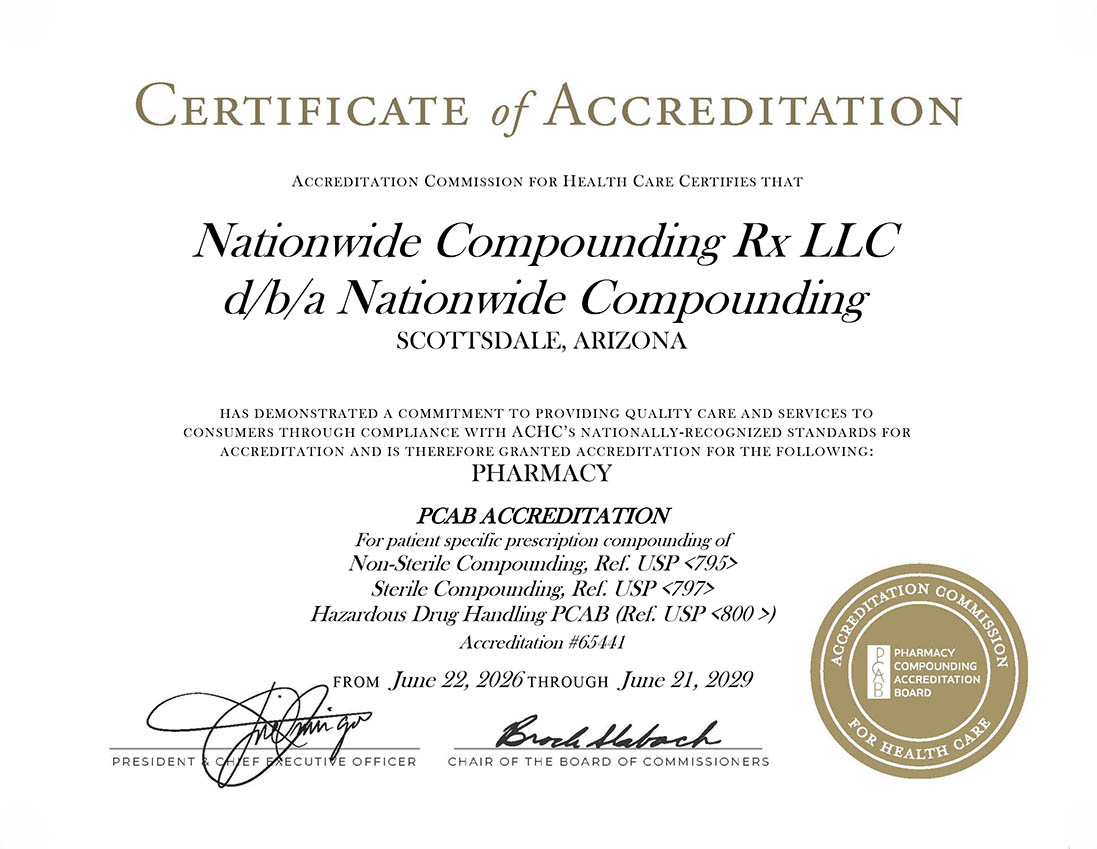
The pharmacy is PCAB accredited and USP <800> compliant, which addresses the accreditation gap and hazardous-drug handling requirements discussed earlier. Its team has more than 40 years of combined experience. It sources chemicals only from FDA-inspected and cleared vendors and uses independent third-party testing to check quality and consistency.
Its BHRT program follows the personalized-medicine model closely. Formulas can be adjusted at each refill based on updated lab results, so a patient’s prescription changes as their hormone levels change.
Its GLP-1 and peptide support runs through patient-specific, prescription-based channels, not retail dispensing. That is the model HF 2779 now requires in Minnesota.
The pharmacy also publishes a tiered, multi-state licensing and shipping map with three categories: fully licensed states, non-sterile only states (sterile pending), and states where licensure is pending or not held. Providers and patients can use the map, along with the Minnesota Board’s verification portal, to confirm how the pharmacy is authorized to serve Minnesota for a particular medication type.
Two secure portals support its “Connect, Collaborate, Create, Care” partnership model. The Provider Portal lets prescribers submit and manage prescriptions, track orders, and reach the pharmacy team. The Patient Portal lets patients view account information and manage refills and support requests. Both create a documented record that supports compliance.
Conclusion: Personalized Medicine in Minnesota Depends on a Compliant Pharmacy, Not Just a Good Formula
Personalized medicine in Minnesota, from genomics to BHRT, peptides, and custom formulations, is only as trustworthy as the legal and regulatory framework behind it. A well-designed formula still needs a compliant pharmacy to prepare and dispense it.
Four pillars define that framework in 2026:
- USP <795>/<797>/<800> enforcement, which began January 1, 2026
- HF 2779, which ended med-spa peptide retailing
- The 503A/503B distinction, which separates patient-specific compounding from batch production
- Board of Pharmacy license verification, which is required for every pharmacy shipping into the state
In late 2026, PCAB accreditation and current compliance status are the clearest signals patients and providers can check. Verifying them is the first step toward safely using personalized medicine in Minnesota.
Work With a Pharmacy Built for Minnesota’s Current Regulatory Standard
Providers can connect with Nationwide Compounding Rx® through the Provider Portal to discuss BHRT, peptide, pain management, dermatology, pediatric, or sports medicine formulations.
Patients can use the Patient Portal or the website contact form to ask about licensing and compliance or to start a prescription transfer.
- Phone: (480) 499-8379
- Website: nationwidecompounding.com
- Hours: Monday through Friday, 7:00 AM to 3:30 PM
With PCAB accreditation and USP <800> compliance, Nationwide Compounding Rx® offers the safety and legal standing that personalized medicine in Minnesota requires.
Related Posts

Louisville providers often struggle to find a compounding pharmacy that explains how true partnerships work. This 2026 guide breaks down the Connect → Collaborate → Create → Care framework, covering BHRT, pediatrics, dermatology, and pain management compounding for local practices.

This 2026 guide to the community compounding pharmacy in Lake Oswego covers more than an address and phone number. It breaks down Oregon's nonresident pharmacy rules, GLP-1 compounding enforcement, and USP compliance standards every patient should understand before having medication shipped.

Choosing a Lexington KY compounding pharmacy takes more than proximity and a star rating. This 2026 guide shows you how to verify Kentucky Board licensure, PCAB accreditation, and USP 795/797/800 compliance before trusting a provider with your prescription.

Central Ohio's booming population, aging demographics, and billion-dollar health system investments are driving unprecedented demand for personalized medication. This article explores what's fueling the rise in central Ohio compounding pharmacy needs in 2026 and how new regulations are reshaping access to quality care.