
NYU Specialty Pharmacy: When the In-Network Rule Blocks You in 2026
Introduction: What Happens When NYU Specialty Pharmacy Can’t Fill Your Prescription
Most people who search for “NYU specialty pharmacy” want something simple: the phone number (877-698-2330), the Brooklyn address, or help paying a bill through MyChart. For that, NYU Langone’s official pages are the right destination.
A smaller group of patients and referring providers runs into a problem those pages do not address. They learn that NYU’s pharmacy cannot fill their prescription, and the official materials do not explain what to do next.
This article maps the three structural boundaries behind those dead ends:
- NYU-patients-only eligibility
- A mandatory in-network insurance requirement
- A fixed disease-state list
The goal is twofold. First, it gives fair credit to NYU Langone Specialty Pharmacy’s real strengths. Second, it shows where those boundaries end and what New Yorkers can do next. For specific gap scenarios, such as compounded, discontinued, or allergen-free medications, Nationwide Compounding Rx®, a PCAB-accredited pharmacy that ships nationwide, is one option worth understanding.
What NYU Langone Specialty Pharmacy Actually Is
NYU Langone Specialty Pharmacy is a comprehensive outpatient specialty pharmacy that serves NYU Langone patients exclusively.
- Location: 882 Third Avenue, Industry City Building 10, 3rd Floor, Brooklyn, NY 11232
- Hours: Monday through Friday, 8:30 AM to 5:00 PM, closed weekends
- Fulfillment: Pickup, mail, or courier delivery
The operation is large. According to an interview with NYU Langone’s assistant director of pharmacy in Pharmacy Times, the specialty pharmacy serves close to 20 unique departments across Manhattan, Long Island, and Brooklyn.
It also sits inside a broader pharmacy system. NYU Langone’s program at Tisch Hospital includes more than 75 pharmacists and 65 technicians. It offers 24-hour service with Swisslog robotic dispensing, a USP 797-compliant HEPA-filtered clean room, and the DoseEdge workflow system.
The Real Advantages of NYU’s Model, Credited Honestly
Any fair look at where NYU’s pharmacy falls short should start with what it does well. Those strengths are real.
URAC Accreditation and Quality Standards
NYU Langone Specialty Pharmacy is accredited by URAC, an independent leader in healthcare quality accreditation. URAC specialty pharmacy accreditation typically covers nine operational modules, including patient management, drug handling, and performance reporting.
For patients, this signals that specialty drugs are stored, dispensed, and monitored to audited standards. For payers and PBMs, URAC accreditation is often a basic requirement for network participation.
Embedded Pharmacy Liaisons and Speed of Fulfillment
NYU uses embedded Pharmacy Liaisons who handle prior authorization and patient financial assistance. Because these liaisons are NYU Langone employees with direct access to the electronic medical record (EMR), they avoid much of the back-and-forth that slows external pharmacies.
Integration matters. When the prescriber, the patient’s records, and the pharmacy all sit in the same health system, missing chart notes and delayed callbacks become less common. In practice, prescriptions reach patients faster.
$17 Million in Financial Assistance and System Scale
In the same Pharmacy Times interview, NYU Langone reported securing $17 million in financial assistance for its patients in one year. For people on high-cost specialty therapies, that support can determine whether treatment is affordable at all.
This fits a national trend. Accredited specialty pharmacies run by hospitals and health systems grew from 106 locations in 2017 to 553 in 2025. Drug Channels links much of that growth to 340B Drug Pricing Program economics. The context helps explain why NYU built this pharmacy and who benefits most: established NYU patients with chronic, high-cost conditions.
The Hard Structural Boundaries of the NYU Model
These strengths depend on a closed-system model, and that model has firm eligibility limits.
Boundary 1: NYU-Patients-Only Eligibility
The pharmacy serves NYU Langone patients only. A non-NYU patient cannot use it, regardless of insurance or medication type.
This affects referring providers outside the NYU system. A community rheumatologist or pediatrician cannot send a prescription to NYU’s specialty pharmacy unless the patient is also under NYU Langone care.
Boundary 2: The Mandatory In-Network Insurance Requirement
According to NYU Langone, its pharmacy will contact a patient only when all three of these conditions are met:
- The medication is available through the pharmacy.
- It was prescribed through an associated NYU clinic.
- It is in-network with the patient’s specific insurance.
The underlying cause is systemic. Health plans and PBMs often require patients to use a preferred specialty pharmacy, and that pharmacy is frequently affiliated with the PBM itself. Drug Channels reports that 34% of drugs have exclusive single-pharmacy networks.
This is not a quality failure on NYU’s part. It is a structural PBM dynamic that affects every health-system pharmacy.
Boundary 3: A Fixed Disease-State List
NYU’s specialty pharmacy provides medication management for:
- Asthma
- Crohn’s disease
- Hemophilia
- Hepatitis B and C
- HIV
- Multiple sclerosis
- Pulmonary arterial hypertension
- Rheumatoid arthritis
The list does not include compounded, customized, discontinued, or allergen-free formulations. That is by design. A commercial specialty pharmacy is built around FDA-approved, manufacturer-supplied drugs for specific chronic conditions. It is not built to prepare individualized formulations.
The Insurance Mechanics Behind the In-Network Wall
NYU’s eligibility rules are rarely explained alongside the insurance terms that drive them. Here is that context, explained plainly.
Coinsurance, Copays, and Out-of-Network Reality
NYU’s own employee prescription drug plan shows the stakes. For specialty medications filled in-network, cost-sharing is listed as 30% coinsurance or a $0 copay. If a patient uses an out-of-network pharmacy (one outside CVS Caremark), they pay 100% of the retail price.
On a specialty drug, that difference can mean thousands of dollars a month. In-network status is not a minor technicality. It largely determines whether a medication is affordable.
The PrudentRx $0-Copay Program Nuance
NYU’s PrudentRx program sets specialty copays to $0 only for drugs on a monthly exclusive specialty drug list. It does this by enrolling patients in manufacturer copay assistance.
This is a common source of confusion. Many patients assume every specialty drug qualifies and only learn otherwise when a claim is denied. It reflects a larger pattern: insurance structure, not clinical judgment, often decides who gets access.
Why Even Strong Health-System Pharmacies Hit Network Walls
The problem is not unique to NYU. Industry evidence shows these limits apply across health-system pharmacies.
The PBM and Manufacturer Catch-22
Healthcare law firm Frier Levitt has documented a circular problem:
- PBMs often require a specialty pharmacy to already have access to limited distribution drugs (LDDs) before it can join their networks.
- Manufacturers often require network participation before they grant that access.
Each side waits for the other. This makes it structurally difficult for health-system pharmacies, including NYU’s, to enter certain specialty networks, even when they are accredited and well run.
Evidence From Limited Distribution Drugs
A peer-reviewed study of dalfampridine, a multiple sclerosis medication, found that inclusion in a manufacturer’s limited distribution network directly affected how quickly patients received the drug, even at an integrated health-system specialty pharmacy. Insurance restrictions, high costs, and limited distribution networks all delayed access.
This is a documented, industry-wide limitation of the integrated model, not a weakness specific to NYU.
Where the Real Gaps Appear for New York Patients
The following scenarios are the ones NYU’s structure is not designed to handle.
Compounded or Customized Medications
NYU’s disease-state list and commercial-drug model do not accommodate non-standard dosages, strengths, or custom formulations. This is where 503A compounding pharmacies fill a legal gap. A 503A pharmacy is state-licensed and compounds medications under a patient-specific prescription, following USP 797 (sterile) and USP 800 (hazardous drug) standards enforced through state board inspection.
Discontinued or Unavailable Formulations
Manufacturers sometimes discontinue a strength or dosage form that a patient has relied on for years. A commercial specialty pharmacy can only dispense what manufacturers supply, so it has no way to replace a discontinued product. A compounding pharmacy can recreate that formulation from pharmaceutical-grade ingredients under a valid prescription.
Allergen-Free and Dye/Filler-Free Needs
Some patients react to the dyes, fillers, or preservatives in commercial products. NYU’s model offers no option for them, because the pharmacy dispenses manufacturer formulations as made. Custom compounding can remove the problem ingredient. This is especially important for pediatric patients with sensitivities.
PBM-Blocked or Out-of-Network Drugs
In the most common scenario, a patient’s PBM requires a different specialty pharmacy, or the drug is simply not in-network with NYU. That denial is based on contract and network terms, not on medical necessity or the quality of NYU’s pharmacy.
Important Caveat: The 2026 GLP-1 Compounding Narrowing
On August 27, 2026, the Fifth Circuit ruled in favor of the FDA, Eli Lilly, and Novo Nordisk. As a result, compounders can no longer cite a “drug shortage” to mass-produce copies of Ozempic, Wegovy, Mounjaro, or Zepbound.
Legitimate patient-specific compounding is different. A 503A pharmacy may still compound lawfully when there is a genuine, documented clinical need that the approved product cannot meet, such as a specific allergy or a dosage form the patient requires.
Patients should set expectations accordingly. Compounding is not a workaround for saving money on GLP-1 drugs. It remains a valid option for the clinical gap scenarios described above.
New York’s Nonresident Compounding Rules: What to Know Before Shipping In
In 2026, New York is one of the strictest states for enforcing rules on nonresident compounding pharmacies. Out-of-state compounders must register with the New York State Board of Pharmacy before they ship compounded medications to residents.
This is a compliance detail patients and providers should confirm with any out-of-state pharmacy before placing an order. Properly licensed and registered compounders can legally serve New York patients.
Nationwide Compounding Rx®: The Alternative for These Specific Gaps
Nationwide Compounding Rx® is not a general competitor to NYU’s chronic-disease specialty pharmacy. It is a specific option for compounded, discontinued, allergen-free, and PBM-blocked scenarios.
Accreditation and Quality Standards
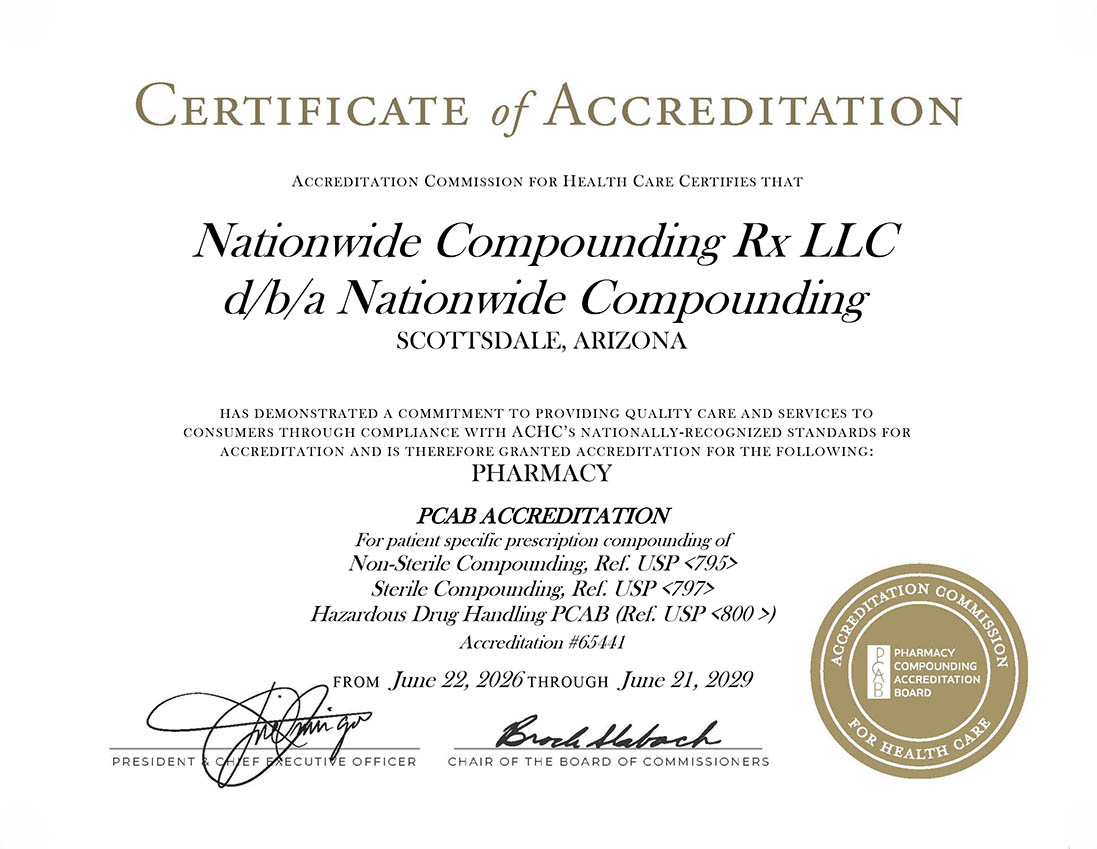
- PCAB Accreditation (Pharmacy Compounding Accreditation Board), the compounding-specific counterpart to the credibility URAC provides for specialty pharmacies
- USP 800 compliance for handling hazardous drugs
- Independent third-party testing to verify quality and consistency
- Sourcing only from FDA-inspected and cleared vendors
Capabilities That Map Directly to NYU’s Gaps
- Custom dosage forms: capsules, liquids, topicals (creams, gels, ointments), troches and lozenges, oral and sublingual tablets, suppositories, and pediatric forms such as flavored liquids, popsicles, and suckers
- Allergen-free formulations made without dyes, fillers, and preservatives
- Recreation of discontinued medication strengths and forms
- Flavor options including cherry, peppermint, bubblegum, piña colada, strawberry, and marshmallow, for children and other patients who are difficult to dose
Speed, Access, and Nationwide Licensing
The pharmacy offers a 1 to 2 business day turnaround, with same-day pickup available for some medications. It ships nationwide and publishes a three-tier state licensing map:
- Fully licensed states
- Non-sterile only, with sterile licensing pending
- Pending or unlicensed states
This transparency is useful for New York patients. Given the state’s nonresident registration requirement, patients and providers can check current licensing status for their specific medication type before an order ships.
Provider Collaboration Model
Nationwide Compounding Rx® works with prescribers through a four-step framework: Connect → Collaborate → Create → Care. A secure Provider Portal lets prescribers submit and manage prescriptions and track orders. A Patient Portal handles account access, refills, and support requests. For referring providers who hit NYU’s structural limits, this collaborative process offers a clear route forward.
How to Know Which Path Is Right for You
The right pharmacy depends on the patient’s clinical needs and insurance situation.
When NYU Langone Specialty Pharmacy Is the Right Choice
- The patient is an established NYU Langone patient with one of the listed chronic conditions.
- The patient’s insurance is in-network with NYU’s pharmacy.
- The patient benefits from the speed and financial-assistance support of an embedded, EMR-connected pharmacy.
When Nationwide Compounding Rx® Is the Right Choice
- The prescription requires compounding, a discontinued strength, or an allergen-free formulation.
- The patient’s PBM blocks NYU’s pharmacy, or the drug is not in-network.
- The patient and provider have a documented clinical reason for a customized, patient-specific medication.
Conclusion: Two Models, Two Different Jobs
NYU Langone Specialty Pharmacy is a strong, URAC-accredited, integrated option for NYU patients with in-network coverage and one of a defined set of chronic conditions. Its boundaries (NYU-only eligibility, the in-network requirement, and a fixed disease list) are real limitations, but they are not failures of quality.
Nationwide Compounding Rx® serves a different purpose. It is a PCAB-accredited, nationwide-shipping complement for the compounded, discontinued, allergen-free, or PBM-blocked situations that NYU’s model is not designed to address. The practical task is matching the right pharmacy model to each patient’s clinical and insurance situation.
Next Steps: Talk to Nationwide Compounding Rx® About Your Specific Gap
Patients and referring providers who need a compounded, discontinued, allergen-free, or PBM-blocked medication can contact Nationwide Compounding Rx® directly:
- Phone: (480) 499-8379
- Website: nationwidecompounding.com
- Portals: Secure Provider and Patient portals for prescriptions, order tracking, and refills
- Hours: Monday through Friday, 7:00 AM to 3:30 PM
- Email response: Within one business day through the website contact form
Providers can use the Connect → Collaborate → Create → Care process to set up a prescription pathway. New York patients should confirm current licensing for their medication type before an order ships.
Related Posts

Choosing a Lexington KY compounding pharmacy takes more than proximity and a star rating. This 2026 guide shows you how to verify Kentucky Board licensure, PCAB accreditation, and USP 795/797/800 compliance before trusting a provider with your prescription.

Central Ohio's booming population, aging demographics, and billion-dollar health system investments are driving unprecedented demand for personalized medication. This article explores what's fueling the rise in central Ohio compounding pharmacy needs in 2026 and how new regulations are reshaping access to quality care.

Partell Specialty Pharmacy officially became National Health Rx after a 2025 ownership change approved by the Nevada State Board of Pharmacy. This guide helps patients and prescribers decide whether to stay or transfer, with a capability checklist and a clear five-step pathway to a PCAB-accredited compounding pharmacy.

BioPlus Specialty Pharmacy has long been known for high-touch specialty infusion services, but its 2026 status under Carelon ownership raises new questions for patients and providers. This guide breaks down what changed, what stayed the same, and how BioPlus's dispensing model compares to specialty compounding pharmacies.