Marty’s Compounding Pharmacy: Mississippi-Only vs. Nationwide in 2026
Introduction: Searching for Marty’s Compounding Pharmacy? Here’s What to Verify First
Most people who search for “Marty’s compounding pharmacy” are looking for one specific business: Marty’s Pharmacy & Compounding Center in Flowood, Mississippi. They typically want hours, directions, a phone number, or a quick look at available services.
A second group of searchers has different needs. These include telehealth patients, out-of-state residents, and people on ongoing bioidentical hormone replacement therapy (BHRT), GLP-1, or other custom medication protocols. They often need a pharmacy that can legally ship to their state rather than a single storefront in the Jackson metro area.
This article offers an objective, credential-based comparison. It is not a criticism of a respected local pharmacy with roots going back more than 40 years. Its goal is to help readers decide which service model fits their situation. Along the way, it introduces a five-point credential checklist that applies to any compounding pharmacy, local or national:
- PCAB accreditation
- USP <795>/<797>/<800> compliance
- Third-party testing
- FDA-inspected API (active pharmaceutical ingredient) vendors
- Shipping-license tiers
Who Is Marty’s Pharmacy & Compounding Center?
Marty’s is a well-established independent pharmacy with deep community ties in central Mississippi. The background below comes from the pharmacy’s own materials and public directory listings.
History and Ownership
According to the pharmacy’s “About Us” page, Marty’s was founded in 1984 by Marty Jones and purchased by current owner Ronnie Bagwell, Jr. in 1996. The business describes itself as one of the oldest independent pharmacies in the Jackson Metropolitan area and says its staff has more than 60 years of combined compounding experience.
Location and Service Area
Marty’s operates from a single location at 1042 River Oaks Dr, Flowood, MS 39232, next to River Oaks Hospital. The pharmacy states that it “serves patients in the State of Mississippi.” That describes a state-bound, largely in-person service model, not a nationwide shipping operation.
Hours and Access Model
Published hours are:
- Monday–Friday: 8:30am–6:00pm
- Saturday: 8:30am–1:00pm
- Sunday: Closed
There is no 24-hour access, and weekend hours are limited. Some online reviews mention wait times and early closures without notice to customers.
Services Offered
Marty’s lists a broad range of services:
- Custom human and veterinary compounding
- Bioidentical hormone replacement therapy (BHRT)
- Hormone saliva testing
- Sterile compounding
- Unit-dose blister packaging
- Hospice and surgical center consulting
- Delivery and drive-thru service
The pharmacy’s materials refer to a “certified” sterile compounding room. However, its public materials do not cite PCAB accreditation or documentation of compliance with specific USP chapters.
Reputation Snapshot
| Platform | Rating |
|---|---|
| Birdeye | 4.4/5 (110 reviews) |
| Apple Maps | 94% recommend (16 ratings) |
| 88% recommend (13 reviews) | |
| Yelp | 2.5/5 (2 reviews) |
The Better Business Bureau lists Marty’s as “Not BBB Accredited.” Its BBB file was opened in 2021, and the BBB shows a “Not Rated” status because it does not have enough information to issue a rating.
Why Many Searchers Need Something Beyond Marty’s Model
Finding Marty’s is one goal. Getting the right medication, delivered reliably, is another, and for some searchers the two do not line up.
Telehealth has changed how many patients receive BHRT and GLP-1 therapy. A patient might see a provider by video, live outside Mississippi, and never be able to visit a Flowood counter. Others are relocating, traveling, or managing chronic therapy refills on schedules that do not fit weekday and Saturday-morning hours at one physical location.
None of this reflects a flaw in Marty’s business. The pharmacy was built to serve a local Mississippi community in person. It was not designed for nationwide, nonresident, or remote access. Patients who need that kind of access should evaluate pharmacies built for it.
The Credential Checklist: 5 Questions to Ask Any Compounding Pharmacy
The following checklist is a neutral framework. It applies equally to Marty’s, to Nationwide Compounding Rx®, and to any other compounding pharmacy a patient or prescriber is considering.
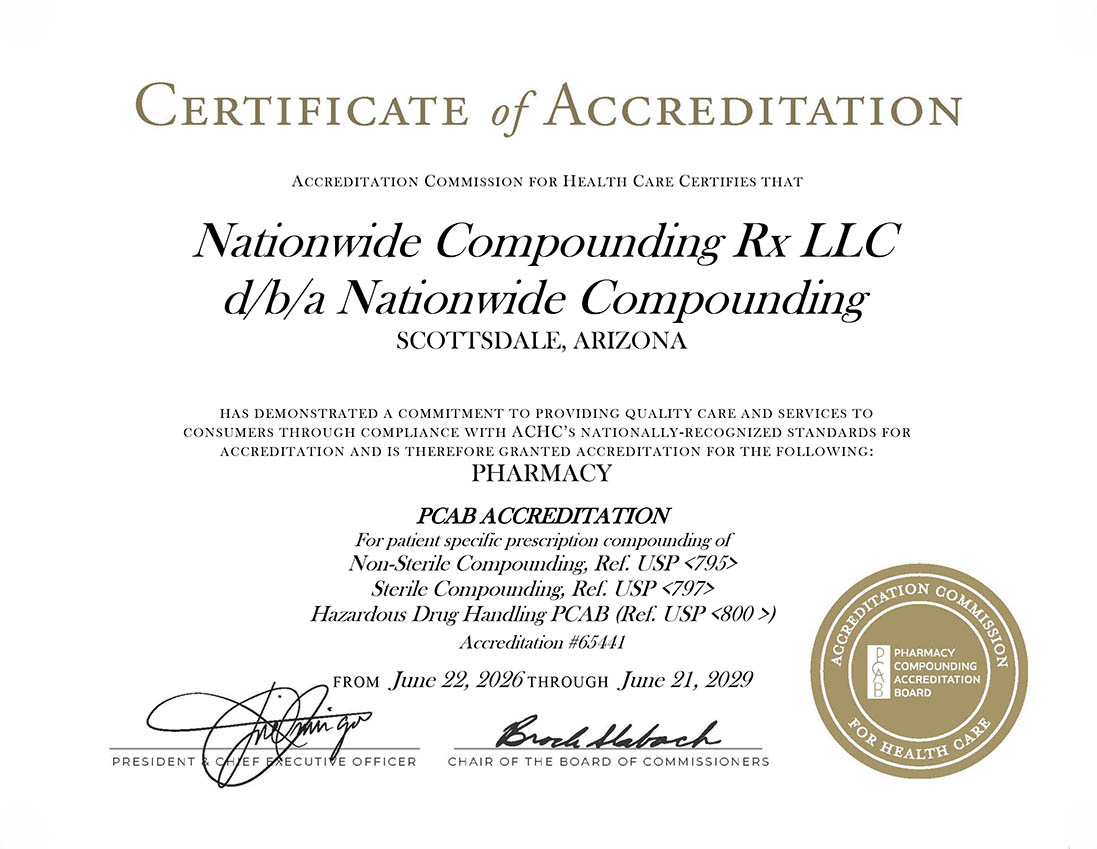
Context matters here. Of more than 7,500 compounding pharmacies in the United States, only about 68 hold PCAB accreditation, fewer than 1%. Because so few pharmacies hold it, PCAB accreditation is a verifiable differentiator rather than a marketing buzzword.
1. PCAB Accreditation
The Pharmacy Compounding Accreditation Board (PCAB) program is administered by the Accreditation Commission for Health Care (ACHC). It is a third-party accreditation that requires on-site surveys, documented standard operating procedures (SOPs), and quality control practices.
The American Medical Association recommends that physicians work only with PCAB-accredited compounding pharmacies when prescribing compounded medications. That makes accreditation a standard-of-care and liability question for prescribers, not just a quality preference.
Actionable tip: Ask any pharmacy for its PCAB certificate, or check ACHC’s public accreditation directory.
2. USP <795>/<797>/<800> Compliance
Three United States Pharmacopeia (USP) chapters set the core standards for compounding:
- USP <795>: Non-sterile compounding (for example, creams, capsules, and oral liquids)
- USP <797>: Sterile compounding (for example, injectables)
- USP <800>: Safe handling of hazardous drugs
A pharmacy saying it has a “certified” lab is not the same as documented compliance with these chapters. PCAB accreditation verifies that a pharmacy’s processes meet the relevant USP standards through outside review.
Standards are also tightening. Kentucky, for example, began enforcing revised USP standards on January 1, 2026, reflecting rising regulatory expectations nationwide.
3. Third-Party Testing
In-house quality control checks have value, but independent testing of potency, sterility, and stability adds an outside layer of verification. This matters most when problems start upstream. In the past year, multiple glutathione recalls have been tied to a common Medisca ingredient lot. Pharmacies that test independently and share results are better positioned to catch issues before they reach patients.
4. FDA-Sourced API Vendors
Active pharmaceutical ingredients should come from FDA-inspected and cleared vendors, not unverified or overseas bulk suppliers. The FDA’s public tracker of compounding inspections, recalls, and warning letters shows why. Apothecary Pharma’s nationwide tirzepatide recall, and related warning letters citing sterility deficiencies and insanitary conditions, show how sourcing and process failures can affect patients across many states at once.
5. Shipping-License Tiers
A compounding pharmacy cannot legally ship to every state by default. It must hold nonresident pharmacy licenses state by state, and some licenses cover only non-sterile preparations. Patients should confirm that a pharmacy is licensed in their state for the specific type of medication they need.
This area is also tightening. Washington and Ohio now require PCAB accreditation for nonresident compounding pharmacy licensure, signaling a broader regulatory trend.
Applying the Checklist to Marty’s Pharmacy
Applied to Marty’s publicly available information, the checklist shows the following:
- PCAB accreditation: No public documentation was found. Marketing materials refer to a “certified” sterile room but do not cite PCAB.
- USP <795>/<797>/<800> compliance: No public documentation was found citing these specific chapters.
- Third-party testing: Not referenced in public materials.
- FDA-sourced API vendors: Sourcing practices are not publicly described.
- Shipping-license tiers: Mostly not applicable, since Marty’s states that it serves only Mississippi patients.
This is a documentation gap, not a judgment about quality. A pharmacy may follow strong practices without publishing them. The checklist simply lists what a prudent patient or prescriber should confirm directly before relying on any compounding source, Marty’s included.
Why This Matters Now: The 2025–2026 Compounding Safety Landscape
The past two years have brought a steady stream of FDA warning letters and nationwide recalls. Compounded tirzepatide and other GLP-1 products have been recalled over sterility concerns. In those cases, FDA investigators noted that drugs intended to be sterile were prepared, packed, or held under insanitary conditions. Separately, multiple glutathione recalls traced back to a shared ingredient lot showed how one upstream problem can spread across many pharmacies.
These events have changed how people choose a compounding pharmacy. What was once a decision based mostly on convenience is now a decision about verifiable safety. Several developments point the same way:
- The AMA recommends PCAB-accredited pharmacies.
- Washington and Ohio require PCAB accreditation for nonresident licensure.
- Kentucky began enforcing revised USP standards in January 2026.
Together, these changes have made credential verification a mainstream patient concern rather than a niche topic.
Marty’s Mississippi-Only Model vs. Nationwide Compounding Rx®: A Side-by-Side Comparison
| Dimension | Marty’s Pharmacy & Compounding Center | Nationwide Compounding Rx® |
|---|---|---|
| Location | Flowood, MS (single site) | Scottsdale, AZ |
| Service area | Mississippi patients | Multi-state licensed shipping |
| Hours | M–F 8:30am–6pm; Sat 8:30am–1pm | M–F 7am–3:30pm |
| Remote access | In-person, delivery, drive-thru | Secure Provider and Patient Portals |
| PCAB accreditation | No public documentation | PCAB accredited |
| USP documentation | Not publicly cited | USP 800 compliant |
| Third-party testing | Not referenced | Independent third-party testing |
| API sourcing | Not described | FDA-inspected and cleared vendors |
Geographic Reach and Service Area
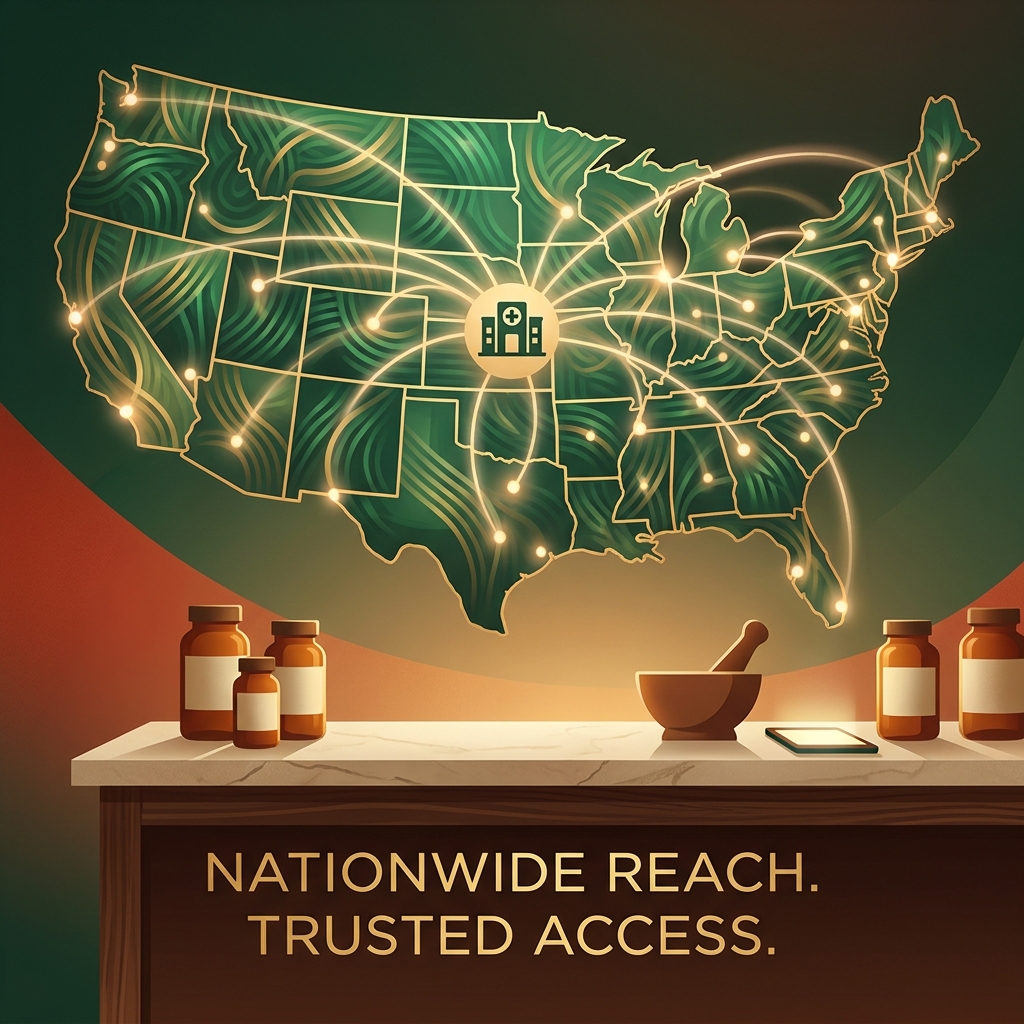
Marty’s serves a state-bound patient base from its single Flowood location. Nationwide Compounding Rx® ships to multiple licensed states and publishes a tiered state map with three categories: fully licensed states, states where it ships non-sterile preparations only (sterile licensure pending), and states that are pending or unlicensed. This lets patients check availability for their own state before ordering.
Hours, Turnaround, and Access
Marty’s offers weekday hours plus Saturday mornings, with a focus on in-person and drive-thru service. Nationwide Compounding Rx® operates Monday through Friday, 7:00 AM to 3:30 PM, with a 1–2 business day turnaround and same-day pickup for some medications. Its secure online portals let providers submit and track prescriptions and let patients manage refills remotely, without visiting a counter.
Accreditation and Compliance Documentation
Marty’s has no public PCAB documentation, and its BBB profile is “Not Rated” because of insufficient information. Nationwide Compounding Rx® is PCAB accredited and USP 800 compliant. It also uses independent third-party testing and sources ingredients from FDA-inspected and cleared vendors.
BHRT, GLP-1, and Custom Medication Offerings
Both pharmacies offer BHRT. Marty’s pairs it with hormone saliva testing. Nationwide Compounding Rx® adjusts BHRT formulas at each refill based on updated lab results.
Nationwide Compounding Rx® also offers:
- GLP-1 and peptide support
- Pain management
- Dermatology
- Pediatric formulations
- Sports medicine formulations
These come in capsules, liquids, topicals, troches, sublingual tablets, suppositories, and flavored pediatric forms, with allergen-free options available. Nationwide delivery makes these services practical for patients who cannot visit a Flowood location.
Who Should Consider Nationwide Compounding Rx®
Nationwide Compounding Rx® may be the better fit for:
- Patients outside Mississippi who found Marty’s through search but need a pharmacy licensed to ship to their state.
- Telehealth patients on GLP-1 or BHRT protocols who need documented sourcing and dependable nationwide delivery.
- Providers and clinics looking for a PCAB-accredited compounding partner for patients in multiple states.
- Patients who prioritize documented credentials, such as PCAB accreditation, USP compliance, and third-party testing, over proximity alone.
How to Verify Any Compounding Pharmacy’s Credentials Yourself
- Ask for the PCAB accreditation certificate, or search the ACHC/PCAB public accreditation directory.
- Request documentation of USP <795>/<797>/<800> compliance. A verbal assurance that the lab is “certified” is not enough.
- Ask whether third-party testing results are available for review.
- Confirm API vendor sourcing, including whether vendors are FDA-inspected.
- Verify nonresident shipping licenses for your state, and for your medication type (sterile or non-sterile), before relying on mail-order delivery.
Conclusion
Marty’s Pharmacy & Compounding Center is a legitimate, long-standing option for Mississippi patients who want in-person, community-based service. Its history in the Jackson metro area deserves respect.
In 2026, however, any compounding pharmacy decision should rest on the five-point credential checklist, not on reputation or proximity alone. Patients who need nationwide access, documented accreditation, or remote management of BHRT and GLP-1 therapy may be better served by a PCAB-accredited, multi-state licensed provider such as Nationwide Compounding Rx®.
Get Started with a PCAB-Accredited, Nationwide Compounding Partner
For patients and prescribers who need more than a state-bound, limited-hours model, Nationwide Compounding Rx® offers BHRT, GLP-1 and peptide support, and a full range of custom medications with 1–2 business day turnaround.
Getting started is simple:
- Prescribers can use the Provider Portal to submit prescriptions, track orders, and connect with the pharmacy team.
- Patients can use the Patient Portal to access account information and manage refill and support requests.
Contact Nationwide Compounding Rx®:
- Phone: (480) 499-8379
- Website: nationwidecompounding.com
- Hours: Monday–Friday, 7:00 AM – 3:30 PM
Before choosing any compounding pharmacy, patients and providers should call and verify its credentials directly, including PCAB accreditation, USP compliance, testing practices, and state licensure.
Related Posts

The term 'board of specialty pharmacy' actually refers to four distinct organizations, each serving a different purpose. This article breaks down BPS, SPCB, state boards, and PCAB to reveal which body truly governs compounding pharmacy quality in 2026.

Many patients assume CVS Pharmacy Specialty Services can compound custom medications simply because it holds PCAB accreditation—but the reality is more nuanced. This article breaks down what the accreditation actually covers, how the FDA's 503A/503B rules apply, and what it means for prior authorizations on oncology, MS, and RA prescriptions in 2026.

Many patients land on Accredo after a physician, insurer, or PBM directs them there. This guide breaks down what specialty pharmacy Accredo actually does—and the critical compounding limitations you need to know about in 2026.

Looking beyond the directory listing, this 2026 guide breaks down Lexington's compounding pharmacy options, the accreditation standards that matter, and how new GLP-1 regulations affect local patients. Learn what to check before trusting a pharmacy with your prescription.