
Board of Specialty Pharmacy: Who Really Governs Quality in 2026
Introduction: One Search Term, Four Different Governing Bodies
The phrase “board of specialty pharmacy” looks like it should point to a single organization. It does not. At least four distinct audiences type this term into search engines, and each is looking for a different body.
Depending on who is searching, the phrase may refer to:
- The Board of Pharmacy Specialties (BPS), which certifies individual pharmacists
- The Specialty Pharmacy Certification Board (SPCB), which governs the Certified Specialty Pharmacist credential
- State Boards of Pharmacy, which license pharmacists and pharmacies
- Organizational accreditors such as PCAB, URAC, ACHC, and The Joint Commission, which evaluate the pharmacy itself
This article separates these four entities clearly, then narrows to the one body that actually governs compounding pharmacy quality: the Pharmacy Compounding Accreditation Board (PCAB).
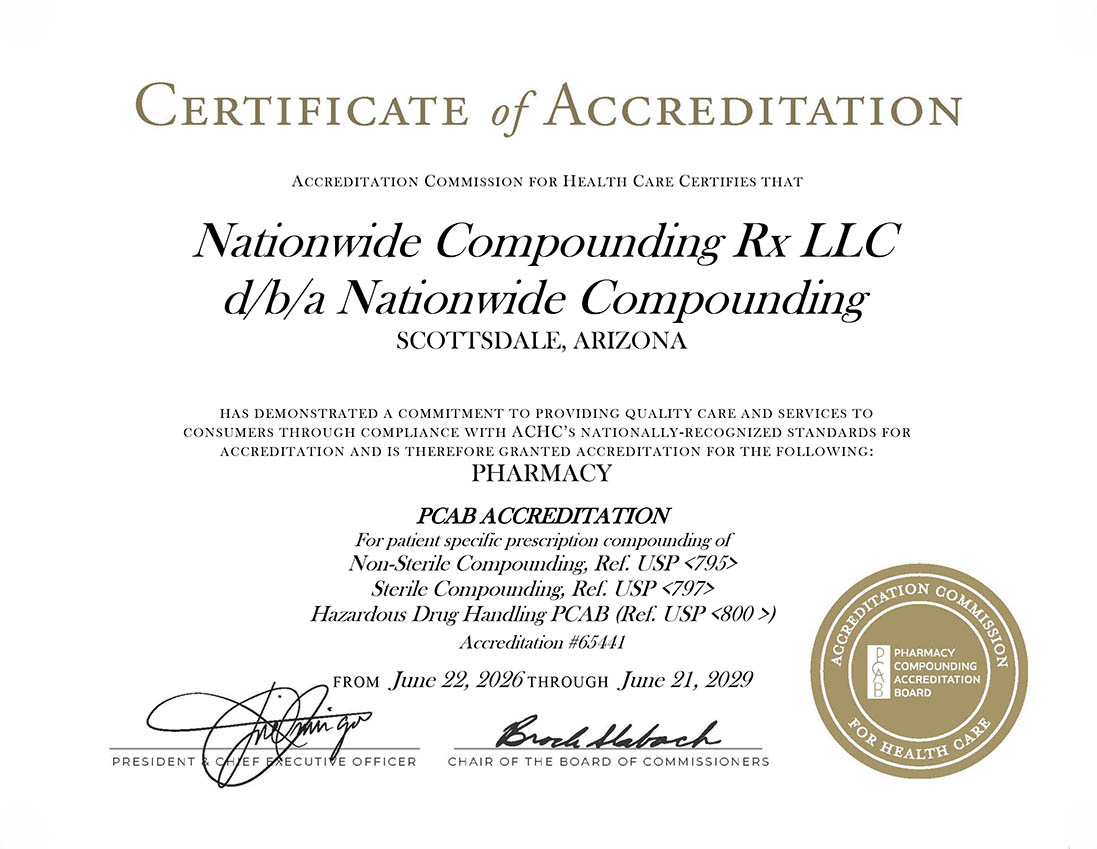
The distinction matters more in 2026 than ever. Patients and prescribers increasingly need to verify a pharmacy’s legitimacy themselves rather than trust branding claims. Later sections use Nationwide Compounding Rx®, a Scottsdale, Arizona compounding pharmacy, as a real-world example of verifiable PCAB accreditation and USP compliance.
Why the “Board of Specialty Pharmacy” Search Term Causes So Much Confusion
Both “specialty pharmacy” and “board” carry several meanings in healthcare. “Specialty” can describe a pharmacist’s clinical area of expertise, a distribution channel for high-cost specialty drugs, or a category of pharmacy accreditation. “Board” can mean a certifying body, a licensing authority, or an accrediting organization.
The most important distinction is between credentialing individual pharmacists and accrediting pharmacy organizations. These functions belong to entirely separate bodies with different purposes. A pharmacist can hold an impressive board certification while working at a pharmacy that has never undergone a facility-level quality review.
Official bodies such as BPS and SPCB explain their own missions clearly. However, they do not connect their credentials to pharmacy-level quality verification, which leaves searchers without a map. The next section provides one.
The Four Entities Searchers Actually Mean
Each subsection below describes one entity: what it does and who should care about it. Readers can use these descriptions to identify which body they are actually trying to find.
1. The Board of Pharmacy Specialties (BPS): Individual Pharmacist Board Certification
The Board of Pharmacy Specialties was established in 1976 as an autonomous division of the American Pharmacists Association (APhA). It is an independent, nongovernmental certification body that develops and administers board certification examinations in recognized pharmacy practice specialties.
BPS currently recognizes more than 63,400 pharmacist certifications across 17 specialties. These include:
- Compounded Sterile Preparations Pharmacy (BCSCP)
- Ambulatory Care Pharmacy (BCACP)
- Pharmacotherapy (BCPS)
- Oncology Pharmacy
- Geriatric Pharmacy
- Critical Care Pharmacy
The key fact is simple: BPS certifies individual pharmacists, not pharmacies. BPS certification is not a license, and it does not accredit a dispensing location. BPS also seeks national accreditation through the National Commission for Certifying Agencies (NCCA) and international accreditation under ISO standards for its own programs, which reinforces its rigor as a credentialing body.
Who should care: pharmacists, pharmacy students, and employers evaluating an individual clinician’s expertise. Patients vetting a pharmacy’s safety practices need a different credential.
2. The Specialty Pharmacy Certification Board (SPCB): The Certified Specialty Pharmacist (CSP) Credential
The Specialty Pharmacy Certification Board was established in 2012. Following a 2016 merger, it now operates as an unincorporated division within the National Association of Specialty Pharmacy (NASP). SPCB governs the Certified Specialty Pharmacist (CSP) credential, which is offered in the United States and Canada.
CSP eligibility requires:
- A BSPharm or PharmD degree
- An active pharmacist license
- 3,000 hours of specialty pharmacy practice experience
- 30 hours of specialty-pharmacy-specific continuing education
- A passing exam score
Like BPS, SPCB certifies individual practitioners. It does not accredit a pharmacy’s facility, cleanroom, or compounding processes.
Who should care: specialty pharmacy professionals building career credentials. Consumers trying to verify a specific pharmacy’s trustworthiness should look elsewhere.
3. State Boards of Pharmacy: The Baseline Licensure Authority
State boards of pharmacy are the governmental bodies that license pharmacists to practice. Licensure requires passing the NAPLEX, developed by the National Association of Boards of Pharmacy (NABP), along with a pharmacy law exam.
Through licensure, a state board confirms that an individual is competent to dispense drugs and understands the legal requirements of practice. Board certification (BPS or SPCB) and accreditation (PCAB or URAC) recognize specialized knowledge or facility-level quality beyond that baseline.
Every pharmacy and pharmacist must hold state licensure. Licensure alone, however, says nothing about specialty compounding capability or advanced quality controls.
Who should care: anyone confirming that a pharmacy or pharmacist is legally permitted to operate in a given state. This check is necessary but insufficient for evaluating compounding quality.
4. Organizational Accreditors: URAC, ACHC, The Joint Commission, CPPA, and PCAB
The fourth category accredits the pharmacy organization itself rather than an individual pharmacist.
For specialty (non-compounding) pharmacies, the primary accreditors are URAC, ACHC, The Joint Commission, and the Center for Pharmacy Practice Accreditation (CPPA). According to industry reporting in Pharmacy Times, URAC is preferred by roughly two-thirds of payers for network access, while ACHC offers additional disease-state distinctions in oncology, HIV, and rare or orphan drugs.
This accreditation carries significant commercial weight. OptumRx, CVS Caremark, and Express Scripts contractually require URAC, ACHC, or Joint Commission accreditation for specialty pharmacy network participation, making it a market-access requirement rather than merely a quality badge.
None of these general specialty accreditors directly governs compounding pharmacy quality. That responsibility belongs to a distinct, specialized body: PCAB.
Quick-Reference Comparison: Which Body Does What
| Entity | Credentials a Person or Organization? | Governing Scope | Who Should Care |
|---|---|---|---|
| BPS | Person (pharmacist) | Board certification in 17 clinical specialties | Pharmacists, students, employers |
| SPCB | Person (pharmacist) | CSP credential for specialty pharmacy practice | Specialty pharmacy professionals |
| State Boards of Pharmacy | Both (licensure) | Legal authority to practice and operate | Anyone confirming legal operation |
| URAC / ACHC / Joint Commission / CPPA | Organization | Specialty pharmacy operations and payer network access | Payers, PBMs, specialty pharmacy operators |
| PCAB (an ACHC brand) | Organization | Compounding quality aligned with USP <795>, <797>, <800> | Patients, prescribers, clinics using compounded medications |
The biggest takeaway: BPS and SPCB certify people. PCAB and general specialty accreditors certify the pharmacy itself. For compounding pharmacy quality specifically, PCAB is the relevant body.
The One Body That Actually Governs Compounding Pharmacy Quality: PCAB
If a reader’s real question is “Is this compounding pharmacy legitimate and safe?”, the answer lies with PCAB. Neither BPS nor SPCB certification, nor a state license alone, answers that question. The following sections cover PCAB’s history, standards, voluntary status, and rarity.
What PCAB Is and Why It Was Created
The Pharmacy Compounding Accreditation Board was established in 2007 by eight national pharmacy organizations. Today, PCAB operates as a premier service brand of the Accreditation Commission for Health Care (ACHC).
PCAB standards are developed by practicing compounding pharmacists rather than generalist auditors, which gives the review genuine clinical credibility. The standards are also actively maintained: revised PCAB standards took effect on June 1, 2024, and hazardous-drug standards (HDPCAB) have been enforceable since November 1, 2023.
How PCAB Aligns With USP <795>, <797>, and <800>
The United States Pharmacopeia (USP) publishes three general chapters central to compounding:
- USP <795> governs non-sterile compounding, such as creams, capsules, and oral liquids.
- USP <797> governs sterile compounding, such as injectable preparations.
- USP <800> governs the safe handling of hazardous drugs.
PCAB accreditation confirms a pharmacy’s compliance with these chapters through documented policies and on-site verification. Compliance with them forms the technical backbone of quality in compounding, covering cleanroom standards, beyond-use dating, batch records, and compounding technique.
Voluntary, Yet AMA-Recommended
No federal law requires PCAB accreditation. It is entirely voluntary.
Even so, the American Medical Association formally recommends that physicians use only PCAB-accredited compounding pharmacies when prescribing compounded medications. That pharmacies voluntarily pursue this credential, and that a national physician organization endorses it, signals a commitment to quality beyond regulatory minimums.
A Rare Credential: The Numbers Behind PCAB Accreditation
PCAB accreditation is uncommon. Industry estimates indicate that fewer than 1% of the roughly 7,500+ U.S. compounding pharmacies hold it, with approximately 68 holding active accreditation as of 2026. Participation is meaningfully higher, around 21%, among dedicated high-volume compounders, which suggests the credential is associated with serious, scaled compounding operations.
The process is demanding:
- An extensive application
- A review of policies and procedures
- An on-site inspection by experienced compounding pharmacist surveyors who examine cleanrooms, batch records, beyond-use dating, and actual compounding technique
Accreditation runs on a renewable cycle, commonly 36 months, and can be revoked at any time for non-compliance. In other words, “was accredited” and “is accredited” are not the same claim.
How to Verify a Compounding Pharmacy’s Legitimacy in Practice
Patients, prescribers, and practice administrators do not need to take a pharmacy’s word for its credentials. The steps below explain how to verify accreditation independently, a topic that many compounding pharmacy marketing pages fail to cover in depth.
Step 1: Check the ACHC Accreditation Directory Directly
ACHC maintains a searchable public directory of currently PCAB-accredited pharmacies. Search by pharmacy name and confirm that the listing matches the exact legal business name and physical location.
A PCAB logo on a pharmacy’s website is not sufficient proof. Confirming the listing in the directory is the reliable step.
Step 2: Confirm “Currently Accredited” vs. “Previously Accredited”
Because accreditation renews on a cycle (commonly 36 months) and can be revoked, current status matters. Check expiration or renewal dates where available. If anything is unclear, ask the pharmacy directly for current proof.
It is also worth asking which USP chapters the pharmacy’s accreditation covers. Not every accredited pharmacy performs both sterile and non-sterile compounding.
Step 3: Watch for Red Flags
Warning signs include:
- Vague references to “quality standards” without naming PCAB, specific USP chapters, or an accreditor
- Inability to confirm that ingredients come from FDA-inspected vendors
- No mention of third-party testing
A legitimate pharmacy should readily provide its accreditation status, compliance scope, and sourcing practices when a prescriber or patient asks.
Real-World Example: Nationwide Compounding Rx® as a Verified, PCAB-Accredited Pharmacy
Applying the verification steps above to a real pharmacy shows what verified compliance looks like. Nationwide Compounding Rx® is a PCAB-accredited pharmacy that patients and providers can confirm directly in the ACHC directory.
PCAB Accreditation and USP <800> Compliance in Practice
Nationwide Compounding Rx® maintains USP <800> compliance alongside its PCAB accreditation, which covers protocols for handling hazardous drugs. The pharmacy produces both sterile and non-sterile formulations, placing its work within the scope of USP <795> and <797> as well.
Its offerings include bioidentical hormone replacement therapy, GLP-1 and peptide support, topical pain management, dermatology, pediatric formulations, and sports medicine. The team brings more than 40 years of combined experience and uses modern, high-tech methods that emphasize accuracy, consistency, and speed.
Additional Quality Markers Beyond Accreditation
Nationwide Compounding Rx® also maintains several practices that complement its accreditation:
- Independent third-party testing to verify product quality and consistency
- High-grade chemicals sourced exclusively from FDA-inspected and cleared vendors
- Formulations free of dyes, fillers, preservatives, and allergens when patients need them
These practices reinforce formal PCAB accreditation. They do not replace it.
Frequently Asked Questions
Is the “Board of Specialty Pharmacy” a single organization?
No. No single entity uses that exact name. The term usually refers to BPS, SPCB, a state board of pharmacy, or an organizational accreditor such as PCAB, URAC, or ACHC.
Does BPS or SPCB certification mean a pharmacy is accredited?
No. Both certify individual pharmacists, not facilities.
Is PCAB accreditation legally required?
No. It is voluntary, but the AMA recommends it, and informed prescribers increasingly expect it.
How often does PCAB accreditation need renewal?
Accreditation typically runs on a 36-month cycle and can be revoked at any time for non-compliance.
What is the fastest way to verify a compounding pharmacy’s accreditation?
Search the ACHC public directory, which is the authoritative source for current PCAB accreditation status.
Conclusion: Knowing Which “Board” You’re Actually Looking For
The phrase “board of specialty pharmacy” points to four different kinds of bodies. BPS and SPCB certify individual pharmacists. State boards of pharmacy license practice. PCAB, alongside general specialty accreditors such as URAC and ACHC, accredits the pharmacy organization itself.
For anyone evaluating whether a compounding pharmacy is safe and legitimate, the credential that matters most is PCAB accreditation aligned with USP <795>, <797>, and <800>. Only a small fraction of compounding pharmacies hold it, yet the AMA formally recommends it. Nationwide Compounding Rx® shows what verified compliance looks like and offers a model for evaluating any compounding pharmacy.
Partner With a Verified, PCAB-Accredited Compounding Pharmacy
Healthcare providers can work with Nationwide Compounding Rx® through its structured partnership framework: Connect → Collaborate → Create → Care. Patients and clinics are encouraged to confirm the pharmacy’s PCAB accreditation in the ACHC directory using the verification steps outlined earlier in this article.
To discuss custom compounding needs:
- Phone: (480) 499-8379
- Online: the contact form at nationwidecompounding.com
- Portals: the secure Provider Portal or Patient Portal
- Hours: Monday through Friday, 7:00 AM to 3:30 PM (Arizona time)
Nationwide Compounding Rx® offers a 1 to 2 business day turnaround, nationwide shipping where licensed, and formulations built around each patient’s needs, all backed by current accreditation that anyone can verify.
Related Posts
Searching for Marty's Compounding Pharmacy but not sure if a local Mississippi storefront fits your needs? This guide compares Marty's Pharmacy & Compounding Center to nationwide compounding options using a five-point credential checklist covering accreditation, testing, and shipping licenses in 2026.

Many patients assume CVS Pharmacy Specialty Services can compound custom medications simply because it holds PCAB accreditation—but the reality is more nuanced. This article breaks down what the accreditation actually covers, how the FDA's 503A/503B rules apply, and what it means for prior authorizations on oncology, MS, and RA prescriptions in 2026.

Many patients land on Accredo after a physician, insurer, or PBM directs them there. This guide breaks down what specialty pharmacy Accredo actually does—and the critical compounding limitations you need to know about in 2026.

Looking beyond the directory listing, this 2026 guide breaks down Lexington's compounding pharmacy options, the accreditation standards that matter, and how new GLP-1 regulations affect local patients. Learn what to check before trusting a pharmacy with your prescription.