Las Colinas Pharmacy Compounding & Wellness: 2026 DFW Guide
Introduction: Looking for Las Colinas Pharmacy Compounding & Wellness, But Asking a Bigger Question
Most people who search for “Las Colinas Pharmacy Compounding & Wellness” want a few quick answers: the address, the hours, and a phone number for the Irving, Texas pharmacy. This guide provides those facts up front.
A growing share of Dallas-Fort Worth patients, however, is asking a deeper question. Before trusting any pharmacy with hormone pellets, peptide therapy, or a child’s custom medication, they want to know how to evaluate whether that pharmacy meets current safety and regulatory standards.
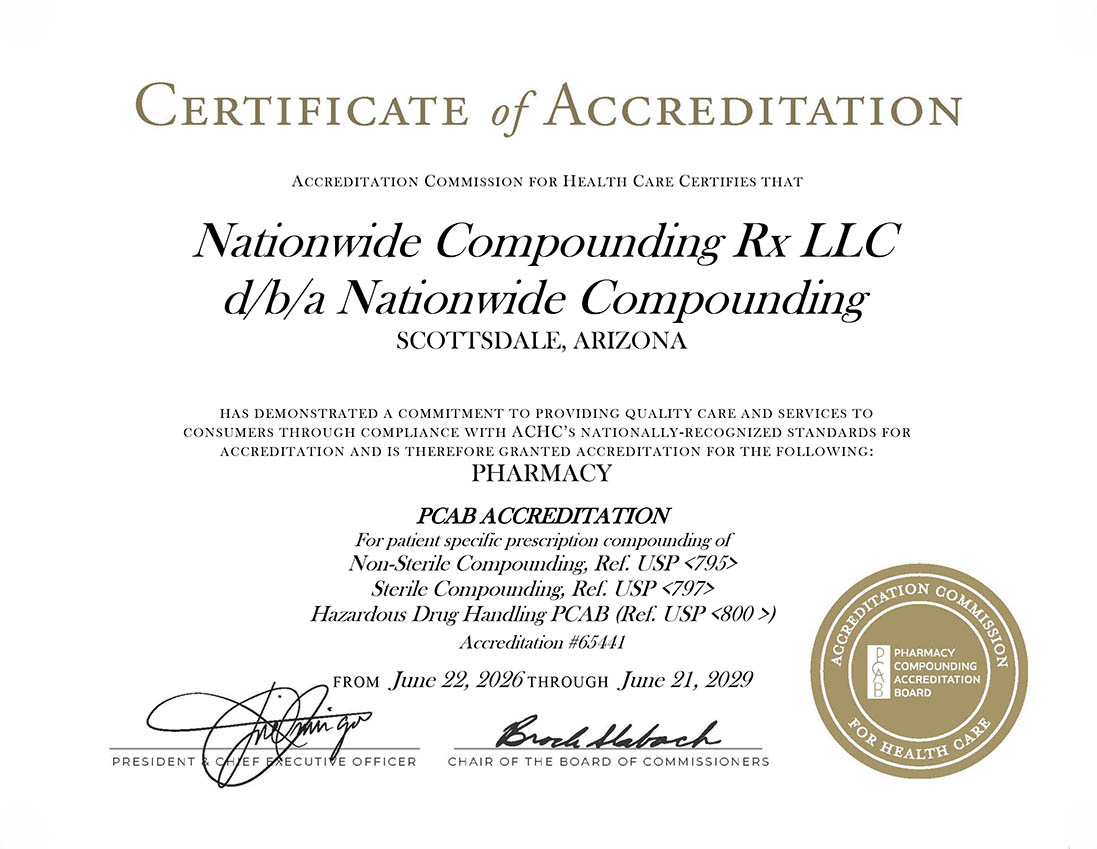
This guide covers both needs. It starts with quick facts, then explains Texas’s 2026 sterile compounding rule changes, PCAB/ACHC accreditation, the 503A vs. 503B distinction, and the shifting rules around GLP-1 compounding. The goal is a credential-based framework rather than a branding pitch. Along the way, it uses Nationwide Compounding Rx®, a PCAB-accredited compounding pharmacy, as a point of comparison that readers can measure against any local option.
Las Colinas Pharmacy Compounding & Wellness: Quick Facts for DFW Patients
- Address: 4255 N. MacArthur Blvd, Irving, TX 75038
- Phone: (972) 993-9700
- Hours: Monday through Friday, 9:00 AM to 6:30 PM; Saturday, 10:00 AM to 3:00 PM; closed Sunday
- History: Founded in 1984 by Jim, RPh, and his wife Jan as a family-owned, patient-first pharmacy. It describes itself as one of the original pioneers in pharmacy compounding.
- Core services: Bio-identical hormone balance, advanced dermatology, veterinary compounding, ethical nutritional supplementation, integrative medicine consultations, and peptide therapy, including tirzepatide.
- Professional affiliations: PCCA, Alliance for Pharmacy Compounding, A4M, EAGLE Science Based Solutions, NCPA, and the Texas Pharmacy Association.
- Staff: Seven pharmacists.
- Accreditation: The pharmacy claims PCAB accreditation. As explained later in this guide, any accreditation claim from any pharmacy is worth independently verifying.
Why This Search Is Really About Trust, Not Just an Address
Patient behavior has changed. DFW residents are no longer simply looking up store hours. Many now research hormone pellets, GLP-1 peptides, and pediatric compounds in depth before committing to a pharmacy.
That research often runs into marketing language. Phrases like “founded in 1984” and “family-owned” are meaningful as signals of community roots and longevity, but they are not regulatory signals. They say nothing about a pharmacy’s current sterile compliance, its accreditation status today, or how it sources active ingredients.
The fairest approach is to evaluate every pharmacy, local or national, on the same objective criteria: state licensing, independently verified accreditation, and compliance with current USP and Texas State Board of Pharmacy (TSBP) standards. The following sections build that framework.
The DFW Compounding Pharmacy Landscape in 2026
Texas is one of the largest compounding markets in the country. As of July 2025, 891 Class A, B, C, and E pharmacies in the state performed sterile compounding. For community (503A) compounding pharmacies, the primary regulator is the TSBP, not the FDA.
The DFW area alone offers many choices, including:
- Uptown Pharmacy
- Abrams Royal Compounding Pharmacy
- Dougherty’s Pharmacy
- Plano Care Pharmacy
- Preston Road Pharmacy/Apothecary
- Lindsey’s Pharmacy
- Pharmacy Plus
- ReNue Rx
- Lone Star Compounding Pharmacy, Daniel Drug, Ridgmar Pharmacy, and Tower Medic Pharmacy (all in Fort Worth)
Most of these pharmacies compete on personalized service and legacy branding. Few publish substantive education about regulation or safety. This guide aims to fill that gap.
Texas’s Updated Sterile Compounding Rules (Effective March 1, 2026)
On March 1, 2026, the TSBP’s updated sterile compounding rules took effect. These changes matter to anyone in Texas receiving sterile injectables, IV preparations, or hormone pellets.
The updated rules tighten expectations around sterile compounding environments, documentation, and quality assurance. They sit alongside the national standards that TSBP-licensed 503A pharmacies must follow:
- USP <795>: Non-sterile compounding (capsules, creams, troches, oral liquids)
- USP <797>: Sterile compounding (injectables, pellets, IV preparations)
- USP <800>: Safe handling of hazardous drugs, including certain hormones
Hormone pellets and sterile injectables fall squarely under this heightened scrutiny. That is a direct reason for patients to ask any Irving-area pharmacy about its current sterile compliance status, rather than relying on a PCAB claim alone.
503A vs. 503B: The Distinction Most Local Pharmacy Websites Skip
Anyone comparing DFW compounding pharmacies for hormone, peptide, or pediatric medications should understand the two federal categories of compounders. The category determines who oversees the pharmacy and how its products can be made.
What Is a 503A Pharmacy?
Most community compounding pharmacies, including the majority in DFW, operate under 503A status. These pharmacies are regulated primarily by state boards of pharmacy such as the TSBP. They are not FDA-registered and are not routinely inspected by the FDA.
503A compounding requires a valid, patient-specific prescription with a documented clinical basis. This is the legal pathway for compounded testosterone and bio-identical hormones in Texas.
What Is a 503B Outsourcing Facility?
503B outsourcing facilities are FDA-registered and routinely inspected. They may compound in larger batches without patient-specific prescriptions, often supplying clinics for office use.
That status brings stricter federal oversight but a narrower list of permitted bulk substances. This distinction is now central to the 2026 debate over compounded GLP-1 medications.
Why the 503A/503B Line Matters for Hormone Pellets and Peptide Therapy
Neither 503A nor 503B compounded drugs are FDA-approved, and neither is reviewed by the FDA for safety or efficacy before marketing. This remains true even for PCAB-accredited pharmacies. Professional organizations in reproductive medicine have noted that compounded hormone formulations are not monitored by the FDA in the same way as commercial products, so long-term safety information is limited.
Patients should ask explicitly which designation a pharmacy operates under and what that means for oversight of their specific hormone or peptide formulation.
PCAB/ACHC Accreditation: What It Actually Means (and Doesn’t)
PCAB accreditation is administered through ACHC (Accreditation Commission for Health Care). It is a separate credential from FDA 503B registration and evaluates a pharmacy’s compounding processes against rigorous quality standards.
Accreditation Is Voluntary, and Rare
No federal law requires PCAB accreditation, and fewer than 1% of U.S. pharmacies hold it. A pharmacy can legally operate and compound both sterile and non-sterile medications without ever pursuing accreditation. Pharmacies that do pursue it voluntarily submit to an additional layer of review.
A New Signal: States Starting to Require It
As of 2026, Washington and Ohio require verifiable PCAB accreditation for nonresident compounding pharmacy licensure. Texas does not yet mandate it, but these state requirements suggest where regulatory expectations may be heading nationally. Accreditation is becoming a meaningful differentiator rather than a nice-to-have badge.
How to Verify Accreditation Claims Yourself
Patients and providers can take a few practical steps:
- Check the ACHC/PCAB directory directly rather than relying on a pharmacy’s website.
- Cross-check any website claim, since accreditation can lapse, and claims are sometimes stated imprecisely (for example, a single location or service line may be accredited while others are not).
- Keep expectations accurate. Accreditation signals process quality. It is not FDA endorsement, and accredited pharmacies still compound drugs that are not FDA-approved.
The 2026 GLP-1 and Peptide Compounding Shift Every DFW Patient Should Know
Las Colinas Pharmacy and many other DFW pharmacies offer tirzepatide and peptide therapy. The rules governing these medications have changed significantly, and patients deserve to understand how.
The Shortage Exception Has Closed
The FDA declared the tirzepatide injection shortage resolved on December 19, 2024, and the semaglutide injection shortage resolved on February 21, 2025. Those decisions closed the “essentially a copy” compounding exception that had allowed broad compounding of these GLP-1 medications during the shortage periods.
FDA’s April 2026 Proposal to Exclude GLP-1s from the 503B Bulks List
On April 30, 2026, the FDA proposed excluding semaglutide, tirzepatide, and liraglutide from the 503B Bulks List entirely. If finalized, the change would close the last legal pathway for most large-scale compounded GLP-1 production. The public comment period ran through June 29, 2026.
The practical implication is clear. DFW patients seeking compounded GLP-1 or peptide therapy should ask specifically how a pharmacy sources and justifies these formulations under the 2026 rules.
FDA Enforcement Is Intensifying
On March 3, 2026, the FDA issued 30 warning letters in a single day to telehealth companies over false or misleading marketing claims about compounded GLP-1 products. That action was preceded by a round of warnings in September 2025 and followed by another in September 2026, which included a letter to a Houston compounding pharmacy.
The message for patients: marketing claims about peptide therapy deserve the same scrutiny as accreditation claims.
A Credential-Based Framework: How to Vet Any Irving or DFW Compounding Pharmacy
This checklist applies the guide’s framework in practical terms. Patients and providers can use it with any pharmacy they are considering.
Questions About Accreditation and Licensing
- Is the pharmacy’s PCAB/ACHC accreditation current and independently verifiable?
- Is the pharmacy licensed by the TSBP, and does it comply with the March 1, 2026 sterile compounding rule update?
- Does the pharmacy clearly state whether it operates as a 503A pharmacy, a 503B outsourcing facility, or both?
Questions About Sterile Compliance and Hormone Pellets
- Does the pharmacy follow USP <795>, <797>, and <800> standards appropriate to the formulation requested?
- For hormone pellets, what cleanroom and sterile processing standards are in place following the March 2026 rules?
- Is there documentation of an individualized prescription and clinical basis, as required for compounded testosterone and bio-identical hormones?
Questions About Sourcing, Testing, and Peptide/GLP-1 Compliance
- Does the pharmacy source chemicals from FDA-inspected and cleared vendors?
- Does it use independent third-party testing to verify potency and purity?
- For peptide or GLP-1 therapy, how does the pharmacy address the 2026 Bulks List proposal and shortage-resolution rules? Can it clearly explain its compliant sourcing pathway?
How Nationwide Compounding Rx® Compares on These Credentials
Nationwide Compounding Rx®, based in Scottsdale, Arizona, offers DFW patients and providers a nationally oriented benchmark against these criteria:
- PCAB accredited and USP 800 compliant
- Independent third-party testing to verify quality and consistency
- High-grade chemicals sourced exclusively from FDA-inspected and cleared vendors
- Sterile and non-sterile formulations, including capsules, liquids, topicals, troches, sublingual tablets, suppositories, and pediatric-friendly forms with flavors such as cherry, bubblegum, and marshmallow
- 1 to 2 business day turnaround, with same-day pickup available for some medications
- Nationwide shipping, with availability varying by medication type and a three-tier state licensing system (fully licensed, non-sterile only with sterile pending, and pending or unlicensed states). Texas patients should confirm availability for their specific prescription.
For providers, the pharmacy follows a structured partnership model: Connect → Collaborate → Create → Care. Its BHRT formulas can be adjusted at each refill based on updated lab results, supporting ongoing collaboration between prescriber, patient, and pharmacist.
This comparison is not intended to disparage any local pharmacy. It offers a transparent, verifiable alternative or second opinion. Readers can explore related resources, including Compounding Pharmacy Texas: What To Know In 2026 and Is Compounding Pharmacy Safe? The 2026 Answer.
Choosing the Right Fit: Local Convenience vs. National Compliance Infrastructure
There are legitimate reasons patients may prefer a local Irving pharmacy. In-person consultations, same-day pickup, and established relationships with local prescribers all carry real value.
Some situations, however, may call for weighing compliance infrastructure more heavily:
- Sterile hormone pellets, now subject to Texas’s tightened March 2026 rules
- Peptide and GLP-1 therapy, where federal rules shifted throughout 2026
- Pediatric formulations, where precise dosing and strict quality controls are essential
In every case, the decision should rest on verifiable credentials and current regulatory compliance, not founding dates or legacy branding alone.
Conclusion: Vet the Pharmacy, Not Just the Search Result
Most people searching for Las Colinas Pharmacy Compounding & Wellness want its address and hours, and those are 4255 N. MacArthur Blvd in Irving, open six days a week. A growing number, though, are really asking how to evaluate any DFW compounding pharmacy.
The key takeaways:
- Texas’s updated sterile compounding rules took effect March 1, 2026.
- PCAB/ACHC accreditation is voluntary, held by fewer than 1% of pharmacies, and should always be independently verified.
- 503A and 503B pharmacies operate under different oversight, and neither produces FDA-approved drugs.
- The 2026 GLP-1 compounding landscape has narrowed sharply, with enforcement intensifying.
Credentials and verifiable compliance, rather than legacy or marketing claims, should drive the choice of a compounding pharmacy for hormone pellets, peptide therapy, or pediatric formulations.
Next Step: Compare Your Options with Nationwide Compounding Rx®
DFW patients and providers are encouraged to apply the credential checklist in this guide to every pharmacy they evaluate, including Nationwide Compounding Rx®.
- Providers can use the secure Provider Portal to submit prescriptions, track orders, and begin a collaborative relationship under the Connect, Collaborate, Create, Care framework.
- Patients can call (480) 499-8379 (Monday through Friday, 7:00 AM to 3:30 PM Arizona time) or use the secure contact form to ask about PCAB accreditation, ingredient sourcing, and compliance with 2026 regulatory standards.
The team responds to email inquiries within one business day. More Texas-specific compounding guides are available at nationwidecompounding.com.
Related Posts

Searching for Avera Specialty Pharmacy's phone number or fax line? This guide offers verified 2026 contact details and explains what happens when insurance mandates or drug restrictions route a prescription elsewhere. Learn your options when the network says no.
This 2026 depth check on Koshland Pharm custom compounding pharmacy looks past star ratings to test real personalization: dosage flexibility, flavor and allergen customization, refill-adjustable BHRT, and sterile vs. non-sterile capability. Each claim is weighed against PCAB accreditation and USP compliance, with Nationwide Compounding Rx® used as a quality benchmark throughout.
Searching for Jefferson Specialty Pharmacy turns up two unrelated organizations—one in Pennsylvania, one in Washington State. This guide clarifies which is which and explains what to do in 2026 when a prescribed medication can't be filled by either.
Searching for Marty's Compounding Pharmacy but not sure if a local Mississippi storefront fits your needs? This guide compares Marty's Pharmacy & Compounding Center to nationwide compounding options using a five-point credential checklist covering accreditation, testing, and shipping licenses in 2026.