
CareFirst Specialty Pharmacy in 2026: When ESPN Won’t Compound a Prescription
Introduction: Multiple Pharmacies, One Confusing Name
A quick search for “CareFirst Specialty Pharmacy” produces a surprisingly tangled set of results. At least two unrelated independent pharmacies appear alongside the official network pages of CareFirst BlueCross BlueShield, the largest health insurer in the Mid-Atlantic. For a patient trying to fill an important prescription, that confusion costs time.
This article clarifies which business is which. It then explains a specific coverage gap that CareFirst BlueCross BlueShield members frequently encounter when they need a compounded medication. By the end, patients in Maryland, Washington, D.C., and Northern Virginia should know who to contact when the Exclusive Specialty Pharmacy Network (ESPN) or CVS Specialty indicates that a prescription is “not covered” or “not available.”
The 2026 context makes this question more pressing. The FDA’s GLP-1 shortage exceptions have ended, enforcement against compounders has tightened, and CareFirst has updated its own medical policy. Together, these changes make the gap between commercial specialty pharmacy and custom compounding more significant than it has been in years.
Disambiguation: Which “CareFirst Specialty Pharmacy” Is It?
“CareFirst Specialty Pharmacy” is one of the most frequently confused branded search terms in Mid-Atlantic healthcare. Three distinct entities share overlapping names, and only one is connected to the Blue Cross insurer.
CareFirst BlueCross BlueShield’s Specialty Pharmacy Network (ESPN)
This is the insurer’s own program. CareFirst built the Exclusive Specialty Pharmacy Network (ESPN) in partnership with CVS. It supports treatment for more than 60 conditions and provides access to about 95% of specialty and limited-distribution therapies.
Key features of the system include:
- CVS Caremark as pharmacy benefit manager (PBM). CareFirst renewed its PBM contract with CVS Caremark to cover commercial and exchange members, and those members can use CVS Specialty, the specialty pharmacy of CVS Health.
- Specialty Connect. Members can pick up specialty prescriptions at more than 9,900 CVS locations, including CVS pharmacies inside Target stores.
- Specialty Pharmacy Coordination Program. Members with complex conditions such as multiple sclerosis, hepatitis C, hemophilia, and certain IVIG indications are paired with a CVS Caremark registered nurse.
- Medicaid network. CareFirst Community Health Plan Maryland members fill specialty medicines through a preferred network that includes CVS Specialty Pharmacy and select University of Maryland specialty pharmacies.
The scale is considerable. According to a CareFirst presentation to the Maryland Prescription Drug Affordability Board, the insurer has served roughly 3.4 million medical members and 1.2 million pharmacy members while processing about 34,000 pharmacy claims per day. That scale underscores how many patients depend on this system working correctly.
The Unrelated Independent Compounding Pharmacies Sharing the Name
A separate business, CareFirst Specialty Pharmacy, LLC, operates out of Mount Laurel and Cinnaminson, New Jersey. It is an independent compounding pharmacy serving both human and veterinary patients, and it has no corporate relationship with CareFirst BlueCross BlueShield.
Public FDA records show that this New Jersey location received a Form 483 state-referral letter in 2023 following an inspection that identified manufacturing-practice deviations. The pharmacy was later acquired by Fagron Group in January 2025.
A like-named pharmacy in Charlotte, North Carolina, adds a second unrelated entity to the mix.
Directory and aggregator sites such as ZoomInfo, Yelp, LinkedIn, and Healthcare Business Review often rank for this exact name. Many of these listings describe the independent New Jersey or North Carolina pharmacies, and some blend details from different businesses. A patient skimming search results can easily assume these pharmacies are part of the insurer’s network when they are not.
Why This Distinction Matters for Prescriptions
For CareFirst BlueCross BlueShield members, specialty drug coverage flows through CVS Caremark and CVS Specialty, not through any independent compounding pharmacy with a similar name.
For patients referred to a compounding pharmacy by a provider, the reverse applies: they should confirm they are contacting the correct independent business, not the insurer’s network.
There is also a larger issue. Even when a patient is in the right system, ESPN contains a structural gap for compounded, non-commercial medications, and CVS Specialty’s model is simply not built to fill that gap.
How CareFirst’s ESPN/CVS Specialty Model Actually Works
ESPN is designed around FDA-approved, commercially manufactured specialty drugs. It relies on CVS’s national pharmacy footprint and limited-distribution infrastructure to deliver those products to members efficiently.
Members can use CareFirst’s online Pharmacy Locator to check network participation across a broader network of more than 68,000 participating retail pharmacies nationwide.
The important point is that this is a commercial dispensing model. CVS Specialty fills what manufacturers produce, at the strengths, dosage forms, and formulations those manufacturers make available. It is not a compounding pharmacy, and it does not prepare custom medications for individual patients.
CareFirst’s Compound Drug Coverage Policy, Explained
CareFirst does have a standard policy for compounded medications, published in its member FAQ. The main rules are:
- At least one covered ingredient. A compound is covered under the prescription benefit only if at least one ingredient is itself a covered prescription drug.
- Non-preferred brand cost-sharing. Members pay the non-preferred brand copay or coinsurance for covered compounds.
- Prior authorization over $300. Any compound costing more than $300 requires prior authorization from CareFirst before it can be filled. Many patients do not anticipate this step until the pharmacy flags it.
This structure works reasonably well for simple compounds. For many clinically necessary custom formulations, however, it becomes a significant barrier to access, as the following scenarios show.
The Exact Coverage Gap: Where ESPN and CVS Specialty Can’t Help
Four situations recur frequently, in which CareFirst members are told that a medication is “not covered” or “not available” through their specialty network.
Compounded GLP-1 Medications (Semaglutide/Tirzepatide)
CareFirst does not cover compounded semaglutide or tirzepatide under any plan type. Its 2026 obesity medical policy (09.01.126) limits coverage to FDA-approved drugs with an FDA indication for chronic weight management.
The regulatory backdrop has also shifted. The FDA determined that the national tirzepatide shortage was resolved in late 2024 and that the semaglutide injection shortage was resolved on February 21, 2025. Those decisions ended the broad shortage exception that had allowed 503A and 503B pharmacies to mass-compound copies of GLP-1 drugs.
Even during the shortage, the designation never created an insurance coverage pathway. A prescriber may believe compounded GLP-1 therapy is clinically appropriate for a specific patient, but CareFirst’s exclusion is a permanent policy position, not a temporary one.
Enforcement has also intensified in 2026, including FDA warning letters to telehealth compounders in March. Compounding of these drugs is now limited to narrow, patient-specific cases of clinical need. Legitimate, lawful compounding still exists, but it requires a pharmacy that operates within those boundaries.
Non-FDA-Approved Strengths and Dosage Forms
CVS Specialty can dispense only the strengths and forms that manufacturers produce. When a patient needs an off-market strength, a discontinued dose, or a different delivery format (such as a topical cream instead of a tablet, or a liquid instead of a capsule), the commercial model has no way to make it.
These formulations also run into CareFirst’s compound policy. They may fail the “at least one covered ingredient” test, or they may exceed the $300 prior authorization threshold. Either outcome adds friction even when the medication is technically compoundable.
Pediatric Flavoring and Palatability Needs
Many children cannot or will not take adult-formulated tablets or bitter, unflavored liquids. Missed doses follow, and treatment suffers. These patients often need custom flavoring such as cherry, bubblegum, or tutti frutti, or alternative forms like suckers and popsicles.
Commercial specialty pharmacies are not set up to adjust flavor or dosage form for an individual child. That work belongs to compounding, which falls outside ESPN’s scope.
Dye-Free, Filler-Free, and Allergen-Free Formulations
Some patients have allergies, sensitivities, or autoimmune conditions that make standard inactive ingredients a real problem. They may need medications free of dyes, fillers, preservatives, or specific allergens.
Mass-manufactured products, like those CVS Specialty dispenses, use standardized formulations that cannot be altered to remove particular excipients for one patient at a time.
What Happens When CareFirst Says “Not Covered” or “Not Available”
The member experience usually takes one of three forms:
- A prior authorization denial from CareFirst
- A message that the medication cannot be filled through the specialty network
- A CVS Specialty representative explaining that the item is not carried
None of these is a customer service failure. Each reflects the structural limits of a commercial-only specialty pharmacy model that does not compound.
An appeals and prior authorization path does exist for covered compounds over $300. That path does nothing, however, for medications that are categorically excluded, such as compounded GLP-1s, or for formulations that require customization ESPN does not provide.
Federal employees should also watch for a network change. The Blue Cross and Blue Shield Federal Employee Program (FEP), which CareFirst administers in part for federal workers in its region, is moving its specialty pharmacy partner from CVS Caremark and CVS Specialty to Accredo (Evernorth) beginning in January 2027. FEP members should review how that transition affects their current specialty prescriptions.
The Next Step: A PCAB-Accredited Compounding Pharmacy for Mid-Atlantic Patients
Once ESPN or CVS Specialty confirms that a medication is not covered or not available, the logical next step is a qualified compounding pharmacy such as Nationwide Compounding Rx®.
This is not a substitute for CareFirst insurance. It is a specialty compounding resource that works alongside a patient’s prescriber when the commercial network cannot produce what is clinically needed.
Why Nationwide Compounding Rx® Fits This Exact Gap
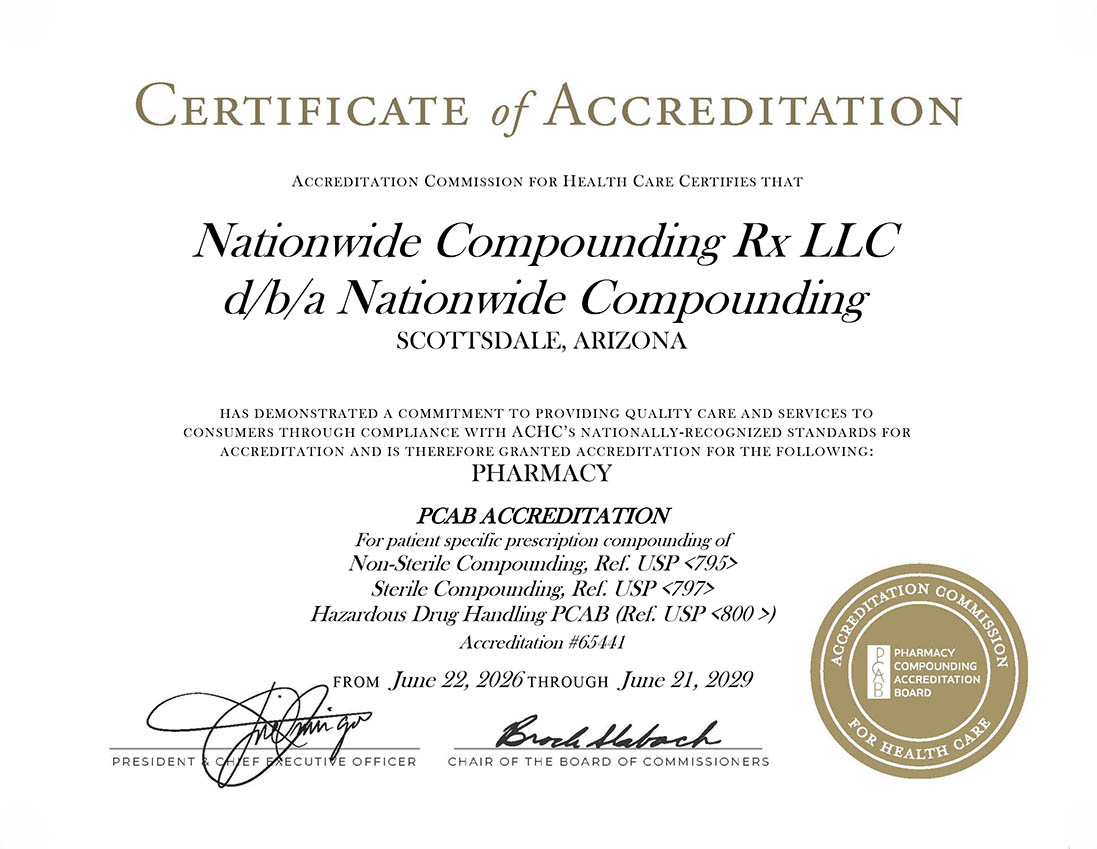
- Recognized quality credentials. The pharmacy is PCAB accredited and USP 800 compliant. With compounding under industry-wide scrutiny, these standards give patients and prescribers a meaningful benchmark.
- Multi-state licensing. Nationwide Compounding Rx® ships to patients across multiple licensed states. Availability depends on medication type and state regulations, and the pharmacy’s shipping map shows each state’s status for sterile and non-sterile preparations. Patients in Maryland, D.C., and Northern Virginia can confirm service for their location.
- GLP-1 and peptide support. The pharmacy offers GLP-1 and peptide support for the narrow, patient-specific clinical-need cases that remain permissible after the shortage, rather than the mass-production approach the FDA has restricted.
- Pediatric formulation expertise. Age- and weight-specific dosing is available in kid-friendly forms, including flavored liquids, troches, suckers, and popsicles. Flavors include cherry, peppermint, raspberry, strawberry, tutti frutti, marshmallow, orange, bubblegum, and piña colada.
- Clean formulations. Preparations can be made free of dyes, fillers, preservatives, and allergens as part of the pharmacy’s sterile and non-sterile compounding services.
- Practical advantages. Typical turnaround is 1 to 2 business days, with same-day pickup available for some medications. Products undergo independent third-party testing, and high-grade chemicals are sourced from FDA-inspected and cleared vendors.
- A collaborative provider model. The pharmacy’s Connect → Collaborate → Create → Care process works directly with a patient’s existing prescriber, so no new provider relationship is required.
How to Get Started
- Submit the prescription. Providers can use the secure Provider Portal to submit and track prescriptions. Patients can use the Patient Portal to manage their accounts and request refills.
- Contact the team directly. Patients and providers can call (480) 499-8379, send a fax to 480-699-5341, or use the website contact form. Email inquiries receive a response within one business day.
- Keep the CareFirst benefit in place. Nationwide Compounding Rx® complements the CareFirst and CVS Caremark pharmacy benefit rather than replacing it. It is meant for the specific medications and formulations that the benefit structurally excludes.
Conclusion
CareFirst BlueCross BlueShield’s ESPN and CVS Specialty network is entirely separate from the unrelated, identically named independent compounding pharmacies in New Jersey and North Carolina. Knowing the difference keeps prescriptions moving in the right direction.
Even within the correct system, a real gap remains. A commercial specialty network built for FDA-approved, manufactured drugs cannot fill compounded GLP-1s, non-FDA-approved strengths, pediatric flavoring needs, or dye-free and filler-free formulations.
That gap is structural and driven by policy. CareFirst’s 2026 medical policy 09.01.126 and the FDA’s post-shortage restrictions are not short-term glitches. Patients facing these limits need a different kind of pharmacy partner, not simply another call to CVS. For Maryland, D.C., and Northern Virginia patients, Nationwide Compounding Rx® offers a credentialed, multi-state-licensed option designed for exactly this situation.
Talk to Nationwide Compounding Rx® About a Prescription
Patients whose compounded medication has been labeled “not covered” or “not available” by CareFirst’s ESPN or CVS Specialty can contact Nationwide Compounding Rx® to review options together with their prescriber.
Providers are invited to submit prescriptions through the Provider Portal, and patients can use the Patient Portal for account access and refill management.
- Phone: (480) 499-8379
- Website: nationwidecompounding.com
- Hours: Monday through Friday, 7:00 AM to 3:30 PM
Nationwide Compounding Rx® is PCAB accredited, USP 800 compliant, and licensed to ship across multiple states, giving patients and prescribers a trusted resource for the medications the commercial specialty network was never designed to make.
Related Posts

Fairview Specialty Pharmacy and Fairview Compounding Pharmacy share a brand but operate very differently, with distinct accreditations and regulatory histories. This 2026 guide breaks down the split, highlights key FDA inspection findings, and explains what patients needing custom formulations should do before Fairview's 2027 network changes take effect.

Discover what compound medication truly means beyond the dictionary definition, exploring the gap between the FDA's legal view and USP's clinical standard. This guide breaks down 503A vs 503B pharmacies, the 2012 NECC outbreak that reshaped oversight, and what 2026 rules mean for compounded GLP-1 medications.

Confirm you've found the real Marty's Compounding Pharmacy in Flowood, MS, and learn a simple four-step process to verify its licensing and accreditation. This 2026 guide also clears up a common mix-up with a similarly named Brooklyn pharmacy and offers a credentialed nationwide-shipping alternative.

This 2026 guide breaks down bioidentical hormone replacement therapy testosterone for women, covering safe dosing caps, preferred delivery methods, and essential lab-monitoring timelines. It also examines emerging FDA developments that may finally bring an approved option to market.