
Bioidentical Testosterone for Women: 2026 BHRT Safety Guide
Introduction: The Honest Contradiction at the Heart of Women’s Testosterone Therapy
Women considering testosterone therapy face a real contradiction. Major medical societies state that compounded testosterone “cannot be recommended” because standardized efficacy and safety data are limited. Yet no FDA-approved testosterone product exists for women in the United States. For most American women, compounding is the only realistic way to access this therapy.
The imbalance is striking. More than 30 FDA-approved testosterone products are available for men and none for women, even though testosterone is present in women’s bodies throughout life and plays an important role in their health.
This guide translates dense clinical guidance from bodies such as the Endocrine Society and the International Society for the Study of Women’s Sexual Health (ISSWSH) into plain-language safety information. It covers dosing caps, preferred delivery forms, and lab-monitoring timelines. It also addresses a timely development: the September 17, 2026 FDA Office of Women’s Health workshop and the AVA-291 development pathway, which suggest an approved option may eventually arrive.
The central conclusion is that until an FDA-approved product exists, individualized, lab-adjusted compounding through accredited pharmacies is a responsible bridge, not a shortcut.
Testosterone in Women’s Bodies: Debunking the “Male Hormone” Myth
Testosterone is often called a “male hormone,” but that label is misleading. Women produce testosterone throughout their lives, and measured by circulating concentration, it is the most abundant biologically active steroid hormone in the female body.
The British Menopause Society notes that premenopausal women produce both testosterone and estrogen. Testosterone levels often begin to decline well before menopause because of gradual changes in ovarian and adrenal function. Women who have had their ovaries surgically removed can experience a sharper drop.
Testosterone’s roles in women fall into two categories:
- Strongest evidence: Libido and sexual function, particularly sexual desire, arousal, and satisfaction.
- Commonly discussed but less proven: Energy, mood, cognition, and musculoskeletal health. These benefits are frequently reported anecdotally, but they lack the clinical trial support that exists for sexual function.
Keeping proven and anecdotal benefits separate helps patients set realistic expectations.
Why There’s No FDA-Approved Testosterone Product for Women
Testosterone has been used in women for decades, but no sponsor has brought a female-specific product through FDA approval in the United States. Earlier candidates stalled, and the regulatory gap has persisted.
Other countries offer a useful comparison. Australia remains the only country with a product, Androfeme, formally approved for testosterone use in women with Hypoactive Sexual Desire Disorder (HSDD). This precedent shows that a female-specific product can meet regulatory standards.
In the United States, prescribers have two imperfect options:
- Off-label use of male-dosed products, which requires patients to measure out a small fraction of a dose designed for men.
- Compounded formulations, prepared at female-appropriate strengths by a pharmacy.
Neither option sits within a dedicated approval framework. Demand, meanwhile, keeps rising. One analysis found that testosterone prescriptions for women increased 146% between January 2023 and July 2026, as growing awareness ran into a stalled approval pathway.
Breaking: The September 2026 FDA Workshop and What It Signals
On September 17, 2026, the FDA’s Office of Women’s Health and the Center for Drug Evaluation and Research (CDER) held a public workshop on testosterone use in menopausal women. The event followed an August 18, 2026 Federal Register notice.
The FDA issued “a call to action to drug sponsors, researchers and payers,” a notable shift in tone. Public interest was clear as well: more than 80% of comments submitted to the docket came from women describing the lack of an approved product.
Industry activity is also emerging. AVA-291 (d3-T), a female-specific candidate from Aviva Bio, received FDA development-pathway guidance in January 2026. Approval timelines remain uncertain, however, and no product is guaranteed to reach the market on any particular schedule.
For patients, nothing changes immediately. Current access still depends on off-label or compounded options. What the workshop does change is the framing: compounding is best understood as a bridge therapy, not a permanent solution.
Inside the Guideline Tension: What Medical Societies Actually Say
The 2019 Global Consensus Position Statement on the Use of Testosterone Therapy for Women, endorsed by major endocrine and menopause societies, states that compounded “bioidentical” testosterone “cannot be recommended for the treatment of HSDD because of the lack of evidence for efficacy and safety, unless an authorized equivalent preparation is not available.”
The final clause matters. In the United States, an authorized equivalent is not available.
The ISSWSH 2021 Clinical Practice Guideline takes a similar position. It recommends systemic transdermal testosterone for women with HSDD that is not primarily related to modifiable factors, and it acknowledges that compounding remains the only real-world option for most U.S. women.
This caution is about standardization and data quality. It is not a blanket rejection of testosterone therapy, and it does not dismiss well-regulated, lab-monitored compounding. The guidelines are also candid about a limitation: long-term safety data beyond 24 months is still lacking. Every patient should discuss this gap with her provider.
Who Testosterone Therapy Is For: HSDD and the Evidence Base
Hypoactive Sexual Desire Disorder is a persistent lack of sexual desire that causes personal distress. ISSWSH and the Global Consensus Statement identify it as the primary evidence-based indication for testosterone therapy in women.
HSDD is common. An estimated 16 million U.S. women over 50 have the condition, and about 4 million experience clinically significant distress. Prevalence estimates range from 8% to 26% and are highest among surgically menopausal women.
Blood tests have limits here. No single testosterone threshold reliably predicts who will respond to treatment. Clinicians use baseline levels mainly to rule out women who already have high androgen levels, not to “diagnose” a deficiency.
Other proposed uses, including energy, cognition, mood, and bone or muscle health, do not have the same level of evidence. They are reasonable to discuss, but as secondary goals rather than the primary reason for treatment.
Translating the Guidelines: Physiologic Dosing, Not “Male” Dosing
The most important safety principle is simple: therapy should restore testosterone to premenopausal physiologic concentrations and never push it to supraphysiologic, male-level ranges. In the words of the ISSWSH guideline, therapy “should not target total testosterone concentrations that exceed those of premenopausal women.”
Guidance referenced through the Endocrine Society caps transdermal testosterone for postmenopausal women with HSDD at a maximum of 10 mg/day.
The cap exists because higher doses raise the risk of androgenic side effects without adding therapeutic benefit. These side effects include:
- Acne
- Hirsutism (unwanted hair growth)
- Voice changes, which may not be fully reversible
More testosterone does not mean better results. Precise, conservative dosing is the foundation of safe therapy.
Choosing the Right Delivery Form: Why Transdermal Is Preferred
Low-dose transdermal creams and gels are the delivery method guidelines prefer for women. They allow gradual absorption and fine dose adjustments, and they can be stopped promptly if side effects appear.
Pellets and intramuscular injections carry more risk. Both can raise testosterone well above the female physiologic range, and once a pellet is implanted or an injection is given, the dose cannot be quickly reversed if acne, hair growth, or voice changes develop.
A critical review of compounded hormonal pellets notes that health organizations have warned of increased adverse effects from their indiscriminate use. This is a concern in the BHRT and anti-aging clinic market, where pellets are often heavily promoted.
Patients should ask prospective providers directly why a particular delivery form is being recommended and whether it matches current guideline preferences.
The Lab-Monitoring Timeline: What Responsible Care Looks Like
Responsible testosterone therapy follows a defined monitoring schedule:
- Baseline testing: Total testosterone before starting therapy, sometimes with sex hormone-binding globulin (SHBG) and free testosterone.
- Early follow-up: A recheck roughly 3 to 8 weeks after starting, to confirm levels remain within the female physiologic range.
- Ongoing monitoring: Rechecks every 4 to 6 months after that. Guidance published through the Alabama Board of Medical Examiners states that “any woman receiving testosterone therapy should be monitored every 6 months.”
Between lab visits, providers also watch for clinical signs of excess dosing, including acne, hirsutism, and voice changes. Any of these signs calls for a dose review.
This cycle of testing and adjusting is what separates responsible, individualized compounding from one-size-fits-all or unmonitored approaches.
Compounding Quality and Safety: What to Look for in a Pharmacy
Independent testing has found some compounded testosterone products containing more than 20% above the prescribed dose, while others contained essentially no active ingredient.
This variability is the main reason for the medical societies’ caution. The concern is not testosterone itself but inconsistent manufacturing quality across the compounding industry. Patients can reduce this risk by choosing their pharmacy carefully.
Questions to ask any compounding pharmacy:
- Is the pharmacy PCAB-accredited (Pharmacy Compounding Accreditation Board)?
- Is it USP 800 compliant for safe handling of hazardous drugs?
- Does it use independent third-party testing to verify potency and consistency?
- Does it source ingredients from FDA-inspected and cleared vendors?
- Can formulas be adjusted at each refill based on updated lab results?
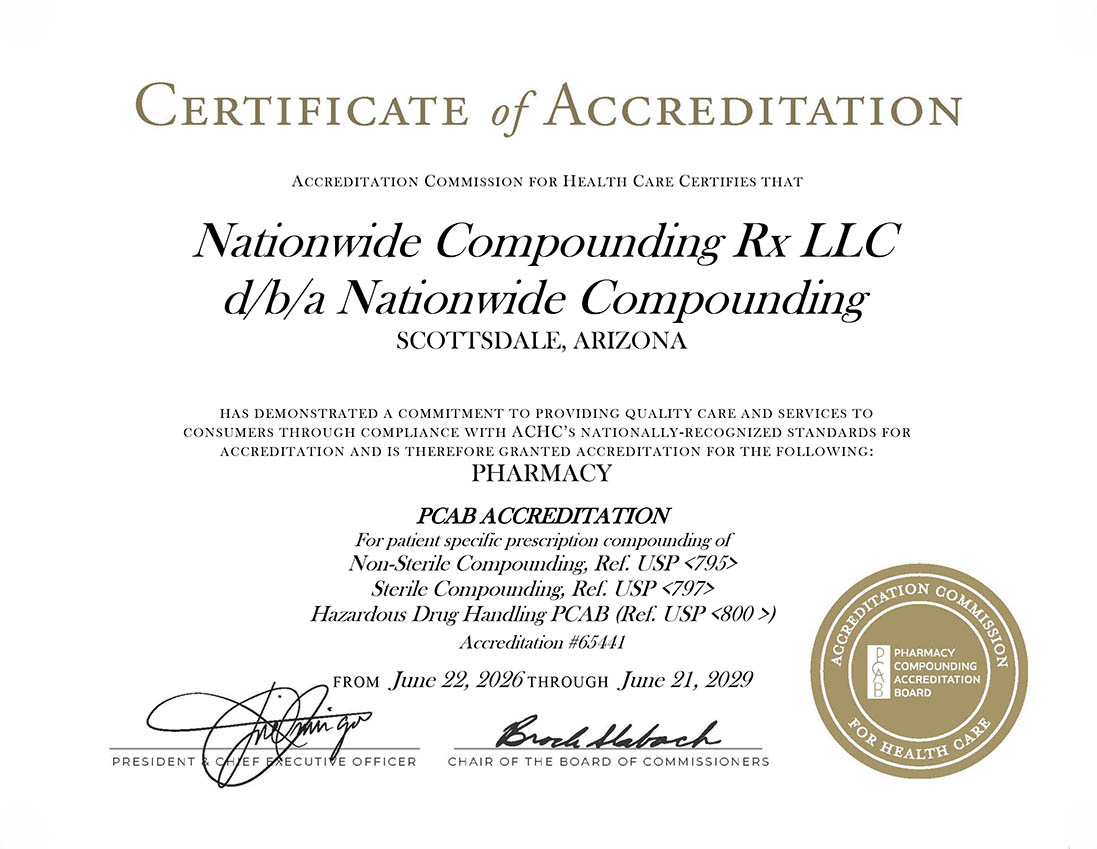
Accredited, lab-adjusted compounding directly addresses the concerns guideline bodies raise. Nationwide Compounding Rx®, a PCAB-accredited and USP 800 compliant pharmacy in Scottsdale, Arizona, uses independent third-party testing and sources high-grade chemicals from FDA-inspected and cleared vendors. These are the safeguards that help ensure the dose on the label matches the dose in the container.
Who Should Avoid Testosterone Therapy: Contraindications and Cautions
Commonly cited contraindications include:
- Pregnancy or breastfeeding
- Hormone-sensitive breast or uterine cancer (with some off-label exceptions for fully informed patients)
- Unevaluated vaginal bleeding
- Signs of existing clinical androgen excess
A listed condition does not always mean automatic disqualification. Women in these categories should have an explicit risk-benefit conversation with a knowledgeable prescriber. Treatment decisions should be individualized, and baseline labs should be reviewed before therapy begins.
The Path Forward: A Bridge, Not a Permanent Workaround
The regulatory landscape may be starting to shift. The FDA’s 2026 workshop, the AVA-291 development pathway, and the sharp rise in prescriptions all suggest an approved product could eventually reach U.S. women.
Until then, compounding remains a necessary bridge rather than an ideal end state. It deserves the same rigor as any other prescription therapy.
Collaboration between provider and pharmacy is central to that rigor. Nationwide Compounding Rx® works with prescribers through a structured framework: Connect, Collaborate, Create, Care. This partnership supports gradual dose refinement based on lab results, which is the main way to reduce the risks guideline bodies identify.
Patients should also revisit their regimen periodically as new data, products, or guidance become available.
Conclusion: Informed, Individualized, and Honest About the Tradeoffs
The gap between guideline caution and real-world access is real, but it can be managed. The keys are physiologic dosing, preferred transdermal delivery, and consistent lab monitoring.
When done responsibly through accredited compounding, testosterone therapy for women is not a fringe or purely cosmetic choice. It is a legitimate, evidence-supported option for HSDD specifically, with honest limits on long-term data and on secondary benefits.
Readers can bring this guide’s framework into conversations with their healthcare provider: the 10 mg/day transdermal cap, the 3-to-8-week and 4-to-6-month monitoring timeline, and the pharmacy-quality questions.
Next Steps: Talk to a Knowledgeable Provider and Accredited Pharmacy
Before starting any testosterone regimen, women should review their symptoms and lab history with a BHRT-informed prescriber. That conversation should cover goals, contraindications, delivery options, and a clear monitoring plan.
Nationwide Compounding Rx® offers the safeguards discussed throughout this guide:
- PCAB accreditation
- USP 800 compliance
- Independent third-party testing
- BHRT formulas adjusted at each refill based on lab results
Providers can use the secure Provider Portal to submit and manage prescriptions, and patients can use the Patient Portal to manage refills and support requests. The team can also be reached at (480) 499-8379, Monday through Friday, 7:00 AM to 3:30 PM. A consultation is a practical way to learn how individualized, lab-adjusted BHRT compounding works and whether it fits a patient’s care plan.
Related Posts

Confirm you've found the real Marty's Compounding Pharmacy in Flowood, MS, and learn a simple four-step process to verify its licensing and accreditation. This 2026 guide also clears up a common mix-up with a similarly named Brooklyn pharmacy and offers a credentialed nationwide-shipping alternative.

OptumRx Specialty Pharmacy's own formulary documents reveal a strange contradiction in how certain high-cost drugs are covered. This article breaks down the 2026 formulary mechanics, regulatory backdrop, and what patients should do to protect their access to specialty medications.

This 2026 guide breaks down bioidentical hormone replacement therapy in Delaware, covering FDA-approved options versus compounded alternatives. Learn about the latest regulatory updates, state compounding laws, and how to verify a legitimate provider. A clear, science-based resource for Delaware patients exploring BHRT.

Confused by conflicting listings for the CVS Specialty Pharmacy phone number? This guide provides a complete, verified 2026 directory of every official line, organized by department. It also explains what to do when calls lead to long holds or unresolved issues.