
Bioidentical Hormone Replacement Therapy: What Is It? A 2026 Guide
Introduction: A Term Patients Hear Everywhere, But Rarely See Explained Clearly
“Bioidentical hormone replacement therapy” is one of the most searched, most marketed, and most misunderstood phrases in menopause and andropause care. Patients encounter it on social media, in wellness clinic advertising, and in conversations with friends. Clear explanations are much harder to find.
Interest has grown since November 10, 2025, when the U.S. Food and Drug Administration (FDA) and the Department of Health and Human Services (HHS) announced the removal of the broad black-box warning from estrogen-containing menopausal hormone therapy products. Many evergreen guides still have not incorporated this change.
Much of the existing content also frames BHRT as a contest between “bioidentical” and “synthetic” hormones. The distinction that clinicians and regulators actually emphasize is different: FDA-approved versus compounded.
This guide covers:
- A clear definition of BHRT
- The regulatory distinction that matters most
- Why compounded BHRT exists
- Its honest limitations
- What a typical patient journey looks like
The goal is patient education that is balanced, grounded in evidence, and transparent.
What Is Bioidentical Hormone Replacement Therapy, Really?
BHRT generally refers to hormones that are molecularly identical to those the human body naturally produces. The most common examples are 17β-estradiol, progesterone, and testosterone.
“Bioidentical” is not a legally standardized regulatory category, and the FDA has no single definition for the term. Research published through the National Institutes of Health confirms this lack of standardization, noting that it often confuses both patients and practitioners.
The Menopause Society traces the term’s origins partly to marketing language for custom-compounded hormones. Over time, most clinicians came to use it more broadly to describe any hormone with the same chemical structure as the body’s own.
The Misleading “Bioidentical vs. Synthetic” Framing
This framing confuses patients because many bioidentical hormones are themselves FDA-approved pharmaceutical products. They are not unregulated “natural” alternatives.
The word “bioidentical” does not automatically mean any of the following:
- Unregulated
- Custom-made
- Safer than other hormone therapy
The distinction that carries real weight is whether a bioidentical hormone is FDA-approved or compounded.
The Distinction That Actually Matters: FDA-Approved vs. Compounded Bioidentical Hormones
This is the conceptual core of BHRT. Two products can contain the same molecule, such as estradiol, and still differ greatly in how they are manufactured, tested, and regulated.
FDA-Approved Bioidentical Hormones
Several widely prescribed products are both bioidentical and FDA-approved:
- Estradiol patches, pills, and gels, including brands such as Estrace, Climara, and Vivelle
- Micronized progesterone, marketed as Prometrium, which received FDA approval in May 1998
These products undergo FDA testing for purity, potency, and consistency. They come in standardized, regulated dosage forms such as patches, gels, oral tablets, and vaginal inserts. This pathway has the most robust safety and efficacy data available to patients.
Compounded Bioidentical Hormones
Compounded BHRT consists of custom-mixed hormone formulations that a licensed compounding pharmacy prepares according to an individual prescription. Compounded products are not FDA-approved as finished products, nor are they individually tested for purity and potency the way manufactured drugs are.
Compounding allows delivery forms that commercial products do not offer, including:
- Creams
- Capsules
- Troches
- Suppositories
- Subcutaneous pellets
Pellets deserve particular caution. They are not FDA-approved, and some clinicians advise against them because absorption can be unpredictable.
Compounded bioidentical hormone therapy (cBHT) is a multibillion-dollar segment of the broader bioidentical hormones market. Depending on methodology, that market was valued at roughly $3.8 billion to $8 billion in 2025 and 2026, with projected annual growth of about 5.5% to 9.4%.
The November 2025 FDA Black-Box Warning Removal: What Changed and What Didn’t
On November 10, 2025, HHS and the FDA announced that they would remove the broad black-box warning from estrogen-containing menopausal hormone therapy products. The decision followed more than two decades of controversy over how hormone therapy risks were communicated.
FDA Commissioner Marty Makary stated that tens of millions of women had been denied the benefits of hormone therapy because of warnings rooted in a “distortion of risk.”
What Still Carries a Warning
The change was not a blanket removal of every warning. The FDA did not remove the boxed warning for endometrial cancer risk associated with systemic estrogen-alone products. This matters most for women who still have a uterus, because estrogen used without a progestogen can increase that risk.
The update changes labeling and risk communication. It does not reverse every safety consideration surrounding hormone therapy.
Why This Matters for Patients Researching BHRT in 2026
Clinicians have reported a steep rise in the number of women starting hormone therapy since the announcement. Some experts believe media and social coverage are driving much of that momentum, rather than individualized clinical consultation.
The regulatory shift is encouraging for access, but headlines cannot replace personalized medical guidance. Patients benefit from understanding the difference between FDA-approved and compounded options before choosing a path.
Why Compounded BHRT Exists at All
If FDA-approved bioidentical products exist, why would anyone choose a compounded version? There are several legitimate reasons, alongside some motivations that deserve closer scrutiny.
Personalized Dosing and Combination Formulas
Some patients need doses or combinations that do not exist as single FDA-approved commercial products. Examples include:
- Biest, a blend of estriol and estradiol
- Triest, a blend of estriol, estradiol, and estrone
- Combined estradiol and progesterone creams
Research shows that patients often choose compounded hormone therapy because they are dissatisfied with the fixed, standardized doses available in commercial products.
Allergen-Free and Filler-Free Formulations
Some patients have documented allergies or sensitivities to dyes, fillers, preservatives, or other inactive ingredients in manufactured products. For these patients, a compounded formulation without the problematic ingredient may be a practical solution.
A 2020 consensus report from the National Academies of Sciences, Engineering, and Medicine recommended reserving compounded hormone therapy largely for two groups:
- Patients with documented allergies to ingredients in FDA-approved products
- Patients who need a dosage form that is not commercially available
This recommendation confirms that these uses are clinically legitimate, not simply a product of marketing.
Patient Psychology: Trust, Narrative, and the “Natural” Appeal
A qualitative study of menopausal decision-making found that women chose compounded hormone therapy for three main reasons:
- Distrust of pharmaceutical companies
- A desire for an individualized, “natural” treatment story
- Dissatisfaction with standardized commercial dosing
These motivations are understandable and deserve respect; feeling unheard in conventional care is a real experience. Still, an appealing story is not the same as clinical evidence, and claims that compounded hormones are inherently safer remain unsupported.
The Honest Limitations of Compounded BHRT
Any trustworthy discussion of compounded BHRT has to address its limitations directly.
No FDA Testing for Purity or Potency
Compounded formulations do not go through the same FDA manufacturing, purity, and potency testing as approved drugs. As a result, batch-to-batch consistency depends heavily on the individual pharmacy.
Reputable compounding pharmacies manage this risk through industry best practices, including:
- PCAB accreditation from the Pharmacy Compounding Accreditation Board
- USP 800 compliance for safe handling of hazardous drugs
- Independent third-party testing of preparations
- Sourcing ingredients from FDA-inspected and cleared vendors
These safeguards strengthen quality, but they are not a substitute for FDA approval.
The Weak Evidence Behind Salivary and Urinary Hormone Testing
Some providers market salivary or urinary hormone testing alongside compounded BHRT as a tool for “personalized dosing.” These tests have weak clinical correlation with meaningful tissue hormone exposure.
In some case series, doses based on these tests produced supraphysiologic serum estradiol levels, meaning levels abnormally higher than the body would naturally produce. Few consumer guides mention this problem, but patients should know about it.
What Medical Consensus Actually Says
The Menopause Society, Cleveland Clinic, and the Endocrine Society share a similar position: compounded bioidentical hormones likely carry risks and benefits similar to those of FDA-approved hormone therapy. There is insufficient evidence that compounded formulations are safer or more effective.
The 2020 consensus report’s recommendation to limit compounded hormone therapy to documented allergies or unavailable dosage forms reinforces this view. Compounded therapy is not a universally better option.
Some real-world data does exist. An observational cohort study at a wellness center found that compounded BHRT improved mood symptoms in some patients. However, large randomized controlled trials comparing compounded and FDA-approved options are still lacking.
Bioidentical vs. Synthetic Hormones: A Quick Clarification
For readers who still want the chemical distinction: bioidentical estradiol and micronized progesterone match the body’s own hormones molecule for molecule. Synthetic hormones do not.
Examples of Non-Bioidentical (Synthetic) Hormones
Two common examples are:
- Conjugated equine estrogens, which are derived from mare urine
- Progestins such as medroxyprogesterone acetate
Both are structurally different from human hormones. However, “synthetic” does not automatically mean “dangerous.” At least one study associated conjugated equine estrogens and medroxyprogesterone acetate with a decreased risk of breast cancer relative to bioidentical hormone therapy.
Why “Natural” Doesn’t Automatically Mean Safer
The most meaningful safety and quality distinction is FDA-approved versus compounded. Bioidentical hormones are not risk-free. The boxed warning that remains for endometrial cancer risk with systemic estrogen-alone products applies regardless of whether the estrogen is bioidentical.
BHRT for Men: Testosterone Replacement
Most consumer content overlooks men, but testosterone replacement for andropause is a form of BHRT. The same distinction applies:
- FDA-approved options include testosterone gels, patches, and injections.
- Compounded options include creams, troches, and pellets.
Men considering testosterone therapy should ask the same question women do: is this product FDA-approved or compounded, and why?
What to Expect: The BHRT Patient Journey
For someone still in the research phase, it helps to know what the process typically looks like before committing to treatment.
Initial Consultation and Baseline Lab Work
A typical first consultation lasts 45 to 90 minutes. The prescriber reviews symptoms and medical history and orders baseline bloodwork, which commonly covers:
- Estradiol
- Progesterone
- Testosterone
- DHEA
- Cortisol
- Thyroid panel
As a matter of best practice, patients are not prescribed hormones on the day of the first visit. A follow-up appointment is used to review the results and build a plan.
Prescriber Collaboration and Treatment Decisions
During the follow-up, the prescriber and patient decide together whether an FDA-approved product, a compounded formulation, or a combination fits the patient’s documented needs. Relevant factors include allergies, dosage form preferences, and the need for specific hormone combinations.
A good prescriber explains the FDA-approved versus compounded distinction openly rather than defaulting to one option.
Compounding and Formulation (When Applicable)
When a prescriber writes a compounded prescription, a pharmacy such as Nationwide Compounding Rx® prepares the custom formulation. Dosage forms can include capsules, topical creams and gels, troches, and sublingual tablets. Formulations can also be made without dyes, fillers, preservatives, or specific allergens when needed.
When evaluating any compounding pharmacy, patients and prescribers should look for these quality benchmarks:
- PCAB accreditation
- USP 800 compliance
- Ingredients sourced from FDA-inspected and cleared vendors
- Independent third-party testing
Follow-Up, Refills, and Dose Adjustments
BHRT is rarely a “set it and forget it” prescription. Compounded formulas in particular can be adjusted at each refill based on updated lab results and how symptoms respond.
Finding the right formulation and dose is often an iterative process that depends on ongoing communication among the patient, prescriber, and pharmacy.
Conclusion: Making an Informed Choice, Not a Marketed One
The most useful question about BHRT is not “bioidentical or synthetic?” It is “FDA-approved or compounded, and why?“
Both pathways have legitimate roles:
- FDA-approved products offer the strongest safety and efficacy data.
- Compounded options serve specific needs, such as allergies, combination formulas, or dosage forms that are not commercially available.
The November 2025 removal of the broad black-box warning is an encouraging development for access to hormone therapy. Personalized clinical guidance remains essential regardless of the headlines. Transparency, not persuasion, gives patients the foundation for a confident, informed decision.
Next Steps: Talk to a Provider Who Can Walk You Through Your Options
Anyone considering BHRT should first discuss symptoms and goals with a qualified prescriber. That conversation should include whether an FDA-approved or compounded product best fits the patient’s needs.
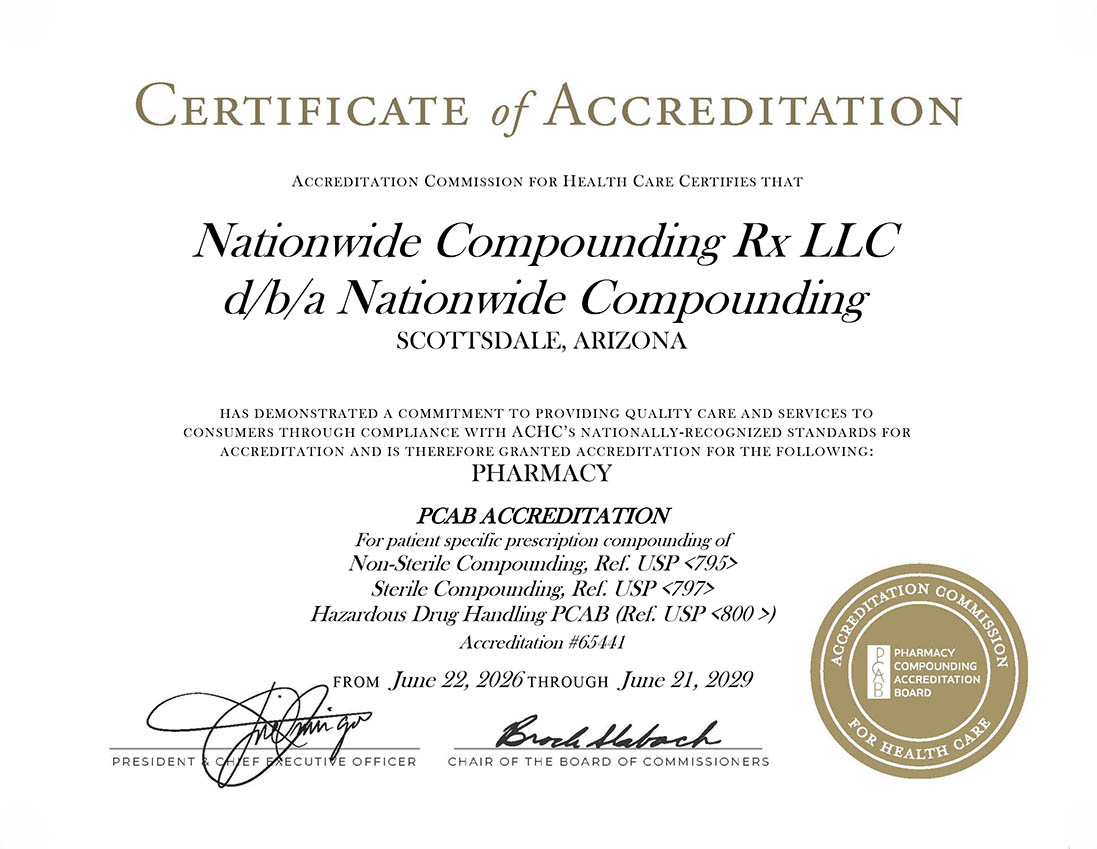
When a prescriber determines that a compounded formulation is appropriate, Nationwide Compounding Rx® works alongside the care team through its Connect, Collaborate, Create, Care approach. The pharmacy is PCAB accredited and USP 800 compliant, uses independent third-party testing, and offers formulas that can be adjusted at each refill based on lab results.
Patients and providers with questions about how compounded hormone formulations fit within a prescriber’s care plan can explore the pharmacy’s BHRT services page or call the Scottsdale, Arizona team at (480) 499-8379, Monday through Friday, 7:00 AM to 3:30 PM.
Related Posts

Partell Specialty Pharmacy officially became National Health Rx after a 2025 ownership change approved by the Nevada State Board of Pharmacy. This guide helps patients and prescribers decide whether to stay or transfer, with a capability checklist and a clear five-step pathway to a PCAB-accredited compounding pharmacy.

BioPlus Specialty Pharmacy has long been known for high-touch specialty infusion services, but its 2026 status under Carelon ownership raises new questions for patients and providers. This guide breaks down what changed, what stayed the same, and how BioPlus's dispensing model compares to specialty compounding pharmacies.

Can't access your CVS specialty pharmacy log in? You're not alone—CVS Specialty, Caremark, and CVS.com use separate credentials entirely. Discover the fast fix and the deeper PBM ownership structure driving this friction.

Lloyd Central Compounding Pharmacy's accreditation claims have shifted, and online reviews are sharply divided. This 2026 investigative guide examines its current credentials, shipping limitations, and a nationally accredited alternative worth considering.