
ACRX Specialty Pharmacy: The FDA Letter & 2026 Trust Guide
Introduction: Why ‘ACRX Specialty Pharmacy’ Searches Need More Than a Phone Number
Most people who search for “ACRX Specialty Pharmacy” want something simple: an address, a phone number, or store hours for a prescription they have already been handed. ACRX is a real, operating pharmacy in Las Vegas, Nevada, currently located at 8440 W Lake Mead Blvd, Suite 103. Patients looking for hours and a direct phone line should confirm these details through the pharmacy’s own website or a current directory listing, since they can change.
Many of these searchers are also asking a second question they may not type into a search bar: Is this pharmacy legitimate? Patients are often referred to ACRX for compounded hormone therapy, semaglutide and other GLP-1 medications, or anti-aging formulations. Those are categories where quality control matters a great deal and where regulation has changed quickly.
This guide focuses on brand-specific facts rather than general theory. It covers the 2022 FDA referral letter tied to ACRX, the question of accreditation, and the sharply divided patient reviews. It also places all of this within the 2026 regulatory picture for GLP-1 compounding, which has made due diligence on any compounder more urgent than ever.
ACRX Specialty Pharmacy: The Quick Facts
ACRX is a small, independently owned pharmacy. Publicly available business data shows the following:
- Location: Las Vegas, NV (Summerlin area)
- Founded: April 2018
- Size: 11 to 50 employees
- Estimated revenue: Under $5 million
- Current address: 8440 W Lake Mead Blvd, Ste 103
- Prior address: 3200 Soaring Gulls Dr
The address change matters: the FDA documentation discussed below relates to the prior Soaring Gulls Drive facility, which makes the relocation a relevant part of the timeline.
ACRX lists a broad set of clinical focus areas:
- Hormone replacement therapy
- Anti-aging
- Erectile dysfunction
- ENT (ear, nose, and throat)
- Ophthalmology
- Thyroid dysfunction
- Pain management
- Veterinary compounding (equine and companion animal)
The pharmacy positions itself around personalization, stating that it “specializes in compounding medications tailored to individual patient needs.” In other words, its model is built around custom preparations rather than dispensing fixed, pre-manufactured drugs.
The Name Is Misleading: ACRX Is a Compounding Pharmacy, Not a Specialty Pharmacy
The most important factual correction concerns the business itself. Despite the words “Specialty Pharmacy” in its name, ACRX describes itself as a compounding pharmacy. Its own website states: “As a compounding pharmacy in the Las Vegas area, we are dedicated to helping our patients and physicians in the local area.” Third-party directories also list it as a “Summerlin Compounding Pharmacy.”
This is not just a naming quirk. The industry group SPAARx has publicly pushed back against blurring these terms, stating that “specialty pharmacies dispense FDA-approved and commercially available medications requiring patient-specific prescriptions.” Specialty pharmacies typically handle high-cost, complex manufactured drugs for conditions such as cancer, multiple sclerosis, or rheumatoid arthritis.
The practical differences for patients include:
| Factor | Specialty Pharmacy | Compounding Pharmacy |
|---|---|---|
| What it dispenses | FDA-approved, commercially manufactured drugs | Custom preparations made for individual patients |
| Legal framework | Standard pharmacy dispensing | Section 503A (state-regulated) or 503B (FDA-regulated outsourcing) of the FD&C Act |
| Quality standards | Manufacturer controls plus dispensing rules | USP <795>, <797>, and <800> |
| Typical accreditation | URAC, ACHC, CPPA, The Joint Commission | PCAB (administered by ACHC) |
None of this means compounding is inferior; it is a parallel category, not a lesser one. It fills real gaps: discontinued strengths, allergen-free versions, alternative dosage forms, and doses that do not exist commercially. The point is simply that patients should evaluate a compounding pharmacy using compounding standards, not assumptions drawn from the word “specialty.”
The 2022 FDA Referral Letter: What Actually Happened
The FDA publicly posted a State Referral Letter (SRL) concerning ACRX. The documented timeline is:
- July 2021: The FDA conducted a six-day inspection at ACRX’s Soaring Gulls Drive facility.
- May 2022: The FDA held a regulatory meeting with the pharmacy after its corrective response was considered inadequate.
- July 13, 2022: The FDA issued a formal referral letter to the Nevada State Board of Pharmacy.
The letter flagged “poor sterile practices observed during an FDA inspection.” Sterile compounding covers preparations such as injectables, where contamination can cause serious harm, so this is a meaningful finding.
It is equally important to understand what a referral letter is and is not:
- It is a formal notice from the FDA asking the state regulator, which holds primary oversight of 503A pharmacies, to review and address the observed problems.
- It is not an FDA revocation of a license, a shutdown order, or a court action against the pharmacy.
Readers can verify the primary source by searching FDA.gov for “ACRX Specialty Pharmacy LNC, Las Vegas, NV – SRL Issued 07/13/2022.”
Has anything changed since then? The pharmacy has moved from Soaring Gulls Drive to its current Lake Mead Boulevard location. However, no public follow-up inspection report or documented closure of corrective actions has been identified. A relocation does not by itself confirm that sterile practices were corrected, nor does it prove they were not. That open question is exactly why the verification steps later in this guide matter.
Why PCAB Accreditation and USP <795>/<797>/<800> Compliance Matter
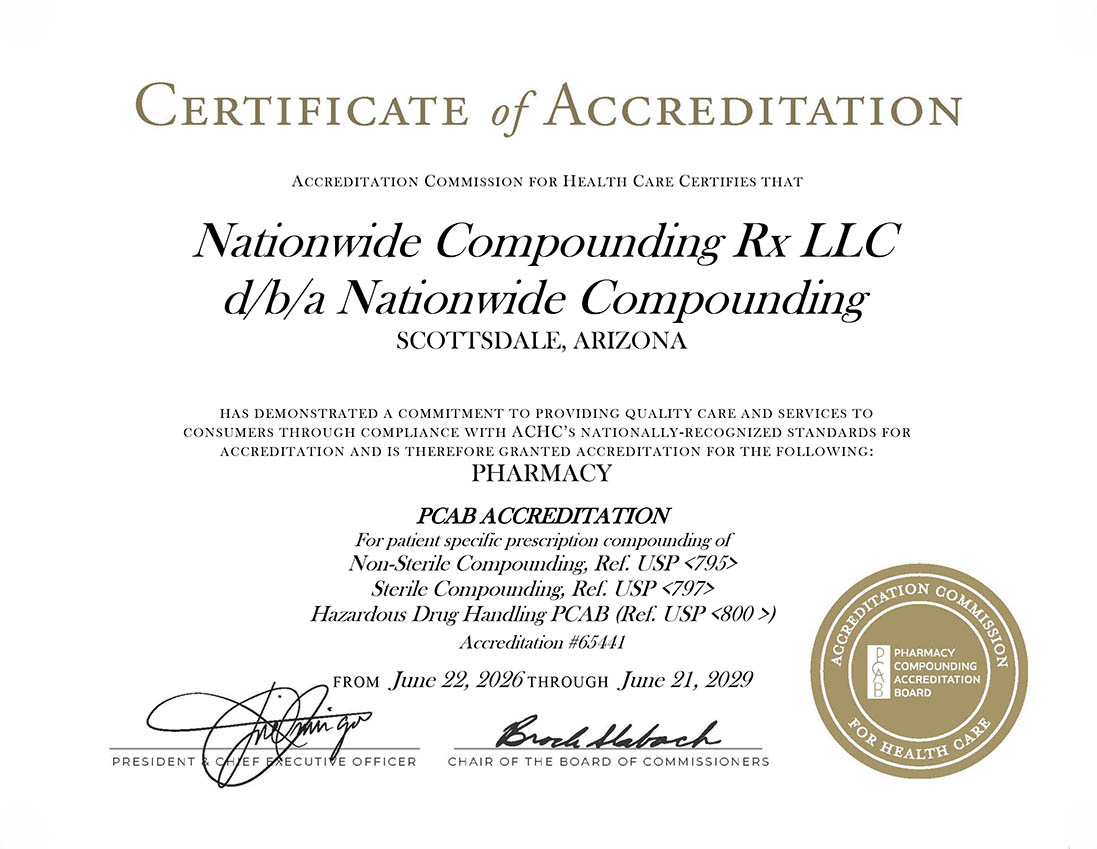
PCAB (the Pharmacy Compounding Accreditation Board, administered by ACHC) is widely considered the gold-standard accreditation for compounding pharmacies. It is voluntary, which is precisely what makes it meaningful: a pharmacy chooses to submit to an outside review of its sterile and non-sterile compounding operations.
PCAB accreditation verifies compliance with three core USP chapters:
- USP <795> (non-sterile compounding): Governs creams, capsules, troches, oral liquids, and similar preparations. It covers ingredient quality, cleanliness, beyond-use dating, and documentation.
- USP <797> (sterile compounding): Governs injectables and other preparations that must be free of microbial contamination. It covers cleanroom design, air quality, staff garbing, aseptic technique, and environmental monitoring.
- USP <800> (hazardous drugs): Governs how hazardous substances, including certain hormones, are handled to protect staff, patients, and the environment.
One estimate places the number of PCAB-accredited pharmacies nationwide at roughly 68. There is no public evidence that ACRX holds PCAB accreditation.
This check is not specific to ACRX; it is the single most useful verification tool available to any patient referred to a compounding pharmacy. Asking “Are you PCAB accredited?” takes seconds, and the answer reveals a great deal about whether a pharmacy has invited independent scrutiny of its quality systems.
What Patients Are Actually Saying: A Synthesis of ACRX Reviews
Public reviews of ACRX are sharply divided.
Positive signals: Yelp and Yahoo listings show ratings of roughly 4.3 to 4.5 stars. Reviewers frequently praise a pharmacist named “Jerry,” along with low prices and attentive service.
Negative signals: RxLocal shows a rating of 1.4 out of 5, with complaints centered on side effects from compounded semaglutide. One reviewer wrote that “ACRX pharmacy along with other compounding pharmacies are not FDA regulated.”
That statement is partially accurate. Under Section 503A, compounding pharmacies are regulated primarily by state boards of pharmacy, and their individual preparations are not FDA-approved on a batch-by-batch basis. However, they are not unregulated: federal law still applies, the FDA can and does inspect them (as the 2021 inspection shows), and state boards hold licensing authority.
Employee signals: On Indeed, ACRX holds a 1.3 out of 5 rating across reviews spanning 2018 to 2024. Former staff cite disorganization, low pay, a lack of benefits, and favoritism. Employee reviews are indirect evidence, but they are worth weighing. Sterile compounding depends on consistent training, careful documentation, and stable staffing. High turnover or disorganization can make it harder to maintain those disciplines.
Anecdotal reviews should not be read as a verdict in either direction. Happy customers may never have used sterile products; unhappy ones may have experienced side effects unrelated to compounding quality. These are signals to weigh, not conclusions.
The 2026 GLP-1 Regulatory Shift and What It Means for ACRX’s Semaglutide Offerings
Compounded semaglutide is where the regulatory ground has moved the most.
- February 21, 2025: The FDA declared the semaglutide shortage resolved. That ended the shortage-based legal rationale that had allowed routine, large-scale compounding of the drug.
- April 30, 2026: The FDA proposed excluding semaglutide, tirzepatide, and liraglutide from the 503B Bulks List, which would further limit outsourcing facilities from producing these drugs from bulk ingredients.
- September 2026: A warning letter to a major outsourcing facility targeted compounded GLP-1 products considered “essentially a copy” of commercially available drugs, a clear sign of active enforcement.
For 503A pharmacies like ACRX, the core legal constraint is that they may not compound drugs that are “essentially copies” of commercially available products unless there is a documented, patient-specific clinical difference. Examples might include a necessary dose that is not commercially available or a documented allergy to an inactive ingredient.
Patients referred to ACRX for compounded semaglutide in late 2026 should ask the pharmacy specifically how it is complying with the “essentially a copy” restriction and the post-shortage rules. A clear, documented answer is a good sign. A vague answer is a reason for caution.
A Practical Due-Diligence Checklist for Any ACRX (or Compounding) Patient
Before filling a compounded prescription at ACRX or any other compounding pharmacy, patients can work through these steps:
- Ask directly about PCAB accreditation. Do not assume. Request confirmation.
- Confirm current state licensure. For ACRX, check license status with the Nevada State Board of Pharmacy.
- Ask which USP protocols apply to the specific medication. A sterile injectable falls under <797>; a topical cream or capsule falls under <795>; hormones may also involve <800>.
- For semaglutide and other GLP-1s: Ask how the pharmacy documents the “essentially a copy” exemption and the medical-necessity justification required after the shortage was resolved.
- Request third-party testing documentation. Ask whether batches are independently tested for potency, sterility, and endotoxins.
- Cross-reference several review sources. Look beyond the highest-rated aggregator to get a balanced view.
- Speak with a pharmacist. Ask for a direct conversation with the compounding pharmacist, not only an intake or sales representative, about ingredient sourcing and quality control.
The Alternative: PCAB-Accredited, Nationwide-Licensed Compounding
Some readers will want the same personalization ACRX advertises, such as hormone therapy, GLP-1 and peptide support, pain management, or dermatology, but without open regulatory questions. For them, the checklist above describes what to look for.
Nationwide Compounding Rx®, based in Scottsdale, Arizona, offers a useful point of comparison:
- PCAB accredited, verifying adherence to compounding standards
- USP 800 compliant for hazardous drug handling
- High-grade chemicals sourced from FDA-inspected and cleared vendors
- Independent third-party testing to verify quality and consistency
- Both sterile and non-sterile formulations
The pharmacy also offers practical advantages:
- Multi-state licensed nationwide shipping, with a published three-tier map showing fully licensed states, non-sterile-only states, and pending or unlicensed states
- 1 to 2 business day turnaround, with same-day pickup for some medications
- BHRT formulas adjustable at each refill based on updated lab results
- A provider-collaborative model built on Connect, Collaborate, Create, Care
- Dedicated, secure Provider and Patient Portals
This comparison is not meant to disparage ACRX. It illustrates what transparent, verifiable credentials look like, so patients can hold any pharmacy to the same standard.
Conclusion: Making an Informed Choice, Not Just a Navigational Click
ACRX is a real, operating compounding pharmacy in Las Vegas with a public address and an established local presence. It is not, however, a “specialty pharmacy” in the regulated industry sense, despite its name. It also carries a documented 2022 FDA referral letter citing poor sterile practices at its former facility, with no public record yet identified showing how those concerns were resolved.
Neither the divided reviews nor the FDA letter should be treated as a final verdict. They are data points to bring into the due-diligence process outlined above.
For any compounded medication, whether hormone therapy, a GLP-1, or an anti-aging formulation, the highest-leverage action a patient can take is to verify PCAB accreditation and USP compliance before starting treatment.
Ready for Personalized Compounding With Verified Accreditation?
Patients and providers evaluating ACRX or any other compounding pharmacy are welcome to compare credentials directly with Nationwide Compounding Rx®.
- Providers can use the secure Provider Portal to submit and manage prescriptions, track orders, and connect with the pharmacy team.
- Patients can use the secure Patient Portal to access account information and manage refill or support requests.
Contact Nationwide Compounding Rx®:
- Phone: (480) 499-8379
- Website: nationwidecompounding.com
- Address: 14000 N. Hayden Rd., Suite 104, Scottsdale, AZ 85260
- Hours: Monday to Friday, 7:00 AM to 3:30 PM
- Email inquiries: Answered within one business day via the website contact form
Whatever pharmacy a patient chooses, the same rule applies: request documentation of PCAB accreditation and USP <795>/<797>/<800> compliance before treatment begins. A trustworthy compounding partner will be glad to provide it.
Related Posts

Lumicera Specialty Pharmacy markets transparent, cost-plus drug pricing, but that promise only applies to select conditions and stocked drugs. This article examines the data behind Lumicera's coverage limits, prior authorization denials, and what patients can do when they fall outside the model.

Searching for the right Optum Specialty Pharmacy phone number can lead to outdated or conflicting results. This 2026 verified list breaks down each legitimate contact line, what it's used for, and why the old BriovaRx name still causes confusion today.
Kentucky's 2026 crackdown on compounded peptides has left many Lexington patients searching for answers and legal alternatives. This guide breaks down what changed under 201 KAR 2:076, what it means for existing prescriptions, and how a PCAB-accredited compounding pharmacy can still legally fill compliant formulations.
As GLP-1 use surges in 2026, not all tirzepatide compounding pharmacy options are equally safe. This article breaks down FDA's 2026 adverse event data and shows exactly how PCAB accreditation—not facility type—prevents dangerous dosing errors.