
PCAB Accredited Compounding Pharmacy: The 2026 Patient and Provider Verification Guide
Introduction: Why Verification Comes Before Trust in Compounding Pharmacy
The compounding pharmacy market is a $7.42 billion industry in 2026, projected to reach more than $12 billion by 2034. Yet despite this growth, the industry still relies on a patchwork of state-by-state licensing standards with no unified national quality benchmark. That gap leaves both patients and providers exposed to real risk. Choosing a PCAB accredited compounding pharmacy is one of the few reliable ways to close that gap, because it replaces guesswork with a verifiable, third-party quality credential.
The stakes are not theoretical. As of early 2025, the FDA had received more than 455 adverse event reports linked to compounded semaglutide and more than 320 reports associated with compounded tirzepatide. These numbers illustrate what happens when quality controls fail and compounding operations scale faster than their safety infrastructure.
This is where PCAB accreditation matters. It is not a marketing badge. It is a credential held by fewer than 1% of all U.S. pharmacies, and the American Medical Association formally recommends that prescribers use only PCAB-accredited compounding pharmacies. This guide takes a verification-first approach: readers will learn how to confirm current accreditation status, spot false or lapsed claims, and understand why this matters for both patient safety and prescriber liability.
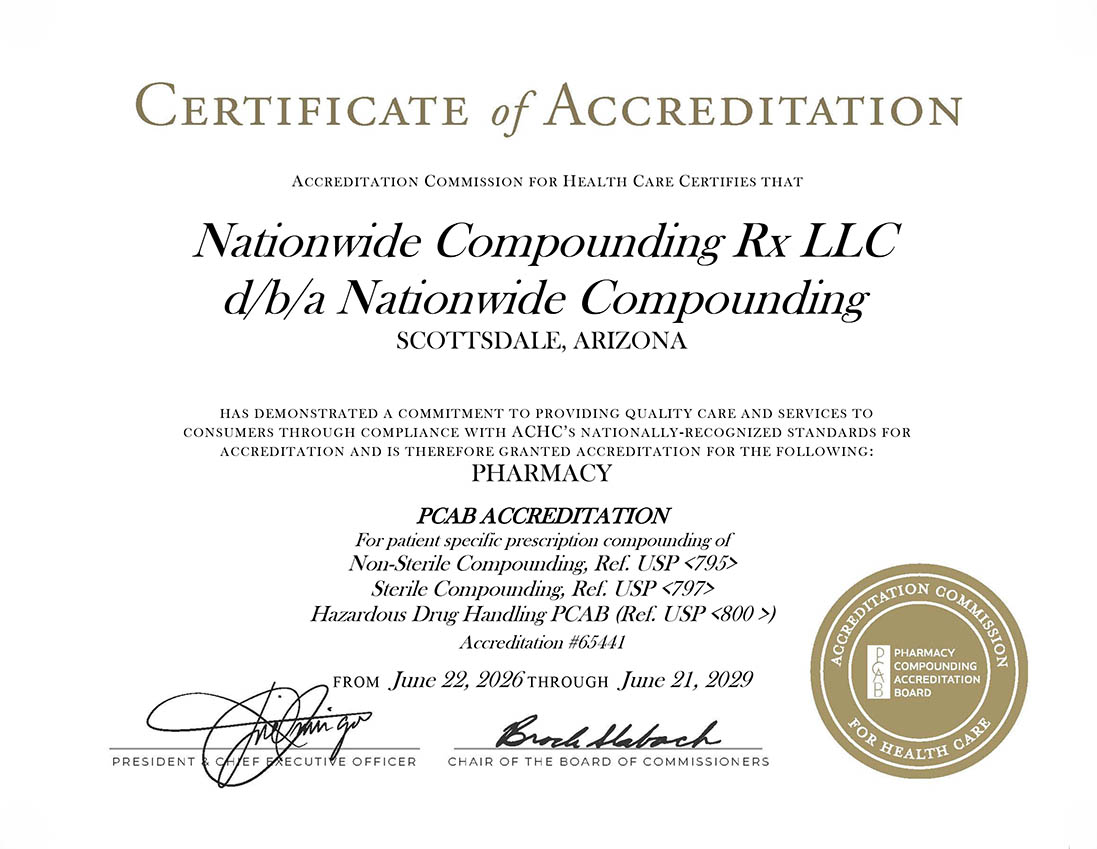
Throughout, this article references Nationwide Compounding Rx®, a verified, actively PCAB-accredited pharmacy and one of approximately 68 in the entire country, to anchor these principles in a real-world example.
What Is PCAB Accreditation? The Foundation Every Patient and Provider Needs to Understand
The Pharmacy Compounding Accreditation Board (PCAB) was established in 2007 by eight leading national pharmacy organizations, including the American Pharmacists Association, the National Association of Boards of Pharmacy (NABP), and the United States Pharmacopeia (USP). Today, PCAB operates as a service of the Accreditation Commission for Health Care (ACHC).
PCAB was created to fill the gap left by inconsistent state-by-state licensing. Its purpose is to establish a single, rigorous national standard for compounding pharmacy quality.
PCAB standards directly align with the three pillars of safe pharmaceutical compounding:
- USP <795> for non-sterile compounding
- USP <797> for sterile compounding
- USP <800> for hazardous drug handling
Revised PCAB standards incorporating the updated USP <795> and <797> chapters took effect June 1, 2024, meaning accredited pharmacies must meet the most current safety benchmarks.
The rarity of this credential is striking. With over 7,500 compounding pharmacies in the U.S., only approximately 68 hold PCAB accreditation as of 2026, representing fewer than 1% of all U.S. pharmacies. Among dedicated high-volume compounding pharmacies specifically, roughly 21% hold PCAB accreditation according to the APC 2023 to 2024 Demographic Survey. Among serious operators, accreditation is a professional expectation.
The 36-Month Accreditation Cycle: Why “Was Accredited” Is Not the Same as “Is Accredited”
PCAB accreditation is not permanent. It operates on a 36-month cycle and must be renewed every three years through a full re-evaluation process. Accreditation can also be revoked at any time for non-compliance.
This creates a verification obligation. A pharmacy that was accredited last year may not be accredited today. Past accreditation claims on a website, brochure, or social media profile do not guarantee current status. Only the ACHC public directory reflects real-time standing.
The preparation burden explains why this matters. The PCAB accreditation process typically takes one to two or more years of preparation, covering facility design, cleanroom classifications, equipment calibration, staff training, quality management systems, adverse event reporting, and corrective action processes. A pharmacy that earned accreditation three years ago but failed to renew may have allowed standards to slip. The 36-month cycle is designed to catch exactly this scenario.
The practical guidance is straightforward: always verify accreditation status at the time of prescribing or filling, not based on historical claims or marketing materials.
How to Verify a Pharmacy’s Current PCAB Accreditation Status: A Step-by-Step Guide
The only authoritative, real-time source for current PCAB accreditation status is the ACHC searchable public directory at achc.org.
The verification process is as follows:
- Navigate to achc.org.
- Select “Find a Provider.”
- Filter by PCAB or compounding pharmacy.
- Search by pharmacy name or location.
- Confirm the listing shows active, current accreditation.
An active PCAB-accredited pharmacy will appear in the directory with its accreditation type, location, and current status. Absence from the directory means the pharmacy is not accredited, regardless of any claims made elsewhere.
For providers, a practical tip: screenshot or document the ACHC directory result at the time of referral as part of due-diligence documentation. This creates a defensible record if questions arise later.
Nationwide Compounding Rx® appears in the ACHC directory as a verified, actively accredited PCAB pharmacy. Both patients and providers are encouraged to confirm this directly. The verification process takes less than two minutes and should be a standard step in any provider’s pharmacy vetting workflow.
Spotting False or Lapsed Accreditation Claims: Red Flags Every Patient and Provider Must Recognize
The most common red flag is a pharmacy claiming to be “PCAB-compliant,” “following PCAB guidelines,” or “PCAB-certified.” None of these phrases mean the pharmacy is actually accredited.
This language is misleading because PCAB accreditation is a binary status. A pharmacy either appears in the ACHC directory as accredited or it does not. There is no partial or compliance-only tier.
Additional red-flag language patterns to watch for include:
- “PCAB standards-based”
- “Accreditation in progress”
- “PCAB-equivalent”
- Displaying a PCAB logo without a verifiable directory listing
There is also the lapsed accreditation scenario. A pharmacy may have legitimately held PCAB accreditation in the past but failed to renew. Websites and marketing materials often lag behind actual status changes, sometimes by years.
When any pharmacy claims PCAB status, patients and providers should ask:
- What is your ACHC accreditation number?
- When does your current accreditation expire?
- Can I verify your status at achc.org right now?
The stakes are real. In March 2026, the FDA issued 30 warning letters to telehealth companies in a single day for misleading marketing of compounded GLP-1 products. False accreditation claims are part of this broader pattern of deceptive practices that put patients at risk.
The AMA’s Formal Recommendation: Why This Is a Clinical Liability Decision, Not a Quality Preference
The American Medical Association formally recommends that physicians use only PCAB-accredited compounding pharmacies when prescribing compounded medications.
This is not a suggestion or a best-practice tip. It is a formal professional directive from the nation’s largest physician organization, and that distinction transforms pharmacy selection from a quality preference into a clinical risk management decision.
Prescriber liability is central to this issue. When a patient suffers harm from a compounded medication, malpractice claims can be brought not only against the pharmacy but also against the prescribing physician. The prescriber’s choice of pharmacy is a documented clinical decision. A prescriber who refers patients to a non-PCAB-accredited compounding pharmacy, particularly when the AMA has formally recommended otherwise, faces a more difficult defense if harm occurs.
PCAB accreditation verification is a defensible, documented step that demonstrates the prescriber exercised reasonable care in selecting a compounding partner. Its absence is a gap in the clinical record.
The regulatory trend reinforces this logic. Washington and Ohio now legally mandate PCAB accreditation for nonresident compounding pharmacy licensure, and Kentucky began active enforcement of revised USP standards on January 1, 2026. The regulatory environment is moving toward mandatory accreditation, making early adoption of PCAB-only referral practices a forward-looking liability measure. Providers can learn more about how state regulations affect compounding pharmacy practice and compliance obligations.
What the PCAB Accreditation Process Actually Requires: Inside the Standards That Protect Patients
PCAB accreditation requires a full on-site evaluation by experienced compounding pharmacist surveyors. It is not a self-reported checklist or a document review alone.
Surveyors examine:
- Standard operating procedures (SOPs)
- Environmental monitoring records
- Personnel training and competency documentation
- Quality control testing results
- Beyond-use date documentation
- Equipment calibration logs
- Corrective action processes
The rigor of the standard becomes clear when examining the most commonly cited PCAB survey deficiencies, per the ACHC 2024 Surveyor Quality Review:
- Equipment calibration and maintenance: 48% citation rate
- Safe storage, labeling, and handling: 41%
- Shipping system validation: 37%
- Designated Person designation: 31%
- Personnel training and competency: more than 25%
These numbers carry a direct implication for patients: nearly half of surveyed pharmacies have equipment calibration issues. Accreditation is not automatic even for pharmacies that pursue it, and the bar is genuinely high.
For Nationwide Compounding Rx®, active PCAB accreditation means the pharmacy has passed this comprehensive evaluation, including the areas where most pharmacies struggle: equipment calibration, shipping validation, and personnel competency. The one-to-two-year preparation timeline reflects the depth of operational transformation required. PCAB accreditation cannot be achieved through paperwork alone; it requires sustained investment in facility, process, and people.
PCAB vs. Other Pharmacy Credentials: Understanding the Difference
In 2026, three main third-party accreditation options exist for compounding pharmacies: PCAB (via ACHC), NABP Compounding Pharmacy Accreditation, and The Joint Commission’s Medication Compounding Certification.
PCAB is widely regarded as the gold standard. It is the only accreditation backed by a formal AMA recommendation, the only one developed specifically by and for compounding pharmacists, and the most widely recognized benchmark for compounding-specific quality.
It is also important to distinguish PCAB from FDA 503B registration. A 503B facility is an FDA-registered outsourcing facility operating at a manufacturing level; as of March 2026, exactly 83 active 503B facilities exist. PCAB is a third-party, compounding-specific accreditation for traditional compounding pharmacies (503A). The two are not interchangeable and serve different purposes.
Other credentials serve narrower functions. LegitScript and state board licensure verify that a pharmacy is legally operating and not fraudulent, but they do not evaluate compounding pharmacy safety standards, SOPs, environmental monitoring, or personnel competency the way PCAB does.
A simple comparison framework:
- State licensure: legal permission to operate
- LegitScript: online pharmacy legitimacy verification
- 503B: FDA-registered manufacturing-level outsourcing
- PCAB: the only compounding-specific quality accreditation with AMA endorsement
Nationwide Compounding Rx® holds PCAB accreditation, not merely state licensure or a lesser credential, and is also USP 800 compliant, reflecting a multi-layered commitment to quality.
The 2026 Regulatory Landscape: Why PCAB Accreditation Matters More Than Ever
2026 represents a regulatory inflection point for compounding pharmacy. Multiple simultaneous developments are tightening quality and oversight across the entire supply chain.
- The SAFE Drugs Act of 2025 (H.R. 6509) proposes expanded FDA oversight of compounding pharmacies, including mandatory annual FDA reporting for any pharmacy shipping more than 20 out-of-state prescriptions of a given drug.
- The FDA’s March 2026 enforcement action delivered 30 warning letters to telehealth companies in a single day for misleading marketing of compounded GLP-1 products, signaling that the entire supply chain (including prescribers and pharmacy partners) is under active scrutiny.
- The GLP-1 compounding closure: on April 30, 2026, the FDA proposed to permanently exclude semaglutide, tirzepatide, and liraglutide from the 503B Bulks List, effectively ending large-scale GLP-1 compounding and raising quality expectations for all remaining compounders.
- The state-level mandate trend: Washington and Ohio now require PCAB accreditation for nonresident compounding pharmacy licensure, and Kentucky began active enforcement of revised USP <795>, <797>, and <800> standards on January 1, 2026.
PCAB-accredited pharmacies are better positioned to navigate this environment. Their existing compliance infrastructure, including SOPs, environmental monitoring, quality management systems, and adverse event reporting, directly aligns with the requirements being imposed by new federal and state regulations.
As a PCAB-accredited pharmacy with USP 800 compliance and sourcing from FDA-inspected vendors, Nationwide Compounding Rx® is built to operate within the tightening regulatory environment, not only today but as standards continue to evolve.
Why PCAB Accreditation Matters Across All Therapeutic Areas, Not Just GLP-1
While GLP-1 compounding has dominated headlines, the quality standards PCAB enforces apply equally to every therapeutic area.
Hormone replacement therapy (HRT) leads the U.S. compounding pharmacy market with roughly 33.9% market share in 2026 and is projected to grow at a 7.86% CAGR through 2031. Patients receiving bioidentical hormone replacement therapy deserve the same quality assurance as any other compounded medication.
Pain management compounding requires precise active ingredient concentrations. Too little means inadequate pain relief; too much risks systemic toxicity. Poor compounding practices can result in serious drug quality problems, such as contamination or a drug that contains too much or too little active ingredient, leading to serious patient injury and death. PCAB standards directly govern the accuracy and consistency that prevent these errors.
Pediatric compounding carries the highest risk of harm from dosing errors. Age- and weight-specific formulations for newborns through adolescents depend on PCAB’s personnel competency and quality control in compounding pharmacy standards, which are especially critical in this population.
Dermatology compounding for acne, rosacea, eczema, and similar conditions requires consistent potency and sterility standards that PCAB accreditation helps ensure.
For Nationwide Compounding Rx®, PCAB accreditation covers the entire service portfolio: GLP-1 and peptide support, BHRT, pain management, dermatology, pediatrics, and sports medicine, all under the same accredited quality framework.
A Practical Verification Checklist for Patients and Providers
Use this checklist when evaluating any compounding pharmacy.
For patients:
- Search the ACHC directory at achc.org to confirm current PCAB accreditation.
- Ask the pharmacy for its ACHC accreditation number and expiration date.
- Verify the pharmacy sources chemicals from pharmaceutical grade ingredients from FDA-inspected vendors.
- Confirm the pharmacy conducts independent third-party testing.
- Watch for red-flag language such as “PCAB-compliant” or “PCAB-certified” without a corresponding directory listing.
For providers:
- Verify PCAB status in the ACHC directory before referring any patient.
- Document the verification date and directory result in the patient record.
- Confirm the pharmacy holds accreditation for the specific compounding type needed (sterile vs. non-sterile).
- Ask about the pharmacy’s adverse event reporting process.
- Confirm the pharmacy has a designated pharmacist-in-charge with documented compounding competency.
One question to ask any pharmacy: “Has your PCAB accreditation ever been revoked, suspended, or allowed to lapse?” A legitimate pharmacy will answer this directly and transparently.
Nationwide Compounding Rx® is prepared to answer all of these questions and encourages both patients and providers to verify its PCAB status directly through the ACHC directory. This verification process takes less than five minutes and is the single most important step in selecting a compounding pharmacy partner.
Nationwide Compounding Rx®: Verified PCAB Accreditation in a Market Where It Matters Most
Nationwide Compounding Rx® holds active, verified PCAB accreditation, placing it among fewer than 1% of all U.S. pharmacies and approximately 68 accredited compounding pharmacies nationwide.
The quality commitment is multi-layered:
- PCAB accreditation
- USP 800 compliance
- Independent third-party testing
- Sourcing exclusively from FDA-inspected and cleared vendors
The team brings more than 40 years of combined experience spanning sterile and non-sterile compounding across all major therapeutic areas: GLP-1 and peptide support, BHRT, pain management, dermatology, pediatrics, and sports medicine, all under the same PCAB-accredited quality framework.
Operational advantages complement the accreditation: one-to-two business day turnaround, same-day pickup availability, nationwide shipping, secure provider and patient portals, and a structured partnership process (Connect, Collaborate, Create, Care).
Location and contact: 14000 N. Hayden Rd., Suite 104, Scottsdale, AZ 85260 | Phone: (480) 499-8379 | Hours: Monday to Friday, 7:00 AM to 3:30 PM | nationwidecompounding.com.
Conclusion: Verification Is the Standard, Not the Exception
In a compounding pharmacy market growing toward $12 billion by 2034, with hundreds of adverse events documented and federal enforcement accelerating, verification of PCAB accreditation is not optional. It is the minimum standard of care.
Every reader should take three actions:
- Verify any compounding pharmacy’s current PCAB status at achc.org before use.
- Reject pharmacies using “PCAB-compliant” or similar non-accreditation language.
- Treat the AMA’s formal recommendation as a clinical and liability directive, not a suggestion.
As state mandates expand and federal oversight tightens, PCAB accreditation is moving from voluntary gold standard to regulatory baseline. Choosing an accredited pharmacy now means choosing a partner built for the future of compounding.
Every compounded medication represents a personalized clinical decision. The pharmacy that prepares it should be held to a standard that matches that responsibility. As one of fewer than 68 PCAB-accredited compounding pharmacies in the United States, Nationwide Compounding Rx® represents the verified, accountable standard that both patients and providers deserve.
Ready to Work With a Verified PCAB-Accredited Compounding Pharmacy?
Whether seeking a trusted compounding pharmacy as a patient or building a reliable clinical partnership as a provider, Nationwide Compounding Rx® is ready to connect.
Patients: Contact Nationwide Compounding Rx® to discuss medication needs and verify accreditation status.
Providers: Access the Provider Portal to submit prescriptions, explore the partnership framework, and confirm PCAB credentials.
Before calling or submitting, verify Nationwide Compounding Rx®’s active PCAB accreditation at achc.org/find-a-provider/. The pharmacy encourages this step because transparency is part of its standard.
Contact details: Phone: (480) 499-8379 | Fax: 480-699-5341 | Address: 14000 N. Hayden Rd., Suite 104, Scottsdale, AZ 85260 | Hours: Monday to Friday, 7:00 AM to 3:30 PM | Website: nationwidecompounding.com.
With active PCAB accreditation, USP 800 compliance, independent third-party testing, and more than 40 years of combined team experience, Nationwide Compounding Rx® is built to meet the standard the AMA recommends and the standard patients deserve.
Related Posts
Searching for Marty's Compounding Pharmacy but not sure if a local Mississippi storefront fits your needs? This guide compares Marty's Pharmacy & Compounding Center to nationwide compounding options using a five-point credential checklist covering accreditation, testing, and shipping licenses in 2026.

The term 'board of specialty pharmacy' actually refers to four distinct organizations, each serving a different purpose. This article breaks down BPS, SPCB, state boards, and PCAB to reveal which body truly governs compounding pharmacy quality in 2026.

Many patients assume CVS Pharmacy Specialty Services can compound custom medications simply because it holds PCAB accreditation—but the reality is more nuanced. This article breaks down what the accreditation actually covers, how the FDA's 503A/503B rules apply, and what it means for prior authorizations on oncology, MS, and RA prescriptions in 2026.

Many patients land on Accredo after a physician, insurer, or PBM directs them there. This guide breaks down what specialty pharmacy Accredo actually does—and the critical compounding limitations you need to know about in 2026.