
Austin Compounding Pharmacy: Beyond Local Loyalty in 2026
Introduction: Austin’s Crowded Compounding Market Hides a Bigger Question
Austin has one of the densest compounding pharmacy markets in Texas. Patients searching for a custom-made medication will quickly find established names such as Austin Compounding Pharmacy, Peoples Rx, Martin’s Wellness, Tarrytown Pharmacy, VMC Pharmacy, NuCara, and Stonegate Pharmacy, all competing for the same prescriptions.
With so many options, most patients choose based on proximity, word of mouth, or how long a pharmacy has been in business. Those factors are understandable, but they say little about the regulatory credentials that actually determine compounding quality and safety.
This article starts from a simple premise: local trust and longevity are not substitutes for verifiable quality signals. PCAB accreditation, Texas State Board of Pharmacy (TSBP) license class, USP compliance, and 503A status reveal far more about how a pharmacy operates than its years on the block. The sections below lay out a credential-based evaluation framework any patient can use, then explain how a PCAB-accredited, nationwide-shipping pharmacy such as Nationwide Compounding Rx® addresses gaps that Austin-local pharmacies often cannot.
The Austin Compounding Landscape: Who’s Who in 2026
Austin’s compounding scene includes several long-standing businesses:
- Austin Compounding Pharmacy (3010 Bee Cave Rd): Founded in 2005 and acquired by Revelation Pharma in August 2022.
- Peoples Rx: Compounding since 1986, with four Austin locations.
- Martin’s Wellness & Compounding Pharmacy: More than 40 years in business, located on South Lamar Boulevard.
- Tarrytown Pharmacy and VMC Pharmacy: Familiar neighborhood names with loyal followings.
Their marketing tends to follow a common pattern: decades of community service, named pharmacists and their credentials, in-person and same-day service, and membership badges from groups such as the National Community Pharmacists Association. What is usually missing is any clear discussion of accreditation status or regulatory compliance detail.
That distinction matters. Longevity and local reputation answer the question “How long have you been here?” They do not answer “How is your compounding verified for safety and consistency?”
Beyond Local Loyalty: A Credential-Based Framework for Evaluating Any Compounding Pharmacy
Four pillars deserve attention before trusting any compounding pharmacy, whether it sits around the corner or ships from another state. Together, they form a practical toolkit that patients can use immediately, regardless of which pharmacy they ultimately choose.
PCAB Accreditation: The Signal Almost No One Holds
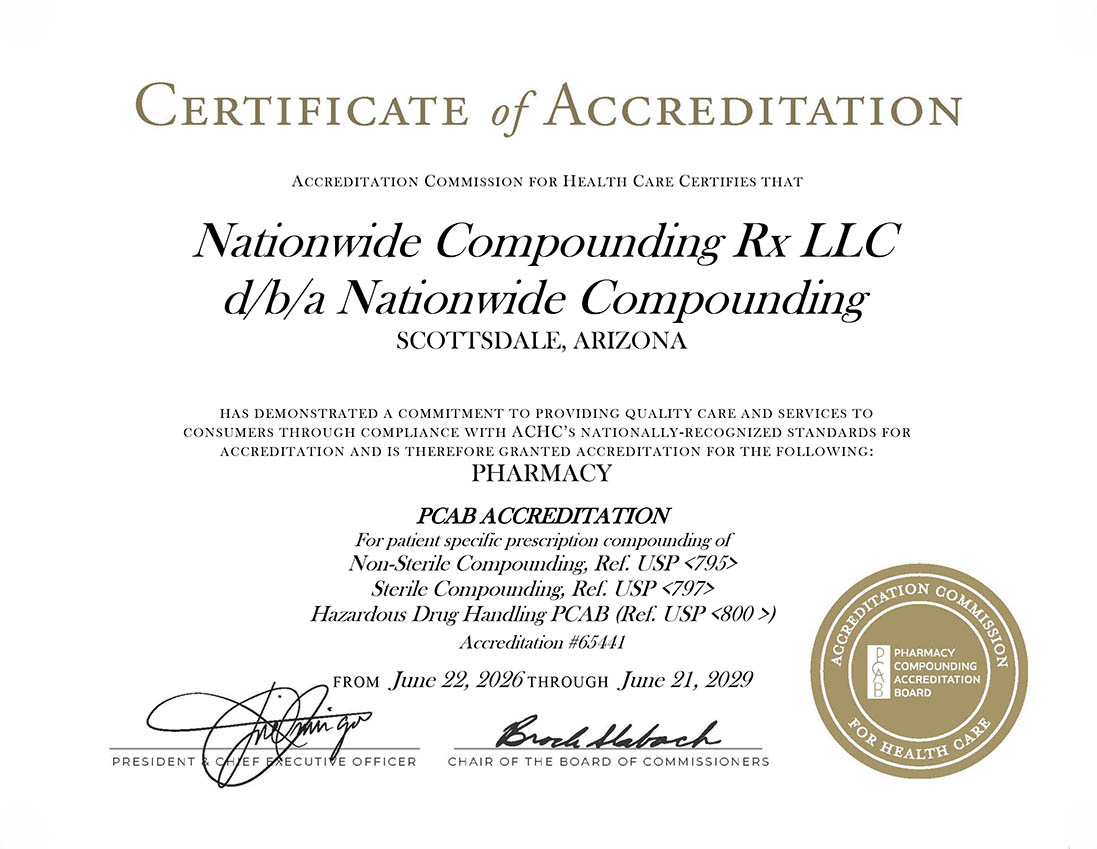
The Pharmacy Compounding Accreditation Board (PCAB), now administered by the Accreditation Commission for Health Care (ACHC), offers a voluntary, third-party accreditation. Neither federal law nor Texas licensure requires it.
That voluntary status is exactly what makes it meaningful. Of roughly 3,000 compounding pharmacies in the United States, fewer than 200 (under 1%) hold PCAB accreditation.
PCAB accreditation reflects independent audits of sterile and non-sterile processes, equipment, staff training, and quality systems that go beyond minimum state licensing. A pharmacy that earns it has invited outside scrutiny rather than relying solely on routine state inspections.
Patients should ask any Austin pharmacy directly whether it is PCAB-accredited, then verify the answer through ACHC rather than assuming.
TSBP Licensing Classes: What Class A, B, C, and E Actually Mean
The Texas State Board of Pharmacy is the primary regulator of 503A compounding pharmacies statewide. Texas is one of the most active compounding states in the country: as of July 2025, 891 Class A, B, C, and E pharmacies in Texas perform sterile compounding, according to TSBP licensing data.
In plain language, the classes break down as follows:
- Class A: Community or retail pharmacies, the type most patients visit.
- Class B: Nuclear pharmacies that prepare radioactive drugs.
- Class C: Institutional pharmacies, typically within hospitals or other healthcare facilities.
- Class E: Nonresident pharmacies located outside Texas that ship medications to Texas patients.
Pharmacies that perform sterile compounding carry an additional designation tied to their class. Patients can confirm a pharmacy’s license class and current status through the TSBP’s public license verification tool, a step that takes only a few minutes.
USP 795 and 797 Compliance: The Operational Backbone of Safe Compounding
United States Pharmacopeia (USP) General Chapter 795 sets standards for non-sterile compounding, such as capsules, creams, and oral liquids. General Chapter 797 covers sterile compounding, such as injectables. Texas rules require pharmacies to follow both.
TSBP §291.133 governs sterile compounding specifically, and a March 1, 2026 sterile compounding rule update further tightened requirements statewide, as published in the Texas Register.
For consumers, these standards are not abstract. They govern cleanroom conditions, beyond-use dating (how long a preparation remains safe to use), testing protocols, and contamination controls. Each of these directly affects patient safety.
Despite their importance, most local pharmacy websites describe services in detail but rarely disclose USP compliance status or recent inspection history.
The 503A Framework: Understanding Patient-Specific Compounding
Section 503A of the Federal Food, Drug, and Cosmetic Act requires that compounding be based on a valid, patient-specific prescription. Oversight of 503A pharmacies falls primarily to state boards such as the TSBP rather than the FDA.
By contrast, 503B outsourcing facilities compound in bulk without individual prescriptions and face direct FDA oversight under current Good Manufacturing Practice (cGMP) standards.
Nearly all Austin retail compounding pharmacies, including those named above, operate as 503A pharmacies. Patients benefit from understanding both the protections this framework offers (a prescriber and pharmacist tailoring a medication to one person) and its limits (no FDA pre-approval of the final preparation).
Where Local Austin Pharmacies Fall Short, Even the Good Ones
Reputable local pharmacies can and do provide excellent, compliant care. Still, certain structural limitations exist regardless of quality. Three gaps come up repeatedly for Austin patients.
The Relocation Problem: What Happens When Patients Move
Pharmacies that ship across state lines must hold a separate nonresident permit in every state they serve. As a result, even local pharmacies that advertise shipping often cover only a handful of states, such as Texas, Oklahoma, Arkansas, Louisiana, and Florida.
Consider a common scenario. An Austin patient has spent months stabilizing on a compounded regimen, perhaps BHRT, a topical pain formulation, or a child’s custom-dosed liquid. A job transfer moves the family to Colorado or Pennsylvania. Their trusted pharmacy cannot legally ship there, and the patient must find a new pharmacy, sometimes a new prescriber, and potentially restart the titration process.
A pharmacy’s licensing footprint is therefore a practical continuity issue, not just a convenience feature.
Allergen-Free Pediatric and BHRT Formulation Depth
Pediatric dosing and hormone therapy are among the fastest-growing compounding specialties nationally. Industry research cites hormone replacement therapy as the fastest-growing therapeutic application segment through 2031.
Families increasingly seek dye-free, preservative-free, and allergen-free formulations in kid-friendly flavors and forms, including flavored liquids, troches, popsicles, and suckers. Formulation breadth in these areas varies widely between local pharmacies.
BHRT presents its own demands. Formulas that are adjusted from refill to refill based on lab results require consistent, high-capability compounding infrastructure. Not every local shop advertises this capability clearly.
The GLP-1 Transparency Gap
None of the Austin-specific pharmacy websites reviewed for this article address the 2025 and 2026 GLP-1 regulatory shifts in any meaningful detail. Given how significant those enforcement changes have been, that silence represents a real trust gap for patients trying to make informed decisions.
The 2025-2026 GLP-1 Compounding Crackdown: What Austin Patients Need to Know
The legal landscape for compounded weight-loss medications has changed dramatically:
- December 2024: Tirzepatide was removed from the FDA drug shortage list.
- February 21, 2025: Semaglutide followed, ending the shortage-based exemption that had allowed broad 503A compounding of these drugs.
- April 22, 2025: FDA enforcement discretion ended for 503A pharmacies.
- May 22, 2025: Enforcement discretion ended for 503B outsourcing facilities.
- February 6, 2026: The FDA announced intended enforcement against mass-marketed, non-FDA-approved compounded GLP-1 products and misleading marketing claims.
- April 30, 2026: The FDA proposed permanently excluding semaglutide, tirzepatide, and liraglutide from the 503B Bulks List.
Safety scrutiny continues as well. As of May 31, 2026, the FDA reported 990 adverse-event reports associated with compounded semaglutide and more than 730 associated with compounded tirzepatide.
For Austin patients currently using or considering compounded GLP-1 medications, the implications are clear. Pharmacies compounding outside narrow legal exceptions face increased legal risk, and patients face uncertainty about product consistency and supply. Patients should ask any pharmacy directly how it is complying with current rules. This is precisely the kind of regulatory detail missing from local Austin pharmacy marketing pages.
A Practical Checklist: How to Vet Any Compounding Pharmacy in 2026
Whether evaluating a pharmacy in Austin or one that ships nationwide, patients can use these six questions:
- Is the pharmacy PCAB-accredited? Verify through ACHC.
- What TSBP or home-state license class does it hold, and is the license current?
- Does it disclose USP 795 and 797 compliance status?
- Does it operate strictly under 503A patient-specific prescriptions?
- How does it handle GLP-1 compounding following the 2025 shortage delisting?
- Which states can it legally ship to if the patient relocates?
Asking these questions takes minutes but reveals more about safety than years of local reputation alone.
Due diligence matters more as the field expands. IBISWorld values the U.S. compounding pharmacy industry at roughly $20.2 billion in 2026, growing at a 5.3% compound annual rate over the past five years. Rapid growth attracts both high-quality operators and those cutting corners.
How Nationwide Compounding Rx® Fills the Gaps Local Pharmacies Leave Open
Nationwide Compounding Rx®, based in Scottsdale, Arizona, was built around the credentials outlined in the framework above.
Accreditation and compliance. The pharmacy is PCAB-accredited, placing it in the under-1% tier of U.S. compounding pharmacies, and is USP 800 compliant, the standard governing safe handling of hazardous drugs.
Coverage continuity. Nationwide Compounding Rx® operates under a multi-tier state licensing system, with states categorized as fully licensed, non-sterile only (with sterile pending), or sterile/non-sterile pending or unlicensed; shipping availability can vary by medication type and state regulations. For Austin patients who may relocate, this broad licensing footprint directly addresses the continuity problem that regional pharmacies cannot solve.
Specialty depth. The pharmacy produces both sterile and non-sterile preparations, including:
- Allergen-free pediatric formulations free of dyes, fillers, and preservatives, available as flavored liquids, popsicles, suckers, and troches in flavors such as cherry, bubblegum, and tutti frutti
- BHRT formulas that are adjustable at each refill based on updated lab results
- Pain management topicals, dermatology preparations, and sports medicine formulations
- Recreations of discontinued or commercially unavailable strengths
This work is backed by 40+ years of combined team experience.
Operational transparency. Nationwide Compounding Rx® offers a 1 to 2 business day turnaround, same-day pickup for some medications at its Scottsdale location, independent third-party testing, and high-grade chemicals sourced from FDA-inspected and cleared vendors.
GLP-1 and peptide support. The pharmacy offers GLP-1 and peptide support and is direct with patients about the current regulatory landscape, including TSBP oversight, the 503A and 503B distinction, and the GLP-1 enforcement timeline. That openness stands in contrast to the silence of local competitor sites on this exact topic.
Provider and patient portals. A secure Provider Portal lets prescribers submit and manage prescriptions, track orders, and communicate with the pharmacy team. A Patient Portal gives patients access to account information and refill requests. Both support the company’s Connect, Collaborate, Create, Care framework, which is useful for Austin providers seeking a vetted compounding partner for their patients.
Conclusion: Credentials, Not Just Community, Should Drive the Decision
Austin’s compounding market is dense and locally trusted, and many of its pharmacies serve their communities well. Trust, however, should rest on verifiable credentials: PCAB accreditation, TSBP license class, USP 795 and 797 compliance, and 503A status. Years in business alone are not enough.
The 2025 and 2026 GLP-1 enforcement changes make regulatory transparency more urgent than ever. When a pharmacy stays silent on these developments, that silence is itself a signal worth noticing.
Patients can and should apply the credential-based framework whether they stay local or choose a nationwide, PCAB-accredited alternative such as Nationwide Compounding Rx®.
Ready to Evaluate Compounding Pharmacy Options?
Before the next prescription fill, Austin patients can run their current or prospective pharmacy through the six-question checklist above. The answers will clarify far more than a storefront or a long history.
Providers and patients seeking PCAB-accredited compounding with nationwide shipping can explore Nationwide Compounding Rx®’s provider and patient portals. To begin the Connect, Collaborate, Create, Care process for a personalized, accredited compounding solution, contact Nationwide Compounding Rx® at (480) 499-8379 (Monday through Friday, 7:00 AM to 3:30 PM Arizona time) or visit nationwidecompounding.com.
Related Posts

Integrity Rx Specialty Pharmacy has a corporate history most patients never see. This article traces its journey from founder Jeffrey Karp to BelHealth Investment Partners and VFP Pharmacy Group's 2026 ownership structure, explaining what the consolidation means for patients filling fertility prescriptions.

Many searchers land on Sterling Specialty Pharmacy looking for a custom Zepbound dose, allergen-free capsule, or discontinued strength—only to hit a dead end. This guide explains what Sterling Specialty Pharmacy does well, why it can't fill certain clinical needs, and where patients should turn instead in 2026.

Looking for Solutions Specialty Pharmacy in Las Vegas, NV? This 2026 guide covers SSPRX's address, hours, and services, plus how Nevada's updated compounding licensing rules affect your choice of pharmacy. Learn what to verify before filling a prescription locally or out of state.

Columbus patients and providers often need multiple types of compounded medications, but most local pharmacies specialize narrowly. Learn how a single PCAB-accredited, nationwide compounding pharmacy can consolidate every specialty—from hormones to pain management—while staying compliant ahead of the 2026 semaglutide deadline.