Sterling Specialty Pharmacy: When Zepbound Needs a Custom Dose
Introduction: The Search That Leads Nowhere
Most people who search for “Sterling Specialty Pharmacy” want something simple. They need the phone number, the hours, a refill status update, or the line for transferring a prescription. Their insurance plan or a drug manufacturer routed them to Sterling, and they want to get their medication without friction.
A growing subset of searchers arrives with a different problem. They are providers or patients who have learned that Sterling cannot fill a specific clinical need. That need might be a titrated dose of a GLP-1 therapy like Zepbound, an allergen-free capsule, or a strength the manufacturer discontinued. These searchers often end up with no clear answer about where to go next.
This article explains what Sterling Specialty Pharmacy is and what it does well. It then clarifies the structural reason it cannot solve certain clinical problems and identifies where patients should turn instead. The core contrast is simple: specialty pharmacy is built around the drug; compounding pharmacy is built around the patient.
What Sterling Specialty Pharmacy Actually Is
For navigational searchers, here are the essential details:
- Headquarters: 1312 Northland Dr, Suite 500, Mendota Heights, MN 55120 (additional suite at 1408 Northland Dr, Ste 204)
- Main phone line: 888-618-4126
- Websites: sterlingspecialtyrx.com and sterlingspecialtycare.com
- Hours: Monday through Friday, 7:30 a.m. to 5:30 p.m., closed weekends (per Healthgrades)
- Listed services: Compounding, Delivery, Handicapped Accessible, Medicaid, Medicare
Company snapshot: Business data lists Ty Heuer as President, with roughly $5.3 million in revenue, 11 to 50 employees, and a founding year of 2018. Sterling is a member of the Astrup Companies family, which describes a heritage of personalized patient care spanning more than six decades.
Sterling describes itself as a national network specialty pharmacy for medication fulfillment. Its parent pharmacy network serves more than a dozen communities across southern Minnesota and northern Iowa. As an independent specialty pharmacy, Sterling positions itself around a personalized approach to patient outcomes. It focuses on connecting patients, providers, and manufacturers, reducing provider time spent on prior authorization paperwork, and removing barriers to prescription fulfillment.
Patient feedback suggests Sterling performs this core function well. One Yelp reviewer reported no problems with service or prescriptions, noting that Sterling sends a text when a refill is ready and again when it ships, and that staff have been courteous and helpful on calls. For a fulfillment-focused specialty pharmacy, that is exactly the experience patients should expect.
Specialty Pharmacy vs. Compounding Pharmacy: Two Different Models
The confusion many patients run into stems from one foundational fact: specialty pharmacies dispense FDA-approved, commercially manufactured medications exactly as they are made. They do not alter doses, remove allergens, or create custom dosage forms.
Sterling’s own patient materials define the category clearly. Specialty pharmacy focuses on high-cost, complex medications that require high-touch therapy management. Nothing in that definition involves customization. The “personalized” element refers to service, support, and access, not to the medication itself.
The industry reinforces this boundary. The specialty pharmacy trade association SPAARx, as reported by Chain Drug Review, has stated that specialty pharmacy and the art and science of extemporaneous compounding are dissimilar. Specialty pharmacies dispense FDA-approved, commercially available medications that require patient-specific prescriptions. Compounding is a separate discipline, not a more advanced point on the same spectrum.
The accreditation tracks make the difference even clearer:
| Specialty Pharmacy | Compounding Pharmacy | |
|---|---|---|
| Primary accreditors | URAC, ACHC, CPPA, The Joint Commission | PCAB (Pharmacy Compounding Accreditation Board) |
| What accreditation governs | Fulfillment, therapy management, patient support | Formulation quality, preparation, testing |
| Benchmark | URAC is the gold standard, preferred by two-thirds of payers, with about 465 accredited organizations reporting data | PCAB held by fewer than 1% of U.S. compounding pharmacies |
A URAC-accredited specialty pharmacy and a PCAB-accredited compounding pharmacy are each excellent at something different. Neither credential substitutes for the other.
The Zepbound Scenario: Where Sterling’s Model Reaches Its Limit
Consider a common real-world situation. A patient has been stable on Zepbound, dispensed reliably through Sterling. Over time, the prescriber identifies a clinical need the commercial product does not address: the patient may need a dose between the manufacturer’s available strengths, react to an inactive ingredient, or require a slower titration schedule than the commercial pens allow.
At this point, a limited-distribution specialty model has nowhere to go. Sterling can only dispense the strengths and formulations the manufacturer produces. It cannot adjust the product, and asking it to do so is like asking a car dealership to rebuild an engine. The request falls outside what the business is designed to do.
This is not a failure of service. It is a structural limit. The patient does not need a better specialty pharmacy. The patient needs a prescriber-led conversation about whether a compounded preparation is clinically appropriate, and a pharmacy legally and technically equipped to prepare one. Federal and state rules on compounding GLP-1 medications are specific and continue to evolve, so this path depends on a documented, patient-specific clinical need determined by the prescriber.
The Drug List That Confirms the Model
Prescriberpoint listings show Sterling fills named specialty and biologic drugs, including:
- Otezla (apremilast), used for psoriasis and psoriatic arthritis
- Zepbound (tirzepatide), a GLP-1/GIP therapy for chronic weight management
- Myalept (metreleptin), a rare-disease therapy for leptin deficiency
This list confirms the model. Sterling operates as a limited-distribution, specialty dispensing channel for manufacturer-direct biologic and GLP-1 therapies. It is not a compounder of individualized formulations.
The broader market explains why. The global specialty pharmacy market was valued at $312.4 billion in 2025 and is projected to reach $698.7 billion by 2034, growing at roughly 9.3% annually. This is a high-volume, insurance-driven ecosystem built on prior authorizations, payer contracts, and manufacturer relationships. It is optimized for dispensing efficiency at scale, not for per-patient formulation changes.
What a PCAB-Accredited Compounding Pharmacy Does Differently
A 503A compounding pharmacy prepares non-sterile and sterile medications tailored to an individual patient’s prescription. Rather than dispensing a product exactly as a manufacturer made it, a 503A pharmacy creates a preparation based on what the prescriber determines a specific patient needs.
The regulatory backbone for this work is the United States Pharmacopeia (USP) compounding standards:
- USP <795> governs non-sterile compounding
- USP <797> governs sterile compounding
- USP <800> governs the safe handling of hazardous drugs
These revised standards became officially enforceable on November 1, 2023. They dictate how legitimate compounding pharmacies must prepare, test, and handle medications. Standard specialty pharmacies are not built around this framework because they do not compound.
In plain terms: if a patient needs a strength that does not exist commercially, or a dosage form the patient can tolerate, specialty pharmacy cannot help. A compounding pharmacy can.
Not every “compounding” label carries the same weight. Directory sites like Healthgrades list a compounding tag for Sterling, but such tags can reflect basic capabilities and do not indicate full-service, accredited compounding. PCAB accreditation, held by fewer than 1% of U.S. compounding pharmacies, is a far more reliable signal of formulation expertise.
Nationwide Compounding Rx®: Built for the Scenarios Sterling’s Model Can’t Solve
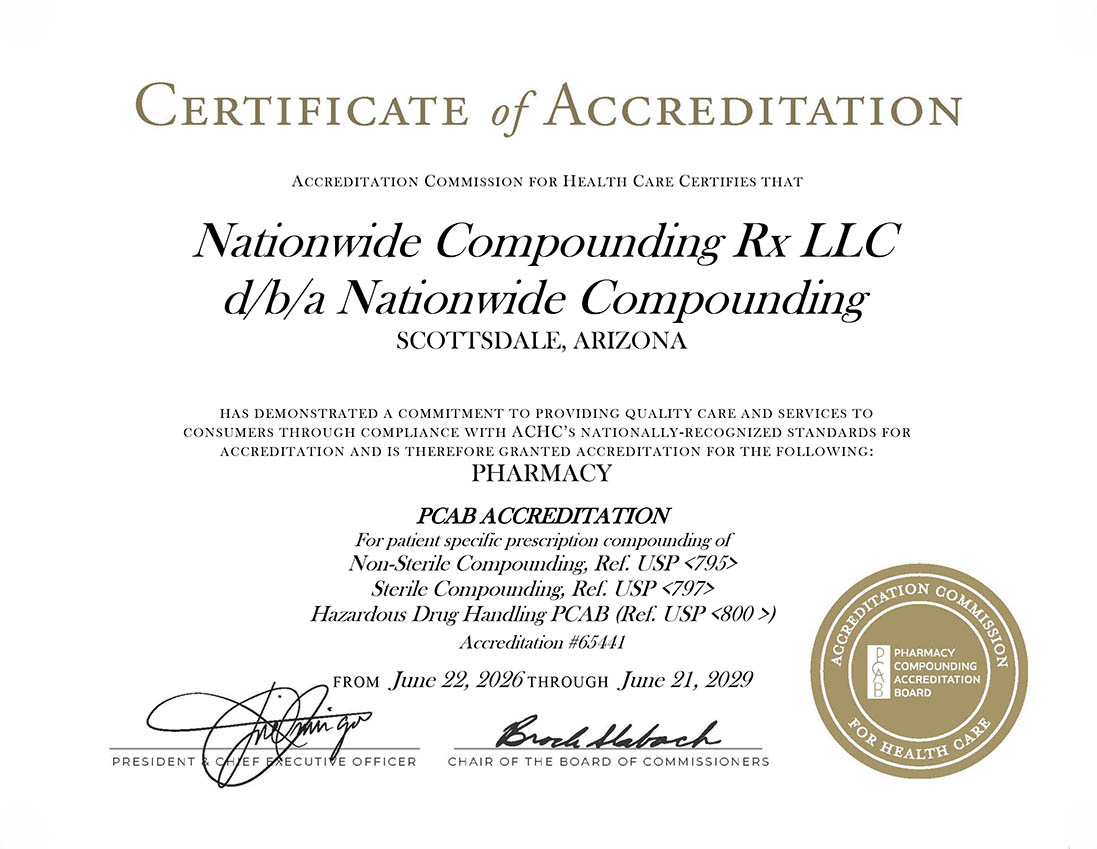
Nationwide Compounding Rx® is the structural counterpart to a specialty pharmacy like Sterling. Based in Scottsdale, Arizona, it is a 503A, PCAB-accredited, USP 800-compliant compounding pharmacy built around the patient rather than the drug.
Key capabilities include:
- PCAB accreditation (Pharmacy Compounding Accreditation Board)
- USP 800 compliance for the safe handling of hazardous drugs
- Sterile and non-sterile formulations, including GLP-1/peptide support, BHRT, pain management, dermatology, pediatrics, and sports medicine
- Custom strengths and dosage forms, including capsules, liquids, topicals, troches, sublingual tablets, and suppositories
- Allergen-free preparations free of dyes, fillers, and preservatives
- Recreation of discontinued or unavailable strengths
- Independent third-party testing and high-grade chemicals sourced from FDA-inspected and cleared vendors
- 1 to 2 business day turnaround, with same-day pickup available for some medications
- Nationwide shipping, with availability depending on medication type and state regulations
The pharmacy works through a structured provider partnership process: Connect, Collaborate, Create, Care. Dedicated, secure Provider and Patient Portals streamline prescription submission, order tracking, and refill management. This relationship-driven approach suits situations where a prescriber needs to fine-tune a formulation over time.
How to Know Which Pharmacy Fits Your Situation
A simple framework helps patients and providers choose:
Choose a specialty pharmacy like Sterling when:
- You need a commercially manufactured biologic or GLP-1 therapy dispensed exactly as made
- You need help with prior authorizations, insurance coordination, and reliable shipping
Choose a PCAB-accredited compounding pharmacy when:
- You need a dose that does not exist commercially
- You need an allergen-free or dye-free version
- You need a discontinued strength recreated
- Your prescriber has documented a clinical need for a compounded alternative, including during a shortage
One question clarifies almost every situation: “Is this pharmacy dispensing a manufactured product, or compounding a custom formulation?” The answer reveals which model applies.
Providers managing both specialty and compounded therapies may need relationships with both pharmacy types at the same time. The two serve complementary, non-overlapping functions, and patients benefit when each does what it was built to do.
Conclusion: Two Pharmacies, Two Purposes
Sterling Specialty Pharmacy excels at what it is built for: high-touch fulfillment of FDA-approved specialty and biologic drugs like Zepbound, Otezla, and Myalept through a national network. Patients routed there can expect reliable notifications, courteous support, and help navigating insurance.
When a patient’s clinical need falls outside what a commercially manufactured product can provide, the solution is not a better specialty pharmacy. It is a different kind of pharmacy entirely. Understanding this structural difference empowers patients and providers to get the right medication, in the right form, without unnecessary delay.
Partner With a Compounding Pharmacy Built Around You
If a GLP-1, peptide, or specialty therapy needs a custom dose, an allergen-free formulation, or an alternative to a discontinued strength, Nationwide Compounding Rx® is equipped to help.
Next step: Call (480) 499-8379 or visit nationwidecompounding.com to discuss provider or patient portal access. The team is available Monday through Friday, 7:00 a.m. to 3:30 p.m., and responds to email inquiries within one business day.
The credentials matter. PCAB accreditation, USP 800 compliance, and GLP-1/peptide formulation expertise represent the exact profile needed when a specialty pharmacy’s limited-distribution model reaches its limit.
Related Posts

Austin's compounding pharmacy market is crowded with long-standing local names, but proximity and reputation don't guarantee quality or safety. This guide breaks down the regulatory credentials—PCAB accreditation, TSBP licensing, USP compliance, and 503A status—that truly set an Austin compounding pharmacy apart.

Integrity Rx Specialty Pharmacy has a corporate history most patients never see. This article traces its journey from founder Jeffrey Karp to BelHealth Investment Partners and VFP Pharmacy Group's 2026 ownership structure, explaining what the consolidation means for patients filling fertility prescriptions.

Looking for Solutions Specialty Pharmacy in Las Vegas, NV? This 2026 guide covers SSPRX's address, hours, and services, plus how Nevada's updated compounding licensing rules affect your choice of pharmacy. Learn what to verify before filling a prescription locally or out of state.

Columbus patients and providers often need multiple types of compounded medications, but most local pharmacies specialize narrowly. Learn how a single PCAB-accredited, nationwide compounding pharmacy can consolidate every specialty—from hormones to pain management—while staying compliant ahead of the 2026 semaglutide deadline.