
Bioidentical Hormone Replacement Therapy Virginia: 2026 License Guide
Introduction: The Question Most Virginia BHRT Pages Never Answer
Search for bioidentical hormone replacement therapy in Virginia, and a predictable pattern emerges. Most results offer a short definition, a list of hormone forms such as creams and troches, and a prominent phone number. Very few address the question that matters most to a patient holding a prescription: can an out-of-state compounding pharmacy legally ship bioidentical hormones to a Virginia address, and how can that be verified?
The answer rests on a specific statute, Code of Virginia §54.1-3434.2, which governs Nonresident Pharmacy Registration. That registration, not marketing claims about being “bioidentical,” “natural,” or “nationwide,” determines whether a pharmacy is authorized to deliver prescription drugs to Virginia residents.
The timing of this question also matters. In 2026, the FDA removed boxed warnings from several FDA-approved menopausal hormone products, reshaping the commercial landscape. Those changes did not alter the rules governing compounded BHRT, and the distinction is easy to miss.
This guide is designed to help Virginia patients and referring providers evaluate three things before choosing a pharmacy: legal authority to ship, quality credentials, and clinical appropriateness.
What Is Bioidentical Hormone Replacement Therapy?
“Bioidentical” refers to hormones that are chemically and molecularly identical to those the human body produces, such as estradiol, progesterone, and testosterone. The term describes molecular structure, not regulatory status.
This leads to a common misconception: many people assume “bioidentical” means unregulated, or inherently safer than conventional hormone therapy. Neither is accurate. Both FDA-approved products and compounded preparations can be bioidentical.
Patients generally receive bioidentical hormones through one of two pathways:
- FDA-approved commercial products, manufactured at standardized doses and reviewed by the FDA.
- Compounded preparations made by a 503A pharmacy for an individual patient based on a specific prescription.
Demand for the second pathway is substantial. Hormone replacement therapy is the largest and fastest-growing compounding therapeutic segment, holding roughly a 33.9% share of the therapeutic area in 2026, with projected growth of 7.86% annually through 2031. At that scale, the legal and safety distinctions between pathways carry real consequences.
FDA-Approved vs. Compounded Bioidentical Hormones
Only 13 FDA-approved bioidentical hormone products are available in the United States. That formulary is limited in dosing strengths, hormone ratios, and delivery methods. A patient who needs an intermediate dose, a specific estrogen-to-progesterone combination, or a non-oral format may find no commercial option that fits.
This constrained menu is the primary clinical justification prescribers and compounding pharmacies cite for custom formulations. Common compounded dosage forms include:
- Creams and gels
- Troches and lozenges
- Capsules
- Sublingual tablets
- Suppositories
- Pellets
One point deserves emphasis: compounded products are never FDA-approved. A pharmacy’s 503A status reflects state board oversight and compliance with USP standards. It does not mean the FDA has reviewed or approved the specific formulation a patient receives.
The 2026 FDA Boxed-Warning Removals: What Changed and What Didn’t
In 2026, the FDA removed boxed warnings related to cardiovascular disease, breast cancer, and probable dementia from select menopausal hormone therapy products. These warnings had been in place for more than two decades and were the agency’s strongest safety measure short of market withdrawal.
The changes occurred in two phases:
- February 12, 2026: Boxed warnings were removed from six products: Prometrium, Divigel, Cenestin, Enjuvia, Estring, and Bijuva. These span progestogen-only, systemic estrogen-only, topical vaginal estrogen, and combined estrogen-progestogen therapies.
- October 30, 2026: Three additional estradiol patch products received the same labeling update.
The removal was not universal. The endometrial cancer boxed warning remains for unopposed systemic estrogen in women who have a uterus, since estrogen without a progestogen can stimulate the uterine lining.
These updates followed an FDA initiative launched in November 2025 to reassess the blanket warnings applied to estrogen-containing menopause treatments, as summarized in reporting from JAMA and the U.S. Department of Health and Human Services.
Why This Does Not Change the Rules for Compounded BHRT
The 2026 label changes apply only to the specific FDA-approved products named. They do not extend to compounded creams, troches, or pellets.
Compounded BHRT sits outside the FDA drug-approval process entirely. Because these preparations never carried FDA labeling, there was no warning to remove. Oversight for compounded hormones comes instead from state boards of pharmacy and USP compounding standards.
Patients should be cautious about assuming that eased warnings on FDA-approved products signal a parallel safety upgrade for compounded alternatives. The evidence reviewed by the FDA concerned specific approved products with known, consistent formulations. Choosing between an FDA-approved product and a compounded preparation remains a clinical decision best made with a prescriber, not a conclusion drawn from regulatory headlines.
The Legal Mechanism: Virginia’s Nonresident Pharmacy Registration
This is the regulatory piece most Virginia BHRT pages omit. The controlling law is Code of Virginia §54.1-3434.2 and the related provisions in Article 2.1 of Chapter 34, which govern the registration of nonresident pharmacies.
At the federal level, compounded BHRT is legal in all 50 states when prepared by a state-licensed 503A pharmacy under a valid, patient-specific prescription. Federal permission, however, does not override state shipping rules. A pharmacy licensed in Arizona, Florida, or Texas still needs Virginia’s authorization before it can deliver medications to a Virginia resident.
Who Must Register and Who Is Exempt
According to the Virginia Board of Pharmacy, any out-of-state pharmacy that ships, mails, or otherwise delivers prescription drugs to Virginia residents must register as a Nonresident Pharmacy.
The exemption is narrow. Pharmacies that dispense only in person to Virginia residents who walk into their out-of-state location are not subject to this registration requirement.
This distinction explains why a compounding pharmacy that ships BHRT nationwide must hold this specific Virginia registration. A home-state license alone is not sufficient.
Core Requirements for Nonresident Pharmacy Registration
To register and remain registered, a nonresident pharmacy must meet several requirements:
- A current, unrestricted pharmacy license in its home jurisdiction within the United States.
- A Virginia-licensed Pharmacist-in-Charge (PIC), or an attestation or waiver permitted in limited circumstances.
- Annual renewal to keep the registration active.
- A qualifying inspection report. Under regulations updated in 2013, pharmacies must submit an inspection report demonstrating compliance with the Virginia Drug Control Act and USP-NF standards for sterile and non-sterile compounding. New registrants need an inspection within the preceding six months; renewals require one within the preceding two years.
The Virginia Board of Pharmacy accepts inspections conducted through the National Association of Boards of Pharmacy (NABP) Verified Pharmacy Program (VPP) as meeting these requirements. VPP participation gives patients and providers a recognizable third-party benchmark.
How to Verify a Pharmacy’s Virginia Registration Status
Before trusting any pharmacy to fill a BHRT prescription, patients and providers can follow a straightforward verification process:
- Ask the pharmacy directly for its Virginia Nonresident Pharmacy Registration number.
- Use the license lookup offered by the Virginia Department of Health Professions (DHP), which houses the Board of Pharmacy, and search by the pharmacy’s name or registration number.
- Confirm the registration type. The record should identify the business as a nonresident pharmacy.
- Check the status. An active registration is required. Expired or lapsed status means the pharmacy should not be shipping into Virginia.
- Review compounding authorization. The Board’s Nonresident Pharmacy Attestation Form asks separately whether a pharmacy compounds sterile and non-sterile products. Patients who need sterile preparations, such as injectable hormones, should confirm that sterile compounding is covered.
Independent verification is more reliable than any marketing claim, including claims of “nationwide shipping.”
Red Flags: Signs a Pharmacy May Not Be Legally Compliant
Certain warning signs suggest a pharmacy may not meet Virginia’s requirements:
- Vague or missing licensing information on its website.
- Inability or refusal to provide a Virginia registration number when asked.
- No identifiable Pharmacist-in-Charge or unclear accreditation claims.
- Heavy use of “natural” or “bioidentical” language without reference to regulatory status, PCAB accreditation, or USP compliance.
Clinical Evidence and Professional Guidance on Compounded BHRT
A responsible evaluation of compounded BHRT includes what major medical organizations have concluded. Their positions are more cautious than most marketing pages suggest.
The 2020 NASEM Report
The National Academies of Sciences, Engineering, and Medicine (NASEM) produced a report commissioned by the FDA. It concluded there was insufficient high-quality evidence to support routine or widespread use of compounded bioidentical hormone therapy (cBHT). The committee recommended restricting compounded use to patients with a documented allergy to an ingredient in an approved product, or a clinical need for a dosage form or strength that is not commercially available.
ACOG and Endocrine Society Positions
The American College of Obstetricians and Gynecologists (ACOG) stated in its 2023 Clinical Consensus that compounded bioidentical menopausal hormone therapy should not be prescribed routinely when FDA-approved formulations exist.
The Endocrine Society’s 2017 Scientific Statement found no scientific basis for choosing compounded hormones over FDA-approved options, citing concerns about dosing variability and contamination risk.
These positions are presented here without softening. Compounding is not a superior default; it is a tool with specific, appropriate uses.
When Compounded BHRT Is Clinically Justified
Within the framework set by these organizations, compounding is generally considered appropriate when a patient has:
- A documented allergy to an excipient, dye, filler, or preservative found in commercial products.
- A need for a dosage form, strength, or hormone ratio unavailable among the 13 FDA-approved products.
- Difficulty swallowing pills, requiring alternatives such as troches, sublingual tablets, or topical preparations.
The broader need is significant. Of roughly 41 million U.S. women aged 45 to 64 in 2020, only about 2 million received a hormone therapy prescription. That gap reflects unmet need relevant to both FDA-approved and compounded pathways.
Why Pharmacy Credentials Matter: PCAB Accreditation and USP <800> Compliance
Virginia registration confirms a pharmacy’s legal authority to ship. It does not, by itself, certify quality. Independent credentials and adherence to USP standards help fill that gap.
PCAB Accreditation Explained
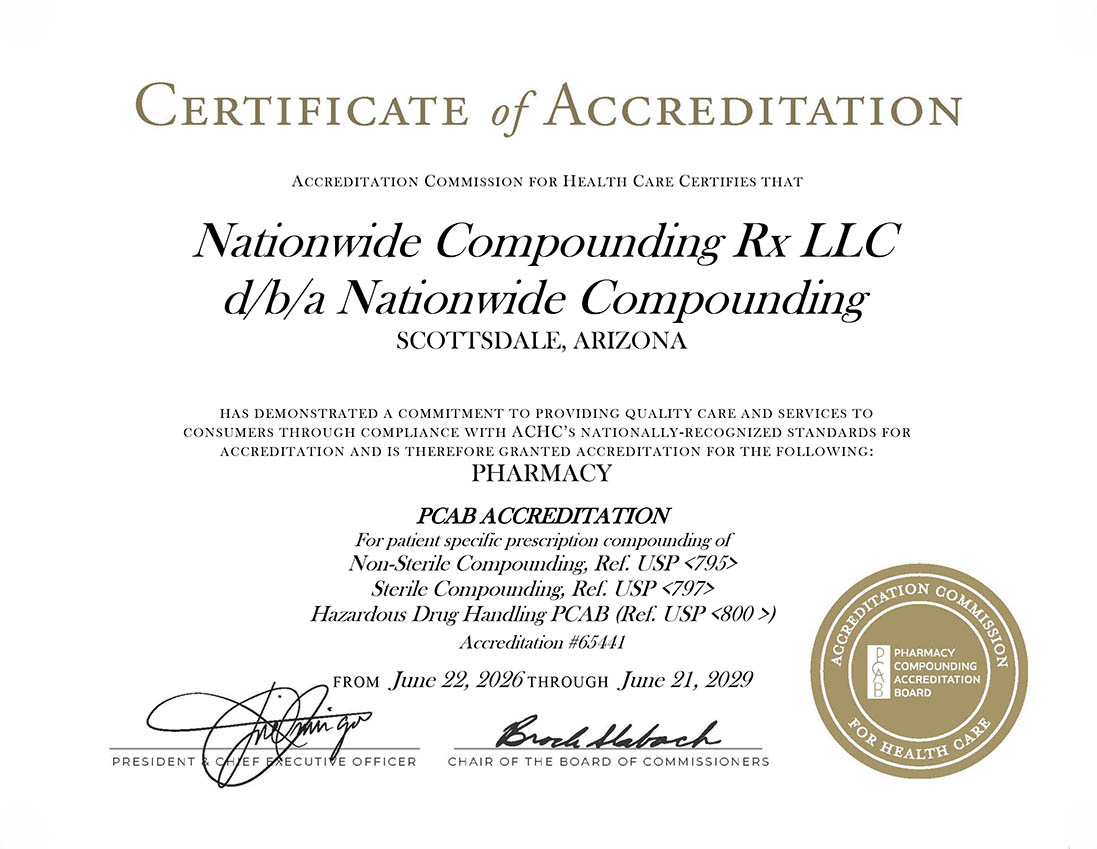
The Pharmacy Compounding Accreditation Board (PCAB) offers a voluntary, third-party accreditation administered through ACHC. No federal law or state board requires it, which is precisely why it carries weight: pharmacies choose to undergo the additional scrutiny.
PCAB accreditation is widely regarded as the strongest non-FDA quality signal available for a 503A compounding pharmacy. It evaluates standardized compounding processes, quality control systems, facility standards, and staff training and competency.
USP <795>, <797>, and <800> Standards
The United States Pharmacopeia sets the core compounding standards:
- USP <795> governs non-sterile compounding, such as creams, capsules, and troches.
- USP <797> governs sterile compounding, such as injectables.
- USP <800> addresses the safe handling of hazardous drugs.
USP <800> compliance is relevant to BHRT because certain hormones are classified as hazardous drugs requiring containment, protective equipment, and handling procedures that protect both pharmacy staff and patients. These standards also connect directly to Virginia’s registration process, since the required inspection report must demonstrate compliance with USP-NF sterile and non-sterile compounding standards.
503A vs. 503B: Clarifying a Commonly Confused Distinction
- 503A pharmacies compound patient-specific prescriptions under state board oversight. This is the category relevant to individualized BHRT.
- 503B outsourcing facilities compound larger batches under direct FDA oversight, typically for office use rather than individual prescriptions.
Neither designation means the FDA has approved the compounded medication itself. Both describe how the facility is regulated, not the approval status of the product.
Nationwide Compounding Rx: A Registered, Credentialed Option for Virginia Patients
Nationwide Compounding Rx®, based in Scottsdale, Arizona, aims to differentiate itself through regulatory transparency rather than marketing language, aligning with the criteria outlined above.
The pharmacy is PCAB accredited and USP <800> compliant, the baseline credentials patients should verify with any compounding pharmacy. Its state shipping map uses a three-tier system: fully licensed states, states where non-sterile compounding is available with sterile pending, and states that are pending or unlicensed. Virginia patients are encouraged to confirm the pharmacy’s current Virginia Nonresident Pharmacy Registration status directly through the DHP lookup before transferring a prescription.
For BHRT, the pharmacy prepares creams, troches, capsules, sublingual tablets, and suppositories. Formulas can be adjusted at each refill based on updated lab results, a dynamic-dosing approach that fixed-dose commercial products cannot replicate.
Quality practices include sourcing high-grade chemicals from FDA-inspected and cleared vendors, independent third-party testing, and a one- to two-business-day turnaround. The team brings more than 40 years of combined experience.
Rather than operating as a transactional dispensary, the pharmacy follows a provider partnership model: Connect, Collaborate, Create, Care. This framework supports physicians, clinics, and wellness practices in developing formulations suited to each patient.
What Virginia Patients Still Need: A Valid Prescription
Compounded BHRT, like any prescription medication, requires a bona fide prescriber-patient relationship and a valid, patient-specific prescription consistent with §54.1-3303. Nationwide Compounding Rx fills prescriptions; it does not diagnose conditions or prescribe treatment. Patients still need an appropriately licensed and authorized prescriber.
Cost planning matters as well. FDA-approved bioidentical hormones are often covered by insurance, while compounded BHRT typically is not. State-level coverage-parity rules are evolving, but patients should budget accordingly.
Conclusion: Verify Before You Trust
For Virginia residents, the legality of receiving shipped BHRT depends on a pharmacy’s Nonresident Pharmacy Registration under §54.1-3434.2, not on claims of being “bioidentical” or “nationwide.”
Compounded BHRT remains a clinically justified option primarily for patients with documented allergies or needs for unavailable dosage forms and strengths, consistent with guidance from NASEM, ACOG, and the Endocrine Society. The 2026 FDA boxed-warning removals represent meaningful progress for FDA-approved menopausal hormone therapy, but they do not extend to or validate compounded alternatives.
The verification steps in this guide (DHP lookup, a registration number request, and confirmation of PCAB and USP compliance) apply to every pharmacy under consideration, including Nationwide Compounding Rx.
Next Steps: Connect With a Credentialed Compounding Pharmacy
Virginia patients with a valid prescription can use the Patient Portal to submit prescriptions, access account information, and manage refills.
Referring providers, including physicians, clinics, and wellness practices, can explore the Provider Portal to submit and track prescriptions and begin the Connect, Collaborate, Create, Care partnership process.
Contact Nationwide Compounding Rx®:
- Phone: (480) 499-8379
- Website: nationwidecompounding.com
- Hours: Monday to Friday, 7:00 AM to 3:30 PM
Before transferring a prescription, patients are encouraged to independently verify Nationwide Compounding Rx’s current Virginia Nonresident Pharmacy Registration status. Transparency should be confirmed, not assumed.
Related Posts

Partell Specialty Pharmacy officially became National Health Rx in late 2025 after Nevada regulators flagged it as a 'distressed' pharmacy requiring monthly inspections. This 2026 guide breaks down the name change, Partell's FDA warning-letter history, and what current patients need to know before filling their next prescription.

Can't access your account? This 2026 guide breaks down why CVS specialty pharmacy log in issues happen and how to fix them fast. Learn the difference between CVS Specialty, Caremark, and CVS.com logins, plus which support line to call for each problem.

Houston's compounding pharmacy market is booming, but 2026 recalls and a decade of FDA warning letters have exposed a critical credential gap. Discover why PCAB accreditation matters more than size or reputation, and get a practical framework for vetting any compounding pharmacy in Houston TX.

Patients searching for a compounding pharmacy in Asheville need clarity on GLP-1 rules in 2026. This guide breaks down North Carolina's regulations on compounded semaglutide and tirzepatide, plus how to verify a legitimate pharmacy before filling a prescription.