Compounding Pharmacy in Houston TX: The PCAB Credential Gap in 2026
Introduction: Houston’s Compounding Boom Meets a Trust Reckoning
Texas is one of the most active compounding markets in the United States. According to Texas State Board of Pharmacy (TSBP) licensing data, 891 Class A, B, C, and E pharmacies in the state performed sterile compounding as of July 2025. Texas also hosts 13 of the roughly 80+ FDA-registered 503B outsourcing facilities nationwide, second only to Florida’s 14, according to Houston Chronicle reporting. Houston sits at the center of that activity.
In 2026, this growth has collided with a trust problem. Several developments have converged to expose a credential gap in the Houston market:
- Two Houston-based pharmacies issued recalls of injectable products.
- The city’s largest compounder has accumulated a decade of FDA warning letters.
- Amendments to the state’s sterile compounding rule, 22 TAC §291.133, took effect on March 1, 2026.
As a result, a search for “compounding pharmacy in Houston TX” increasingly reflects a ‘vet before you buy’ mindset. Size, longevity, and local reputation are not reliable proxies for quality. A verifiable accreditation such as PCAB is a much stronger signal.
This article covers the 2026 incidents, the Empower Pharmacy paradox, what PCAB accreditation actually verifies, the new Texas rule, and the GLP-1 regulatory landscape. It closes with a practical framework readers can use to vet any pharmacy, whether it is local or national.
The 2026 Houston Incidents That Put Compounding Quality Under the Microscope
Two Houston recalls in late summer 2026 brought compounding quality back into public view:
- August 19, 2026: Optimal Balance Pharmacy in Houston recalled compounded glutathione lots because of elevated endotoxin levels.
- September 9, 2026: Centric Compounding in Houston issued a nationwide recall of glutathione, Myers’ Cocktail, and Tri-Immune Boost products, also for elevated endotoxin levels.
Endotoxins are toxic substances released by bacteria. In injectable products, they can cause fever, inflammation, and more serious reactions.
These recalls were not isolated. On August 27, 2026, the FDA issued a broader alert flagging at least 30 adverse events nationally tied to dietary-supplement-grade glutathione used in injectables. Supplement-grade ingredients are not intended for sterile injection. The pattern points to a sourcing and quality-control failure, not a single bad batch.
Houston has seen this before. In 2021, the FDA issued an alert telling veterinarians and animal owners not to use sterile compounded products from Greenpark Compounding Pharmacy in Houston. During inspections in July and August of that year, FDA investigators observed conditions that could cause the compounded drugs to become contaminated.
The lesson is clear. These were Houston-based, locally operating pharmacies. Being nearby and well known in the community did not prevent serious sterility failures.
The Empower Pharmacy Paradox: Why PCAB Accreditation Isn’t a Guarantee by Itself
Empower Pharmacy is headquartered in Houston. It describes itself as the nation’s largest 503A compounding pharmacy and FDA-registered 503B outsourcing facility. The company reports more than 1,500 employees, more than 185,000 square feet of facilities, and PCAB accreditation. It was named to the 2025 Inc. 5000 list of fast-growing companies.
Investigative reporting by the Houston Chronicle, however, documented a decade of FDA warning letters and regulatory violations at the company. That reporting stated that the record raises serious questions about Empower’s adherence to quality and safety rules. At one point, the Texas pharmacy board moved to revoke Empower’s license before settling on a four-year probation.
This creates a paradox that matters for anyone choosing a pharmacy. PCAB accreditation reflects a pharmacy’s status at a point in time, and it must be actively maintained. Accreditation is necessary, but it is not sufficient on its own. Size and market dominance can also make operational problems harder to see from the outside.
None of this is an argument against PCAB accreditation. It is an argument for two habits:
- Verify accreditation status continuously, not just once.
- Pair that check with a review of the pharmacy’s actual compliance history, rather than relying on a badge or a well-known brand name.
What PCAB Accreditation Actually Verifies (And Why So Few Pharmacies Have It)
Where PCAB came from. The Pharmacy Compounding Accreditation Board was founded in 2007 by eight national pharmacy organizations, including the American Pharmacists Association (APhA), the National Association of Boards of Pharmacy (NABP), and the United States Pharmacopeia (USP). It is now administered as a service of the Accreditation Commission for Health Care (ACHC).
Why it is rare. Fewer than 200 U.S. compounding pharmacies hold PCAB accreditation, representing less than 7% of the field. That makes PCAB a genuine minority credential, not a routine checkbox. The National Community Pharmacists Association estimates that 30 million to 40 million prescriptions are compounded each year in the U.S. With that volume, a profession-wide quality benchmark carries significant weight.
What it confirms. According to ACHC, PCAB accreditation verifies compliance with three USP General Chapters:
- USP
<795>: non-sterile compounding, such as capsules, creams, and oral liquids - USP
<797>: sterile compounding, such as injectables and other preparations that must be free of microbes - USP
<800>: safe handling of hazardous drugs
How it is enforced. Pharmacies that fail to maintain these standards can be suspended or removed from the public ACHC/PCAB directory. This is the most useful feature for patients and providers. Accreditation is a live record that anyone can check, not a permanent marketing stamp.
Texas Raises the Bar: The New Sterile Compounding Rule (22 TAC §291.133)
The Texas State Board of Pharmacy adopted major amendments to its sterile compounding rule, 22 TAC §291.133, effective March 1, 2026. This is the most significant update to Texas sterile compounding regulation in years.
Key changes include:
- Stricter environmental monitoring of the spaces where sterile preparations are made
- Expanded quality-control documentation requirements
- On-site media-fill testing before compounding begins. A media-fill test simulates sterile compounding to confirm that a person can perform aseptic technique correctly. The adopted rule states that no preparation intended for patient use may be compounded by an individual until on-site media-fill tests show that the individual can competently perform aseptic procedures.
For Houston pharmacies, the higher compliance burden is likely to widen the gap between two groups. Pharmacies with mature quality systems, which are often PCAB-accredited, are already built for this level of documentation. Pharmacies operating closer to minimum licensing standards will have more ground to cover.
The timing is also notable. The rule took effect in the same year as the Houston glutathione recalls. This suggests state regulators are responding to real, documented risk in the market.
The GLP-1 and Telehealth Factor: Why Houston’s Med-Spa Market Faces Extra Scrutiny
Houston has a dense network of med spas, wellness clinics, and telehealth-adjacent prescribers. That makes national GLP-1 policy especially relevant locally.
The shortage exception ended. Compounded versions of semaglutide and tirzepatide were legally permitted largely because of drug shortages. The FDA declared the tirzepatide shortage resolved in December 2024 and the semaglutide shortage resolved on February 21, 2025. That ended the shortage-based exception, and wind-down deadlines for compounders fell between March and May 2025.
A permanent closure was proposed. On April 30, 2026, the FDA proposed permanently excluding semaglutide, tirzepatide, and liraglutide from the 503B Bulks List. As Stanford Medicine and Pharmacy Times have reported, this signals a long-term closing of the compounded GLP-1 market.
Safety data has accumulated. By May 2026, the FDA had logged more than 1,700 adverse events tied to compounded semaglutide and tirzepatide combined. Many involved dosing errors when patients self-administered from multidose vials. This highlights a key difference between patient-specific compounding, which is dispensed for one individual’s prescription, and mass-produced vial products.
Telehealth sellers were warned. The FDA sent three escalating waves of warning letters to telehealth sellers of compounded GLP-1s in 2026:
- March 3, 2026: 30 letters
- June 8, 2026: an additional wave
- June 15, 2026: a further wave
The letters cited illegal marketing that presented compounded products as equivalent to FDA-approved drugs.
Federal legislation is pending. The SAFE Drugs Act of 2025 (H.R. 6509 / S. 3794) would tighten the prohibition on compounding copies of FDA-approved drugs and narrow the “clinical difference” exception. Federal scrutiny of compounding is intensifying, not easing.
How to Actually Vet a Compounding Pharmacy in Houston (A Verification Framework)
Patients and providers can use the following steps before choosing any compounding pharmacy, local or national:
- Check the ACHC/PCAB directory directly. Do not rely on a logo on a website. Search the public ACHC directory to confirm that the accreditation is current and has not been suspended.
- Confirm the Texas license and its class. TSBP licenses pharmacies by class, and those classes define what a pharmacy may compound. A pharmacy shipping from another state must hold the appropriate Texas license for the specific type of medication involved, sterile or non-sterile.
- Search FDA records. Review the FDA’s Compounding Risk Alerts page, the agency’s recall listings, and its warning letter database for the pharmacy’s name.
- Ask about USP compliance by chapter. A capable pharmacy can explain how it meets USP
<795>,<797>, and<800>for the type of preparation being ordered. - Ask how ingredients are sourced. Ask whether active ingredients come from FDA-inspected and FDA-registered vendors. The 2026 glutathione recalls show why supplement-grade ingredients are a serious concern for injectables.
- Ask about third-party testing. Independent testing for potency, sterility, and endotoxins provides verification beyond the pharmacy’s own internal checks.
- Clarify whether the product is patient-specific or office-use. A 503A pharmacy dispenses for individual prescriptions. A 503B outsourcing facility supplies office-use stock. Each operates under different rules.
- Watch for red-flag marketing. Claims that a compounded drug is “the same as” an FDA-approved brand name product are exactly what the FDA’s 2026 warning letters targeted.
Why a Nationally Accredited Pharmacy Can Offer More Consistent Quality Control Than Local Size or Reputation Alone
Many Houston independents market themselves on local reputation and decades of operation. Those qualities have value, but they do not substitute for an active, verifiable, standards-based accreditation.
A PCAB-accredited pharmacy that ships into Houston is held to the same USP <795>, <797>, and <800> standards and the same ACHC audit cycle regardless of where it is physically located. Accreditation removes geography as a proxy for trust.
The Empower case applies here as well, and the point should be stated carefully. Accreditation combined with large scale is not automatically safer than a smaller, well-run national operation that is actively monitored. The real differentiators are consistent adherence to standards and a transparent status that anyone can check. Size is not one of them.
Nationwide shipping pharmacies can therefore be a complementary option for Houston patients and providers. They allow access to documented quality systems without limiting the choice to a single metro area’s pharmacy pool. Examples of such systems include allergen-free formulation controls, sourcing from FDA-inspected vendors, and third-party testing.
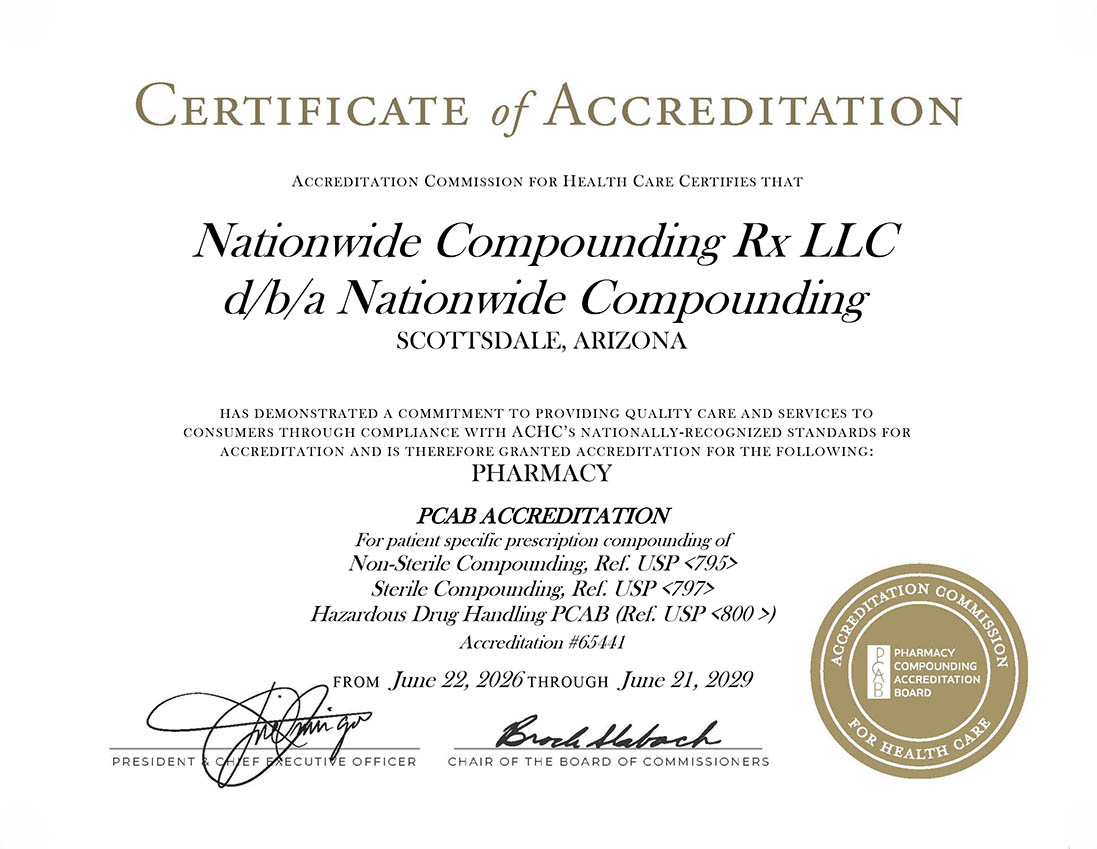
Nationwide Compounding Rx®, based in Scottsdale, Arizona, is one example of this model. It is PCAB-accredited and USP <800> compliant, uses independent third-party testing, and sources high-grade chemicals from FDA-inspected and cleared vendors. Its shipping availability varies by state and medication type. Texas patients and prescribers should confirm current licensing status for their specific prescription before ordering.
What This Means for Houston Patients and Providers Choosing a Compounding Partner Today
For patients. Accreditation status should be checked before committing to any specialty compounded formulation. This applies to bioidentical hormone replacement therapy (BHRT), pediatric medications, pain management, and dermatology, and it matters most for sterile or injectable products, where contamination carries the greatest risk.
For prescribers and clinics. The business stakes are significant. Purchasing decisions for office-use 503B products carry liability implications. A compounding partner should be able to demonstrate:
- Transparency about where ingredients come from
- Clarity on which states it is licensed in, and for which types of products
- Documented quality-control processes
A structured, collaborative relationship helps. Nationwide Compounding Rx® describes its provider partnership process as “Connect → Collaborate → Create → Care.”
For specialty formulations. Several categories benefit from pharmacies that combine accreditation with flexible, patient-specific customization rather than scale alone:
- Pediatric dosing based on weight
- Allergen-free compounds made without dyes, fillers, or preservatives
- BHRT formulas that can be adjusted at each refill based on new lab results
Conclusion: Credentials You Can Verify Beat Reputation You Can’t
Taken together, the events of 2026 tell a consistent story. The Houston glutathione recalls, Empower’s warning letter history, and the new TSBP sterile compounding rule all show that location, size, and longevity are insufficient signals of compounding quality.
The most reliable, evidence-based standard available to patients and providers today combines two things:
- PCAB accreditation that can be checked in real time through the ACHC directory
- Transparent sourcing and testing practices
The smartest search in Houston is not for the pharmacy that is closest or biggest. It is for the pharmacy that can be verified, right now, as meeting the standard, whether it operates down the street or ships nationwide.
Work With a Verifiably PCAB-Accredited Compounding Partner
Nationwide Compounding Rx® invites Houston patients and healthcare providers to connect with a pharmacy that offers:
- PCAB accreditation and USP
<800>compliance - Independent third-party testing
- Ingredient sourcing from FDA-inspected and cleared vendors
- Nationwide shipping, with availability by state and medication type
Services relevant to Houston searchers include:
- BHRT with formulas adjustable at each refill based on lab results
- Pediatric medications in kid-friendly forms and flavors, from bubblegum to cherry
- Dermatology and pain management topicals, including creams, gels, and ointments
- GLP-1 and peptide support delivered through patient-specific compounding
Providers can use the Provider Portal to submit and track prescriptions under the “Connect → Collaborate → Create → Care” framework. Patients can use the Patient Portal to manage refills and support requests.
Before choosing any pharmacy, readers are encouraged to verify its credentials directly in the ACHC/PCAB directory.
Contact Nationwide Compounding Rx®:
- Phone: (480) 499-8379
- Website: nationwidecompounding.com
- Hours: Monday through Friday, 7:00 AM to 3:30 PM
- Turnaround: 1 to 2 business days
Related Posts

Partell Specialty Pharmacy officially became National Health Rx in late 2025 after Nevada regulators flagged it as a 'distressed' pharmacy requiring monthly inspections. This 2026 guide breaks down the name change, Partell's FDA warning-letter history, and what current patients need to know before filling their next prescription.

Thinking about bioidentical hormone replacement therapy in Virginia? This 2026 guide breaks down the state's Nonresident Pharmacy Registration law, what recent FDA labeling changes mean for patients, and how to verify a compounding pharmacy is legally authorized to ship to your address. Learn the three essentials—legal authority, quality credentials, and clinical fit—before choosing a BHRT provider.

Can't access your account? This 2026 guide breaks down why CVS specialty pharmacy log in issues happen and how to fix them fast. Learn the difference between CVS Specialty, Caremark, and CVS.com logins, plus which support line to call for each problem.
Patients searching for a compounding pharmacy in Asheville need clarity on GLP-1 rules in 2026. This guide breaks down North Carolina's regulations on compounded semaglutide and tirzepatide, plus how to verify a legitimate pharmacy before filling a prescription.