Most women researching HRT encounter a misleading binary—but the real choice spans three distinct hormone categories with different safety profiles and clinical evidence. This guide breaks down FDA-approved bioidentical, compounded bioidentical, and conventional synthetic hormones so you can have a fully informed conversation with your provider. Get the clearest, most up-to-date comparison available in 2026.

Mass-manufactured drugs are built for an average patient—but no real patient is average. Individualized medication compounding eliminates the barriers of standard prescriptions by tailoring formulations to each person's unique biology, sensitivities, and lifestyle. This 2026 roadmap gives patients and providers everything they need to navigate precision Rx with confidence.

Choosing a compounding pharmacy for prescribers is a clinical decision with direct implications for patient safety, liability, and regulatory compliance. This 2026 guide provides a structured framework for evaluating accreditation, formulary fit, and turnaround capability before submitting a first prescription. Built for MDs, DOs, NPs, PAs, and other licensed prescribers navigating today's tightened regulatory landscape.

Millions of Americans can't get what they need from a standard pharmacy. This 2026 guide explores the real-world benefits of compounding pharmacy for patients, from custom dosing to allergen-free formulations. Learn how compounded medications bridge the gap between mass-produced drugs and individual patient needs.

92.8% of oral medications contain at least one potential allergen—and it's rarely the active drug. This 2026 guide exposes the excipient sensitivity blind spot that keeps patients misdiagnosed and cycling through failed medications. Learn how a PCAB-accredited compounding pharmacy for medication sensitivities offers a clinically sound, personalized solution.

For the 15 million Americans living with dysphagia, taking daily medications can be a dangerous challenge. Swallowing difficulty medication compounding offers safer, customized alternatives—from liquids to orodispersible films—when standard pills aren't an option. This 2026 guide explains what patients and caregivers need to know to make informed, safer choices.

Selecting a compounding pharmacy for pain management practices has never been more critical than in 2026. With opioid prescribing under scrutiny and the NOPAIN Act expanding non-opioid reimbursement, your compounding partner is now a strategic clinical asset. This playbook walks practice owners and physicians through every key criterion for making the right choice.

Appropriate medication dosing for children is a persistent challenge—64% of FDA-approved drugs still lack pediatric prescribing data. This article explores the pharmacokinetic science behind why children can't simply receive scaled-down adult doses and how weight-based compounding offers a safer, evidence-backed solution in 2026.

No FDA-approved LDN formulation exists, meaning a compounding pharmacy is the only legal way to obtain low dose naltrexone in the United States. This 2026 guide helps patients find reputable sources and helps providers prescribe with confidence. Discover the clinical evidence, regulatory framework, and practical steps for safe LDN access.

The 503B compounding pharmacy difference is widely misunderstood—and that misunderstanding puts providers at serious legal and patient safety risk. This 2026 guide goes beyond the basics to address dangerous misconceptions, shifting regulations, and real clinical workflow decisions. Discover why a 503B designation doesn't automatically mean safer.

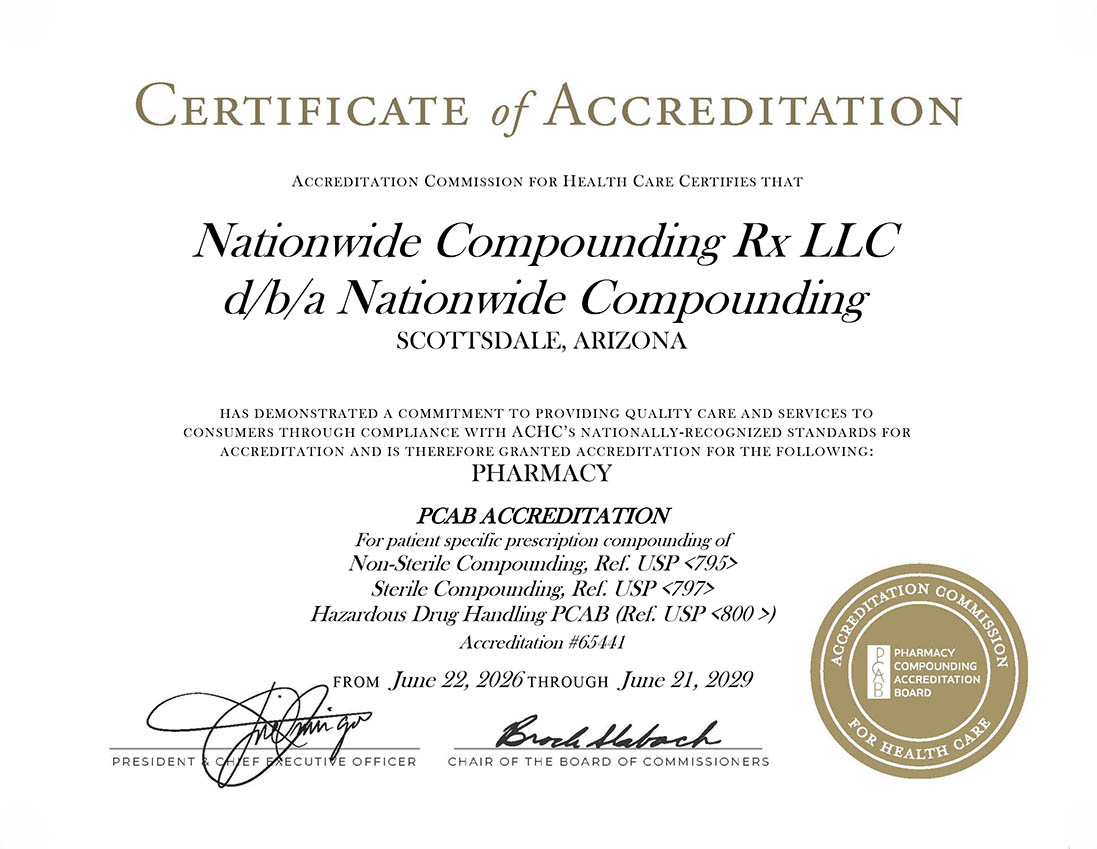
At Nationwide Compounding Rx®, we partner with prescribing practices to provide personalized medications with quality, safety, and patient care at the forefront. We offer convenient pickup, free standard shipping, same-day pickup on select medications, and a 1–2 business day turnaround on most orders.
At Nationwide Compounding Rx®, we partner with prescribing practices to provide personalized medications with quality, safety, and patient care at the forefront. We offer convenient pickup, free standard shipping, same-day pickup on select medications, and a 1–2 business day turnaround on most orders.
Quick Links
Accredited & Compliant