
What Is a Custom Medication Formulation Pharmacy? The Complete 2026 Guide
Introduction: When One-Size-Fits-All Medicine Fails You
Consider a patient who experiences severe allergic reactions to the dyes in a standard medication, a child who cannot swallow pills, or a prescriber whose patient depends on a drug that manufacturers have discontinued. These scenarios reveal a significant gap that mass-manufactured pharmaceuticals cannot address.
A custom medication formulation pharmacy, commonly known as a compounding pharmacy, is a licensed facility where pharmacists prepare individualized medications tailored to a specific patient’s needs as directed by a licensed prescriber. This practice represents both a science and a craft, combining precise formulation chemistry with the ability to adapt delivery forms, flavors, and concentrations to individual patients.
The scale and legitimacy of this field are substantial. Approximately 135 million compounded prescriptions are dispensed annually across the United States, and the domestic market was valued at roughly $6.45 billion in 2025, with projections indicating growth to $11.52 billion by 2035, reflecting sustained demand for personalized medicine solutions.
This guide provides a complete, authoritative resource covering what custom medication formulation pharmacies are, who they serve, how the process works, what regulatory standards govern them, and how to choose a high-quality provider. Throughout this article, Nationwide Compounding Rx® serves as an authoritative reference point: a PCAB-accredited, USP 800-compliant compounding pharmacy based in Scottsdale, Arizona, serving patients across 47 states plus Washington, D.C.
What Is a Custom Medication Formulation Pharmacy?
A custom medication formulation pharmacy is a state-licensed pharmacy where trained pharmacists and technicians combine, alter, or prepare drug ingredients to create a medication precisely matched to an individual patient’s prescription. Unlike retail pharmacies that dispense pre-manufactured, standardized products, compounding pharmacies build medications from active pharmaceutical ingredients according to a prescriber’s specific instructions.
Compounded prescriptions represent an estimated 1 to 3 percent of all U.S. prescriptions. While this is a small share, it nonetheless serves a substantial patient population whose needs fall outside what mass manufacturing can address. Patients who require allergen-free formulations, non-standard dosage strengths, or alternative delivery forms depend on these specialized pharmacies for their care.
The Two Legal Categories: 503A vs. 503B Compounding
U.S. federal law, specifically the Drug Quality and Security Act of 2013, created two distinct regulatory pathways for compounding pharmacies. Understanding this difference matters for both patients and prescribers.
503A pharmacies are traditional compounding pharmacies that prepare medications for specific, identified patients based on individual prescriptions. They are licensed by state boards of pharmacy and must comply with USP standards. The 503A segment dominates the U.S. market with approximately 73 percent of revenue share in 2025.
503B outsourcing facilities are larger-scale operations that may compound without patient-specific prescriptions, primarily supplying hospitals and clinics. They are registered with the FDA and subject to current Good Manufacturing Practice standards, representing a higher federal regulatory bar.
This distinction matters because 503A pharmacies like Nationwide Compounding Rx® serve individual patients through prescriber relationships, offering the highest degree of personalization. Working with a reputable 503A pharmacy means medications are prepared specifically for the patient, under a valid prescription, by licensed professionals following established safety standards.
Who Needs a Custom Medication Formulation Pharmacy?
Patients with Allergies or Ingredient Sensitivities
Many commercial medications contain inactive ingredients such as lactose, gluten, dyes, parabens, or artificial preservatives that can cause reactions in sensitive patients. Compounding pharmacies can formulate the same active drug without the offending ingredient. Nationwide Compounding Rx® specifically offers allergen-free formulations, removing lactose, dyes, gluten, sugar, and other common sensitizers on a patient-by-patient basis.
Patients Who Cannot Use Standard Dosage Forms
Patients who cannot swallow tablets or capsules due to dysphagia, age, or other factors need alternative delivery methods. Compounding pharmacies offer troches, transdermal creams and gels, oral liquids, sublingual solutions, capsules, gummies, suppositories, and lip balms. Nationwide Compounding Rx® offers eight flavoring options, including banana crème, cherry, grape, peppermint, raspberry, strawberry, tutti frutti, and vanilla butternut, to improve palatability and medication adherence.
Patients Requiring Non-Standard Dosage Strengths
Commercial medications come in fixed strengths. Some patients, particularly those on hormone therapy, pediatric dosing, or titration protocols, need precise strengths unavailable commercially. Compounding allows pharmacists to prepare exact concentrations based on a prescriber’s order. This precision is especially relevant for bioidentical hormone replacement therapy, which accounts for approximately 37.6 to 38.4 percent of the compounding pharmacy market.
Patients Whose Medications Have Been Discontinued
Large pharmaceutical manufacturers discontinue medications when they become unprofitable, even if patients still depend on them. Compounding pharmacies can replicate discontinued formulations using the same active pharmaceutical ingredients. Drug shortages amplify this need: hospitals faced a record 323 active pharmaceutical supply shortages in early 2024, and 89 new shortages emerged throughout 2025. Nationwide Compounding Rx® explicitly offers discontinued medication replication as a core service capability.
Prescribers and Medical Practices
Compounding pharmacies serve a business-to-business function. Medical practices in hormone therapy, pain management, dermatology, sports medicine, pediatrics, and weight management frequently partner with compounding pharmacies. The median 503A compounding pharmacy collaborates with approximately 150 prescribers. Nationwide Compounding Rx® positions itself as a collaborative partner to prescribers, working alongside healthcare providers to design patient-specific solutions.
The Therapeutic Areas Custom Compounding Serves
Bioidentical Hormone Replacement Therapy (BHRT)
BHRT is the leading therapeutic application in compounding, representing 37.6 to 38.4 percent of market revenue. Compounded BHRT addresses fatigue, mood swings, weight gain, infertility, hot flashes, vaginal dryness, and sexual dysfunction. Nationwide Compounding Rx® prepares BHRT formulations adjustable at each refill based on a patient’s current lab results, enabling truly dynamic, data-driven hormone management.
Pain Management
Pain management is the second-largest therapeutic segment, capturing 31.23 to 33.6 percent of compounding market revenue. Topical compounded analgesics deliver medication directly to the site of pain, minimizing systemic exposure and reducing risks of addiction, dizziness, nausea, and fatigue associated with oral opioids. Nationwide Compounding Rx® specializes in personalized topical pain formulations designed to minimize systemic side effects.
Dermatology
Commercial dermatological products are formulated for average skin types and standard concentrations. Compounding allows dermatologists to prescribe formulations matched to a patient’s specific skin type, condition severity, and lifestyle. Conditions addressed include rosacea, acne, aging, scarring, stretch marks, hyperpigmentation, eczema, psoriasis, and atopic dermatitis.
Pediatric Compounding
Pediatric patients represent approximately 33.1 percent of the compounding market by patient segment. Children frequently require lower doses than commercially available strengths, alternative delivery forms, and palatable flavors to achieve medication adherence. Oral liquids are the fastest-growing dosage form segment in compounding, particularly for pediatric and geriatric patients.
Sports Medicine
Athletes often require specialized formulations for injury recovery, inflammation management, and performance-adjacent treatment protocols. Compounded sports medicine formulations can combine multiple active ingredients, adjust concentrations for body weight and treatment goals, and use delivery forms that minimize systemic effects.
Weight Management
Medical weight management is a growing area for compounding. Nationwide Compounding Rx® is the exclusive provider of RM3® for Red Mountain Weight Loss®, demonstrating the depth of partnership possible between a compounding pharmacy and a specialty medical practice. Working with a licensed, accredited compounding pharmacy and a legitimate prescriber is essential for patient safety in the weight management space.
How the Custom Medication Formulation Process Works
Step 1: The Prescriber-Patient Consultation
All compounded medications begin with a valid prescriber-patient relationship. A licensed healthcare provider evaluates the patient, determines that a compounded medication is medically necessary, and writes a prescription specifying the active ingredients, strength, dosage form, and any special requirements. Compounded medications cannot be obtained without a valid prescription.
Step 2: Prescription Transmission to the Compounding Pharmacy
The prescriber transmits the prescription to the compounding pharmacy via fax, electronic prescription system, or mail. The pharmacy’s pharmacists review the prescription for clinical appropriateness, ingredient compatibility, and regulatory compliance before beginning preparation.
Step 3: Formulation and Compounding
Pharmacists and trained technicians prepare the medication using pharmaceutical-grade active ingredients sourced from FDA-inspected and cleared vendors. Modern compounding facilities use advanced technologies including robotic dispensing systems, barcode verification, and AI-driven visual inspection. Nationwide Compounding Rx® operates a USP 800-compliant facility, which eliminates cross-contamination risks. The pharmacy’s staff brings a combined 40 years of field experience in pharmaceutical compounding.
Step 4: Quality Review and Dispensing
Before dispensing, the completed preparation undergoes pharmacist review for accuracy, appearance, and labeling compliance. Nationwide Compounding Rx® offers a 1 to 2 business day turnaround on all medications, with same-day pickup available for select formulations.
Step 5: Delivery to the Patient
Compounded medications are dispensed directly to the patient through pickup or mail order. Nationwide Compounding Rx® ships to 47 states plus Washington, D.C. The states currently not served are Alabama, California, North Carolina, and South Carolina.
The Regulatory and Quality Standards That Matter
USP Standards: 795, 797, and 800
The United States Pharmacopeia is the authoritative standards-setting body for pharmaceutical compounding in the U.S. USP 795 governs non-sterile compounding. USP 797 governs sterile compounding. USP 800 governs the safe handling of hazardous drugs in healthcare settings. Nationwide Compounding Rx® operates a USP 800-compliant facility, demonstrating commitment to both patient and staff safety.
PCAB Accreditation: The Gold Standard for Compounding Pharmacies
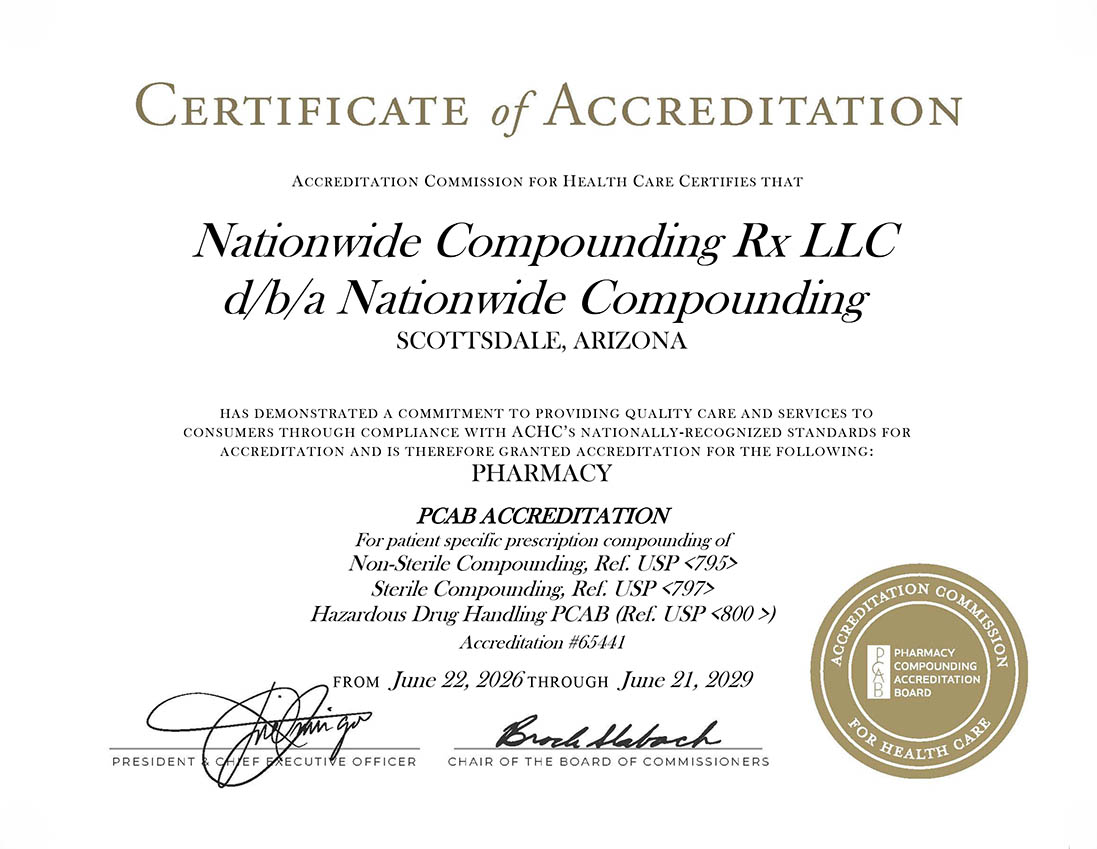
PCAB accreditation is a voluntary, third-party accreditation program that evaluates compounding pharmacies against rigorous quality and safety standards. PCAB accreditation is held by fewer than 1 percent of pharmacies in the United States. The American Medical Association recommends PCAB accreditation as the benchmark of quality when evaluating compounding pharmacies. Nationwide Compounding Rx® has maintained PCAB accreditation since the early days of its operation.
503A State Licensing and Federal Compliance
All 503A compounding pharmacies must be licensed by the state board of pharmacy where they are located. Federal compliance requirements include valid prescriptions for all compounded medications and sourcing active pharmaceutical ingredients only from FDA-registered facilities. Nationwide Compounding Rx® follows all state and federal guidelines pertaining to prescription medication compounding.
What Separates a High-Quality Compounding Pharmacy from a Commodity One
When evaluating a compounding pharmacy, patients and prescribers should verify several key credentials. PCAB accreditation is the single most important credential to confirm. USP 800 compliance is essential for any pharmacy handling hazardous drugs. Ingredient sourcing should be exclusively from FDA-inspected and cleared vendors.
Pharmacist expertise matters enormously. The APC reports that pharmacists in the compounding sector average 19 years of experience. Nationwide Compounding Rx® staff brings a combined 40 years of field experience.
Modern compounding pharmacies invest in AI and automation for precision and safety. Turnaround time also matters for patient care continuity. Nationwide Compounding Rx® offers 1 to 2 business day turnaround on all medications and same-day pickup for select formulations.
Red flags to avoid include pharmacies that offer compounded medications without a valid prescription, make unsubstantiated efficacy claims, cannot provide accreditation documentation, or source ingredients from non-FDA-registered suppliers.
Patient Safety: What You Need to Know Before Using a Compounding Pharmacy
FDA-approved medications have undergone rigorous clinical trials demonstrating safety, efficacy, and manufacturing consistency. Compounded medications have not gone through this approval process as finished products. This does not mean compounded medications are unsafe; it means their safety depends heavily on the quality of the compounding pharmacy, the accuracy of the prescription, and the clinical judgment of the prescriber.
Patients should always ensure their compounded medication is prepared by a licensed, accredited pharmacy under a valid prescription from a licensed prescriber. They should follow beyond-use date instructions carefully and report any unexpected reactions to their prescriber and the compounding pharmacy immediately.
Nationwide Compounding Rx®: A Full-Service Custom Medication Formulation Pharmacy
Nationwide Compounding Rx® embodies the principles outlined throughout this guide. The pharmacy rejects the one-size-fits-all approach in favor of individualized patient care and medication customization. The full-service portfolio includes BHRT, pain management, dermatology, pediatric compounding, sports medicine, and weight management.
Operational advantages include 1 to 2 business day turnaround, same-day pickup for select medications, and nationwide shipping to 47 states plus Washington, D.C. Quality credentials include PCAB accreditation maintained since the pharmacy’s early days, a USP 800-compliant facility, FDA-inspected vendor sourcing, and a staff with 40 combined years of compounding experience.
For more information, contact Nationwide Compounding Rx® at 480-499-8379 or toll-free at 1-833-650-9836. The pharmacy is located at 14000 N. Hayden Rd., Suite 104, Scottsdale, AZ 85260, with hours Monday through Friday, 7:00 a.m. to 3:30 p.m.
Conclusion: Personalized Medicine Starts with the Right Pharmacy Partner
Custom medication formulation pharmacies exist to serve patients whose needs fall outside what mass-manufactured pharmaceuticals can address. They do so through a rigorous, regulated, prescriber-driven process built on three pillars: accreditation and compliance, expertise and experience, and operational excellence.
As the market grows from $6.45 billion in 2025 toward $11.52 billion by 2035, the demand for patient-specific medications will only increase. Custom medication formulation is not a niche workaround; it is an essential component of modern, patient-centered healthcare. Whether serving a patient navigating a complex health condition, a caregiver seeking better options for a child, or a prescriber building a personalized treatment protocol, the right compounding pharmacy partner can make a meaningful difference in outcomes, adherence, and quality of life.
Related Posts

Searching for Marty's Compounding Pharmacy but not sure if a local Mississippi storefront fits your needs? This guide compares Marty's Pharmacy & Compounding Center to nationwide compounding options using a five-point credential checklist covering accreditation, testing, and shipping licenses in 2026.

The term 'board of specialty pharmacy' actually refers to four distinct organizations, each serving a different purpose. This article breaks down BPS, SPCB, state boards, and PCAB to reveal which body truly governs compounding pharmacy quality in 2026.

Many patients assume CVS Pharmacy Specialty Services can compound custom medications simply because it holds PCAB accreditation—but the reality is more nuanced. This article breaks down what the accreditation actually covers, how the FDA's 503A/503B rules apply, and what it means for prior authorizations on oncology, MS, and RA prescriptions in 2026.

Many patients land on Accredo after a physician, insurer, or PBM directs them there. This guide breaks down what specialty pharmacy Accredo actually does—and the critical compounding limitations you need to know about in 2026.