Personalized Medicine Bioinformatics: The 2026 Compounding Bridge
Introduction: The Gap Between Genomic Insight and the Pharmacy Counter
Personalized medicine bioinformatics has matured quickly. Clinicians can now look up a gene-drug pair in Clinical Pharmacogenetics Implementation Consortium (CPIC) guidelines and cross-reference variant annotations in PharmGKB and ClinVar. They can also confirm labeled warnings in the FDA’s pharmacogenomic biomarker table. The interpretive tools are rigorous and widely used.
Most published content stops at interpretation, though. Journals explain the science. Market reports measure the industry. Neither explains what happens after a lab report says a patient is a CYP2D6 poor metabolizer.
That missing step can be called the compounding bridge. It is the operational layer where bioinformatic output becomes an actual prescription: dose-adjusted, free of problem ingredients, and prepared for one specific patient.
This article is written for pharmacists, prescribers, and precision-medicine researchers who understand the data pipeline and want to see where it ends. It also explains how compounding pharmacies such as Nationwide Compounding Rx® act as execution partners, turning genomic insight into formulations patients can take.
The State of Personalized Medicine Bioinformatics in 2026
Personalized medicine bioinformatics is the computational infrastructure used to predict how an individual will respond to a drug. It includes curated databases, variant-calling pipelines, and AI and machine learning models.
A 2026 review in the Journal of Pharmacy and Pharmacology described bioinformatics as the backbone that turns pharmacogenomics into actionable clinical guidance. The review covered applications in psychiatry, cardiology, oncology, and autoimmune disorders, and found that genetically guided therapies can improve efficacy and reduce adverse effects.
Market data points the same way:
- One estimate values the personalized medicine bioinformatics market at $3.86 billion in 2026, rising to $6.17 billion by 2031 (a 9.85% CAGR).
- Another estimate places the 2026 market at $4.4 billion, growing at a 13.6% CAGR.
- Analysts attribute this growth to wider next-generation sequencing (NGS) use, larger genomic datasets, more precision-medicine research funding, and better algorithms.
The largest enabler has been cost. Whole genome sequencing cost roughly $100 million in 2001. In 2026, clinical-grade 30X sequencing costs under $500, a price that can include sequencing, bioinformatic analysis, and clinical reporting. At that price, pharmacogenomic data can be collected across whole populations.
The Evidence Infrastructure: CPIC, PharmGKB, ClinVar, and the FDA Biomarker Table
Precision prescribing depends on a layered evidence base. Each layer has a different job.
CPIC: the clinical guidance layer. As of October 2026, CPIC lists 29 freely accessible, evidence-based gene-drug guidelines covering 34 genes and 164 drugs. Its guidelines have:
- More than 10,000 citations and 1.4 million views
- Reported use by 128 healthcare institutions and 40 commercial laboratories
- References in 85% of PubMed-indexed pharmacogenomic implementation studies
That last figure makes CPIC the de facto clinical standard for turning genotypes into prescribing recommendations.
PharmGKB/ClinPGx and ClinVar: the annotation layer. These resources classify individual genetic variants and link them to drug-response evidence. Their curated annotations are the raw material for CPIC’s guidance.
The FDA biomarker table: the regulatory layer. The FDA’s Table of Pharmacogenomic Biomarkers in Drug Labeling covers about 275 drugs. It connects a genotype reported by a lab to the gene-related warnings and dosing language in a drug’s official label.
CYP2D6 is the clearest example. This liver enzyme metabolizes many common medications, including certain antidepressants, antipsychotics, opioids, and beta-blockers. CYP2D6 metabolism can vary up to 60-fold between individuals. A standard dose that works well for one patient may build up to toxic levels in another, or have no effect in a third.
From Multi-Omics to Molecule: How AI Is Reshaping the Interpretation Layer
Genomics is now one of several data sources. AI-enabled multi-modal data integration combines genomic, transcriptomic, proteomic, imaging, environmental, and electronic health record (EHR) data into a single analytical framework. Researchers use these frameworks to:
- Detect disease earlier
- Find clinically actionable biomarkers
- Speed up rational drug development, especially in oncology, neurology, and cardiovascular medicine
Modeling methods are also changing. In multi-omics cancer research, the field is moving away from universal, cohort-wide models and toward fine-tuning AI on a single patient’s multi-omics profile. At the same time, there is growing demand for explainable AI (XAI), so that clinicians can see and check the reasoning behind a recommendation.
Large datasets make this work possible. In 2026, NIH’s All of Us Research Program announced its entry into a “multiomics era”:
- 883,000+ participants enrolled, including 645,000+ from historically underrepresented communities
- 535,000+ whole genome sequences linked to EHRs
- New for 2026: proteomics data from nearly 10,000 participants, RNA sequencing from nearly 9,000, and long-read whole genome sequences from more than 14,500
The clinical yield is significant. Real-world data published in Pharmacogenetics and Genomics (March 2026) found an average of 4.7 actionable genetic variants per patient, with at least one drug-gene interaction in 46% of patients. Almost half of patients therefore carry information that could change how a medication should be prescribed.
Why Interpretation Alone Doesn’t Change Outcomes
The case for acting on this information starts with the harm caused by adverse drug reactions (ADRs):
- ADRs account for 6% of all U.S. hospital admissions each year.
- ADR-related illness costs were estimated at $528.4 billion in 2016.
- 5% to 15% of adult hospitalizations are attributed to ADRs, rising to 15% among patients with multiple conditions.
Pharmacogenomic guidance can reduce this harm:
- In the European PREPARE study, therapy guided by a 12-gene pharmacogenetic panel reduced clinically relevant ADRs by 30% across different disease areas and healthcare systems.
- In another study, preemptive testing of six genes cut 60-day rehospitalizations by 52%, emergency department visits by 42%, and the combined measure by 48%.
These results share a requirement. Benefits appeared only because the genetic findings changed the medication the patient actually received. A correct genomic interpretation that never becomes a properly formulated, dosed, and tolerated medication delivers none of these benefits. The value is realized at the bridge.
The Compounding Bridge: Translating Bioinformatic Output into Dispensable Therapy
With a prescription and the patient’s pharmacogenomic profile, a compounding pharmacist can prepare a medication at that patient’s best dosage and in the most suitable dosage form. Pharmacogenomics shows what needs to change. Compounding makes the change.
This is often necessary because commercial products come in a few fixed strengths, chosen to suit the average patient. CPIC-guided adjustments do not always line up with those strengths. A poor metabolizer may need a reduced dose that no manufacturer makes. An ultra-rapid metabolizer may need a different strength or a different drug. Splitting tablets can produce uneven doses, and measuring liquids at home is prone to error.
Compounding addresses two kinds of variables at once:
- The pharmacogenomic variable: the exact dose indicated by the patient’s genotype and the prescriber’s judgment.
- The clinical variable: allergens, dyes, fillers, and preservatives the patient must avoid; difficulty swallowing; and flavor or format preferences that affect whether the patient takes the medication consistently.
Nationwide Compounding Rx® works on both. The pharmacy prepares capsules, liquids, topicals, troches, oral and sublingual tablets, and suppositories. It can produce formulations free of dyes, fillers, preservatives, and allergens, and it can recreate discontinued or unavailable strengths.
The industry outlook supports a larger role for this work. As pharmacogenomics increasingly determines which therapies are appropriate, compounding pharmacists are expected to play a growing role in preparing the individualized dosage forms that precision therapy requires.
A Worked Example: CYP2D6 Status to Compounded Dose
The following scenario is hypothetical but representative. Prescribing decisions in real cases belong to the treating clinician.
Scenario: An adult patient completes a CPIC-aligned pharmacogenomic panel. The report shows CYP2D6 poor-metabolizer status. The patient’s prescriber is considering a tricyclic antidepressant for neuropathic pain. The patient also has a documented sensitivity to a common dye and has trouble swallowing larger tablets.
The decision chain:
- CPIC guideline lookup. The prescriber checks the CPIC guideline for CYP2D6 and tricyclic antidepressants. For poor metabolizers, the guideline generally advises considering an alternative drug. If a tricyclic is still warranted, it recommends a substantially reduced starting dose (around 50%) together with therapeutic drug monitoring.
- FDA label confirmation. The prescriber checks the FDA pharmacogenomic biomarker table to confirm that the drug’s labeling includes CYP2D6-related information.
- Prescriber dose adjustment. The prescriber decides the tricyclic is clinically appropriate and writes a prescription at a reduced, genotype-guided strength.
- Compounding formulation. The compounding pharmacist prepares that strength, which may not exist commercially, without the flagged dye, and in a form the patient can tolerate, such as a small capsule or a flavored liquid.
- Monitoring and refinement. As monitoring results come in, the prescriber can adjust the dose, and the pharmacy can prepare each refill at the new strength.
Every step in this chain depends on bioinformatics: variant calling, star-allele assignment, phenotype translation, and guideline matching. The pipeline only reaches the patient at step four. With fixed commercial strengths and standard excipients, the patient might receive a dose that is too high or a tablet containing an ingredient they cannot tolerate. In cases like this, compounding is a structural requirement.
Where This Is Headed: Multi-Omics, Foundation Models, and the Next Compounding Frontier
Regulation is changing. Frameworks for AI-enabled omics and multi-omics tools are developing, including the FDA’s 2026 draft guidance on Bayesian methodology. Compounding pharmacies that serve precision-medicine prescribers will need to keep up with these emerging clinical and regulatory standards.
Recommendations will become more individualized. As AI models are fine-tuned on individual patients rather than whole cohorts, dosing recommendations will increasingly fall between standard commercial strengths. A model may recommend a dose that no manufacturer will ever produce. Compounding is one of the few ways to fill that prescription.
Some challenges remain:
- Computational complexity in interpreting high-dimensional data
- Data privacy concerns as genomic data is linked to medical records
- Underrepresentation of diverse populations in genomic datasets, although programs such as All of Us are addressing this
Because of these limits, the execution layer needs to stay flexible and evidence-driven, ready to change formulations as the evidence changes.
Manufacturing is catching up. 3D printing is starting to appear in compounding practice for precision dosing. Published work describes making a 14.4 mg tablet, a strength that would be hard to achieve reliably with liquid measurement, which depends on the patient’s technique. Combined with pharmacogenomic data and monitoring of how the patient responds, 3D-printed and compounded precision dosing gives increasingly detailed bioinformatic output a practical way to reach patients.
Conclusion: Closing the Loop Between Data and Dose
Personalized medicine bioinformatics has largely solved the interpretation problem. CPIC, PharmGKB/ClinPGx, ClinVar, and the FDA biomarker table form a mature, evidence-based foundation. AI and multi-omics programs continue to add detail.
Interpretation without execution, however, leaves the outcome gains unrealized, including the 30% ADR reduction seen in PREPARE and the drop in rehospitalizations seen with preemptive testing. Those benefits depend on the medication that reaches the patient.
Compounding pharmacy does the translating. It turns validated genomic insight into a dispensed therapy that is dose-adjusted, free of problem ingredients, and suited to the patient. Nationwide Compounding Rx® works at this intersection, serving providers and researchers who need an execution partner for genotype-guided prescribing.
Partner with Nationwide Compounding Rx to Operationalize Precision Prescribing
Prescribers and healthcare organizations that use pharmacogenomic data can submit genotype-guided prescriptions through Nationwide Compounding Rx®’s secure Provider Portal. The portal also supports order tracking and direct communication with the pharmacy team.
Practices adding pharmacogenomics to their prescribing can follow the pharmacy’s structured partnership framework:
- Connect: Start a relationship with the pharmacy team and discuss the practice’s precision-prescribing needs.
- Collaborate: Work through dosing, dosage form, and excipient considerations for patients with known gene-drug interactions.
- Create: Have sterile and non-sterile formulations prepared at the prescribed strength.
- Care: Keep support going as monitoring data and lab results lead to refill adjustments.
Reasons providers choose Nationwide Compounding Rx®:
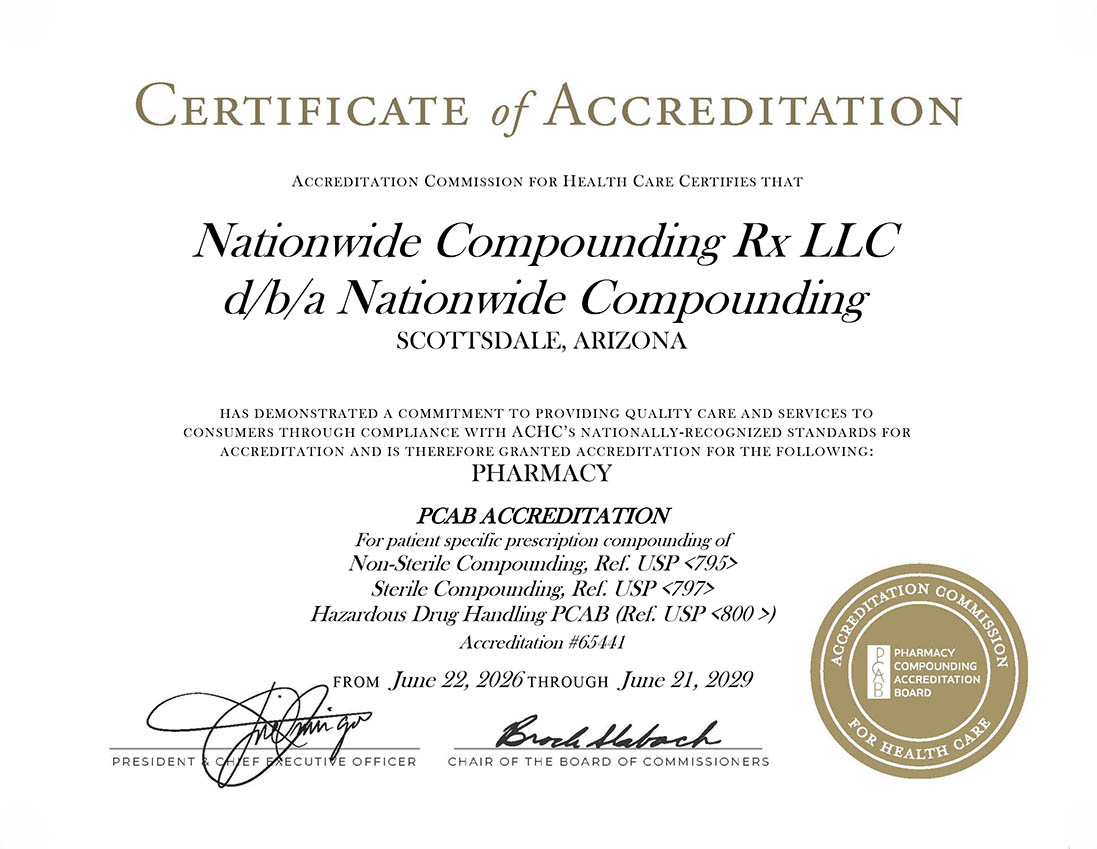
- PCAB Accredited and USP 800 Compliant
- Independent third-party testing and chemicals sourced from FDA-inspected and cleared vendors
- 1 to 2 business day turnaround, with same-day pickup available for some medications
- 40+ years of combined team experience
Contact Nationwide Compounding Rx®:
- Phone: (480) 499-8379
- Website: nationwidecompounding.com
- Location: 14000 N. Hayden Rd., Suite 104, Scottsdale, AZ 85260
- Hours: Monday to Friday, 7:00 AM to 3:30 PM
Nationwide shipping is available. Service depends on state licensing tier (fully licensed; non-sterile only; or pending/unlicensed), medication type, and prescription requirements. Providers can check their state’s status on the pharmacy’s shipping map.
Related Posts

Wondering if CVS is a compounding pharmacy? This 2026 guide clears up the confusion around CVS's limited compounding services versus true 503A custom formulations. Learn what CVS can and can't provide, and where to turn for specialized medication needs.

Lumicera Specialty Pharmacy markets transparent, cost-plus drug pricing, but that promise only applies to select conditions and stocked drugs. This article examines the data behind Lumicera's coverage limits, prior authorization denials, and what patients can do when they fall outside the model.

Searching for the right Optum Specialty Pharmacy phone number can lead to outdated or conflicting results. This 2026 verified list breaks down each legitimate contact line, what it's used for, and why the old BriovaRx name still causes confusion today.

Kentucky's 2026 crackdown on compounded peptides has left many Lexington patients searching for answers and legal alternatives. This guide breaks down what changed under 201 KAR 2:076, what it means for existing prescriptions, and how a PCAB-accredited compounding pharmacy can still legally fill compliant formulations.