
Compounded Suppository Pharmacy: The Science Behind Custom Formulations
Introduction: When One Size Does Not Fit All in Drug Delivery
Millions of patients face a frustrating reality: the medication they need does not exist in a form they can use. The commercially manufactured product may come in the wrong dose, the wrong format, or contain an excipient that triggers an allergic reaction. Sometimes the product has been discontinued entirely, or it was never made at all. For these patients, mass-produced pharmaceuticals fall short.
Compounded suppositories represent one of the most sophisticated, science-driven answers to this problem. Far from being a relic of pre-modern pharmacy, suppositories are a growing segment of a global market projected to reach $3.04 billion by 2032, according to Coherent Market Insights. They leverage precise pharmacokinetics, careful base selection, and the ability to combine multiple active ingredients into a single dose.
This article moves beyond surface-level lists of conditions. It delivers a clinically grounded explanation of how compounded suppositories work, why base selection matters, which drugs can be compounded this way, and what patients and prescribers need to know about safety and regulatory compliance. Behind this content stands Nationwide Compounding Rx®, a PCAB-accredited compounding pharmacy in Scottsdale, Arizona, with 40 years of combined staff experience and nationwide shipping to 47 states plus Washington, D.C. Whether the reader is a patient seeking to understand available options or a prescriber evaluating compounding as a clinical tool, what follows is a practical, evidence-based guide.
What Is a Compounded Suppository? Defining the Dosage Form
A suppository is a solid or semi-solid dosage form designed to melt, soften, or dissolve at body temperature once inserted into a body cavity, releasing its active pharmaceutical ingredients (APIs) either locally or systemically.
There are three primary routes of administration, each with distinct anatomical considerations, base material requirements, and therapeutic applications:
- Rectal suppositories, used for both local and systemic effects
- Vaginal suppositories, often used for local therapy and hormone delivery
- Urethral suppositories, also called bougies, used for specialized indications
What makes a suppository “compounded” is that a licensed pharmacist prepares it from bulk APIs and excipients to fulfill a specific patient’s prescription. It is not mass-manufactured, and it is not one-size-fits-all.
Compounded prescriptions account for an estimated 1 to 3 percent of all U.S. prescriptions, according to the APC 2025–2026 Snapshot, yet they serve a disproportionately important patient population whose needs cannot be met by commercial products. Rectal suppositories currently hold the largest product-type market share globally at 45.2 percent in 2025, reflecting their broad clinical utility.
The Pharmacokinetic Advantage: Why Suppositories Bypass First-Pass Metabolism
When a drug is swallowed, it travels through the gastrointestinal tract and then the liver before reaching systemic circulation. During this journey, called first-pass metabolism, a significant portion of the drug is broken down and rendered inactive before it can exert a therapeutic effect.
Rectal and vaginal suppositories can largely circumvent this process. Drugs absorbed through the lower rectal mucosa, by way of the inferior and middle hemorrhoidal veins, enter systemic circulation without first passing through the hepatic portal system. There is an important nuance: absorption from the upper rectum can still involve some portal circulation, so placement depth matters. Skilled compounding pharmacists account for this in formulation design.
The vaginal route offers an even cleaner advantage, bypassing first-pass metabolism entirely. This produces higher local tissue concentrations with fewer systemic side effects, a benefit particularly relevant for progesterone and other hormone therapies.
Additional pharmacokinetic benefits include avoidance of gastrointestinal irritation, protection of acid-labile drugs from gastric pH, and value for patients with nausea, vomiting, dysphagia, or impaired GI absorption. Peer-reviewed research confirms that rectal drug delivery reduces hepatic first-pass elimination and avoids gastric irritation, making it especially valuable for pediatric and geriatric populations who struggle with oral medications.
The Science of Suppository Base Selection
Base selection is arguably the most critical formulation decision a compounding pharmacist makes. The base determines drug release rate, patient comfort, storage requirements, compatibility with the API, and overall therapeutic efficacy.
The USP recognizes several approved suppository base categories, including cocoa butter, cocoa butter substitutes (vegetable oils), glycerinated gelatin, hydrogenated vegetable oils, mixtures of polyethylene glycols (PEGs) of various molecular weights, and fatty acid esters of polyethylene glycol. Three primary categories deserve detailed exploration: fatty/oleaginous bases, PEG bases, and glycerinated gelatin bases.
Fatty and Oleaginous Bases: The Gold Standard for Rectal Delivery
Fatty or oleaginous bases are lipid-based materials, most classically cocoa butter (theobroma oil) and modern synthetic hard fats such as Witepsol® and Fattibase®. These melt at or just below body temperature, around 37°C, releasing the drug as the base liquefies and spreads across the mucosal surface for absorption.
Cocoa butter carries deep historical significance but also practical limitations. It exhibits polymorphism, meaning it can crystallize into multiple forms with different melting points. Careful temperature control during compounding is essential to avoid producing a form that melts at room temperature. Synthetic hard fats solve this problem; these semi-synthetic triglycerides are engineered for consistent melting points, better oxidative stability, and improved compatibility with a wider range of APIs.
Fatty/oleaginous bases lead the global suppository base market at 39.5 percent share in 2025. One important storage note: cocoa butter-based suppositories require refrigeration (typically 2 to 8°C) to prevent premature melting, and patients must be counseled accordingly.
Polyethylene Glycol (PEG) Bases: Water-Soluble Versatility
PEG bases are water-soluble synthetic polymers that dissolve in body fluids rather than melting, releasing the API through dissolution. The molecular weight spectrum gives pharmacists considerable control. Low-molecular-weight PEGs (such as PEG 400 and PEG 1000) are liquid or soft at room temperature, while high-molecular-weight PEGs (such as PEG 3350 and PEG 8000) are harder solids. By blending PEGs of different molecular weights, a pharmacist can engineer suppositories with specific hardness, dissolution rates, and drug release profiles.
The key advantage is convenience: PEG suppositories do not require refrigeration and remain stable at room temperature, improving compliance. They are preferred for vaginal and urethral suppositories and suit water-soluble APIs well. Polybase® is a commercially available PEG-based suppository base widely used in compounding, including for progesterone vaginal inserts per US Pharmacist clinical guidance.
One important limitation: PEG bases can irritate the rectal mucosa in some patients, particularly with repeated use or existing mucosal inflammation. This is a critical counseling point. In vitro research also shows that PEG bases generally produce faster drug release than cocoa butter, which is advantageous for acute symptom management but less ideal for sustained release.
Glycerinated Gelatin Bases: Prolonged Release for Vaginal Applications
Glycerinated gelatin is composed of gelatin, glycerin, and water. It forms a firm, transparent suppository that disperses slowly in mucous secretions rather than melting. This slow-dispersion mechanism provides prolonged, sustained release, which is particularly advantageous for local vaginal therapy with antifungal agents, hormone therapy, or anti-inflammatory drugs.
As ScienceDirect notes, vaginal suppositories are typically glycerol-gelatin based to avoid irritation, while urethral bougies traditionally use cocoa butter. Glycerinated gelatin suppositories are hygroscopic, absorbing moisture from the environment, so they must be stored in airtight packaging and may require a moistened applicator for comfortable insertion.
The base selection decision ultimately weighs four factors: the prescriber’s therapeutic goal (rapid systemic absorption versus prolonged local effect), the route of administration, the API’s physicochemical properties, and the patient’s storage capabilities.
The Full Spectrum of Compoundable Drugs: Beyond the Common Few
Most patients, and even some prescribers, are familiar only with progesterone vaginal suppositories or diazepam pelvic floor suppositories. The true range of compoundable drugs is far broader. A defining advantage throughout is the multi-ingredient capability: compounding allows two or three active ingredients to be combined into a single suppository (for example, a muscle relaxant plus a local anesthetic plus an anxiolytic), delivering synergistic, patient-specific relief that no commercial product can replicate.
Hormone Therapy and Fertility Support
- Progesterone vaginal suppositories are the most widely prescribed compounded vaginal suppository, used for luteal phase support in IVF cycles, recurrent pregnancy loss, luteal phase defect, and bioidentical hormone replacement therapy (BHRT). Vaginal administration achieves high local uterine concentrations (the “first uterine pass effect”) with lower systemic exposure, reducing sedation and mood changes.
- Estradiol vaginal suppositories treat vaginal atrophy, dyspareunia, and genitourinary syndrome of menopause, with precise dosing unavailable commercially.
- Testosterone vaginal suppositories are an emerging option for female sexual dysfunction and hypoactive sexual desire disorder, particularly in postmenopausal women.
Nationwide Compounding Rx® specializes in BHRT, and compounded suppositories serve as a key delivery vehicle for hormone therapy adjusted by lab results at each refill.
Pelvic Floor Dysfunction, Vulvodynia, and Chronic Pelvic Pain
- Diazepam vaginal suppositories deliver targeted benzodiazepine muscle relaxation to hypertonic pelvic floor muscles with fewer systemic CNS effects than oral diazepam; most patients notice pelvic relaxation within 15 to 30 minutes.
- Baclofen vaginal suppositories, a GABA-B agonist, address pelvic floor hypertonicity, vaginismus, and chronic pelvic pain.
- A multi-ingredient combination such as Baclofen 10mg / Diazepam 2.5mg / Lidocaine 50mg unites a muscle relaxant, anxiolytic, and local anesthetic for synergistic relief.
- Gabapentin vaginal suppositories target vulvodynia and neuropathic pelvic pain locally.
- Lidocaine vaginal suppositories provide local anesthesia for procedural pain or chronic vulvar conditions.
- Ketamine rectal or vaginal suppositories are emerging for refractory chronic pelvic pain and complex regional pain syndrome in palliative settings.
Gastrointestinal Conditions
- Mesalamine rectal suppositories are first-line for distal ulcerative colitis and proctitis, with compounded dose customization beyond limited commercial strengths.
- Budesonide rectal suppositories treat IBD flares in the distal colon and rectum.
- Hydrocortisone rectal suppositories address hemorrhoids, anal fissures, and proctitis, often combined with lidocaine for enhanced relief.
Rectal delivery concentrates drug directly at inflamed tissue, minimizing systemic corticosteroid exposure.
Nausea, Vomiting, and Palliative Care
- Ondansetron rectal suppositories serve patients who cannot take oral antiemetics during chemotherapy-induced nausea, radiation-induced nausea, postoperative nausea, gastroparesis, and palliative care.
- Promethazine rectal suppositories address nausea and vomiting when dose customization or allergen-free formulation is needed.
- Prochlorperazine rectal suppositories treat severe nausea, including migraine-associated nausea.
- Morphine and hydromorphone rectal suppositories support palliative pain management; rectal morphine bioavailability is roughly 20 to 40 percent of the oral dose, requiring adjustment.
Compounded antiemetic suppositories are critical for advanced cancer patients who cannot swallow, a growing and underserved niche.
Pediatric and Geriatric Applications
- Diazepam rectal suppositories or gel manage acute pediatric seizures when IV access is unavailable and the child cannot swallow.
- Acetaminophen and ibuprofen rectal suppositories manage fever and pain in children who are vomiting or refuse oral medication.
- Geriatric dysphagia patients benefit from rectal delivery when oral medications are unsafe.
- Antibiotic and antifungal suppositories accommodate pediatric allergies to dyes, lactose, or gluten.
Nationwide Compounding Rx® extends its pediatric compounding expertise to suppository form when needed.
Vaginal Infections and Sexual Health
- Boric acid vaginal suppositories (typically 600mg) treat recurrent bacterial vaginosis and resistant vulvovaginal candidiasis.
- Metronidazole vaginal suppositories address bacterial vaginosis when gels are not tolerated.
- Sildenafil vaginal suppositories are an emerging option for female sexual arousal disorder and thin endometrium, increasing local blood flow via PDE5 inhibition.
- Nifedipine rectal suppositories relax the internal anal sphincter to promote anal fissure healing.
Patient Safety: Beyond-Use Dating, Storage, and Quality Assurance
Beyond-use dating and storage requirements are rarely addressed in patient-facing content, yet they are fundamental to safety and efficacy.
A beyond-use date (BUD) is the date after which a compounded preparation should not be used. The compounding pharmacist determines it based on the drug, the base, storage conditions, and available stability data; it is distinct from a manufacturer’s expiration date. The USP Chapter <795> framework governs non-sterile compounding, which covers the vast majority of suppositories, and permits BUDs of up to 6 months when stability data and appropriate storage support it. Sterile rectal or vaginal preparations, which are rare, fall under USP <797> with more stringent requirements.
Storage varies by base: cocoa butter-based suppositories require refrigeration (2 to 8°C); PEG-based suppositories are stable at room temperature but should be kept away from heat and humidity; glycerinated gelatin suppositories require airtight packaging due to hygroscopicity.
Patient counseling points include storing suppositories as labeled, never using them after the BUD, consulting the pharmacy if a suppository softens or changes appearance, and keeping them out of reach of children. Nationwide Compounding Rx® purchases only the highest-grade APIs from FDA-inspected and cleared vendors, the foundational ingredient quality that makes reliable BUD assignment possible.
Regulatory Framework: Understanding 503A, 503B, and USP Compliance
Not all compounding pharmacies operate under the same rules. Understanding the distinctions helps prescribers select compliant, safe partners.
The Drug Quality and Security Act (DQSA) of 2013 created the current two-tier framework. 503A pharmacies are traditional compounding pharmacies preparing patient-specific prescriptions, regulated primarily by state boards of pharmacy with FDA oversight focused on insanitary conditions and bulk drug substance use. The 503A segment dominated the U.S. market in 2025. 503B outsourcing facilities are FDA-registered facilities that compound without patient-specific prescriptions for larger-scale distribution, subject to Current Good Manufacturing Practice regulations (21 CFR Part 211).
FDA enforcement has intensified in 2025 and 2026, including roughly 100 cease-and-desist letters sent to compounding pharmacies and telehealth providers in September 2025 alone. Compliance is non-negotiable.
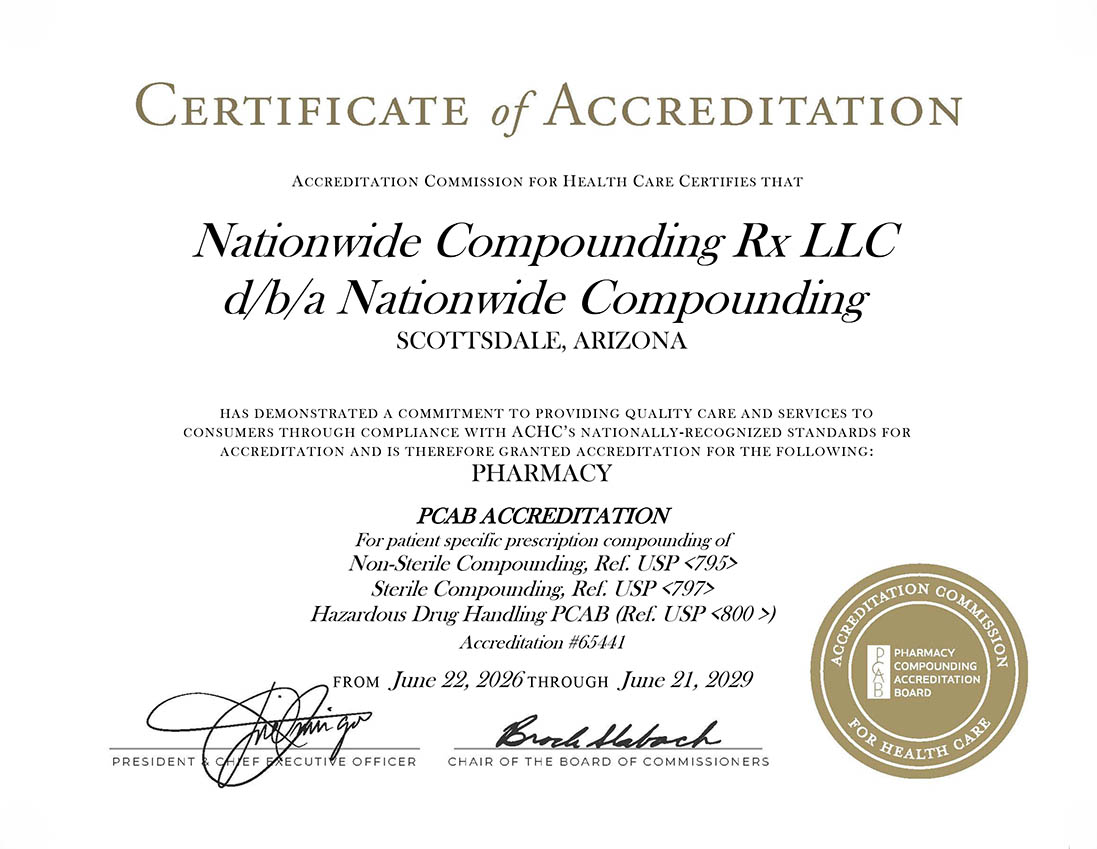
The foundational quality standards are USP <795> (non-sterile compounding), USP <797> (sterile compounding), and USP <800> (hazardous drug handling), with updated requirements in effect as of 2026. Nationwide Compounding Rx® holds PCAB accreditation, operates a USP <800> compliant facility, and adheres to all state and federal guidelines. A new APC and Coalition for Compounding Excellence accreditation partnership, announced in January 2026, offers streamlined USP-based accreditation options that further raise industry quality standards.
How Compounded Suppositories Are Made: The Formulation Process
The compounding process follows clear, science-driven steps:
- Prescription review and formulation design. The pharmacist evaluates the API’s solubility, melting point, stability, and compatibility, then selects the base and determines optimal drug concentration and suppository weight.
- API and excipient sourcing. APIs come from FDA-inspected, USP-grade vendors; excipients are selected for compatibility.
- Fusion method preparation. The base is melted at controlled temperature, the API is uniformly incorporated, and the mixture is poured into molds to solidify.
- Mold technology. Modern systems such as RocketMolds™ produce uniform, individually sealable units, replacing older thin-walled PVC shells.
- Quality checks. Finished suppositories are inspected for uniformity of weight, appearance, and consistency, and a BUD is assigned.
- Labeling, packaging, and dispensing. Each unit is labeled with patient name, drug and strength, BUD, storage instructions, and administration guidance, then shipped in temperature-controlled packaging when required.
Nationwide Compounding Rx® offers a 1 to 2 business day turnaround, with same-day pickup available for select formulations.
Who Benefits Most from Compounded Suppositories?
Compounded suppositories are the right clinical choice for several distinct populations:
- Patients who cannot take oral medications: those with nausea and vomiting (including chemotherapy patients), dysphagia, gastroparesis, post-surgical recovery, or unconsciousness in emergencies.
- Pediatric patients: children who refuse oral medication, cannot swallow tablets, or need doses unavailable commercially, especially for fever and seizure emergencies.
- Geriatric patients: elderly individuals with dysphagia, cognitive impairment, or polypharmacy concerns.
- Patients requiring localized therapy: conditions of the rectum, vagina, or pelvic floor that benefit from maximized local concentration and minimized systemic exposure.
- Patients with allergies or intolerances: those reacting to dyes, lactose, gluten, or preservatives, for whom Nationwide Compounding Rx® can formulate allergen-free suppositories.
- Patients needing discontinued medications: when a commercial product has been discontinued, compounding can replicate it.
- Patients requiring combination therapy: when two or three APIs must be delivered simultaneously for synergistic effect.
- Patients in palliative and hospice care: where comfort and ease of administration are paramount.
Working with a Compounded Suppository Pharmacy: What Prescribers and Patients Should Know
For prescribers: a compounding prescription for a suppository should include the active ingredient(s) and strength(s), the route (rectal or vaginal), the suppository weight if specified, the quantity, and any base preference or patient allergy information. Nationwide Compounding Rx® works alongside prescribers to design formulations, and its pharmacists, with 40 years of combined experience, can provide clinical guidance on base selection or drug concentration when needed.
New digital prescribing platforms launched in 2025, including eNavvi and Craft Telemedicine, are streamlining the prescriber-to-pharmacy pipeline, allowing compounding prescriptions to be transmitted digitally and accelerating patient access.
For patients: a compounded suppository’s label will differ from a commercial product, the BUD will be shorter than a manufacturer’s expiration date, and storage instructions must be followed precisely. Compounded suppositories are often not covered by insurance the way commercial products are, so patients should ask about cost upfront. Nationwide Compounding Rx® pricing is available upon inquiry.
Prescribers can submit prescriptions by fax (480-699-5341) or phone (1-833-650-9836). The pharmacy ships to 47 states plus Washington, D.C., but does not serve Alabama, California, North Carolina, or South Carolina.
Conclusion: The Precision Science of Compounded Suppositories
Compounded suppositories are neither simple nor outdated. They are a pharmacologically sophisticated delivery system that combines base science, route-specific pharmacokinetics, and multi-ingredient formulation to achieve outcomes commercial products cannot. Their defining advantages include first-pass metabolism bypass, base-driven release control, allergen-free formulation, discontinued medication replication, and the ability to combine multiple APIs in a single dose.
Demand is accelerating. The global suppositories market is projected to reach $3.04 billion by 2032, and the U.S. compounding pharmacy market is expected to reach $11.52 to $12.7 billion by 2034 to 2036, according to Precedence Research and Future Market Insights. In a regulatory environment where FDA enforcement is intensifying, choosing a pharmacy with PCAB accreditation, USP <795>/<800> compliance, and FDA-inspected API sourcing is non-negotiable. Nationwide Compounding Rx® delivers clinical sophistication, regulatory compliance, rapid turnaround, and nationwide reach for those who require more than a one-size-fits-all approach.
Ready to Explore Compounded Suppository Options? Contact Nationwide Compounding Rx®
For prescribers: if you have a patient who could benefit from a compounded suppository, whether for hormone therapy, pelvic floor dysfunction, nausea management, GI conditions, or another indication, contact Nationwide Compounding Rx® to discuss formulation options.
For patients: if your prescriber has recommended a compounded suppository, or you believe you may benefit from one, ask your healthcare provider about a referral to Nationwide Compounding Rx®.
Contact Information:
- Phone: 480-499-8379 or toll-free 1-833-650-9836
- Fax: 480-699-5341 (available for after-hours prescription submission)
- Website: www.NationwideCompounding.com
- Address: 14000 N. Hayden Rd., Suite 104, Scottsdale, AZ 85260
- Hours: Monday through Friday, 7:00am to 3:30pm
With a 1 to 2 business day turnaround, nationwide shipping to 47 states plus Washington, D.C., PCAB accreditation, and 40 years of combined compounding experience, Nationwide Compounding Rx® stands apart from less rigorous alternatives.
Related Posts

Searching for Marty's Compounding Pharmacy but not sure if a local Mississippi storefront fits your needs? This guide compares Marty's Pharmacy & Compounding Center to nationwide compounding options using a five-point credential checklist covering accreditation, testing, and shipping licenses in 2026.

The term 'board of specialty pharmacy' actually refers to four distinct organizations, each serving a different purpose. This article breaks down BPS, SPCB, state boards, and PCAB to reveal which body truly governs compounding pharmacy quality in 2026.

Many patients assume CVS Pharmacy Specialty Services can compound custom medications simply because it holds PCAB accreditation—but the reality is more nuanced. This article breaks down what the accreditation actually covers, how the FDA's 503A/503B rules apply, and what it means for prior authorizations on oncology, MS, and RA prescriptions in 2026.

Many patients land on Accredo after a physician, insurer, or PBM directs them there. This guide breaks down what specialty pharmacy Accredo actually does—and the critical compounding limitations you need to know about in 2026.