The Woodlands Compounding Pharmacy: The 2026 Sterile Rule Shift
Introduction: A Quiet Regulatory Overhaul Most Patients Haven’t Heard About
Most people who search for “The Woodlands compounding pharmacy” are looking for a specific local business. The Woodlands Compounding Pharmacy (TWCP) opened in September 2008 and serves patients from locations in Shenandoah and Spring, Texas. For many residents, it is a familiar name tied to years of hormone, pain, and specialty prescriptions.
While patients search for that familiar name, Texas has made its most significant change to sterile compounding regulation in years. The Texas State Board of Pharmacy (TSBP) adopted major amendments to 22 TAC §291.133, the rule governing pharmacies that compound sterile preparations. The amendments took effect March 1, 2026.
The stakes are high in The Woodlands, the largest community in Montgomery County within Greater Houston. According to U.S. Census Bureau data, the average household income there was $201,662 in 2024, the median was $140,701, and 35.9% of households earned $200,000 or more. In a market like this, recurring cash-pay prescriptions such as bioidentical hormone replacement therapy (BHRT), GLP-1 compounds, and custom dermatology formulas are common. Patients can afford these therapies, but they do not always have the information they need to verify who is legally licensed to prepare them.
This article explains what changed in the rule and why it matters for the compound categories Woodlands patients rely on most. It also shows how to check, in a few minutes, whether any pharmacy, local or out-of-state, is legally and safely qualified to fill a prescription.
What Actually Changed: Inside the 2026 Amendment to 22 TAC §291.133
The amendment is a TSBP rule, not a voluntary industry guideline. It carries legal force for every pharmacy that compounds sterile preparations for Texas patients.
The update adds three core requirements:
- Stricter environmental monitoring. Pharmacies must test the air and surfaces in their sterile compounding areas more rigorously to detect microbial contamination.
- Expanded quality-control documentation. Pharmacies must keep more detailed records of how preparations are made, tested, and released.
- On-site media-fill testing before sterile compounding begins. Personnel must demonstrate that they can maintain aseptic technique before preparing sterile products.
Media-fill testing works like a dress rehearsal. A pharmacist or technician goes through the full compounding process using a nutrient growth medium in place of the actual drug. The sample is then incubated. If microorganisms grow, the person’s technique allowed contamination. If the sample stays clear, the technique held up. It is a direct, practical test of whether a person can compound a sterile product without introducing bacteria or fungi.
The rule also covers existing operations. Pharmacies that were already compounding sterile products before March 1, 2026, had to bring their practices into line with the new standards, not just new pharmacies entering the market.
The amended rule is also separate from accreditation. It is a mandatory state requirement enforced by TSBP. Voluntary accreditation through PCAB, now administered by ACHC, is a different matter, covered later in this article.
Why This Matters for the Specific Prescriptions Woodlands Patients Fill
These rules apply directly to the recurring compound categories that drive demand in The Woodlands. Each category is affected in a different way.
BHRT (Bioidentical Hormone Replacement Therapy)
Many BHRT dosage forms count as sterile compounding, including injectables, implantable pellets, and certain other preparations. Any pharmacy preparing these products must now meet the updated environmental monitoring, documentation, and media-fill standards.
BHRT formulas are also adjusted often, sometimes at every refill, based on new lab results. That means patients go through the compounding process again and again over months or years. Sterile compliance needs to be consistent over that whole period. A single check made when the patient first chose the pharmacy is not enough.
GLP-1 / Peptide Compounds
GLP-1 compounding has changed sharply. The FDA declared the tirzepatide shortage resolved on December 19, 2024, and the semaglutide shortage resolved on February 21, 2025. Those decisions ended the shortage exception that had allowed pharmacies to compound GLP-1 formulations that were essentially copies of the commercial drugs. Novo Nordisk’s SEC filings describe the semaglutide timeline and its effect on compounders.
Regulators continue to enforce the rules. On March 3, 2026, the FDA announced 30 warning letters to telehealth companies selling compounded GLP-1 products. That followed an earlier round in September 2025. Federal regulators are actively policing this category.
For Woodlands patients, GLP-1 compounding is now narrower and more closely watched. A patient who still has a legitimate, personalized GLP-1 prescription (one that is not an essentially-copy formulation) should expect the pharmacy’s sterile compliance and license class to come under scrutiny. Patients should confirm both.
Dermatology Compounds
Most dermatology topicals, such as creams, gels, and ointments for acne, rosacea, or pigmentation, are non-sterile. Some dermatology-related preparations are exceptions: certain ophthalmic or injectable products require sterile compounding under a Class A-S or E-S license.
Patients should not assume every dermatology product is automatically lower risk. The safer approach is to ask the prescriber or pharmacist whether the specific formulation is sterile or non-sterile.
The License Classes Behind the Headlines: A-S vs. E-S Explained
The basic rule is simple: TSBP licensure, not accreditation, is the legal floor. TSBP licenses and disciplines every pharmacy that dispenses to Texas patients. A pharmacy without an active TSBP license in the correct class has no legal basis to fill a Texas prescription, regardless of how many trust badges appear on its website.
A standard Class A community pharmacy license covers only non-sterile compounding. Sterile work requires the additional Class A-S designation under 22 TAC §291.133, as outlined in a breakdown of Texas compounding license classes.
Class A-S: In-State Sterile Compounding
Any Texas-based pharmacy preparing sterile compounds needs the Class A-S designation. These compounds include certain BHRT injectables, some GLP-1 formulations, and select dermatology or ophthalmic products.
Since March 1, 2026, holding Class A-S also means meeting the new environmental monitoring, documentation, and media-fill testing requirements. The license class alone no longer tells the whole story. Current compliance with the amended rule matters just as much.
Class E / E-S: Out-of-State (Nonresident) Pharmacies Shipping Into Texas
An out-of-state pharmacy may legally ship compounded medications to Texas patients only if it holds a nonresident pharmacy license from TSBP. Class E covers non-sterile products, and Class E-S covers sterile products.
This matters for patients comparing a local Woodlands pharmacy with a pharmacy that operates nationally, such as Nationwide Compounding Rx®. The legal question is not whether the company has a good reputation. It is whether the company holds Class E-S in Texas for the specific sterile product being ordered.
Many national pharmacies publish state shipping maps. Nationwide Compounding Rx®, for example, uses a three-tier system: fully licensed states, non-sterile only (sterile pending), and pending or unlicensed states. These maps are helpful, but they serve as a secondary signal. The TSBP license record is the primary way to verify.
Where Accreditation Fits (and Where It Doesn’t)
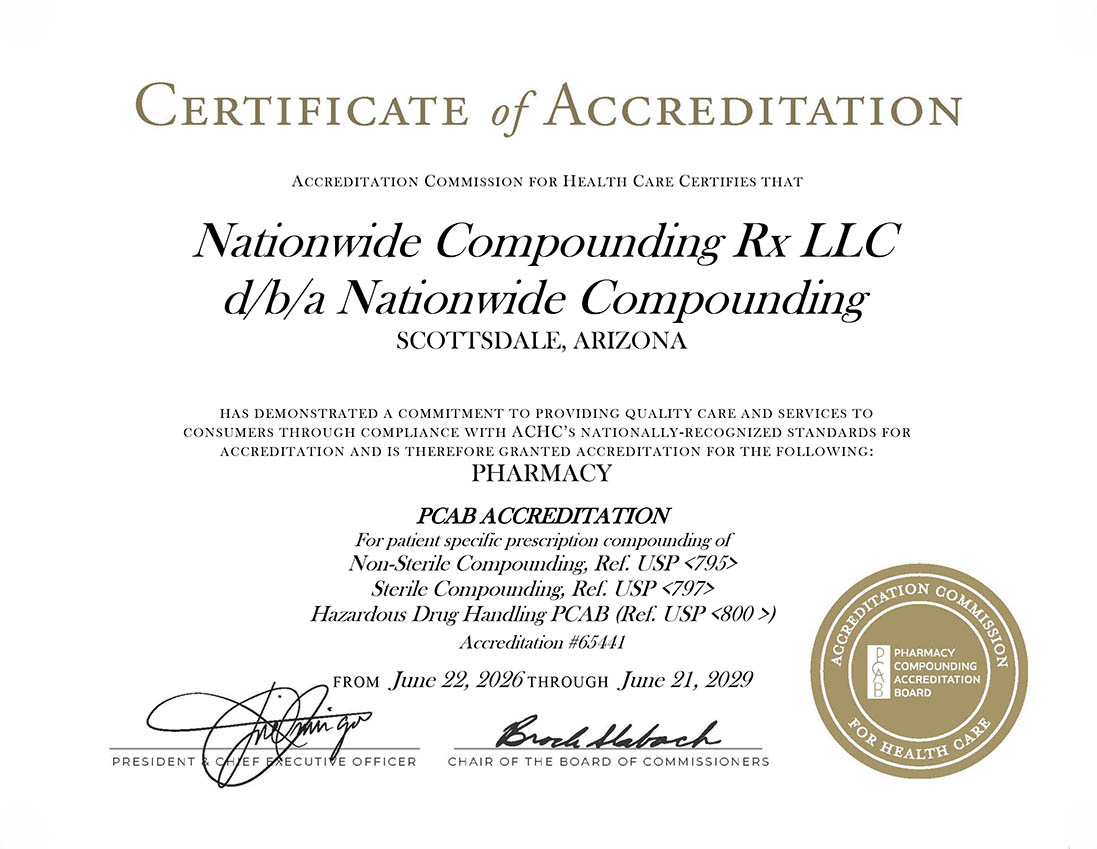
PCAB accreditation, now administered by the Accreditation Commission for Health Care (ACHC), is voluntary. Neither federal law nor Texas licensure requires it. Patients should not assume a pharmacy is accredited just because it compounds.
According to industry sources, fewer than 1% of U.S. compounding pharmacies hold PCAB accreditation. When a pharmacy has it, that is a meaningful sign of quality. When a pharmacy lacks it, that is not illegal.
PCAB verifies compliance with USP <795> for non-sterile compounding and USP <797> for sterile compounding, adding a quality layer on top of TSBP licensure without replacing it.
The trend points toward stricter requirements. As of 2026, Washington and Ohio require verifiable PCAB accreditation for nonresident compounding pharmacy licensure. Texas does not yet require it, but the direction is clear.
How to Verify Your Pharmacy’s License Class in Under Five Minutes
Patients can confirm a pharmacy’s legal standing with a short routine:
- Find the license number. It often appears on the prescription label, the pharmacy’s website, or in its paperwork. If it is not listed, ask for it.
- Search the TSBP public license lookup. The Texas State Board of Pharmacy provides a free online license verification tool.
- Confirm the license class. Look for A, A-S, C, C-S, E, or E-S. Sterile products require an “S” designation.
- Confirm the license is active and in good standing. Check for expiration and for any disciplinary actions.
- Ask the pharmacy directly. Ask whether the specific medication is sterile or non-sterile, and whether it falls within the pharmacy’s licensed class.
Bonus quality check: Search the ACHC public directory to confirm PCAB accreditation. Treat this as an extra quality signal, not a legal requirement.
Local history shows why these checks matter. Houston-area compounding has seen serious quality controversies. The region’s dominant player has accumulated a decade of FDA warning letters. A pharmacy’s size, reputation, or years in business do not confirm that it is compliant today.
The Woodlands’ Local Options in This New Regulatory Context
The Woodlands Compounding Pharmacy has been the established local provider since 2008. According to TWCP’s own “About Us” page, its founder, Jasper Lovoi, is a member of the International Academy of Compounding Pharmacists and the Texas Pharmacy Association. Its services include BHRT, pain management, pediatrics, weight loss, and veterinary compounding, plus male and female hormone replacement therapy and pharmaceutical-grade cosmetics. Several of these categories overlap directly with the products affected by the new sterile rule.
TWCP’s public materials emphasize staff tenure and community relationships. They do not prominently display PCAB accreditation or TSBP license class details. That does not suggest any lack of compliance. It simply means patients should ask for this information instead of assuming it.
Credential transparency is becoming a competitive expectation in the area. Nearby independents, including Magnolia-area pharmacies serving Tomball, The Woodlands, and greater Houston, now market PCAB accreditation as a selling point.
None of this is meant to steer patients away from a local pharmacy. The point is to ask any provider the same two questions:
- Does the pharmacy hold the correct license class for this specific compound?
- Is the pharmacy currently compliant with the amended sterile rule?
Evaluating a Nationally Licensed Alternative: What to Look For
Some patients have good reasons to consider an out-of-state pharmacy for BHRT, GLP-1, or dermatology refills. Pharmacies built around compounding often maintain sterile compliance systems across many states.
Nationwide Compounding Rx®, based in Scottsdale, Arizona, offers a useful example of what to confirm. Patients should verify:
- PCAB accreditation: The pharmacy states that it is PCAB accredited.
- USP <800> compliance: The pharmacy states that it complies with USP <800> standards for handling hazardous drugs.
- Class E-S licensure in Texas: This must be confirmed for the specific sterile medication, using both the pharmacy and the TSBP lookup.
- Independent third-party testing: The pharmacy reports using third-party testing and sourcing chemicals from FDA-inspected vendors.
Patients should also ask practical questions of any pharmacy, local or national:
- Turnaround time: Nationwide Compounding Rx® cites 1 to 2 business days.
- Refill and portal systems: Secure patient and provider portals make prescription management easier.
- BHRT flexibility: Ask whether formulas can be adjusted at each refill based on updated labs.
The deciding factor should be documentation, not marketing. Patients should ask any pharmacy to confirm in writing its license class and current sterile compliance status.
Conclusion: Informed Verification, Not Brand Loyalty, Is the New Standard
Since March 1, 2026, Texas oversight of sterile compounding has been materially stricter. The compounds most common among Woodlands patients, including BHRT, GLP-1s, and select dermatology products, are directly affected.
A trusted local name or long track record does not replace a current, verifiable TSBP license in the correct class (A-S or E-S) and compliance with the amended rule. Patients should treat license and accreditation checks as a routine they repeat, not a one-time decision. This matters most for prescriptions refilled over months or years.
Next Step: Confirm Your Prescription Is Being Filled Correctly
Before the next refill, patients should confirm their current pharmacy’s license class and sterile compliance status. The process takes only a few minutes.
For patients who want a documented, nationally licensed alternative for BHRT, GLP-1, or dermatology compounds, Nationwide Compounding Rx® is a PCAB-accredited, USP <800>-compliant option. Patients and providers should contact the pharmacy team directly to confirm Texas Class E-S licensing for the specific medication needed.
Contact Nationwide Compounding Rx®:
- Phone: (480) 499-8379
- Fax: 480-699-5341
- Hours: Monday to Friday, 7:00 AM to 3:30 PM (Arizona time)
- Address: 14000 N. Hayden Rd., Suite 104, Scottsdale, AZ 85260
- Website: nationwidecompounding.com
Providers can submit and track prescriptions through the secure Provider Portal. Patients can manage refills and support requests through the Patient Portal. Once licensing for the specific medication is confirmed, new and transferred prescriptions typically ship within 1 to 2 business days.
Related Posts

When OptumRx Specialty Pharmacy denies, delays, or refuses to fill a prescription, patients are often left without clear next steps. This guide breaks down how routing and prior authorization actually work, how to spot an appealable denial, and explores credentialed compounding pharmacies as a 2026 alternative when OptumRx structurally can't help.

Not every badge on a compounding pharmacy online means the same thing. This 2026 guide breaks down PCAB accreditation, state licensure, and NABP/LegitScript verification so you can confirm legitimacy before trusting a prescription to the mail.

SureCare Specialty Pharmacy serves two kinds of searchers: those needing basic contact details and those questioning its safety record after 2026 news coverage. This guide covers both, explaining why SureCare is a small 503A compounding pharmacy, not an accredited specialty pharmacy, and how patients can evaluate it accordingly.
NYU Langone Specialty Pharmacy is built to dispense FDA-approved, manufacturer-supplied drugs, but that leaves a gap for patients needing compounded, custom-dose, or allergen-free medications. This article explains why the fixed formulary falls short in 2026 and how NYU patients can access patient-specific compounding alongside their existing care team.