
OptumRx Specialty Pharmacy Denied a Prescription? 2026 Alternatives
Introduction: When Optum Specialty Pharmacy Becomes a Roadblock, Not a Solution
The scenario is familiar to many patients. A provider sends a new prescription, OptumRx routes it to Optum Specialty Pharmacy, and the patient hits a wall: a denial, a weeks-long delay, or a blunt message that the pharmacy “can’t fill this.”
This article does not re-examine OptumRx’s formulary PDFs line by line. Instead, it focuses on the operational reality patients face: mandatory routing, specialty-only dispensing limits, and the prior authorization (PA) and denial cycle. It explains how routing works, which rights OptumRx’s own published policies grant members, how to tell an appealable denial from a structural one, and when custom compounding becomes a legitimate next step.
This is educational guidance, not legal or clinical advice. Where OptumRx structurally cannot help, accredited compounding pharmacies such as Nationwide Compounding Rx® offer a credentialed option worth understanding.
What Optum Specialty Pharmacy Is, and Why Patients Are Routed There
Optum Specialty Pharmacy is the dispensing arm affiliated with OptumRx, the pharmacy benefits manager (PBM) owned by UnitedHealth Group. It was formerly branded BriovaRx. In 2019, OptumRx acquired Diplomat Specialty Pharmacy for roughly $300 million, after which it claimed to be the largest independent specialty pharmacy in the United States.
In 2026, the National Association of Specialty Pharmacy (NASP) named Optum Specialty Pharmacy its Specialty Pharmacy of the Year. That recognition speaks to industry positioning, but an award does not resolve the patient-level friction that leads people to search for alternatives.
The PBM-Specialty Pharmacy Connection
OptumRx operates on both sides of the transaction. As the benefits manager, it helps decide what gets covered. As the owner of the specialty pharmacy, it dispenses what it covers. This vertical integration is a structural conflict of interest, and it is worth naming plainly.
The scale is enormous. According to industry analysis from Drug Channels, OptumRx managed $188 billion in total drug spend in 2025, with $87 billion (46%) classified as specialty pharmaceuticals. Equivalent claims grew 2.2% year over year to 1.659 billion.
OptumRx also held roughly 23% of U.S. prescription claims in 2024 as one of the “Big Three” PBMs, which together processed about 80% of all claims. For many members, that concentration is why routing to Optum Specialty Pharmacy feels inevitable.
How OptumRx Defines “Specialty Medication”
OptumRx describes specialty medications as high-cost injectable, oral, infused, or inhaled drugs that may be self-administered or provider-administered and often require special storage or handling, such as refrigeration.
This definition matters operationally. It is the gatekeeping criterion that determines whether a prescription can be filled at Optum Specialty Pharmacy at all.
The Structural Limits Patients Actually Hit
Understanding what Optum Specialty Pharmacy is only goes so far. The more pressing question is where the system breaks down in practice.
Mandatory-Use and “White Bagging” Mandates
Some plans require white bagging, in which the pharmacy ships a drug directly to the provider’s office for administration. Others mandate specialty routing before a prescription can move forward.
OptumRx also maintains an exclusive specialty drug list. Drugs on this list are covered only when filled through Optum Specialty Pharmacy, with a narrow exception if OptumRx cannot deliver the drug in a timely manner.
The Specialty-Only Dispensing Restriction
OptumRx states explicitly that Optum Specialty Pharmacy can only fill specialty medications. Non-specialty prescriptions are sent back to home delivery or a retail pharmacy.
This creates real confusion when a treatment plan includes both types. A patient managing a chronic condition might receive an injectable biologic from Optum Specialty Pharmacy, a supporting oral medication by mail, and a short-term prescription from a local retailer. Three pharmacies, three refill schedules, and three customer service lines make missed doses and miscommunication more likely.
Multi-State Routing “Where Allowed by Law”
On its specialty website, OptumRx discloses that it offers pharmacy services in all 50 states and may process prescriptions at any Optum Specialty Pharmacy location “where allowed by law.”
In practice, a prescription may be filled at a facility in another state. That can add shipping time, complicate cold-chain handling, and reduce continuity with a pharmacist who knows the patient’s history.
Know Your Rights: What OptumRx’s Own Policies Actually Say
Many patients assume they have no choice. OptumRx’s own materials, however, disclose member rights that are rarely communicated proactively.
The Member Right to Request Other In-Network Pharmacies
OptumRx acknowledges in patient materials that other in-network pharmacies can sometimes be available. Mandatory use is not always absolute.
The practical step is simple: patients can ask OptumRx directly, in writing, whether an in-network alternative exists for their specific drug before assuming Optum Specialty Pharmacy is the only route.
The Narrow Exception for Delivery Delays
The exclusive specialty drug list includes an exception if OptumRx cannot deliver a drug in a timely manner. This is a leverage point patients can cite when shipments stall.
Invoking it requires evidence. Patients should document:
- Dates the prescription was sent and acknowledged
- Promised and actual ship dates
- Call logs, including representative names and reference numbers
- Any missed doses or clinical consequences
Inside the Prior Authorization and Denial Cycle
Even patients who are “approved for” Optum Specialty Pharmacy often find their care stalls. The prior authorization process accounts for much of that delay.
How Prior Authorization Actually Works
Benefits verification before a specialty prescription ships typically takes 3 to 7 business days. Prior authorization requires the prescriber’s office to submit clinical documentation for OptumRx’s review.
Providers must call a dedicated patient care coordinator line or submit enrollment forms, and PA requests go through fax lines separate from general customer service. When a patient calls one line and the provider faxes another, each side may receive different information.
Why Denials Happen, and Why Many Are Avoidable
A meaningful share of specialty and GLP-1 PA denials stem from documentation gaps rather than outright clinical ineligibility. Many are appealable once complete records are submitted.
Common patient-reported issues include:
- PAs approved, then reversed
- Multi-week shipment delays
- Inconsistent information from different representatives
- Denials despite documented medical necessity
What the Complaint Data Shows
OptumRx’s Trustpilot score sits around 1.3 to 1.5 out of 5, with recurring complaints about refill delays, long hold times, and forced pharmacy switches. This is not an attack on the company; it is context for why patients are looking for structured, actionable alternatives rather than relying on complaint forums alone.
2026 Formulary Shifts Are Pushing More Patients Toward Alternatives
Operational friction is only one layer. Coverage decisions in 2026 have added another.
New Exclusions and the Copaxone Example
OptumRx’s January 2026 Premium Formulary added 12 new exclusions. Only one specialty drug was affected: brand Copaxone 40mg, impacting an estimated 0.56% of members and 0.84% of total drug spend.
In migraine care, Ajovy was removed from the 2026 formulary, while the previously excluded Emgality returned as the preferred alternative. Formulary churn like this can force patients to switch medications mid-treatment for reasons unrelated to their clinical response.
GLP-1 Coverage Restrictions
The January 2026 update excluded 10 drugs from the Select Formulary and 11 from the Premium Formulary in the GLP-1 space. Some Select Standard plans cover only Zepbound auto-injector pens (not vials), and some exclude weight-loss GLP-1s entirely.
Compounded semaglutide and tirzepatide are categorically not covered by OptumRx or any major commercial PBM, including CVS Caremark and Express Scripts. The reason is structural rather than clinical: compounded medications lack an NDC code, which is required for claims adjudication.
The Regulatory Backdrop Shaping 2026 Policy
In September 2024, the FTC sued OptumRx, Caremark, and Express Scripts over alleged anticompetitive rebate practices that inflated insulin list prices. OptumRx reached a tentative settlement in mid-2026, the last of the three to settle.
As part of that resolution, OptumRx committed to greater transparency about how drug costs move through the supply chain. The episode shows that regulators also recognize structural issues in how PBM-owned pharmacy businesses operate.
The Documented Coverage Gap: When OptumRx’s Formulary Points to a Compound It Will Not Dispense
On certain OptumRx exclusion lists, the listed “formulary alternative” for brand-name macular degeneration drugs (Beovu, Byooviz, Lucentis) is “Compounded Bevacizumab inj.”
Optum Specialty Pharmacy, however, dispenses FDA-approved, pre-manufactured medications. It cannot fill the very alternative its own formulary names.
This is the clearest illustration of the gap. The PBM’s documents acknowledge that a compounded preparation is the appropriate option, yet the PBM-owned pharmacy cannot provide it. Accredited compounding pharmacies exist precisely to fill gaps like this one.
When a Denial Is Not the Final Word: Legitimate Next Steps
A denial or routing restriction is a process checkpoint, not necessarily a dead end.
Step 1: Request the Denial Reason and Appeal With Complete Documentation
Patients should request the specific denial code and reason in writing, then work with the prescriber’s office to resubmit any missing clinical documentation. Because many denials stem from paperwork gaps, a well-documented appeal often succeeds.
Step 2: Ask Directly About In-Network Alternatives
Members can invoke the right to request other in-network pharmacies and, where applicable, the delivery-delay exception. Keeping a written record of every communication provides leverage if a dispute escalates.
Step 3: Recognize When the Problem Is Structural, Not Appealable
Some situations cannot be solved by any appeal:
- The drug or strength has been discontinued
- The medication is categorically excluded, such as compounded GLP-1s
- The patient needs a formulation no manufacturer produces, such as a non-standard dose, an allergen-free version, a flavored pediatric form, or BHRT adjusted to lab results
These are the cases where compounding becomes the appropriate path.
Custom Compounding: The Legitimate Path When OptumRx Structurally Cannot Help
Compounding is not a workaround to PBM rules. It is a distinct, licensed category of pharmacy practice designed for exactly these situations. An estimated 30 to 40 million compounded prescriptions are filled in the U.S. each year.
Situations Compounding Solves That Specialty Pharmacy Cannot
- Discontinued or unavailable strengths: Recreating doses no longer manufactured
- Allergen-free formulations: Preparations free of dyes, fillers, preservatives, and common allergens
- Pediatric needs: Age- and weight-specific doses in flavored liquids, popsicles, or suckers
- Adjustable BHRT: Hormone formulas modified at each refill based on lab results
- Topical pain management: Creams, gels, and ointments that localize treatment and reduce systemic side effects
The compounded bevacizumab example remains the most striking case: a PBM’s own formulary names a compounded solution it cannot provide in-house.
What Makes a Compounding Pharmacy a Credible Alternative
Not all compounding is equal. Patients and providers should look for:
- PCAB accreditation from the Pharmacy Compounding Accreditation Board
- USP 800 compliance for handling hazardous drugs
- Independent third-party testing to verify potency and consistency
- Sourcing from FDA-inspected and cleared vendors
These markers separate legitimate, accredited compounding from unregulated outside sellers, which is essential for patient safety.
How Nationwide Compounding Rx Works With Patients and Providers
Nationwide Compounding Rx®, based in Scottsdale, Arizona, follows a four-part partnership framework: Connect → Collaborate → Create → Care. Providers use a secure Provider Portal to submit and track prescriptions, while patients use a Patient Portal to manage accounts and refill requests.
Practical differentiators include:
- 1 to 2 business day turnaround, with same-day pickup for some medications
- Nationwide shipping, tiered by state licensing and medication type
- Both sterile and non-sterile formulation capability
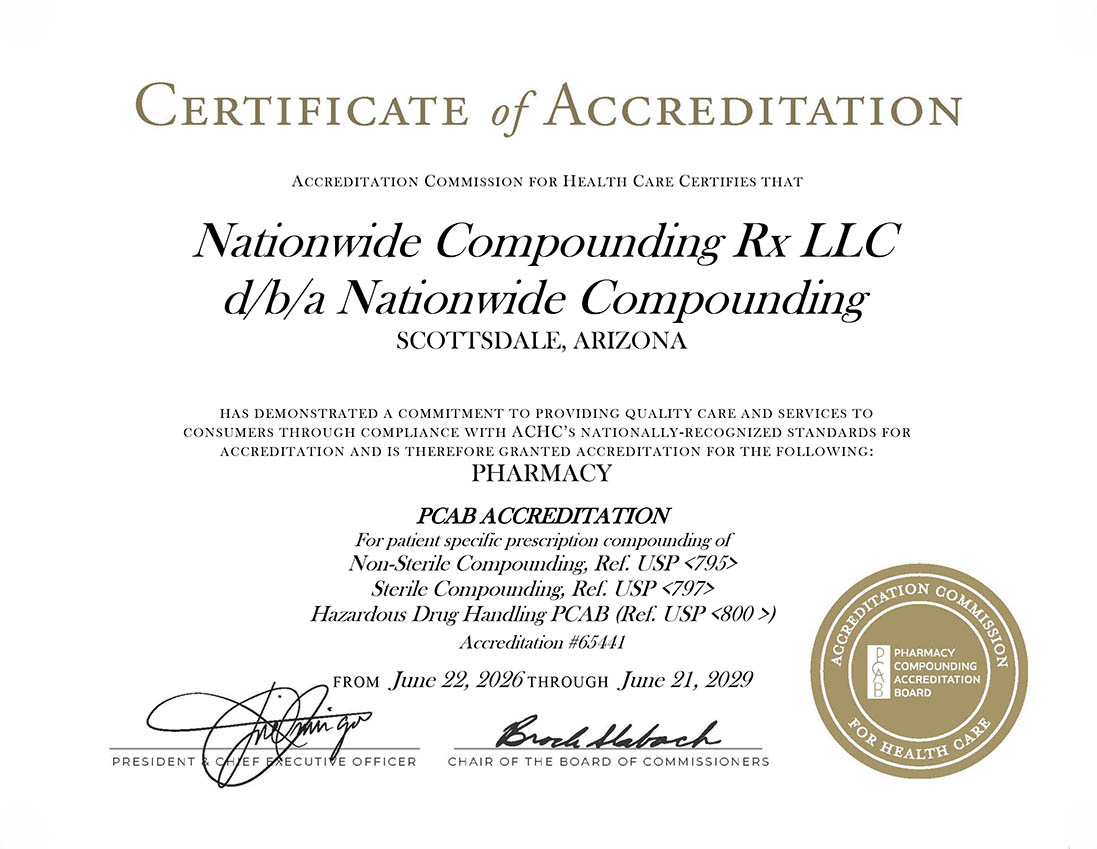
- PCAB accreditation, USP 800 compliance, and 40+ years of combined team experience
Its specialties align closely with the needs of patients displaced from standard specialty channels: BHRT, pain management, dermatology, pediatrics, sports medicine, and GLP-1/peptide support.
How to Get Started With a Compounding Pharmacy After a Specialty Pharmacy Denial
What Providers Need to Submit
Providers can use the Provider Portal to submit a compounded prescription along with clinical rationale, particularly when documenting medical necessity for a customized formulation. Including OptumRx denial or exclusion documentation helps streamline intake and clarifies why a commercial product is not appropriate.
What Patients Should Expect
Patients can manage refills and support requests through the Patient Portal. Turnaround is typically 1 to 2 business days, and shipping availability depends on the patient’s state licensing tier and the medication type (sterile or non-sterile).
Compounding is an ongoing-care model rather than a one-time transaction. BHRT patients, for example, may have formulas adjusted at each refill as new lab results come in.
Conclusion: Understanding the System Is the First Step Toward Getting the Medication Needed
Optum Specialty Pharmacy’s mandatory routing, specialty-only restriction, and PA and denial cycle are structural, published features of the system. They are not proof that patients have no options.
Many denials are appealable with complete documentation. Some restrictions carry documented exceptions, including in-network alternatives and the delivery-delay provision. And some situations are structurally unsolvable within a PBM-owned specialty model, which is precisely where accredited compounding fits.
Custom compounding is best viewed as a credentialed, collaborative complement to standard specialty pharmacy care, especially for formulation-specific needs that no manufacturer addresses.
Talk to Nationwide Compounding Rx About Available Options
Patients whose prescriptions were denied, excluded, discontinued, or require customization can contact Nationwide Compounding Rx® at (480) 499-8379 (Monday through Friday, 7:00 AM to 3:30 PM) or through the website contact form and Patient Portal.
Providers can use the Provider Portal to begin the Connect → Collaborate → Create → Care process for an affected patient.
With PCAB accreditation, USP 800 compliance, independent third-party testing, and FDA-inspected sourcing, Nationwide Compounding Rx® offers a safe, legitimate next step when the standard specialty pharmacy system cannot meet a patient’s needs.
Related Posts

The Woodlands compounding pharmacy patients rely on for BHRT, GLP-1, and specialty prescriptions now face a major regulatory shift. Learn what Texas's 2026 sterile compounding rule change means and how to verify any pharmacy's legal qualifications in minutes.

Not every badge on a compounding pharmacy online means the same thing. This 2026 guide breaks down PCAB accreditation, state licensure, and NABP/LegitScript verification so you can confirm legitimacy before trusting a prescription to the mail.

SureCare Specialty Pharmacy serves two kinds of searchers: those needing basic contact details and those questioning its safety record after 2026 news coverage. This guide covers both, explaining why SureCare is a small 503A compounding pharmacy, not an accredited specialty pharmacy, and how patients can evaluate it accordingly.

NYU Langone Specialty Pharmacy is built to dispense FDA-approved, manufacturer-supplied drugs, but that leaves a gap for patients needing compounded, custom-dose, or allergen-free medications. This article explains why the fixed formulary falls short in 2026 and how NYU patients can access patient-specific compounding alongside their existing care team.