Compounding Pharmacy Near Me: Why Nationwide Beats Local in 2026
Introduction: When ‘Near Me’ Doesn’t Mean What You Think
A patient leaves a doctor’s office with a prescription for a bioidentical hormone cream, a flavored pediatric suspension, a topical pain compound, or a custom dermatology formulation. The next step feels obvious: pull out a phone and search “compounding pharmacy near me.” The expectation is simple. A nearby pharmacy will appear, fill the prescription, and have it ready by tomorrow.
That expectation is shared by millions. Semrush data from 2026 puts “near me” keyword variants at roughly 7.1 million monthly searches, and Glimpse estimates more than 200 million “near me” searches every month overall. According to BrightLocal’s local SEO research, 46% of consumers say they “always” or “often” add “near me” to local queries, and Google increasingly infers local intent even when the phrase is never typed.
These searches carry real urgency. Google reports that 76% of people who conduct a local mobile search visit a business within a day. For someone who needs medication, a poor or empty search result is more than an inconvenience. It can mean delayed treatment.
For compounding specifically, the “near me” model rests on a broken assumption. In 2026, the pharmacy that best serves a patient is rarely the one with the closest map pin. True proximity is better measured by speed, licensing, and reliability, and redefining “near” in those terms is what actually satisfies the searcher’s intent.
The Math Doesn’t Work: Why Compounding Pharmacies Aren’t Actually ‘Near’ Most People
The core problem is scarcity. There are approximately 7,500 compounding pharmacies in the United States, compared with tens of thousands of standard retail pharmacy locations. That gap alone reshapes what a local search can deliver.
The FDA estimates that only about 1% to 3% of all dispensed U.S. prescriptions are compounded medications. Because the volume is comparatively small, compounding pharmacies tend to cluster in select metro areas rather than appearing in every town the way a standard retail chain pharmacy does.
For searchers in mid-size cities and rural areas, the practical results are frustrating:
- Empty map packs, with no genuine compounding option returned at all
- Misleading listings, where a pharmacy appears on Google but does not compound the specific formulation needed
- Long drives, sometimes 45 minutes or more, to reach the nearest real option
Retail chain locator pages add to the confusion, as large retail pharmacy chains often rank well for “medication compounding near [city]” queries. Yet these locations typically offer only limited compounding capability. The result is a false sense of local availability that can cost patients time they may not have.
The Accreditation Gap Nobody’s Search Result Shows You
Even when a local compounding pharmacy exists, proximity reveals nothing about quality. The industry’s most meaningful quality benchmark is PCAB accreditation (Pharmacy Compounding Accreditation Board), administered by ACHC. PCAB standards align with the USP chapters that govern compounding:
- USP <795> for non-sterile preparations
- USP <797> for sterile preparations
- USP <800> for hazardous drug handling
These are the same chapters most state boards enforce, and PCAB verifies that a pharmacy’s practices genuinely meet them.
The critical fact is how rare this credential is. Fewer than 1% of U.S. pharmacies hold PCAB accreditation, roughly 68 out of approximately 7,500 compounding pharmacies nationwide. The bar has also risen: updated, more stringent PCAB standards took effect June 1, 2024, widening the gap between accredited and non-accredited operations.
A Google Maps pin or a high star rating says nothing about accreditation, USP 800 compliance, or whether a pharmacy has ever been inspected. That last point matters more than many patients realize, because half of all states do not conduct routine inspections of 503A pharmacies.
The conclusion is straightforward. The “nearest” pharmacy on a map is frequently not accredited. Proximity and quality are two entirely separate variables, and a standard local search only measures one of them.
Reframing ‘Near’: From Physical Distance to Speed and Reliability
The central reframe for 2026 is this: “near” should mean how fast and reliably a pharmacy can deliver the exact formulation prescribed, not how many miles away it sits.
A useful three-part test for true proximity:
- Can the pharmacy actually make the specific formulation? Strength, dosage form, base, flavor, and allergen requirements all matter.
- Is the pharmacy licensed to legally ship to the patient’s state? Without proper licensure, distance is irrelevant.
- How quickly will the medication arrive? Turnaround time and backlog determine real-world access.
By this standard, a PCAB-accredited, USP 800-compliant pharmacy offering 1 to 2 business day turnaround with nationwide shipping is functionally closer than a local pharmacy with a multi-week backlog or one that does not stock the needed ingredients.
Consider the behavior pattern described earlier: most local mobile searchers visit a business within a day. The underlying goal is speed. Nationwide shipping paired with fast turnaround can match or beat that urgency timeline, while also delivering verified quality that a nearby, unaccredited option cannot guarantee.
The Hidden Reason Most Local Compounders Can’t Serve You Anyway: State Licensing
Licensing is the invisible barrier behind many failed searches. To legally ship compounded medications across state lines, a 503A pharmacy must hold a nonresident pharmacy license in every destination state. Each license carries application costs, renewal obligations, and ongoing compliance requirements.
Most small local compounding pharmacies never pursue multi-state licensure. As a result, many are confined to their home state or a handful of neighboring ones, even if they would like to help a patient elsewhere.
The regulatory landscape is also shifting quickly. Recent state-level changes include:
- Massachusetts (new rules in 2025)
- Ohio (February 2026)
- Washington
- Kentucky
- California (rules effective October 2025)
- Florida
Each has enacted new or stricter compounding requirements across 2025 and 2026. At the federal level, the pending SAFE Drugs Act (H.R. 6509, introduced December 9, 2025) would require pharmacies shipping more than 20 out-of-state prescriptions of a drug to report that activity to the FDA, a sign that nationwide shippers face growing regulatory scrutiny.
A notable trend is accreditation becoming a licensing requirement. Washington and Ohio now require PCAB accreditation for nonresident pharmacy licensure, signaling that accreditation is becoming a de facto national standard for any pharmacy that wants to reach patients across state lines.
Taken together, these facts point to one conclusion. A pharmacy that publishes a transparent, state-by-state licensing map is not simply offering convenience. It is demonstrating a level of regulatory investment most local pharmacies have never made.
What’s Actually Driving ‘Near Me’ Compounding Searches in 2026
The patients behind these searches typically fall into a few major categories of need:
- BHRT, HRT, and TRT for menopause, andropause, and hormonal imbalance
- Pediatric dosing, including age- and weight-specific strengths in palatable forms
- Pain management topicals that localize treatment and limit systemic exposure
- Dermatology formulations for acne, rosacea, eczema, psoriasis, and aging skin
- Sports medicine and recovery compounds
The GLP-1 landscape has shifted this mix considerably. The FDA declared the tirzepatide shortage resolved in late 2024 and the semaglutide shortage resolved on February 21, 2025, ending the primary legal basis for broad compounding of these drugs. Grace periods closed in April and May 2025, with 503A pharmacies given until April 22, 2025, and 503B outsourcing facilities until May 22, 2025. In March 2026, the FDA issued more than 30 warning letters to telehealth companies over illegal marketing of compounded GLP-1 products.
That pullback is redirecting compounding demand toward hormone therapy as telehealth companies pivot into BHRT and TRT. One market estimate puts HRT at a 33.9% share of the compounding market in 2026, meaning more patients than ever are searching for hormone compounding specifically.
These are exactly the categories where formulation-specific expertise and lab-based adjustability matter far more than physical proximity. A hormone protocol that is refined with each set of lab results depends on a pharmacy’s precision and consistency, not its street address.
Why Nationwide Compounding Rx® Answers ‘Near Me’ Better Than a Local Search Result
Nationwide Compounding Rx®, based in Scottsdale, Arizona, is built around the reframed definition of “near” described above.
Accreditation and compliance. The pharmacy is PCAB accredited and USP 800 compliant, placing it within the sub-1% tier of U.S. compounding pharmacies by recognized trust and safety standards.
Speed that matches urgency. Nationwide Compounding Rx® offers a 1 to 2 business day turnaround, with same-day pickup available for some medications. That timeline directly addresses the urgency behind “near me” intent.
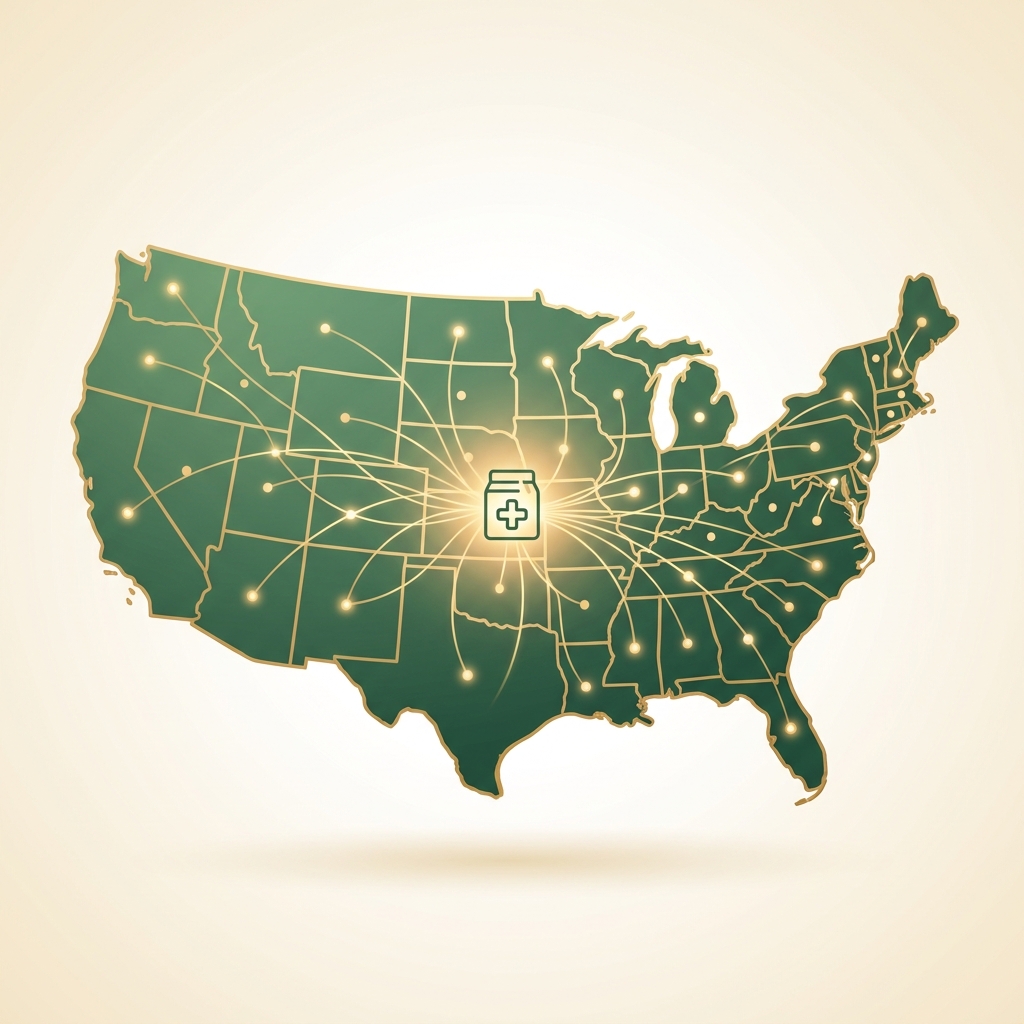
Transparent licensing. The pharmacy publishes a three-tier state shipping map:
- Fully licensed states
- Non-sterile only states (sterile licensure pending)
- Sterile and non-sterile pending, or unlicensed states
This allows any patient to check real-world “nearness” based on legal shipping eligibility rather than guesswork. Availability varies by medication type, state regulations, and prescription requirements.
Breadth of formulation capability. The pharmacy produces both sterile and non-sterile preparations across the categories driving current demand:
- BHRT, with formulas adjustable at each refill based on updated lab results
- GLP-1 and peptide support
- Pain management topicals
- Dermatology formulations
- Pediatrics, including flavored liquids, popsicles, and suckers in options such as cherry, bubblegum, and marshmallow
- Sports medicine
Dosage forms include capsules, liquids, creams, gels, ointments, troches, lozenges, oral and sublingual tablets, and suppositories. Formulations can be prepared free of dyes, fillers, preservatives, and allergens, and discontinued or unavailable strengths can be recreated.
Quality infrastructure. Nationwide Compounding Rx® uses independent third-party testing and sources high-grade chemicals exclusively from FDA-inspected and cleared vendors. Its team brings more than 40 years of combined experience.
A modern, collaborative model. Providers work with the pharmacy through a structured framework: Connect, Collaborate, Create, Care. Separate secure portals serve each audience. The Provider Portal supports prescription submission, order tracking, and direct communication, while the Patient Portal handles account information and refill or support requests. It is a tech-enabled alternative to a walk-in counter.
How to Evaluate Any Compounding Pharmacy — Local or Nationwide
Whichever pharmacy a patient ultimately chooses, a consistent checklist helps separate genuine options from map listings:
- Verify PCAB accreditation status directly rather than relying on marketing claims.
- Confirm USP <795>, <797>, and <800> compliance as relevant to the medication.
- Check state licensing for the patient’s specific location.
- Ask about turnaround time and current backlog before submitting a prescription.
- Confirm sourcing and testing practices, including whether independent third-party testing is performed.
Patients should also ask directly whether a pharmacy can produce their exact formulation before assuming a nearby result is viable. Finally, cross-referencing a pharmacy’s published licensing map is one of the fastest ways to confirm it can legally serve a given state.
Conclusion: Redefining ‘Near’ for a Scarce, Specialized Industry
With only about 7,500 compounding pharmacies nationwide and fewer than 1% holding PCAB accreditation, the traditional “near me” search model breaks down for this category. Map results measure distance, but they say nothing about capability, compliance, or legal ability to serve a patient’s state.
True proximity in 2026 is measured by accreditation, compliance, licensing transparency, and shipping speed. Patients searching “compounding pharmacy near me” are better served by asking a different question: which pharmacy can legally and reliably deliver the exact medication fastest?
For patients in any of its licensed states, Nationwide Compounding Rx® represents that reframed definition of “near” in practice.
Get Started with Nationwide Compounding Rx®
Before concluding that no compounding options exist nearby, patients can check their state’s status on the pharmacy’s state-by-state shipping map at nationwidecompounding.com.
- Patients can begin through the Patient Portal to manage accounts, refills, and support requests.
- Providers can use the Provider Portal to submit prescriptions and start the Connect, Collaborate, Create, Care process.
Contact Nationwide Compounding Rx®:
- Phone: (480) 499-8379
- Website: nationwidecompounding.com
- Hours: Monday through Friday, 7:00 AM to 3:30 PM (Arizona)
- Email: Available through the website contact form, with inquiries answered within one business day
The nearest compounding pharmacy might not be down the street. It might be one order away.
Related Posts
Choosing a compounding pharmacy Columbus OH residents can trust now requires more than proximity. This 2026 guide walks patients and providers through verifying Ohio eLicense status, TDDD licensure, and PCAB/ACHC accreditation amid the state's tougher enforcement climate.
Searching for Morgan Compounding Pharmacy but live outside Georgia? This 2026 guide breaks down the pharmacy's location, accreditation status, and service limits, then compares it to nationwide alternatives so you can choose the right compounder for your needs.

Elite Personalized Medicine reviews consistently earn 5-star ratings, but star ratings only capture the front-desk experience. This article digs deeper into the pharmacy credentials, PCAB accreditation, and lab testing standards that truly matter for BHRT and GLP-1 patients in 2026.

The personalized medicine job market is booming, but most guides overlook compounding pharmacy as a viable entry point. This article breaks down the career lanes within personalized medicine and shows why compounding roles offer one of the most accessible paths into the field in 2026.