
Partell Specialty Pharmacy: The 2026 Name Change & FDA Guide
Introduction: Why “Partell Specialty Pharmacy” Searches Lead Somewhere New in 2026
Most people who search for “Partell Specialty Pharmacy” want quick facts: an address, a phone number, business hours. In 2026, the honest answer is more complicated than a directory listing can show.
Partell Specialty Pharmacy, legally known as One Way Drug LLC dba Partell Specialty Pharmacy, went through an ownership and name change to National Health Rx in October 2025. The Nevada State Board of Pharmacy approved that change with unusual conditions attached. The Board described Partell as a “distressed” pharmacy and required monthly inspections during the transition.
This guide covers four topics:
- The name change and what it means for current patients
- The “distressed pharmacy” designation and the monthly inspection requirement
- Partell’s FDA warning-letter history from 2014 and 2019
- A practical framework for vetting any Nevada compounding pharmacy
The stakes are highest for patients filling compounded GLP-1 weight-loss medications, hormone replacement therapy (HRT), or pediatric and pet prescriptions through Partell. The same applies to patients ordering through a telehealth brand that uses Partell as its back-end pharmacy.
Partell Specialty Pharmacy: Company Background and Core Facts
Before the 2025 transition, these were Partell’s core business details:
- Legal name: One Way Drug LLC dba Partell Specialty Pharmacy
- Founded: April 24, 2006
- Locations (historical): 5835 S Eastern Ave Ste 101, Las Vegas, NV 89119, and 8751 W Charleston Blvd Ste 120, Las Vegas, NV 89117
- Phone: (702) 791-3800
- Ownership: Robert A. Seik, listed as CEO/Owner
Partell also has a wider reach than its two storefronts suggest. It has served as a back-end dispensing pharmacy for direct-to-consumer telehealth weight-loss brands. CeliaRx names Partell Pharmacy directly on its product labels, and Joi + Blokes has also used it. These brands sit in a crowded field alongside other dispensing pharmacies such as Pharmacy Hub.
This matters because many patients never realize which pharmacy actually fills their order. A person can buy from a telehealth brand with a polished website and still receive a medication compounded and dispensed by Partell, now National Health Rx. The telehealth company’s reputation and the dispensing pharmacy’s compliance record are two separate things.
Confirmed: The October 2025 Rebrand to National Health Rx
In October 2025, the Nevada State Board of Pharmacy approved an ownership and name change for Partell Pharmacy to National Health Rx. The primary sources are the Board’s own meeting agenda and minutes, which list National Health Rx’s application for Nevada pharmacy licensure. Representatives for National Health Rx appeared before the Board to answer questions as part of the approval process.
The transition has confused customers. One 1-star review on the Better Business Bureau, posted in June 2026, describes having “previously used Partell Pharmacy before their transition to National Health RX.” The reviewer also noted that the phone number was still listed under Partell even though the business had a new name and website.
For searchers, the practical takeaway is this: anyone looking for “Partell Specialty Pharmacy” today is, in effect, looking for National Health Rx. The new name and ownership structure sit on top of the same underlying operation.
What “Distressed Pharmacy” Means and Why Nevada Mandated Monthly Inspections
During the ownership-transition approval, Nevada regulators explicitly described Partell as a “distressed” pharmacy. The term signals that the business was not in stable operating or compliance condition when the transfer took place.
The Board attached conditions to its approval. According to the Board minutes, the new owner must submit to monthly inspections for the first six months, at the owner’s own expense, along with other conditions intended to ensure compliance during the transition.
The logic is simple. Ownership changes are periods of heightened risk. Staff, procedures, and management priorities can shift quickly, and regulators want to confirm that standards hold. That concern grows when the pharmacy already has a documented compliance history.
For patients, a “distressed” designation and mandated inspections are not routine paperwork. They point to recent or ongoing compliance concerns serious enough that regulators chose to watch the operation closely.
Recent reviews also describe real-world friction. One Apple Maps and Yelp reviewer warned that the pharmacy is “very slow you need to plan a week ahead for a 30 day fill,” with roughly seven days from the initial call to pickup. Delays like this do not prove a compliance problem, but they are consistent with an operation under active regulatory scrutiny and in the middle of a transition.
Partell’s FDA Warning-Letter History: A Pattern, Not a One-Time Issue
The following details come from primary-source documentation published by the U.S. Food and Drug Administration on FDA.gov, along with contemporaneous trade press coverage. They are documented findings, not speculation.
The 2014 Warning Letter
An FDA inspection of Partell concluded on May 30, 2014, and the agency posted a warning letter on December 1, 2014. The FDA found serious deficiencies in the pharmacy’s practices for producing sterile drugs.
The letter also stated that Partell was not receiving valid prescriptions for individually identified patients for a portion of its drug products. This is a significant issue. Legitimate 503A compounding is built around patient-specific prescriptions. Producing drugs without those prescriptions looks more like mass manufacturing, which carries different legal requirements and oversight.
The 2019 Warning Letter and 2017–2018 Inspections
On March 13, 2019, the FDA issued a second warning letter. It followed inspections of Partell’s West facility in July 2017 and its East facility in February and March 2018.
The FDA stated that it had noted “serious deficiencies in Partell’s practices for producing drug products, which put patients at risk.” Among the current good manufacturing practice (CGMP) violations cited, the agency found that the pharmacy used a non-sterile cleaning agent and non-sterile cleaning wipes in the disinfection program for its aseptic processing areas. According to the FDA, this caused its drug products to be adulterated.
Partell responded in a March 29, 2018 letter to the FDA. The pharmacy stated that it had:
- Ceased all sterile compounding activities
- Stopped filling any prescriptions for sterile compounded medications
- Initiated a voluntary recall of all its sterile compounded prescriptions
Today, One Way Drug LLC (dba Partell Specialty Pharmacy) remains listed as a 503A facility on the FDA’s official “Compounding: Inspections, Recalls, and other Actions” enforcement tracking page.
What This History Means for Patients Today
The most important point is the sterile-compounding question. Partell stopped sterile compounding in 2018, and available records do not show that it resumed. That means sterile preparations, such as certain injectables, ophthalmic products, and other high-risk compounds, are not something this pharmacy should be expected to produce based on the public record.
Even so, the Partell website, now rebranded as National Health Rx, continues to market compounded semaglutide and tirzepatide weight-loss products. It also offers durable medical equipment and supplies and presents itself as a preferred provider for Department of Energy (EEOICPA) patients. Injectable GLP-1 medications are sterile products. Patients should ask directly how these products are sourced or compounded, given the documented cessation of sterile work.
The national regulatory picture adds another layer. The FDA removed tirzepatide (Zepbound/Mounjaro) from its drug shortage list in late 2024, reminding pharmacies that “compounded drugs must meet conditions to qualify for exemptions.” Semaglutide came off the shortage list by February 2025. As a result, mass-compounded copies of brand-name GLP-1 drugs are no longer broadly permitted under shortage exemptions.
Safety concerns in this category are well documented. As of early 2025, the FDA had logged more than 455 adverse event reports tied to compounded semaglutide and more than 320 tied to compounded tirzepatide. Many involved dosing errors from multi-dose vials.
Bottom line: a documented history of sterile-compounding violations combined with continued marketing of GLP-1 injectables is a red flag. Patients should verify it independently before filling a prescription.
How to Verify Any Nevada Compounding Pharmacy: A Patient Decision Framework
The four-step checklist below applies to Partell/National Health Rx and to any other compounding pharmacy a patient is considering.
Step 1: Check for PCAB (NABP Compounding Pharmacy) Accreditation
PCAB accreditation, now administered through the National Association of Boards of Pharmacy (NABP), is the industry’s recognized third-party quality credential. It is also rare: fewer than 1% of U.S. compounding pharmacies hold it. The American Medical Association specifically recommends that providers work only with PCAB-accredited pharmacies.
Action step: search the pharmacy by name in the NABP/PCAB accreditation database. Do not rely only on a badge shown on the pharmacy’s own website.
Step 2: Confirm USP <795>, <797>, and <800> Compliance
Three United States Pharmacopeia (USP) standards govern compounding quality:
- USP <795>: non-sterile compounding, such as creams, capsules, and oral liquids
- USP <797>: sterile compounding, such as injectables and ophthalmics
- USP <800>: safe handling of hazardous drugs
For Partell, USP <797> is the key standard. Sterile compounding is exactly where the documented 2014 and 2019 violations occurred.
Compliance gaps are common across the industry. According to a 2024 Pharmacy Purchasing and Products report, only 46% of hospitals report full USP <800> compliance. Compliance should be verified, never assumed.
Step 3: Run a State Licensure Lookup
Patients can use the Nevada State Board of Pharmacy’s license lookup to confirm that a pharmacy holds a current, active license. The lookup also shows disciplinary actions or conditions attached to the license.
Nevada’s shipping rules are strict. Under NRS 639.100(1)(a), any pharmacy sending compounded medication to a Nevada resident must hold the correct Nevada permit, regardless of where the pharmacy is located. In July 2021, the Board reinterpreted this rule to require more than pharmacist or pharmacy licensure alone.
Patients using out-of-state telehealth or compounding services should confirm the dispensing pharmacy’s Nevada permit status. Checking only that the telehealth brand is legitimate is not enough.
Step 4: Request a Certificate of Analysis (COA)
A Certificate of Analysis is third-party laboratory verification of a compounded medication’s potency, purity, and, where applicable, sterility. Reputable pharmacies should provide or reference independent testing results when asked.
This step matters most for injectable and sterile products such as compounded GLP-1s, given the national adverse-event record.
Where Partell/National Health Rx Stands Against This Framework
Measured against the checklist, Partell/National Health Rx shows meaningful gaps:
- A “distressed” designation with six months of mandated monthly inspections
- No sterile compounding since 2018, based on its own letter to the FDA
- Two prior FDA warning letters, both tied to drug production practices
Recent customer reports add practical concerns, including week-long fill times and phone and name confusion after the rebrand.
None of this means a patient cannot get a prescription filled there. It does mean extra diligence is warranted, especially for sterile or injectable formulations.
Closing the Gap: Why Patients Are Looking at PCAB-Accredited Alternatives Like Nationwide Compounding Rx
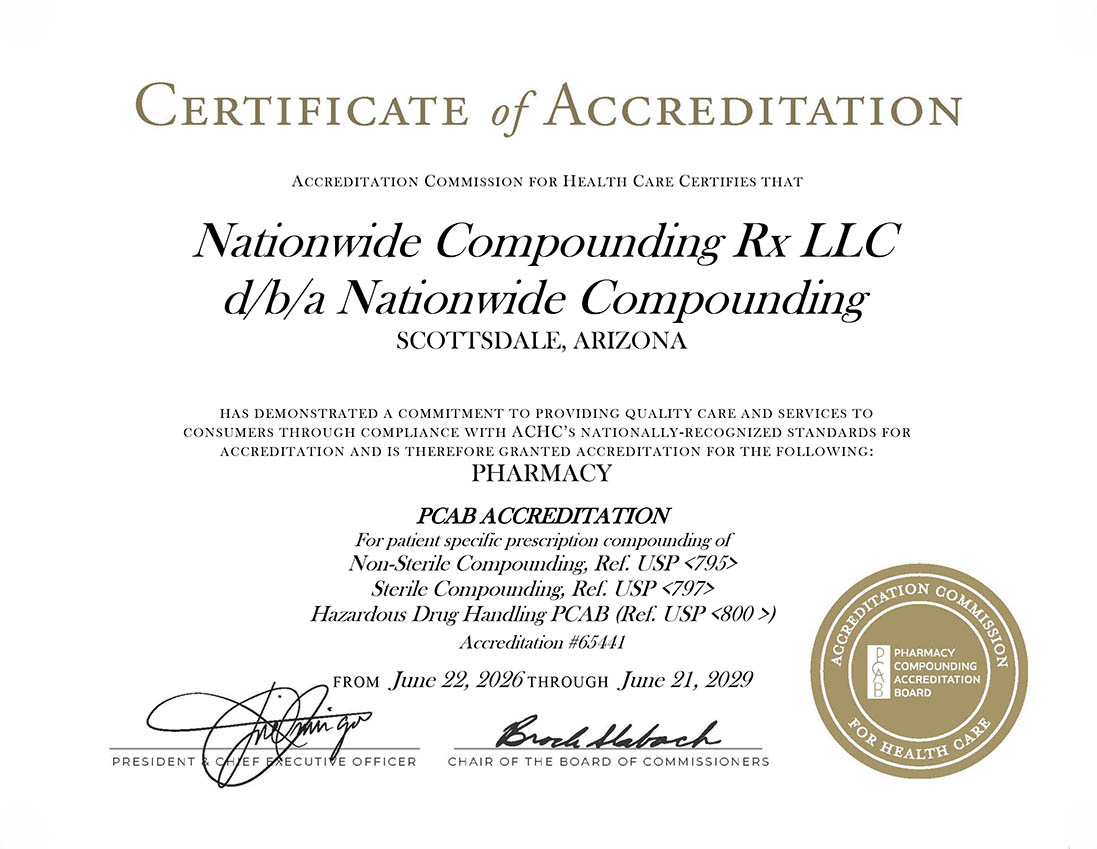
Patients who need sterile compounding, faster turnaround, or credentials they can verify often compare options. Nationwide Compounding Rx®, based in Scottsdale, Arizona, is one pharmacy that lines up with the verification standards above:
- Step 1 (Accreditation): PCAB accredited, which patients can confirm independently
- Step 2 (USP compliance): USP 800 compliant
- Sterile capability: produces both sterile and non-sterile formulations, the category Partell stopped covering in 2018
- Step 4 (Quality verification): independent third-party testing, with high-grade chemicals sourced from FDA-inspected and cleared vendors
- Turnaround: 1 to 2 business days, with same-day pickup available for some medications, compared with reported week-long waits at Partell/National Health Rx
- Step 3 (Licensure): nationwide shipping across multiple licensed states. Availability varies by medication type and state regulations, which is relevant for patients navigating Nevada’s NRS 639.100(1)(a) requirements.
Its formulation categories overlap with many former Partell patients’ needs. These include bioidentical hormone replacement therapy (adjustable at each refill based on lab results), pain management topicals, dermatology, pediatrics, sports medicine, and GLP-1/peptide support. The pharmacy also offers flavored and allergen-free formulations free of dyes, fillers, and preservatives.
Other Nevada-Licensed Alternatives Worth Comparing
Readers who prefer a local option can compare several Las Vegas-area and Nevada-licensed pharmacies:
- Solutions Specialty Pharmacy: BBB A+, Yelp 4.7 across 73 reviews
- AnazaoHealth, Las Vegas: licensed in all 50 states plus D.C.
- Meta Pharmacy Services: two Las Vegas facilities built to USP <795>/<797>/<800> standards, licensed as a nonresident pharmacy in 37 states
- American Wellness Pharmacy: multi-state licensed 503A facility
- Avella Specialty Pharmacy
- Nevada Specialty Pharmacy
Each option should go through the same four-step framework. A local address does not guarantee compliance.
Reliability matters especially in Nevada. A 2026 statewide needs assessment from the Nevada Rare Disease Advisory Council found that providers rated the availability of every category of rare disease specialty care below the midpoint. Some patients reported wait times of more than six months, and 26% of respondents cited insurance or coverage barriers. In a state with these access challenges, a pharmacy’s turnaround and dependability can directly affect care.
Conclusion: What Partell or National Health Rx Patients Should Do
The core facts are clear. Partell Specialty Pharmacy became National Health Rx in October 2025 through a Nevada Board-approved transition. The Board designated the pharmacy as “distressed” and required monthly inspections for six months.
The regulatory history is also documented. Two FDA warning letters, in 2014 and 2019, cited deficiencies in drug production, especially sterile compounding. Partell stopped sterile compounding in 2018 and voluntarily recalled its sterile compounded prescriptions.
The most useful step for any patient is to run the four-step framework before trusting a compounding pharmacy with a prescription:
- PCAB accreditation
- USP <795>/<797>/<800> compliance
- State licensure lookup
- Certificate of Analysis
That applies to Partell/National Health Rx as much as to any other pharmacy. For sterile compounding needs or faster turnaround, accredited alternatives exist that close the gaps this guide identified.
Verifying Before Filling: Contacting a PCAB-Accredited Compounding Team
Patients with upcoming GLP-1, BHRT, pain management, dermatology, pediatric, or sports medicine compounding needs can contact Nationwide Compounding Rx® to confirm licensure and shipping availability in their state.
- Phone: (480) 499-8379
- Hours: Monday through Friday, 7:00 AM to 3:30 PM
- Online: the secure Patient Portal or Provider Portal at nationwidecompounding.com
Healthcare providers can also explore the pharmacy’s Connect → Collaborate → Create → Care partnership process to set up a dependable compounding relationship.
Checking a pharmacy’s accreditation and compliance takes only a few minutes, and it is one of the strongest protections a patient has when choosing where to fill a compounded prescription.
Related Posts

Thinking about bioidentical hormone replacement therapy in Virginia? This 2026 guide breaks down the state's Nonresident Pharmacy Registration law, what recent FDA labeling changes mean for patients, and how to verify a compounding pharmacy is legally authorized to ship to your address. Learn the three essentials—legal authority, quality credentials, and clinical fit—before choosing a BHRT provider.

Can't access your account? This 2026 guide breaks down why CVS specialty pharmacy log in issues happen and how to fix them fast. Learn the difference between CVS Specialty, Caremark, and CVS.com logins, plus which support line to call for each problem.
Houston's compounding pharmacy market is booming, but 2026 recalls and a decade of FDA warning letters have exposed a critical credential gap. Discover why PCAB accreditation matters more than size or reputation, and get a practical framework for vetting any compounding pharmacy in Houston TX.

Patients searching for a compounding pharmacy in Asheville need clarity on GLP-1 rules in 2026. This guide breaks down North Carolina's regulations on compounded semaglutide and tirzepatide, plus how to verify a legitimate pharmacy before filling a prescription.