
Specialty Solutions Pharmacy: Untangling the Name in 2026
Introduction: One Search Term, Two Very Different Destinations
“Specialty solutions pharmacy” looks like a simple search, but it points to two unrelated things. Some people typing it want a specific local business. Others are trying to make sense of healthcare terminology and need to know what a “specialty pharmacy” actually is.
The first group is usually looking for Solutions Specialty Pharmacy (operated by TLGRX Corporation) in Las Vegas, Nevada. The second group uses “specialty pharmacy solutions” as a generic industry phrase, often after a doctor, insurer, or news article mentions specialty pharmacy without explaining it.
This article clears up the name, then offers a practical guide to the difference between specialty pharmacies and compounding pharmacies so readers can find the right type of provider. It does not repeat location-specific details such as licensing records or store hours, which are easy to find elsewhere. Instead, it focuses on clarity and comparison: industry definitions, accreditation standards (URAC versus PCAB and USP), market context, and a decision framework patients and prescribers can use.
The Two Meanings Behind “Specialty Solutions Pharmacy”
There is no single national brand called “Specialty Solutions Pharmacy.” The phrase mixes up a specific business name with a generic industry term. Readers usually need one of two answers, depending on what they meant.
For Readers Looking for Solutions Specialty Pharmacy in Las Vegas
Solutions Specialty Pharmacy is a real, established business operated by TLGRX Corporation, located at 8579 S Eastern Ave in Las Vegas, and in business since 2006.
The name contains an irony. Despite the word “specialty,” the pharmacy’s own Yelp listing says “We Compound” and describes the business as “primarily a compounding pharmacy.” Its services match that description: bio-identical hormones, veterinary medications, dermatological preparations, pain management, dental compounds, and neurological compounds. These are typical compounding services, not specialty pharmacy services in the formal industry sense.
According to its Henderson Chamber of Commerce listing, the pharmacists there trained through PCCA (Professional Compounding Centers of America), a network of more than 3,500 pharmacists and pharmacies. The business reports following USP <795> and <797> compounding guidelines and uses a quality assurance program that traces each prescription back to a formula log sheet.
The overlapping name is not unusual in that market. A similarly named pharmacy operates in the same Las Vegas ZIP code. Readers who need the address, phone number, hours, or customer reviews for the Las Vegas location will find current details on its BBB, Yelp, and Chamber of Commerce listings.
For Readers Searching for “Specialty Pharmacy Solutions” as an Industry Term
Many searchers are not looking for a business. They want to understand what specialty pharmacy means as a category in U.S. healthcare.
In the formal sense, a specialty pharmacy is a state-licensed pharmacy that dispenses medications to people living with rare and complex medical conditions, such as cancer, cystic fibrosis, multiple sclerosis, organ transplantation, and HIV/AIDS. That definition is quite different from what most local pharmacies with “specialty” in their names actually do, which explains why the sections below matter.
Why the Confusion Exists
The confusion is not limited to one business name. It reflects a terminology problem across the industry, one serious enough that even professional journalists and policymakers get it wrong.
SPAARx and the Media Conflation Problem
Major outlets, including The New York Times, The Wall Street Journal, The Boston Globe, and The Washington Post, have used “specialty pharmacy” and “compounding” interchangeably in their reporting. The issue became serious enough that the trade association SPAARx sent formal letters to Congress, the FDA, and state legislators to correct it, as reported by Chain Drug Review.
SPAARx put the distinction directly: “Specialty pharmacies dispense FDA-approved and commercially available medications requiring patient-specific prescriptions.” Specialty pharmacies do not make custom formulations.
The mix-up has consequences beyond wording. When lawmakers and regulators confuse the two categories, rules intended for one type of pharmacy can end up affecting the other, which can reshape how patients get their medications.
When Local Pharmacies Call Themselves “Specialty” But Mean “Compounding”
Many independent pharmacies, like the Las Vegas example, use “specialty” in their branding in an everyday sense. They mean “specialized” or “boutique” service, not the formal industry category of high-cost, insurance-integrated drug dispensing.
This naming pattern appears across the country, so a business name alone does not tell a patient what kind of pharmacy they are dealing with. The reliable way to tell the difference is to understand how each type operates and how each is regulated.
Specialty Pharmacy vs. Compounding Pharmacy: The Real Industry Distinction
This section sets out the industry-standard definitions side by side.
What a Specialty Pharmacy Actually Does
Specialty pharmacies dispense pre-packaged, FDA-approved, manufacturer-produced drugs for high-cost, complex, chronic, or life-threatening conditions. They cannot change a drug’s approved formulation; the medication is dispensed exactly as the manufacturer made it.
These pharmacies are closely tied to insurance carriers and pharmacy benefit managers (PBMs). Much of their work involves prior authorizations, benefits verification, and financial assistance programs, along with patient counseling, adherence monitoring, and care coordination for therapies that often require careful handling.
According to Drug Channels Institute, the U.S. has roughly 1,800 accredited specialty pharmacy locations, and about 40% are hospital-owned.
What a Compounding Pharmacy Actually Does
Compounding pharmacies customize medications based on individual prescriptions. They mix or alter ingredients to adjust strength, change the dosage form, add flavor, or remove allergens.
Common reasons patients use a compounding pharmacy include:
- Allergies or sensitivities to dyes, fillers, preservatives, or other inactive ingredients
- Difficulty swallowing pills
- A needed drug strength that has been discontinued
- A need for alternative forms such as creams, gels, troches, or suppositories
Compounding also acts as a safety valve during drug shortages. When a commercially manufactured drug is unavailable, a compounding pharmacy can often prepare an alternative, filling a gap that pre-packaged specialty supply chains cannot.
The operating model is more independent. Instead of being organized around PBM networks, compounding pharmacies work directly with patients and prescribers to design formulations for one person at a time.
Side-by-Side Comparison: Key Dimensions
| Dimension | Specialty Pharmacy | Compounding Pharmacy |
|---|---|---|
| Drug source | Manufacturer-produced, FDA-approved, pre-packaged | Custom-formulated from pharmaceutical-grade ingredients |
| Accreditation body | URAC | PCAB |
| Regulatory framework | Standard state pharmacy law plus payer requirements | USP <795>, <797>, <800>; 503A/503B rules |
| Typical conditions | Cancer, MS, cystic fibrosis, HIV/AIDS, organ transplant | Hormone therapy, pain, dermatology, pediatrics, allergies, shortages |
| Insurance/PBM involvement | Deeply integrated | Typically more independent |
| Personalization | None; drug dispensed as manufactured | High; strength, form, flavor, and ingredients adjustable |
| Turnaround | Often slowed by prior authorization | Often days, depending on formulation |
The main point of this comparison: compounding is a parallel category, not a smaller or lesser version of specialty pharmacy. Each serves clinical needs the other cannot.
The Regulatory Backbone: Accreditation and Compliance Explained
Accreditation is one of the clearest signals of trust for patients and providers evaluating either type of pharmacy. It shows that an independent body has reviewed the pharmacy’s processes against defined standards.
URAC Accreditation for Specialty Pharmacies
URAC is the main voluntary accreditation body for the specialty pharmacy industry. Its v6.0 specialty pharmacy standard covers nine operational modules.
For patients, URAC accreditation means the pharmacy follows standardized processes for patient safety, care coordination, and the handling of complex, often temperature-sensitive therapies.
PCAB Accreditation and USP <795>/<797>/<800> for Compounding Pharmacies
The Pharmacy Compounding Accreditation Board (PCAB) is the comparable quality benchmark for compounding. Accredited pharmacies are evaluated against the three core USP compounding standards:
- USP <795>: Non-sterile compounding (capsules, creams, liquids, troches)
- USP <797>: Sterile compounding (preparations that must be free of contamination, such as injectables)
- USP <800>: Safe handling of hazardous drugs, protecting both patients and pharmacy staff
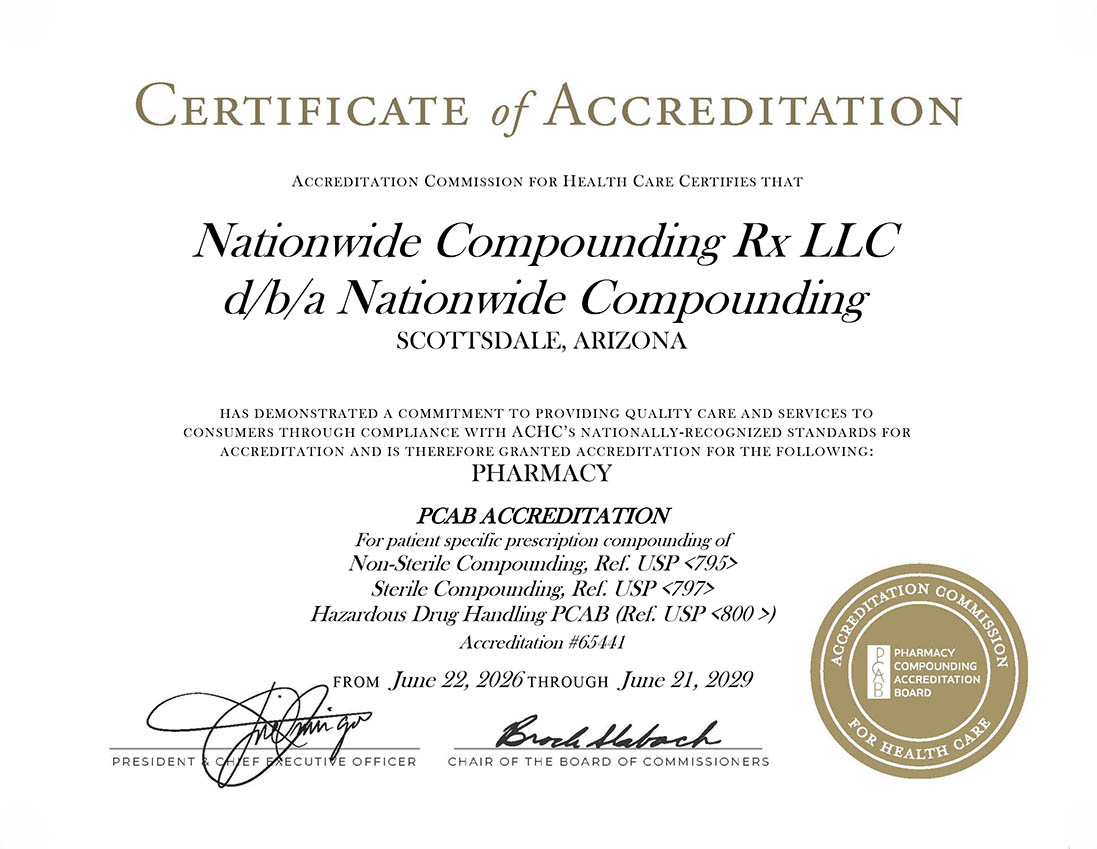
Nationwide Compounding Rx®, based in Scottsdale, Arizona, is an example of a PCAB-accredited, USP <800>-compliant compounding pharmacy that works within this framework.
Compounding also has its own regulatory categories. 503A pharmacies compound patient-specific prescriptions under state board oversight. 503B outsourcing facilities produce larger batches under more direct FDA oversight.
How the 2023 USP Standards Still Shape Compounding Today
The current USP compounding standards became officially enforceable on November 1, 2023. Several years later, they remain the baseline that compounding pharmacies are measured against.
For anyone evaluating a compounding pharmacy in 2026, compliance with these standards shows that the pharmacy follows current safety requirements, not older practices.
Market Size and Scale: Understanding the Bigger Picture
Market figures help show how large each industry is and how different they are.
One industry estimate (Dataintelo) values the global specialty pharmacy market at $312.4 billion in 2025, up from about $286.1 billion in 2024. Figures vary widely depending on the research firm and the market definition used.
Some analyses cite a $751 billion U.S. specialty and mail-order pharmacy market, dominated by large national pharmacy and payer-affiliated players.
Compounding works at a different scale. An estimated 30 to 40 million compounded prescriptions are filled each year in the U.S.
These are markets of different sizes serving different clinical needs, which is another reason the two categories should not be treated as interchangeable.
Which Type of Provider Is Actually Needed? A Decision Framework
With the definitions in place, the practical question is which provider fits a given prescription.
When a Specialty Pharmacy Is the Right Choice
- The patient has a chronic or complex condition that requires an FDA-approved, manufacturer-produced biologic or high-cost drug, such as therapies for cancer, MS, HIV/AIDS, or organ transplant.
- The treatment plan depends on insurance or PBM coverage and the coordination that comes with it.
- The medication must be dispensed exactly as manufactured, with no change to dosage form or ingredients.
When a Compounding Pharmacy Is the Right Choice
- The patient has an allergy or sensitivity, or needs a formulation free of allergens, dyes, or fillers.
- A non-standard dosage form is needed, such as a cream, gel, troche, liquid, or flavored pediatric preparation.
- The prescribed medication is discontinued, on backorder, or unavailable in the needed strength because of a drug shortage.
- The treatment involves BHRT, pain management, dermatology, pediatric, or sports medicine formulations that require titration or personalization.
When Both May Be Needed
Some patients with complex chronic conditions use a specialty pharmacy for their primary biologic therapy and a compounding pharmacy for supportive, personalized formulations, such as a topical for treatment-related skin irritation or an allergen-free version of a secondary medication. Patients should ask their prescriber which category fits each prescription.
How Nationwide Compounding Rx® Fits Into the Compounding Side of the Equation
For readers whose needs point toward custom formulations, Nationwide Compounding Rx® is one example of how a PCAB-accredited, USP <800>-compliant compounding pharmacy operates in practice.
The pharmacy produces both sterile and non-sterile preparations across several areas:
- BHRT, with formulas that can be adjusted at each refill based on updated lab results
- Pain management topicals designed to treat pain locally and reduce systemic side effects
- Dermatology formulations for acne, rosacea, eczema, psoriasis, scarring, and aging
- Pediatrics, offering age- and weight-specific doses in flavored liquids, popsicles, and suckers
- Sports medicine formulations to support recovery and reduce inflammation
- GLP-1 and peptide support
Practical features include a 1 to 2 business day turnaround, same-day pickup for some medications, nationwide shipping based on a tiered state licensing system, independent third-party testing, and ingredients sourced from FDA-inspected and cleared vendors.
The pharmacy works with prescribers through a four-step partnership model, Connect → Collaborate → Create → Care, and uses separate secure Provider and Patient portals. This collaborative, prescriber-focused approach differs from the PBM-driven structure that defines specialty pharmacy.
Conclusion
“Specialty solutions pharmacy” is a search term with two distinct answers: a specific Las Vegas compounding business and a broad industry category.
The core difference is straightforward. Specialty pharmacies dispense pre-packaged, FDA-approved drugs through insurance-integrated channels. Compounding pharmacies, such as Nationwide Compounding Rx®, create custom, patient-specific formulations under PCAB and USP oversight.
Understanding this distinction helps patients and providers choose the right type of pharmacy instead of relying on business names that may be misleading. The confusion is a known, documented issue in the industry, serious enough that SPAARx took it to Congress and the FDA. It is not a mistake on the reader’s part.
Find the Right Fit: Connect With a Compounding Specialist
Readers who have determined they need a custom formulation, whether allergen-free, a non-standard dosage form, a discontinued strength, BHRT, pediatric, pain management, or dermatology, can contact Nationwide Compounding Rx® to discuss their options.
- Healthcare providers can use the Provider Portal to begin a partnership built on the Connect → Collaborate → Create → Care model.
- Patients can use the website contact form or call (480) 499-8379 Monday through Friday, 7:00 AM to 3:30 PM, to talk with the team about formulation needs.
Nationwide shipping is available, but eligibility depends on state licensing tiers and medication type. Contact the pharmacy directly to confirm service for a specific prescription and location.
Related Posts

Pencol Compounding Pharmacy has a documented FDA compliance history, including a 2016 Form 483 and a 2017 Warning Letter, alongside its PCAB accreditation and Colorado 503A licensing. This guide consolidates verified facts about Pencol Compounding Pharmacy so patients and caregivers can make informed decisions, and introduces a PCAB-accredited alternative with broader multi-state shipping.

Thinking about trusting Saveway compounding pharmacy with a prescription? This 2026 guide offers a due-diligence framework covering its Myonex acquisition, FDA recall data, and accreditation gaps. It also includes a rare look at veterinary compounding risks most guides skip.

Louisville providers often struggle to find a compounding pharmacy that explains how true partnerships work. This 2026 guide breaks down the Connect → Collaborate → Create → Care framework, covering BHRT, pediatrics, dermatology, and pain management compounding for local practices.

This 2026 guide to the community compounding pharmacy in Lake Oswego covers more than an address and phone number. It breaks down Oregon's nonresident pharmacy rules, GLP-1 compounding enforcement, and USP compliance standards every patient should understand before having medication shipped.