
Saveway Compounding Pharmacy: A 2026 Buyer’s Due-Diligence Guide
Introduction: Why “Saveway Compounding Pharmacy” Is the Wrong Question to Start With
Most people who search for “Saveway compounding pharmacy” already know the brand. They heard about the Newark, Delaware pharmacy from a veterinarian, a hormone-therapy prescriber, or a friend. What they want to know is whether to trust it with a prescription.
That makes “Is Saveway good or bad?” too narrow a question. A better one is this: how should any patient or caregiver evaluate a 503A compounding pharmacy that has changed ownership, has mixed 2025 and 2026 reviews, and has an accreditation status that public directories do not clearly confirm?
The trigger for this guide is Saveway’s April 2024 acquisition by Myonex, a global clinical-trial supply company. Myonex presented the deal as a way to support clinical-trial sponsors with direct-to-patient and home healthcare capabilities. A companion piece covers the full Delaware-specific history. This guide is broader. It sets out a due-diligence framework based on:
- 2025 and 2026 FDA recall and warning-letter data
- The gap left by state-only oversight
- How rare accreditation actually is
- A dedicated section on veterinary compounding, which most guides skip
The stakes are significant. Roughly 7,500 U.S. compounding pharmacies fill an estimated 30 to 40 million compounded prescriptions each year. Choosing well matters for both human and pet health.
The Structural Reason Compounding Pharmacies Need Extra Scrutiny
Compounding pharmacies fall into two federal categories:
- 503B outsourcing facilities register with the FDA and are subject to federal oversight.
- 503A pharmacies are traditional compounders that prepare medications for individual patients. Most compounding pharmacies, including Saveway, are 503A.
State boards of pharmacy regulate 503A pharmacies. The FDA generally does not inspect them on a routine schedule. It steps in “for cause,” meaning after an adverse event report, a complaint, or visible contamination. Until something goes wrong, quality assurance is largely self-reported.
Baseline standards do exist. USP General Chapters <795> (non-sterile compounding), <797> (sterile compounding), and <800> (hazardous drugs) became officially enforceable on November 1, 2023. However, how well those standards are enforced depends on each state board’s resources and how often it inspects.
This is why voluntary, independent accreditation matters so much. It is the one layer of oversight the system does not otherwise guarantee, and it is the most useful signal a consumer can check.
How Rare Real Accreditation Actually Is, and Why That Changes the Math
Accreditation is the exception, not the norm. Estimates vary, but all of them are low:
- Alliance for Pharmacy Compounding industry survey: about 21% of dedicated compounding pharmacies are PCAB-accredited, and 8% hold NABP VPP accreditation.
- Older Pharmacy Times estimate: only about 2% of all U.S. compounding pharmacies held PCAB accreditation.
PCAB accreditation goes well beyond a state license. Its surveyors conduct an extensive on-site evaluation. They:
- Walk through cleanrooms
- Review batch records
- Evaluate beyond-use dating protocols
- Observe actual compounding technique
This is a clinically endorsed standard, not a marketing badge. A report from the American Medical Association’s Council on Science and Public Health states that the AMA specifically recommends that physicians work with PCAB-accredited compounding pharmacies.
Within that context, Saveway directory entries showing “unconfirmed accreditation” reflect a common industry condition, not an automatic red flag. It does mean the patient needs to verify accreditation directly instead of assuming it.
The 2025–2026 Evidence File: What Happens When Oversight Gaps Go Wrong
The risks are not abstract. Recent enforcement actions show what can happen:
- Apothecary Pharma LLC (Cary, North Carolina): The FDA issued a warning letter in December 2025 citing problems with sterile manufacturing, cleaning, and quality-control procedures. The pharmacy then launched a nationwide recall of compounded tirzepatide injections because sterility could not be assured. The FDA classified that recall as Class II.
- Greenwich Rx: The pharmacy recalled compounded glutathione injections because of high endotoxin levels, which sent two patients to the emergency room. It was the fourth Texas compounding pharmacy to issue a recall for the same issue in the same period.
- Right Value Drug Stores (Texas): The pharmacy recalled more than 4,500 vials of compounded testosterone injections for lack of sterility assurance.
These concerns have a long history. In 2012, the New England Compounding Center fungal meningitis outbreak killed 50 people and sickened more than 720. That disaster led directly to the Drug Quality and Security Act of 2013 and to the growth of voluntary PCAB and NABP accreditation.
These were not fringe operations. Several of the pharmacies involved held state licenses and still failed on sterility. State licensing alone is not a safe place to stop checking.
The 2026 GLP-1/Peptide Shakeup Every Patient Should Know About
Regulation of compounded GLP-1 medications tightened sharply in 2026:
- April 30, 2026: The FDA proposed permanently excluding semaglutide, tirzepatide, and liraglutide from the 503B Bulks List. That proposal directly affects whether these compounded medications will remain legal and available.
- September 18, 2026: The FDA sent a warning letter to Empower Pharmacy, a large and established 503A pharmacy. The letter addressed compounded tirzepatide and semaglutide products that the agency called essentially copies of approved drugs. Size and reputation did not exempt the pharmacy from enforcement.
Patients taking compounded GLP-1s or peptides should not assume their supply will continue or that it is legal. They should ask specific questions, such as:
- Where do the active ingredients come from?
- What is the product’s current regulatory status?
- What is the pharmacy’s plan if the rules change?
Most generic checklists for choosing a compounding pharmacy have not caught up with this issue.
The Due-Diligence Framework: Six Questions to Ask Before Trusting Any Compounding Pharmacy
The following framework can be used for Saveway or any similar pharmacy.
1. Verify State Licensure, Then Go Further
Patients should look up the pharmacy on the state board of pharmacy’s website. They should confirm that the license is active and that it covers the type of compounding they need, whether sterile or non-sterile. If the pharmacy ships across state lines, it also needs a license in the patient’s state. A license confirms that the pharmacy operates legally. It does not confirm quality, especially because the FDA rarely inspects 503A pharmacies without cause.
2. Confirm Accreditation Directly With the Pharmacy; Don’t Rely on Directory Listings
Patients should ask the pharmacy for its PCAB accreditation details or NABP VPP status in writing. They should then check that claim against the public accredited-pharmacy databases that PCAB and NABP maintain. Because only about 21% of pharmacies hold PCAB accreditation and 8% hold NABP accreditation, this one question quickly narrows the options.
3. Ask About USP <795>/<797>/<800> Compliance and Recent Inspection History
Useful questions include:
- When was the pharmacy’s last state inspection?
- Has it ever received an FDA warning letter?
- Can it share third-party testing results or a Certificate of Analysis?
The Apothecary Pharma, Greenwich Rx, and Right Value Drug Stores cases show why these questions matter even when a pharmacy is properly licensed.
4. Read Recent Reviews as Operational Signals, Not Just Star Ratings
Saveway’s ratings across platforms range from roughly 3.5 to 4.4 stars. The averages matter less than what recent reviews actually say. Two reviews from 2025 and 2026 show what red-flag language looks like:
- One longtime customer wrote that the pharmacy had been the family’s go-to for their cats, until “all of a sudden, without any notification, they stopped making medicated chews.”
- A nearly two-year customer reported being unable to reach anyone by phone for three days to refill a cat’s prescription. The order was not shipped, but the customer’s card was charged.
One complaint can be a fluke. The more useful signal is a specific failure, such as discontinued products, unanswered calls, or billing errors, that shows up repeatedly across several platforms and over several months.
5. Investigate Ownership Changes and What They Signal About Priorities
An acquisition is a legitimate reason to look more closely. New owners can shift a business’s focus. In Saveway’s case, Myonex framed the purchase around clinical-trial sponsors and direct-to-patient logistics rather than local retail and veterinary service.
Patients should ask directly:
- Has the pharmacy’s core business changed?
- Does that change affect which products it continues to make?
- Does it affect customer service or responsiveness for retail patients?
These questions apply to any local pharmacy that a larger company has bought, not just Saveway.
6. Request Documentation Proactively, and Treat Reluctance as Data
Patients can ask for:
- Accreditation certificates
- Sourcing information, including confirmation that ingredients come from FDA-inspected vendors
- Third-party testing results
- Beyond-use dating protocols
A confident, transparent pharmacy will provide these without difficulty. Evasion or long delays are themselves meaningful signals.
Extending the Framework to Veterinary Compounding: A Gap Most Guides Ignore
Many pet owners, including many Saveway customers, assume that veterinary compounds meet the same safety standards as human medications. In practice, oversight and testing are often less rigorous. Veterinary compounding gets less routine attention from state regulators, and there is often no FDA-approved equivalent drug to compare a compounded product against.
Dosage Forms and Species-Specific Accuracy
Precise dosing matters even more for animals, because body weight varies so widely across species and breeds. Pet owners should ask whether the pharmacy has documented compounding protocols for each species. Saveway itself offers specialized forms such as preservative-free eye solutions and flavored treatments. Products like these require formulation expertise beyond standard human compounding.
Flavoring and Palatability Claims vs. Reality
The discontinued cat-chew review is a useful example. A product that a pet will reliably take is only valuable if the pharmacy keeps making it. Pet owners should ask:
- How does the pharmacy notify customers about formulation or flavor changes?
- What alternative dosage forms are available if a product is discontinued?
Beyond-Use Dating and Sterility Standards for Animal Medications
Beyond-use dating (how long a compounded medication remains usable) and sterility protocols can differ for veterinary preparations. Pet owners should ask about them explicitly rather than assuming they match human-grade standards. The Apothecary Pharma and Greenwich Rx recalls show that sterility failures are a real risk, and that risk is not limited to human patients.
Customer Service Resilience for Ongoing Prescriptions
Chronic conditions depend on uninterrupted refills. That is true for pets with long-term illnesses and for human patients on therapies such as BHRT. A three-day stretch with no answer from the pharmacy can cause a real gap in treatment.
Before committing to an ongoing prescription, patients and pet owners can test responsiveness. They can call with a specific question and note how long it takes to get an answer.
When Mixed Signals Add Up to “Time to Switch”
No single factor is automatically disqualifying. An ownership change, one bad review, or unconfirmed accreditation on its own does not mean a pharmacy should be avoided. A cluster of unresolved signals is different.
A practical threshold: if a pharmacy
- cannot confirm its accreditation in writing,
- has multiple recent reviews describing discontinued products or billing and communication failures, and
- has shifted its business model away from its original patients,
then it is reasonable to look for a nationally accredited alternative. This applies to Saveway and to any similar small or recently acquired compounding pharmacy.
Choosing a Nationally Accredited Alternative: What to Look For
When switching pharmacies, patients should treat PCAB accreditation and USP <800> compliance as the minimum requirement. This follows from the AMA recommendation and the depth of the PCAB audit described earlier.
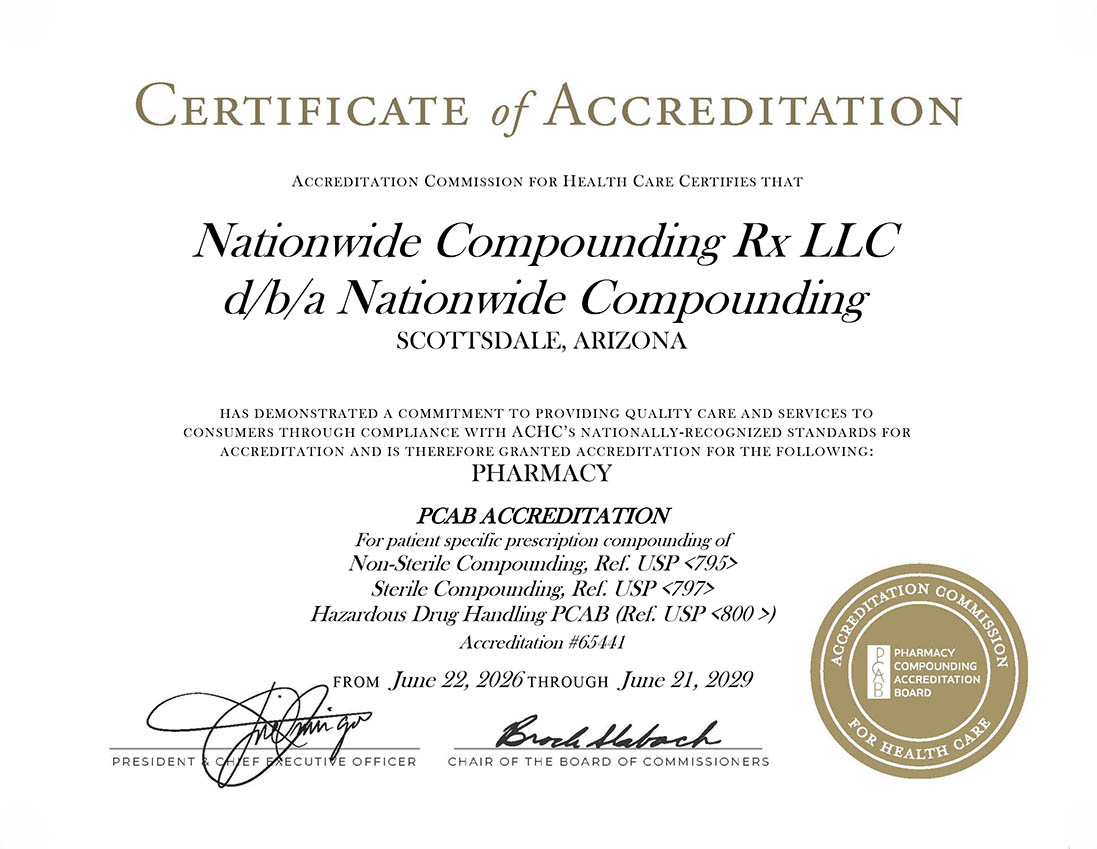
Nationwide Compounding Rx® in Scottsdale, Arizona, is one example of a pharmacy that meets this standard. It is:
- PCAB-accredited
- USP 800-compliant
- Supplied with high-grade chemicals from FDA-inspected and cleared vendors
- Backed by independent third-party testing
It also addresses the operational concerns covered in the framework:
- Turnaround: 1 to 2 business days, with same-day pickup available for some medications
- Shipping: nationwide to licensed states, with availability varying by medication type and state regulations
- Communication: dedicated, secure Provider and Patient Portals for prescription submission, order tracking, and refill requests
The pharmacy offers both sterile and non-sterile compounding, including BHRT formulas that can be adjusted at each refill based on lab results. It also covers pediatrics, dermatology, pain management, sports medicine, and GLP-1 and peptide support. Animal-friendly flavor options are also available, which may be relevant to pet owners weighing their options.
This is not offered as a sales pitch. It illustrates what passing the due-diligence checklist looks like in practice.
Conclusion: Due Diligence Is an Ongoing Practice, Not a One-Time Check
Saveway’s mixed reviews, ownership change, and unconfirmed accreditation are not unusual. They reflect gaps that exist across the roughly 7,500-pharmacy compounding industry. The key points are:
- State licensing is necessary but not sufficient.
- Accreditation is rare but meaningful.
- Recall data from 2025 and 2026 shows real consequences when these checks are skipped.
Even a trusted, long-term pharmacy can change its ownership, staff, or regulatory status. Patients should repeat the six-question framework periodically. For both human and pet prescriptions, the effort of verification is small compared with the risk of sterility failures, billing problems, or interrupted care.
Ready to Make the Switch? Talk to a PCAB-Accredited Pharmacy Today
Patients and pet owners who have identified red flags with their current pharmacy can request a consultation or prescription transfer with Nationwide Compounding Rx®. Providers can start through the Provider Portal and patients through the Patient Portal, which begins the pharmacy’s Connect → Collaborate → Create → Care process.
- Phone: (480) 499-8379
- Website: nationwidecompounding.com
- Hours: Monday through Friday, 7:00 AM to 3:30 PM
With a 1 to 2 business day turnaround and nationwide shipping to licensed states, an accredited option can be set up quickly.
Related Posts

Pencol Compounding Pharmacy has a documented FDA compliance history, including a 2016 Form 483 and a 2017 Warning Letter, alongside its PCAB accreditation and Colorado 503A licensing. This guide consolidates verified facts about Pencol Compounding Pharmacy so patients and caregivers can make informed decisions, and introduces a PCAB-accredited alternative with broader multi-state shipping.

"Specialty solutions pharmacy" actually points to two different things: a Las Vegas compounding pharmacy and a broad industry term. This guide untangles the confusion and breaks down how specialty pharmacies compare to compounding pharmacies in 2026.

Louisville providers often struggle to find a compounding pharmacy that explains how true partnerships work. This 2026 guide breaks down the Connect → Collaborate → Create → Care framework, covering BHRT, pediatrics, dermatology, and pain management compounding for local practices.

This 2026 guide to the community compounding pharmacy in Lake Oswego covers more than an address and phone number. It breaks down Oregon's nonresident pharmacy rules, GLP-1 compounding enforcement, and USP compliance standards every patient should understand before having medication shipped.