
Lumicera Specialty Pharmacy’s Cost-Plus Pricing: The 2026 Coverage Gap
Introduction
Lumicera Health Services describes itself as the country’s first cost-plus specialty pharmacy. Its model is built on actual acquisition cost: the pharmacy charges what it paid for a drug plus a disclosed markup. In an industry known for opaque pricing, that is a meaningful promise of drug-price transparency.
The transparency is real, but it is conditional. It applies only to a defined list of conditions and to the FDA-approved commercial drugs Lumicera actually stocks. For many patients, the promise never applies, because they never reach the point where pricing matters.
Patients typically fall outside the model in one of three ways:
- Their condition is not on Lumicera’s supported list.
- Their prior authorization (PA) is denied.
- They need a non-commercial strength, flavor, or allergen-free form that no specialty pharmacy can dispense.
This article compares Lumicera’s own published data, including its Net Promoter Score and condition list, with industry-wide specialty PA denial statistics. The goal is to show what can be called the “transparent pricing, invisible coverage limit” problem. This is not a challenge to Lumicera’s legitimacy. It is a clear look at where the model starts, where it stops, and what patients can do next.
Who Lumicera Is and What “Cost-Plus” Actually Means
Lumicera Health Services is a wholly owned subsidiary of Navitus Health Solutions, a pharmacy benefit manager (PBM). Navitus is jointly owned by SSM Health and Costco Wholesale Corporation and serves almost 18 million lives across roughly 800 clients. The ownership chain therefore runs from Lumicera to Navitus to two large, well-known parent organizations.
Lumicera was founded in 2014 and is headquartered in Madison, Wisconsin. It holds URAC Specialty Pharmacy accreditation and ACHC accreditation, two of the main quality credentials in the specialty pharmacy field. It has grown through several moves:
- Joining the Turning Point specialty pharmacy network
- Partnering with ParcelShield for delivery logistics
- Acquiring Quality Drug Clinical Care in Irvine, California, to serve HIV patients
- Offering CivicaScript’s lower-cost abiraterone acetate
The actual-acquisition-cost model is Lumicera’s main differentiator. Much of the PBM and specialty pharmacy industry relies on spread pricing, where the amount billed to a plan can differ from what the pharmacy paid, and the gap is rarely visible. Lumicera’s model works differently: plans and patients pay acquisition cost plus a transparent markup. Navitus markets this as a way to improve drug-price transparency and control specialty drug spending.
This is a genuine structural difference, not a marketing gimmick, and it deserves to be taken seriously. Its value, however, depends on who can actually use it.
Where the Transparent Pricing Promise Actually Applies
Lumicera provides medication therapy and education for a defined set of conditions:
- Allergy/asthma
- Cystic fibrosis
- Dermatology
- Gastroenterology
- Hepatitis
- HIV/AIDS
- Oncology/hematology
- Multiple sclerosis
- Rheumatology
Within these categories, cost-plus pricing is tied to specific branded and generic specialty drugs on Lumicera’s formulary. Examples include Dupixent, Xolair, Tysabri, Rituxan, and Vyvgart. The model is not a pricing philosophy applied to every medication. It is a pricing structure for a specific inventory.
That inventory is limited by design. Lumicera dispenses only FDA-approved, pre-manufactured medications in fixed commercial strengths and formulations. Its printable specialty drug list, effective May 2026, is the most current and authoritative statement of what qualifies.
The logic is simple: if a prescription is not on that list, the transparent pricing conversation never starts.
How the Condition List Functions as a Gate
The nine therapeutic categories act as an eligibility filter that applies before pricing transparency becomes relevant. A patient has to pass two checks:
- The condition check. Is the diagnosis in one of the nine categories?
- The SKU check. Even within a covered category, is the specific drug and strength on the formulary?
Many common needs fail one of these checks. Some conditions fall outside the nine categories entirely. In other cases, a patient’s condition is in a supported category, but the medication their physician prefers is not on the formulary list.
Plan design can narrow access further. Some Navitus client plans, including certain county and municipal plans, require Lumicera as the exclusive specialty dispenser and limit fills to a 30-day supply by mail order only. For patients on those plans, there are fewer exits from the system and less flexibility inside it.
The Invisible Coverage Limit: Three Ways Patients Fall Outside the Model
Cost-plus pricing is real, but it depends on conditions that most patients never see being applied. Marketing materials highlight transparency. They do not highlight the earlier filters that decide whether a patient ever benefits from it. The three scenarios below show how patients exit the model before pricing becomes relevant.
Scenario 1: A Condition Outside Lumicera’s Formulary List
Patients whose conditions are not among the nine supported categories receive no cost-plus benefit at all. They are simply out of scope.
In practice, these patients are often sent elsewhere. Plan documents for programs operating under names like “Navitus SpecialtyRx” show that medications unavailable through Lumicera may be routed to Walgreens Specialty Pharmacy. When that happens, there is no guarantee that the same transparency carries over. The patient still gets a pharmacy, but not necessarily the pricing model that made Lumicera distinctive.
Scenario 2: A Denied Prior Authorization
Prior authorization is a major obstacle across all of specialty pharmacy. Industry-wide figures show:
- 25% to 40% of specialty drug PAs are denied on first submission, compared with 10% to 15% for standard medications.
- Initial denial rates for complex biologic requests approach 51%.
- Nearly 53 million PA requests went to Medicare Advantage insurers in 2024, and about 4.1 million were denied.
A denial stops the cost-plus pricing conversation completely. The patient enters an appeals cycle in which pricing transparency does not matter, because no drug is being dispensed yet. A transparent markup on a medication the patient cannot obtain provides no practical benefit.
Internal strain may add to the problem. Employee reviews on Indeed describe high-pressure PA workloads, mandatory overtime, and concerns about training and management. Employee reviews are anecdotal, but the recurring themes suggest systemic pressure that could affect turnaround times and the patient experience during the PA process.
Scenario 3: A Non-Commercial Strength, Flavor, or Allergen-Free Form
This is the firmest limit. Specialty pharmacies such as Lumicera dispense only FDA-approved, pre-manufactured medications in fixed commercial strengths and formulations. They cannot:
- Change a dose to a non-commercial strength
- Remove allergenic dyes, fillers, or preservatives
- Add or change a flavor
- Create a non-commercial dosage form
No pricing model changes these restrictions. Patients affected by them include:
- A pediatric patient who needs a flavored liquid instead of a tablet
- A patient with documented dye or filler allergies
- Someone who needs a discontinued or backordered strength
- An older adult who has difficulty swallowing pills
This is a structural limitation of the specialty pharmacy model, not a flaw unique to Lumicera. Still, it leaves real patients with no way forward through Lumicera.
The Numbers Tell Two Different Stories
Navitus reports that Lumicera achieved a patient Net Promoter Score of 85 in 2024, a strong result by almost any standard. At the same time, industry data shows that up to 40% of specialty PAs are denied on first submission, and complex biologics approach a 51% denial rate.
Both facts can be true at once. NPS measures the experience of patients who were successfully served within the formulary. Denial statistics reflect the many patients who never reach that stage, as well as those whose condition or required formulation was never in scope.
The key point is this: a high NPS measures satisfaction inside the gate, not access through it. That does not mean Lumicera is doing anything wrong. It means there is a gap between how “patient satisfaction” is presented and what it actually measures. Patients and benefits administrators reviewing a specialty pharmacy should consider both numbers together.
Why This Isn’t a Lumicera-Specific Problem: It’s a Structural One
The gap exists across the industry because specialty pharmacies and compounding pharmacies operate under different regulatory frameworks. For a fuller breakdown of how these two models differ, see this comparison of specialty pharmacy vs. compounding pharmacy.
Specialty pharmacies work within inventories of FDA-approved commercial drugs. They are not licensed or equipped to change formulations.
Compounding pharmacies that operate under FDA Section 503A follow a different set of rules:
- They prepare patient-specific prescriptions.
- They are overseen by state pharmacy boards.
- They are exempt from cGMP requirements.
- They are limited to 250 sterile units per batch.
By comparison, 503B outsourcing facilities register with the FDA, follow cGMP, have no batch limits, and do not require patient-specific prescriptions. For more detail on these rules, see this overview of FDA regulations for compounding pharmacies.
A 503A pharmacy generally cannot compound a preparation that is “essentially a copy” of a commercially available drug unless there is a documented clinical difference. In an April 1, 2026 clarification, the FDA indicated it would not take enforcement action against up to four prescriptions per month of an essentially-a-copy preparation. This is relevant for patients who need a non-standard form of a drug that is otherwise commercially available, including GLP-1 and peptide therapies.
PBMs themselves recognize the role of compounding. OptumRx has listed compounded bevacizumab injection as a covered alternative to brand-name macular degeneration drugs such as Beovu and Lucentis. That precedent shows compounding is not a workaround. It is an accepted part of the care continuum, even inside PBM-managed formularies.
What Patients Can Do When They Fall Into the Gap
Patients and caregivers who have been referred to Lumicera can use a simple checklist:
- Check the condition list. Is the diagnosis in one of the nine supported categories?
- Check the formulary SKU. Is the specific drug and strength on the May 2026 printable specialty drug list?
- Check the PA status. Has a prior authorization been submitted, approved, or denied?
- Check the formulation. Does the commercial form match what the patient clinically needs, including strength, dosage form, flavor, and allergen profile?
If a PA is denied, it can be appealed, and patients should pursue that right. Appeals take time, however, and patients with active symptoms often cannot afford long delays.
When the problem is formulation rather than coverage, such as a non-commercial strength, a flavor, an allergen-free version, or a discontinued medication, a 503A compounding pharmacy can often meet the clinical need directly. Compounding is best viewed as a parallel path, not a replacement for specialty pharmacy. To understand more about the right moments to consider this option, see when should you use a compounding pharmacy.
Where Nationwide Compounding Rx Fits the Gap
Nationwide Compounding Rx® is a pathway for patients whose clinical need is not available as a formulary SKU. It does not compete with Lumicera’s cost-plus model. It complements it by preparing what specialty pharmacies cannot dispense.
Relevant capabilities include:
- Custom strengths, including recreations of discontinued or unavailable medication strengths
- Allergen-free formulations without dyes, fillers, preservatives, and other allergens
- Flavor options such as cherry, strawberry, bubblegum, and marshmallow for pediatric patients and those who have trouble swallowing
- Alternative dosage forms, including liquids, troches, lozenges, topicals, suppositories, and sublingual tablets
- Sterile and non-sterile preparations
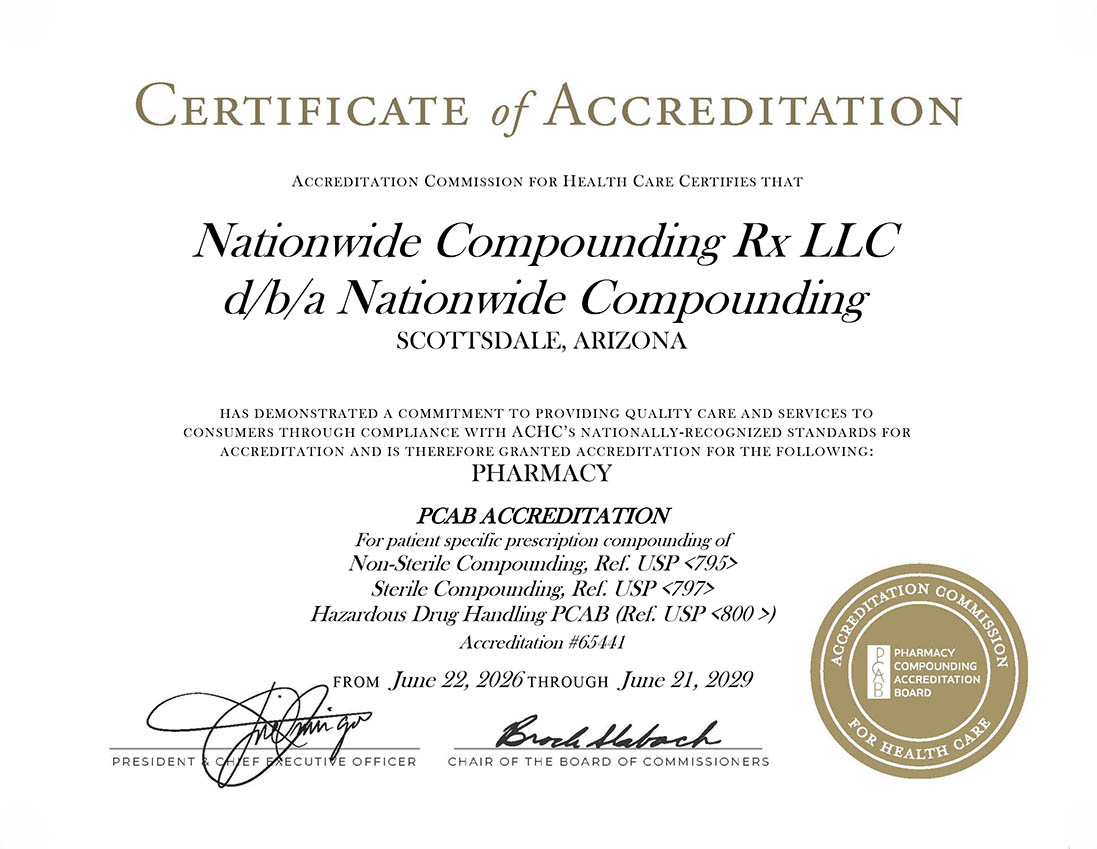
On quality, Nationwide Compounding Rx is PCAB accredited and USP 800 compliant. These credentials are comparable in rigor to Lumicera’s URAC and ACHC accreditations. The pharmacy also uses independent third-party testing and sources chemicals from FDA-inspected and cleared vendors.
Logistics are designed for patients who cannot wait. The pharmacy offers a 1 to 2 business day turnaround, same-day pickup for some medications, and nationwide shipping, though availability depends on state licensing and medication type. Prescribers work with the pharmacy through a structured Connect → Collaborate → Create → Care process and a secure provider portal.
The intended use is clear. Compounding is for patients with a legitimate clinical need for a non-commercial form. It is not a way to bypass PA requirements for standard commercial drugs.
Conclusion
Lumicera’s cost-plus model is a legitimate and meaningful step toward transparency in specialty drug pricing, within its defined scope. Its ownership is solid, its accreditations are real, and its pricing structure addresses a well-known industry problem.
That scope is narrow, however. Transparency applies only to nine supported conditions and to the specific drugs on Lumicera’s formulary. Outside those limits, patients face rerouting to other pharmacies, prolonged PA appeals, or no path at all if they need a form no commercial manufacturer produces.
The contrast between a strong NPS of 85 and specialty PA denial rates of up to 51% is the clearest sign of this invisible coverage limit. Satisfaction is high among patients who get through the gate. Many others never do.
Patients and providers benefit most when they understand this distinction: when to work within Lumicera’s model, and when to look for a compounding solution.
Get the Medication You Actually Need
If a prescription, strength, flavor, or allergen requirement falls outside Lumicera’s formulary, Nationwide Compounding Rx® can help explore a custom formulation.
- Call: (480) 499-8379
- Visit: 14000 N. Hayden Rd., Suite 104, Scottsdale, AZ 85260
- Hours: Monday to Friday, 7:00 AM to 3:30 PM
- Online: Use the secure Provider Portal or Patient Portal at nationwidecompounding.com
Providers whose patients are stuck in PA denials or formulary gaps can start with the Connect → Collaborate → Create → Care partnership process to build a clinically appropriate alternative.
When the formulary says no, compounding offers a way to make the medication the patient actually needs.
Related Posts

Searching for the right Optum Specialty Pharmacy phone number can lead to outdated or conflicting results. This 2026 verified list breaks down each legitimate contact line, what it's used for, and why the old BriovaRx name still causes confusion today.

Kentucky's 2026 crackdown on compounded peptides has left many Lexington patients searching for answers and legal alternatives. This guide breaks down what changed under 201 KAR 2:076, what it means for existing prescriptions, and how a PCAB-accredited compounding pharmacy can still legally fill compliant formulations.
As GLP-1 use surges in 2026, not all tirzepatide compounding pharmacy options are equally safe. This article breaks down FDA's 2026 adverse event data and shows exactly how PCAB accreditation—not facility type—prevents dangerous dosing errors.

Before transferring a prescription to Pencol Compounding Pharmacy, find out if this Denver-based pharmacy can legally ship to your state. We break down its documented 13-state shipping footprint and what Section 503A rules mean for your order in 2026.