Flavored Medication for Children Compounding: The Science Behind Getting Kids to Actually Take Their Medicine
Introduction: The Daily Battle of Getting Kids to Take Their Medicine
Any parent who has tried to give a sick child a dose of bitter antibiotic knows the scene well. The spoon approaches, the lips clamp shut, the negotiating begins, and then comes the spitting, the crying, and the medicine running down a small chin. By the time the struggle ends, no one is certain how much of the dose actually went down.
This is more than a parenting inconvenience. Incomplete medication doses carry real clinical consequences, including antibiotic resistance, prolonged illness, and worsening chronic conditions. When a child does not finish a course of treatment because the medicine tastes terrible, the infection it was meant to clear may not fully resolve.
Flavored medication compounding is not a marketing gimmick. It is a medically meaningful intervention backed by adherence data, biochemistry, and regulatory oversight. This article explores why children reject medications at a biological level, how professional flavor-medication matching actually works, what the adherence research shows, which allergen-free options exist, the safety framework that governs the practice, and when transdermal alternatives become necessary.
The scope of the problem is significant. Pediatric medication adherence rates range from 11% to 93%, with an average around 50%. An estimated 30% to 70% of children with chronic illness are non-adherent to their regimens, and taste is one of the primary drivers. Flavored medication for children compounding addresses that barrier directly.
Why Children Reject Medication: The Biochemistry of Bitter Taste
Children are not simply being difficult. They are biologically more sensitive to bitter taste than the adults caring for them.
A key reason lies in the TAS2R38 gene, which governs bitter taste receptors. Genetic variation in this gene means the same medication can taste dramatically worse to a child than to a parent who tastes it first and declares it “not that bad.” The child is not exaggerating; their receptors are registering a far stronger signal.
Three primary taste categories make medications unpalatable:
- Bitter alkaloids, found in many antibiotics and antihistamines
- Metallic active pharmaceutical ingredients (APIs), which leave a sharp, unpleasant aftertaste
- Sour or astringent compounds, which trigger immediate rejection
A 2025 scoping review from the UCL School of Pharmacy found that poor taste was reported as a barrier to adherence in 27% of reviewed studies, correlating with incomplete dosing in both acute and chronic pediatric conditions. A separate survey of more than 800 pediatricians found that unpleasant taste is a key compliance barrier for 90.8% of patients with acute illness and 83.9% of patients with chronic illness.
Form matters as much as flavor. Approximately 10% of children between ages 6 and 11 cannot swallow a pill at all, making the taste and texture of liquid formulations especially critical. Infants present additional considerations: those under 6 months should not receive preservatives, which makes compounding essential for the youngest patients. Parents dealing with this challenge can learn more about what to do when a child can’t swallow pills and how compounded medication can help.
The Science of Flavor-Medication Matching: Not All Flavors Mask All Tastes
A common misconception is that adding any flavor to a medication guarantees it will taste good. Professional flavor-medication matching is a science, not a guessing game.
The principle behind it is taste category pairing. Certain flavor profiles are chemically more effective at masking specific taste categories. Chocolate, for example, is particularly effective at covering bitter-tasting medications because it masks the underlying flavor more thoroughly than fruit flavors do. Matching the right flavor to the right taste category is what separates a tolerable dose from a rejected one.
To bring rigor to this process, the University of Maryland School of Pharmacy developed the Ew Meds List™, an evidence-based tool that pairs the worst-tasting pediatric medicines with proven flavor-masking strategies. This gives pharmacists a science-backed framework for flavor selection rather than relying on trial and error.
There are also flavors to avoid. Real citrus is generally not used in compounding because natural citric acids can affect drug absorption rates. Simulated citrus flavors are substituted instead. The three most popular flavors chosen by children are cherry, bubblegum, and grape, but popularity does not equal effectiveness for every medication.
Professional compounding pharmacies offer a broad palette. At Nationwide Compounding Rx®, available flavors and dosage forms include banana crème, cherry, grape, peppermint, raspberry, strawberry, tutti frutti, and vanilla butternut. The pharmacist assesses which profile best suits the medication’s taste category before recommending an option.
Importantly, flavoring agents used by accredited compounding pharmacies are independently tested, manufactured in FDA-registered facilities, and considered chemically inert. They do not alter the medication’s therapeutic effectiveness. Over 200 million medications have been flavored using professional flavoring systems, validating the widespread clinical acceptance of the approach.
What the Adherence Data Actually Shows
The headline statistic is compelling: when medications are custom flavored, adherence rates can increase from roughly 60% to 90% or higher.
That jump matters clinically. For a child on a 10-day antibiotic course, the difference between 60% and 90% adherence is the difference between a completed treatment and a partially treated infection, with all the antibiotic resistance implications that incomplete dosing carries.
Child agency plays a powerful role. Cook Children’s reports that children who pick their own medicine flavor are 90% more likely to take it without a struggle. Giving a child a choice increases buy-in and reduces caregiver conflict, transforming medication time from a nightly battle into a routine.
A 2026 peer-reviewed literature review covering 17 studies from 2000 to 2025 confirmed that extemporaneous compounding is a global necessity for pediatric populations, particularly for oral liquids.
The downstream consequences of non-adherence are serious. For chronic conditions, refusal can mean worsening ADHD symptoms, uncontrolled juvenile diabetes, escalating asthma, and increased hospitalizations. For acute infections, incomplete antibiotic courses driven by taste refusal contribute to broader resistance patterns. Adherence is a public health issue, not merely a parenting challenge. Caregivers looking for practical strategies can explore how to improve medication compliance in children for additional guidance.
Dosage Forms Available Through Pediatric Compounding
Flavored compounding extends well beyond liquid suspensions. A wide range of child-friendly dosage forms can be tailored to the child who refuses one format but accepts another:
- Oral suspensions, solutions, and syrups
- Chewable tablets
- Gummy troches
- Lollipops and freezer pops
- Chocolate cubes
- Dissolvable strips
- Capsules
Format can matter as much as flavor. A child who refuses a liquid may readily accept a gummy, and a child who spits out a chewable may do well with a flavored dissolvable strip. Recent peer-reviewed research has proposed pharmacy-compounded oral gels as an innovative alternative to liquid suspensions, offering better taste masking than syrups while reducing spilling risk.
For infants, medications can be delivered via specially designed pacifiers or bottles, with preservative-free formulations required for those under 6 months. For children who refuse all oral forms entirely, transdermal gels offer a route that bypasses the mouth completely.
In every case, the compounding pharmacist works with the prescriber to select both the optimal dosage form and the most effective flavor for that specific medication and that specific child.
When Oral Medications Fail: Transdermal Gels as a Pediatric Alternative
Transdermal gels are medications formulated to be absorbed through the skin, typically applied to the inner wrist or behind the ear. They bypass the oral route entirely.
This becomes the right clinical choice in specific situations: children with severe taste aversion, swallowing disorders, gastrointestinal conditions that affect oral absorption, or extreme behavioral resistance to oral medications. Because nothing is swallowed, there is nothing to spit out or refuse, and the taste barrier disappears altogether.
There is important clinical nuance here. Not all medications are suitable for transdermal delivery. Absorption rates and bioavailability differ from oral routes, and a prescriber must determine whether transdermal delivery is appropriate for the specific medication and condition. Certain ADHD medications and anti-nausea agents are among those that may be compounded into transdermal gels in appropriate cases.
This option is rarely explained in depth elsewhere, which positions the compounding pharmacist as a valuable resource for families who feel they have run out of options. For children who can take oral medications but struggle with taste, allergen-free flavoring addresses another critical layer of concern.
Allergen-Free Flavoring: Dye-Free, Gluten-Free, Soy-Free, and Beyond
Many commercially manufactured pediatric medications contain ingredients that can trigger reactions in sensitive children: FD&C dyes such as Yellow 5 and Red 40, gluten, lactose, soy, parabens, or artificial sweeteners.
For children with celiac disease, food allergies, or sensitivities to artificial dyes, this creates a compounded problem. The medication they need may contain an ingredient their body cannot tolerate.
Professional compounding pharmacies can formulate medications that exclude specific allergens entirely. Dye-free, gluten-free, soy-free, lactose-free, paraben-free, and sugar-free options are all achievable. The allergen-free flavoring agents used are sourced from FDA-registered facilities and independently tested to confirm they are chemically inert and do not interfere with the medication’s therapeutic action.
This is a significant gap in most pharmacy content, despite being a major concern for parents of children with food sensitivities. Parents should communicate all known allergens to both the prescribing physician and the compounding pharmacist before formulation begins.
Nationwide Compounding Rx® can eliminate lactose, dyes, gluten, sugar, soy, and other common allergens from formulations on a patient-by-patient basis. Families can review the full range of pediatric medication flavoring options available to find the right fit for their child’s needs.
The Regulatory Safety Framework Parents Rarely See Explained
A common parental concern is straightforward: if a compounded medication is not FDA-approved in the same way as a commercial drug, is it safe?
The FDA’s compounding framework operates under Sections 503A and 503B of the Federal Food, Drug, and Cosmetic Act. Section 503A governs traditional compounding pharmacies that prepare patient-specific prescriptions, while 503B governs outsourcing facilities engaged in larger-scale production.
“Not FDA-approved” means the FDA does not review compounded drugs for safety, effectiveness, or quality before they are dispensed. However, quality standards, ingredient sourcing requirements, and facility inspections still apply.
USP General Chapter <795>, updated November 1, 2023, classifies the addition of flavoring agents as compounding subject to nonsterile compounding standards, establishing quality benchmarks for the process. Notably, 48 out of 50 State Boards of Pharmacy do not regulate flavoring as full compounding, yet accredited pharmacies voluntarily adhere to the higher USP <795> standard anyway.
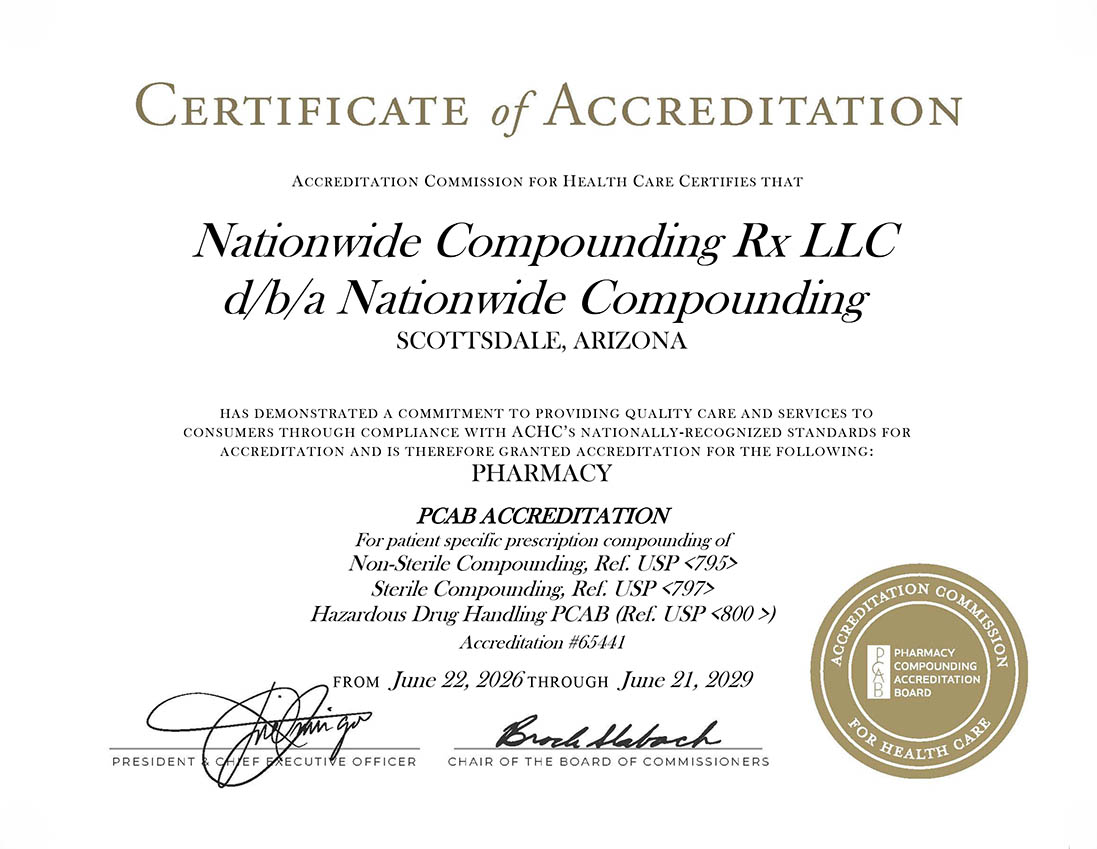
A meaningful quality signal for parents is PCAB accreditation. The Pharmacy Compounding Accreditation Board offers voluntary third-party accreditation that assesses pharmacies against USP standards for safety and quality compliance. Nationwide Compounding Rx® has maintained PCAB accreditation since its early days of operation, operates a USP 800 compliant facility, and sources all chemicals from FDA-inspected and cleared vendors.
The regulatory landscape continues to evolve. A January 2025 FDA guidance update addressed compoundable substances for 503A pharmacies, demonstrating that reputable pharmacies must stay current. Drug shortages add further context: as of March 2025, the American Society of Health-System Pharmacists reported 270 active drug shortages nationwide, including prior shortages of ibuprofen suspension and amoxicillin and oseltamivir suspensions. Compounding pharmacies fill critical gaps when commercial supply fails, and understanding what conditions compounding pharmacy is used for can help families recognize when this option applies to their situation.
How the Flavored Compounding Process Works: A Step-by-Step Guide for Parents
Most content on this topic skips the practical part, leaving parents unsure how to actually access flavored compounded medications. The process is straightforward:
Step 1: Prescription. The child’s physician or pediatrician writes a prescription specifying the medication, dose, and dosage form. The prescriber may also note flavor preferences or allergen restrictions.
Step 2: Pharmacist Assessment. The compounding pharmacist reviews the prescription, evaluates the medication’s taste profile (bitter, metallic, or sour), and applies evidence-based flavor-matching principles to recommend the most effective options.
Step 3: Flavor Selection. Parents and the child choose from available flavors. Giving the child a voice increases buy-in and compliance, as children who pick their own flavor are 90% more likely to take it without a struggle.
Step 4: Formulation. The pharmacist compounds the medication in the selected dosage form and flavor, using allergen-free flavoring agents from FDA-registered facilities. At Nationwide Compounding Rx®, turnaround is 1 to 2 business days.
Step 5: Dispensing and Guidance. The compounded medication is dispensed with clear instructions, and the pharmacist remains available to answer questions about administration, storage, and what to expect.
Nationwide Compounding Rx® ships to 47 states plus Washington, D.C., making access available to families far beyond Arizona. Same-day pickup is available for some medications for local patients in the Scottsdale area.
Frequently Asked Questions About Flavored Medication Compounding for Children
Will the flavoring change how the medication works?
No. Flavoring agents used by accredited compounding pharmacies are chemically inert and do not alter the medication’s therapeutic effectiveness or pharmacokinetics. The one notable exception is real citrus, which is avoided because natural citric acid can affect drug absorption. Simulated citrus flavors are used instead. Pharmacists trained in flavor-medication matching ensure the chosen flavor does not interact with the active ingredient.
Is flavored compounded medication safe for children with food allergies?
Yes, when formulated by an accredited compounding pharmacy. Parents should disclose all known allergens, including dyes, gluten, lactose, soy, and parabens, so the pharmacist can exclude those ingredients. Dye-free, gluten-free, soy-free, lactose-free, and sugar-free formulations are all achievable. Communicating sensitivities to both the prescriber and the pharmacist before the prescription is written is essential.
Does insurance cover flavored compounded medications?
Coverage varies. Some plans cover compounded medications, others do not, and some cover the base medication but not the flavoring add-on. Parents should contact their insurance provider and the compounding pharmacy directly to discuss coverage and out-of-pocket costs. The clinical value, namely significantly improved adherence and health outcomes, often justifies the cost even when coverage is partial.
How do I know if a compounding pharmacy is reputable?
Look for PCAB accreditation, USP <795> compliance, and sourcing from FDA-inspected vendors. Parents can also ask whether the pharmacy follows USP nonsterile compounding standards for flavored formulations. Nationwide Compounding Rx® maintains PCAB accreditation, operates a USP 800 compliant facility, and sources all chemicals from FDA-inspected and cleared vendors.
What if my child refuses all oral medications?
Transdermal gels may be a clinically appropriate alternative for some medications, allowing absorption through the skin without any oral administration. Not all medications are suitable for transdermal delivery, so the prescriber must determine clinical appropriateness. Parents are encouraged to discuss this option with both the child’s physician and the compounding pharmacist.
Conclusion: Flavored Compounding Is a Clinical Tool, Not a Convenience
Flavored medication compounding for children is not about making medicine taste like candy. It is about removing a proven biochemical barrier to treatment adherence, one with measurable health consequences.
The key takeaways are clear. Children are biologically more bitter-sensitive than adults. Professional flavor-medication matching is a science governed by taste category pairing and tools like the Ew Meds List™. Adherence can jump from roughly 60% to 90% or higher with proper flavoring. Allergen-free formulations protect sensitive children. The regulatory framework, including USP <795>, PCAB accreditation, and Section 503A oversight, provides meaningful safety assurance. Transdermal gels exist for children who refuse all oral routes.
Parents who struggle daily to get a sick child to take medication are not failing. They are facing a real biological and behavioral challenge that compounding pharmacists are specifically trained to address. The public health stakes are substantial: improved pediatric adherence reduces antibiotic resistance, prevents disease progression in chronic conditions, and lightens the burden on the broader healthcare system.
As the pediatric compounding market continues to grow, driven by drug shortages, rising diagnoses of ADHD, autism spectrum disorders, and juvenile diabetes, and a persistent gap in commercially available pediatric formulations, flavored compounding will only become more essential to pediatric care.
Ready to Make Medication Time Easier? Contact Nationwide Compounding Rx Today
If a child struggles to take medication because of taste, texture, or swallowing difficulties, a customized flavored formulation may be exactly the solution a family has been looking for.
Nationwide Compounding Rx® brings real differentiators to that challenge: PCAB accreditation, a USP 800 compliant facility, 40 years of combined compounding experience, 1 to 2 business day turnaround, and nationwide shipping to 47 states plus Washington, D.C.
Getting started is simple. Parents can call Nationwide Compounding Rx® at 480-499-8379 or toll-free at 1-833-650-9836, or visit NationwideCompounding.com to learn more or have a child’s prescription transferred. Parents are also encouraged to ask their child’s physician about compounded flavored formulations if they are not already being prescribed, as Nationwide Compounding Rx® works directly with prescribers to customize solutions.
One important reminder: parents whose children have food sensitivities or dye allergies should mention these when contacting the pharmacy so the formulation can be tailored accordingly.
Every child deserves medication they can actually take. That is precisely what personalized compounding is designed to deliver.
Related Posts

Searching for Las Colinas Pharmacy Compounding & Wellness in Irving, TX? This 2026 guide gives you the address, hours, and phone number up front, then breaks down the accreditation and safety standards DFW patients should check before trusting any compounding pharmacy with hormone, peptide, or custom medication needs.

Searching for Jefferson Specialty Pharmacy turns up two unrelated organizations—one in Pennsylvania, one in Washington State. This guide clarifies which is which and explains what to do in 2026 when a prescribed medication can't be filled by either.

Searching for Marty's Compounding Pharmacy but not sure if a local Mississippi storefront fits your needs? This guide compares Marty's Pharmacy & Compounding Center to nationwide compounding options using a five-point credential checklist covering accreditation, testing, and shipping licenses in 2026.

The term 'board of specialty pharmacy' actually refers to four distinct organizations, each serving a different purpose. This article breaks down BPS, SPCB, state boards, and PCAB to reveal which body truly governs compounding pharmacy quality in 2026.