NYU Specialty Pharmacy’s Fixed Formulary: The 2026 Compounding Gap
Introduction: Why ‘NYU Specialty Pharmacy’ Searches Often End in a Dead End
A patient leaves an appointment at NYU Langone with a new prescription, or a caregiver is handling a parent’s medication list, and the natural next step is a quick search for “NYU specialty pharmacy.” The expectation is simple: one trusted, hospital-affiliated pharmacy that can fill whatever specialty prescription the care team writes.
For most standard specialty drugs, that expectation holds. NYU Langone Specialty Pharmacy is a high-quality, URAC-accredited operation. However, it is built to dispense FDA-approved, manufacturer-supplied drugs for a defined list of chronic conditions. That design creates a gap that many patients only discover after a prescription stalls.
Nationwide Compounding Rx® has previously covered the in-network and eligibility rules that limit who NYU’s pharmacy can serve. This article addresses a different problem: the formulary and compounding gap. Even fully eligible, in-network NYU patients can hit a wall when they need a compounded, custom-dose, allergen-free, or discontinued-strength medication. New York State law helps explain why a health-system pharmacy like NYU’s is not structured to bridge that gap itself.
The practical solution is patient-specific compounding through a properly registered nonresident pharmacy, such as Nationwide Compounding Rx®, working alongside the patient’s existing NYU care team.
What NYU Langone Specialty Pharmacy Is Built to Do
NYU Langone Specialty Pharmacy is a comprehensive outpatient specialty pharmacy that serves NYU Langone patients exclusively. It is not a retail pharmacy open to any prescription from any provider. A community physician cannot route a prescription there unless the patient is also an active NYU Langone patient.
Within that closed system, the pharmacy operates at significant scale. According to NYU Langone’s assistant director of pharmacy, interviewed by Pharmacy Times, the specialty pharmacy serves close to 20 unique departments across Manhattan, Long Island, and Brooklyn.
The pharmacy holds specialty pharmacy accreditation from URAC, an independent healthcare quality accreditation organization. URAC accreditation signals that a pharmacy meets demanding standards for patient management, clinical oversight, data reporting, and operational quality.
The program also delivers meaningful financial value. NYU’s system secured $17 million in financial assistance for patients in a single year, a figure that reflects strong benefits coordination for high-cost specialty therapies. By any reasonable measure, this is a well-run specialty pharmacy. Its limitations come from its design, not its quality.
Locations and How the Pharmacy Fits Into NYU’s Care Model
NYU Langone Specialty Pharmacy operates from two physical locations:
- Industry City, Brooklyn: 882 Third Avenue, Building 10, 3rd Floor
- Cobble Hill, Brooklyn: 83 Amity St
- Main phone: 877-698-2330
The pharmacy integrates fully with each patient’s clinical team through one shared medical record. Prescribers, nurses, and pharmacists see the same information, which supports adherence tracking, prior authorizations, and side-effect monitoring.
That integration comes with conditions. The pharmacy will only reach out to a patient when three requirements are met: the medication is available through the pharmacy, it was prescribed through an affiliated NYU clinic, and the pharmacy is in-network with the patient’s insurance. The first condition, “available through the pharmacy,” is where the formulary question begins.
The Fixed Formulary: NYU’s Chronic Condition List
NYU’s specialty pharmacy model is organized around a defined set of chronic, high-cost disease states rather than open-ended prescribing. Covered conditions include:
- Asthma
- Crohn’s disease
- Hemophilia
- Hepatitis B and C
- HIV
- Multiple sclerosis
- Pulmonary arterial hypertension
- Rheumatoid arthritis
- Similar chronic specialty categories
Within these categories, NYU dispenses commercially manufactured, FDA-approved drugs in standard, approved doses. The pharmacy’s value lies in managing complex brand-name therapies, biologics, and injectables. It does not produce compounded variations of those drugs.
Why ‘Compounding’ on NYU’s Service List Doesn’t Mean What Patients Expect
A frequent source of confusion is that NYU’s own materials, and directory sites that copy them, list “compounding” as a service. Patients reasonably assume this means NYU can create a custom version of a medication.
In practice, that listing refers to limited, routine preparation of eligible in-system formulary drugs for qualifying patients. It does not mean custom strengths, allergen-free bases, flavoring, or recreation of discontinued formulations.
True patient-specific compounding, as practiced by independent 503A compounding pharmacies, is a different discipline. A 503A pharmacy prepares a medication from pharmaceutical ingredients based on an individual prescription, adjusting the strength, dosage form, base, and inactive ingredients to fit one patient’s needs. That is the kind of compounding most patients have in mind, and it sits outside the NYU specialty pharmacy’s operating model.
The Structural Compounding Gap: What NYU Cannot Fill
Four categories of prescriptions fall outside what a manufacturer-supplied dispensing model can handle. This is not an insurance problem or an eligibility problem. It is a dispensing-model problem that can affect NYU’s own qualifying patients.
Custom Doses and Strength Adjustments
Manufacturer-supplied drugs come only in fixed, commercially approved strengths. When a patient’s needs fall between those strengths, a manufacturer-dependent pharmacy has no product to dispense in the needed dosage strength.
Common examples include:
- Pediatric patients who need weight-based fractional doses not available in commercial tablets
- Elderly patients who require lower doses to manage side effects or kidney and liver function
- Titration schedules that step up or down in increments smaller than available capsules or tablets
Splitting tablets is sometimes suggested, but it can produce inconsistent dosing and is not possible with many extended-release or coated products.
Allergen-Free and Dye/Filler-Free Formulations
Many patients react not to the active drug but to inactive ingredients. Commercial products may contain dyes, gluten, lactose, preservatives, or other fillers that trigger reactions in sensitive individuals.
An FDA-approved manufacturer product cannot be reformulated without compounding. Because NYU’s specialty pharmacy dispenses those products as supplied, it cannot remove an offending ingredient or substitute a different base.
Discontinued or Unavailable Strengths
Drug shortages and manufacturer discontinuations affect chronic-condition therapies just as they affect other medications. A specific strength may disappear because of supply chain problems, low commercial demand, or a business decision by the manufacturer.
When that happens, a manufacturer-dependent pharmacy has no mechanism to recreate the missing strength. Patients who were stable on a particular dose may be forced to change regimens unless a compounding pharmacy can prepare it.
Why This Happens Even to NYU’s Own Patients
An in-network, fully eligible NYU Langone patient with a qualifying diagnosis can still be unable to fill one of these prescription types through the specialty pharmacy. That outcome is not a policy failure or a lapse in care. It reflects the fact that NYU operates a manufacturer-supply dispensing model, not a 503A compounding pharmacy. The two models are built for different purposes.
Why New York Law Makes This a Structural Wall, Not a Choice
New York is one of only four states, along with California, Texas, and Florida, that enforce particularly strict nonresident compounding pharmacy regulations. That regulatory environment shapes what any pharmacy, including a major health-system pharmacy, can practically and legally do with compounded medications for New York patients. It also helps explain why large institutional pharmacies tend to keep their dispensing models conservative.
New York’s Nonresident Pharmacy Registration Requirements
Any pharmacy located outside New York that ships prescription drugs to New York residents must register with the New York State Board of Pharmacy through the NYSED Office of the Professions. Under Article 137 of New York’s Education Law and 8 NYCRR § 63.8, a “nonresident establishment” includes any out-of-state pharmacy that ships, mails, or delivers prescription drugs to patients residing in New York State.
The process is formal and ongoing. The nonresident pharmacy application carries a $345 fee, with a $260 renewal every three years. Registration also comes with compliance conditions that the pharmacy must continue to meet.
The Anti-‘Office Use’ Compounding Rule
New York does not permit compounding “for office use.” Bulk or anticipatory compounding without an individual prescription falls outside what the state accepts. The state’s nonresident application materials note that New York has never accepted the routine compounding of bulk preparations for office use.
In practical terms, every compounded product shipped into New York must be prepared and dispensed under a specific, individual patient prescription. A pharmacy cannot produce a batch of custom formulations in advance and distribute them to clinics for later use. Any compounding partner serving New York patients must therefore operate strictly on a patient-specific basis.
One of Four States With This Level of Enforcement
This strict posture raises the compliance bar for any pharmacy serving New York patients. Patient-specific compounding requires its own facilities, testing protocols, documentation, and regulatory oversight.
Large health-system pharmacies like NYU’s are structured for compliance within commercial drug distribution: prior authorizations, payer contracts, manufacturer-limited distribution agreements, and accreditation standards for specialty dispensing. Taking on the heavier compliance burden of true compounding would require a fundamentally different operation.
The PrudentRx Formulary Trap: Another Layer of the Same Problem
NYU’s benefits structure adds another formulary boundary. Under the PrudentRx Specialty Medication Program, enrolled members pay a $0 copay only for medications on the monthly “exclusive specialty drug list.”
Drugs outside that list revert to standard brand copay tiers. Out-of-network fills can mean paying full retail price.
This reinforces the article’s central point. Even when insurance coordination works perfectly, the underlying formulary and compounding restrictions remain. A compounded or custom-strength medication is not on a manufacturer drug list to begin with. The limitation is in dispensing, not just billing.
How Nationwide Compounding Rx® Legally Ships Patient-Specific Compounds Into New York
Nationwide Compounding Rx® is designed around exactly these constraints. It is not a workaround; it is a properly licensed alternative for the specific prescriptions that a manufacturer-supplied model cannot fill. Importantly, it complements a patient’s NYU Langone care relationship rather than replacing it.
Built Around Patient-Specific Prescriptions, Not Office Use
Nationwide Compounding Rx® operates on individual, patient-specific prescriptions, which aligns directly with New York’s anti-office-use rule. Each formulation is prepared for one named patient based on one prescriber’s order.
Prescriptions move through the pharmacy’s provider partnership process:
- Connect: The prescriber establishes contact with the pharmacy team.
- Collaborate: Pharmacist and prescriber discuss the patient’s needs, including strength, dosage form, and ingredient restrictions.
- Create: The pharmacy compounds the medication to the prescription’s specifications.
- Care: The pharmacy supports refills and ongoing adjustments with the prescriber.
New York Registration and Compliance Standing
Nationwide Compounding Rx® ships to patients across the United States under a three-tier state licensing model (fully licensed states, non-sterile-only states with sterile pending, and states where licensing is pending or unavailable) that includes New York. Availability depends on the medication type, state regulations, and prescription requirements.
For a New York-based NYU patient, this means compounded prescriptions can be delivered through a legal, compliant channel rather than an unregulated source. Readers seeking more detail on the state’s rules can review the pharmacy’s New York compounding regulatory guide.
Accreditation and Quality Standards: PCAB and USP <800>
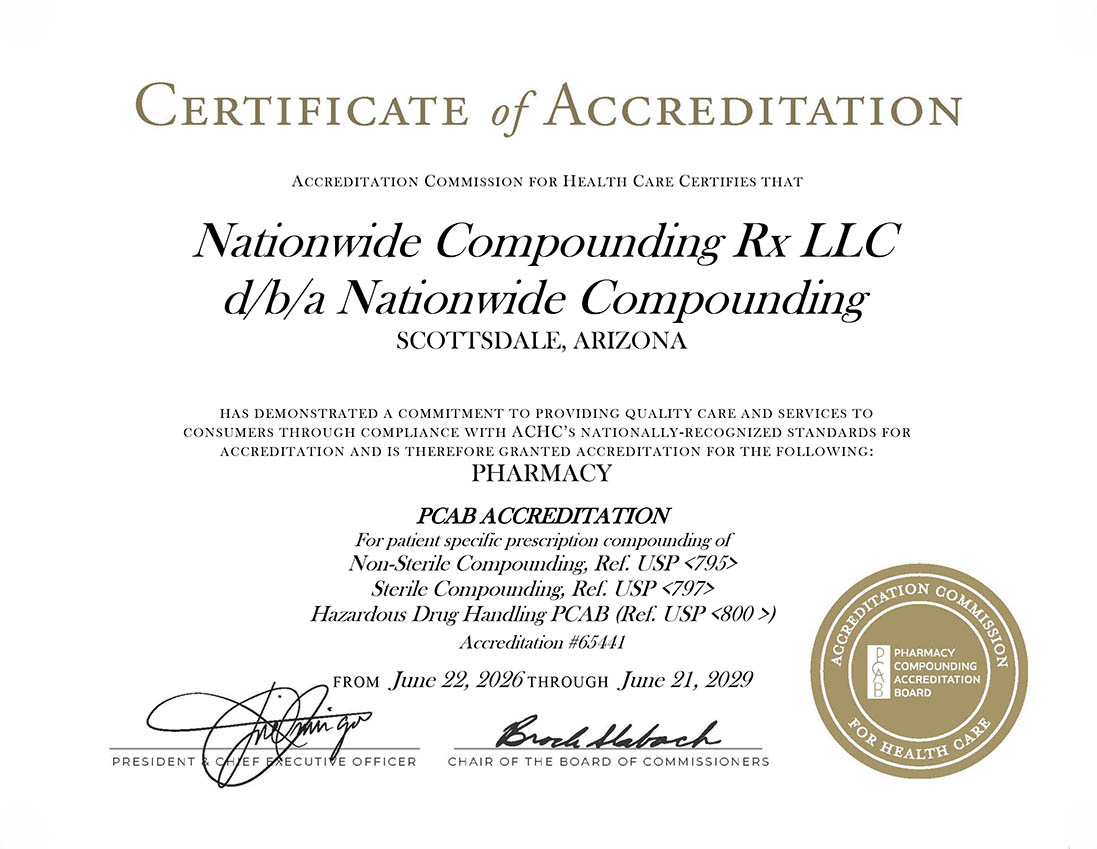
Just as URAC accreditation signals quality for NYU’s specialty pharmacy, Nationwide Compounding Rx® holds benchmarks specific to compounding:
- PCAB Accreditation from the Pharmacy Compounding Accreditation Board, which evaluates compounding practices, quality control, and staff competency
- USP <800> Compliance, the standard governing safe handling of hazardous drugs
- Independent third-party testing to verify potency and consistency
- High-grade chemicals sourced from FDA-inspected and cleared vendors
Capabilities NYU Structurally Cannot Offer
Each gap identified earlier maps directly to a Nationwide Compounding Rx® capability:
| NYU Gap | Nationwide Compounding Rx® Capability |
|---|---|
| Fixed commercial strengths | Custom doses and strength adjustments |
| Dyes, fillers, and allergens in commercial products | Formulations free of dyes, fillers, preservatives, and allergens |
| Discontinued or unavailable strengths | Recreation of discontinued or unavailable strengths |
Additional practical features include:
- Flavor customization for pediatric patients, including cherry, strawberry, bubblegum, and more
- Multiple dosage forms: capsules, liquids, topicals, troches and lozenges, oral and sublingual tablets, and suppositories
- 1–2 business day turnaround, with same-day pickup available for some medications
When to Consider a Compounding Pharmacy Alongside Existing NYU Care
Signs a Prescription Falls Outside NYU’s Fixed Formulary
Several scenarios suggest a prescription may need compounding:
- The prescriber says a drug or strength is “unavailable” or “discontinued”
- The patient has known allergies or sensitivities to inactive ingredients
- Pediatric or elderly dosing falls outside standard tablet or capsule increments
- The patient cannot swallow pills and needs a liquid, topical, or troche alternative
- The condition is not on NYU’s chronic disease list
Patients should ask their NYU care team directly whether a prescription requires compounding. Prescribers are often the first to recognize when a commercial product will not work.
How a Compounding Pharmacy Works Alongside an Existing Care Team
Using a compounding pharmacy does not require leaving NYU Langone’s care system. It fills one specific prescription gap. The typical process is straightforward:
- The NYU prescriber submits a patient-specific prescription to the compounding pharmacy.
- The compounding pharmacy formulates the medication and ships it directly to the patient.
- Care continues with the original NYU provider, who monitors results and adjusts the prescription as needed.
Conclusion
NYU Langone Specialty Pharmacy excels within its designed scope: FDA-approved, manufacturer-supplied drugs for a fixed list of chronic conditions, delivered through an accredited, integrated care model. That scope is not a flaw. It is a structural choice shaped in part by New York’s strict nonresident registration requirements and its prohibition on office-use compounding.
Patients who need custom doses, allergen-free formulas, or discontinued strengths require a different kind of pharmacy, one built specifically for patient-specific compounding. Nationwide Compounding Rx® serves as that legally compliant, quality-accredited complement to NYU’s care model, not a competitor to it.
Talk to Nationwide Compounding Rx® About a Prescription Gap
Patients and providers whose prescriptions fall outside NYU’s fixed formulary can reach out to Nationwide Compounding Rx® to discuss options.
- Physicians can use the secure Provider Portal to submit patient-specific prescriptions, track orders, and connect with the pharmacy team.
- Patients can use the Patient Portal or the website contact form to manage refills and request support.
With a 1–2 business day turnaround, same-day pickup for some medications, and New York-compliant shipping, there is no need to wait on a prescription that a standard specialty pharmacy cannot fill.
Nationwide Compounding Rx®
- Phone: (480) 499-8379
- Website: nationwidecompounding.com
- Hours: Monday–Friday, 7:00 AM–3:30 PM
Related Posts

Not every badge on a compounding pharmacy online means the same thing. This 2026 guide breaks down PCAB accreditation, state licensure, and NABP/LegitScript verification so you can confirm legitimacy before trusting a prescription to the mail.

SureCare Specialty Pharmacy serves two kinds of searchers: those needing basic contact details and those questioning its safety record after 2026 news coverage. This guide covers both, explaining why SureCare is a small 503A compounding pharmacy, not an accredited specialty pharmacy, and how patients can evaluate it accordingly.

Wondering if CVS is a compounding pharmacy? This 2026 guide clears up the confusion around CVS's limited compounding services versus true 503A custom formulations. Learn what CVS can and can't provide, and where to turn for specialized medication needs.

Personalized medicine bioinformatics has transformed how clinicians interpret gene-drug interactions, but the journey doesn't end at the lab report. This article explores the 'compounding bridge'—the critical operational step where genomic insight becomes a dose-adjusted, patient-specific prescription in 2026.