
SureCare Specialty Pharmacy: The 2026 Compounding Trust Gap
Introduction: One Search, Two Very Different Questions
People search for “SureCare Specialty Pharmacy” for two very different reasons. Most want practical information about the El Paso pharmacy, its address, phone number, and hours, so they can fill, refill, or transfer a prescription. A growing share arrive after 2026 news coverage that raised questions about the pharmacy’s safety history and trustworthiness.
This article serves both groups. It provides the basic contact and service facts, then turns the recent controversy into a practical patient-safety framework that applies to any compounding pharmacy.
The central point is simple. The word “specialty” in SureCare’s name does not mean it is a URAC- or ACHC-accredited specialty pharmacy in the regulatory sense. It is a small, independently owned 503A compounding pharmacy, and patients should evaluate it as one.
That distinction matters more in 2026 than ever. Demand for compounded GLP-1s, bioidentical hormone replacement therapy (BHRT), and pediatric formulations keeps rising, and more patients are vetting compounding pharmacies before trusting them with a prescription.
What Is SureCare Specialty Pharmacy, Really?
A fair evaluation starts with the facts. This section covers what SureCare is and does before turning to the questions raised about it.
Quick Facts: Location, Background, and Services
For readers who need practical information, here are the essentials:
- Address: 4005 N Mesa St, El Paso, TX 79902
- Founded: 2013 (the pharmacy’s own website cites 13 years in business)
- Self-reported staffing: 5 pharmacists and 14 qualified staff
- Core services: Sterile and non-sterile compounding, retail prescriptions, CBD products, immunizations, and free citywide delivery
- Listed specialty areas: Pain management, weight loss, veterinary compounding, and nutrition
SureCare describes itself as a locally owned pharmacy founded to serve physicians and patients in El Paso. It operates from a single location, and its delivery service covers the city.
Despite the Name, It’s a 503A Compounding Pharmacy, Not a URAC/ACHC Specialty Pharmacy
In regulatory and industry terms, a “specialty pharmacy” is a specific kind of operation. Specialty pharmacies, usually accredited by URAC or ACHC, dispense FDA-approved, patient-specific prescriptions for complex conditions. The trade group SPAARx has said publicly that specialty pharmacy and compounding are “dissimilar” practices.
SureCare’s services fit the profile of a 503A compounding pharmacy. Its work centers on custom-made preparations, many of which are not FDA-approved products, rather than the drug-centered specialty pharmacy model its name suggests.
This confusion is common across the industry. Chain Drug Review has reported on SPAARx’s pushback against media coverage that treats “specialty pharmacy” and “compounding” as the same thing. For patients, a pharmacy’s name can create expectations its business model does not support. That gap between name and reality is where the trust problem begins.
The 2026 Trust Gap: Mixed Reviews and Resurfacing Controversy
Patients who look into a pharmacy’s history before handing over a prescription are doing reasonable due diligence. The following sections set out what public sources report.
Inconsistent Review Signals Across Platforms
SureCare’s online reputation looks different depending on where a patient checks:
- Yelp: 3.0 out of 5, based on only 6 reviews
- Chamber of Commerce: 4.2 out of 5, based on 37 reviews
- MapQuest (2026): A 1-star review from February 2026 describing the “rudest service,” alongside a 5-star review praising delivery of a compounded GLP-1 medication
Small review counts and inconsistent ratings make it hard to judge a pharmacy from directory listings. A handful of reviews can swing an average sharply, and none of these platforms explain accreditation, compounding standards, or compliance history. Directory sites show what customers felt. They do not show how a pharmacy operates.
The Execution-Drug History Resurfaces in 2026 News Coverage
A 2024 Death Penalty Information Center report and a November 2026 Houston Chronicle opinion piece both identify SureCare as the compounding pharmacy that supplied Tennessee’s 2018 execution drugs.
Reporting based on court documents adds supply-chain details. According to the Tennessean’s coverage, Cardinal Health, one of the country’s largest pharmaceutical distributors, discovered the intended use of the drugs and cut off SureCare’s access to certain controlled distribution products in 2018. SureCare then began compounding the execution drugs from raw materials.
The reporting also describes a staffing concern. The pharmacist assigned to prepare the execution drugs had previously been disciplined at another job for allowing an uncertified technician to work unsupervised. According to the reporting, that same pharmacist later let a technician prepare the execution drugs in violation of state rules, a detail that points directly to questions about technician oversight.
Disciplinary Red Flags: Fines and Mislabeled Drug Recalls
The same reporting cites two compliance issues in SureCare’s history:
- A fine for failing to disclose an owner’s misdemeanor charge
- A recall of mislabeled drugs
These are verifiable compliance records, not opinions. They bear on transparency and quality control, which are the qualities patients depend on most when buying a medication made by hand rather than in a factory.
Patients can check any Texas pharmacy’s standing through the Texas State Board of Pharmacy. The Board can reprimand, suspend, revoke, retire, or fine the license of a pharmacist or pharmacy, and it explains its complaint and discipline process publicly.
Why This Matters for Patients Today, Especially GLP-1 Seekers
In 2026, GLP-1 demand is the fastest-growing reason patients find their way to compounding pharmacies. That is what turns a historical controversy into a question about present-day purchases.
The Direct Link: Execution-Drug Pharmacies Now Marketing GLP-1s
The Houston Chronicle piece points out that several Texas pharmacies with execution-drug histories, including SureCare, now advertise compounded GLP-1 and weight-loss products on their websites.
The concern is practical: the same issues that surfaced in the execution-drug case, technician supervision and sourcing documentation, are the areas patients should examine before trusting any pharmacy with an injectable weight-loss medication.
The Legal Nuance: Tirzepatide Can No Longer Be Legally Mass-Compounded
Tirzepatide, the active ingredient in Zepbound and Mounjaro, was removed from the FDA shortage list in October 2024, and the remaining transition periods ended by March 2025. Mass compounding of tirzepatide copies is no longer legally permitted. Drugs.com states plainly that tirzepatide cannot currently be legally compounded in a U.S. pharmacy as a copy of the commercial product.
This gives patients a useful question to ask any compounding pharmacy, SureCare included:
“What active ingredient is in this compounded GLP-1, and what is the legal basis for compounding it for this patient in 2026?”
A legitimate answer will point to a documented, patient-specific clinical reason, such as personalized dosing or an allergy accommodation. A vague answer, or no answer, is a warning sign.
What the TIME Investigation Reveals About the Compounded Weight-Loss Market
TIME’s October 2026 investigation found that the compounded weight-loss market is booming but shows inconsistent quality and real safety risks across providers. The investigation reinforces a broader point: brand names, marketing, and search rankings do not separate safe options from risky ones. Accreditation and sourcing transparency do.
Specialty Pharmacy vs. Compounding Pharmacy: Clearing Up the Confusion
Neither directory listings nor news reports explain the difference between these two kinds of pharmacy. Nationwide Compounding Rx® sums it up this way: specialty pharmacy is built around the drug, while compounding pharmacy is built around the patient.
What a True URAC/ACHC Specialty Pharmacy Does
- Dispenses FDA-approved, patient-specific prescriptions, often for complex chronic conditions such as cancer or autoimmune disease
- Organizes its services around a specific approved therapy, including insurance management, prior authorization, and clinical support
- Typically holds URAC or ACHC accreditation, not PCAB accreditation, which applies to compounding
What a 503A Compounding Pharmacy Does (and Why SureCare Fits Here)
- Organizes its work around the individual patient, providing custom strengths, dosage forms, flavors, and allergen-free formulations that are not available commercially
- Is regulated under the 503A framework, which is separate from 503B outsourcing facilities and from FDA drug-approval pathways
- SureCare’s service list (sterile and non-sterile compounding, pain management, weight loss, veterinary compounding, and nutrition) is a typical 503A compounding profile, not a specialty pharmacy profile
Why This Distinction Matters for Trust and Safety
The FDA does not approve compounded medications product by product. Their quality depends on the individual pharmacy’s accreditation, staff oversight, and sourcing practices. That makes PCAB accreditation, USP compliance, and technician supervision the tools patients should actually rely on. The word “specialty” in a pharmacy’s name tells them nothing about quality.
The Patient-Safety Checklist: How to Vet Any Compounding Pharmacy in 2026
The following five checks apply to any compounding pharmacy.
1. Check for PCAB Accreditation
The Pharmacy Compounding Accreditation Board verifies that a pharmacy meets standardized requirements for compounding quality, safety, and process controls. Patients should ask about accreditation directly or check public accreditation listings. A professional-sounding name is not evidence of accreditation.
2. Verify USP <795>/<797>/<800> Compliance
- USP <795>: Standards for non-sterile compounding
- USP <797>: Standards for sterile compounding
- USP <800>: Standards for handling hazardous drugs
Compliance affects contamination risk, potency accuracy, and the safety of both staff and patients. This is especially important for sterile GLP-1 injectables and hormone preparations.
3. Ask Who’s Actually Preparing the Medication
In the SureCare case, the reporting describes a previously disciplined pharmacist who allegedly let a technician prepare controlled medications in violation of state rules. Patients should ask whether a licensed pharmacist directly oversees all compounding or whether technicians work with minimal supervision.
4. Demand Sourcing Transparency
Patients should ask two questions:
- Do the raw materials and active pharmaceutical ingredients come from FDA-inspected and cleared vendors?
- Does the pharmacy use independent third-party testing to verify potency and purity?
The Cardinal Health cutoff shows why this matters. When a pharmacy loses access to a major distributor, it may change where its raw materials come from, and patients have a right to know where theirs come from.
5. Confirm State Licensing and Disciplinary History
The Texas State Board of Pharmacy, or the equivalent board in another state, offers a free way to check a pharmacy’s record. Patients should look for fines, recalls, or license actions before trusting any pharmacy with a prescription.
How SureCare Measures Up Against the Checklist
Applying the checklist to what is publicly known:
| Checklist Criterion | What Is Publicly Known |
|---|---|
| PCAB accreditation | Not published on SureCare’s own website; current status unknown |
| USP compliance | Current compliance documentation not published on its site |
| Technician oversight | Reported alleged violation in the execution-drug case |
| Sourcing transparency | Reported shift to raw-material compounding after the Cardinal Health cutoff |
| Licensing and discipline | Documented fine and mislabeled-drug recall |
These facts do not prove that SureCare’s current operations are unsafe. Practices can change, and some information is simply not public. Still, the record supports a clear recommendation: patients should not rely on the “specialty pharmacy” name. Before transferring a prescription, they should ask SureCare, or any pharmacy, for current accreditation and compliance documentation.
A Nationally Shippable, PCAB-Accredited Alternative: Nationwide Compounding Rx®
Patients who have worked through the checklist and want an accredited, transparent option can compare SureCare with Nationwide Compounding Rx®, based in Scottsdale, Arizona.
PCAB-Accredited and USP 800 Compliant by Design
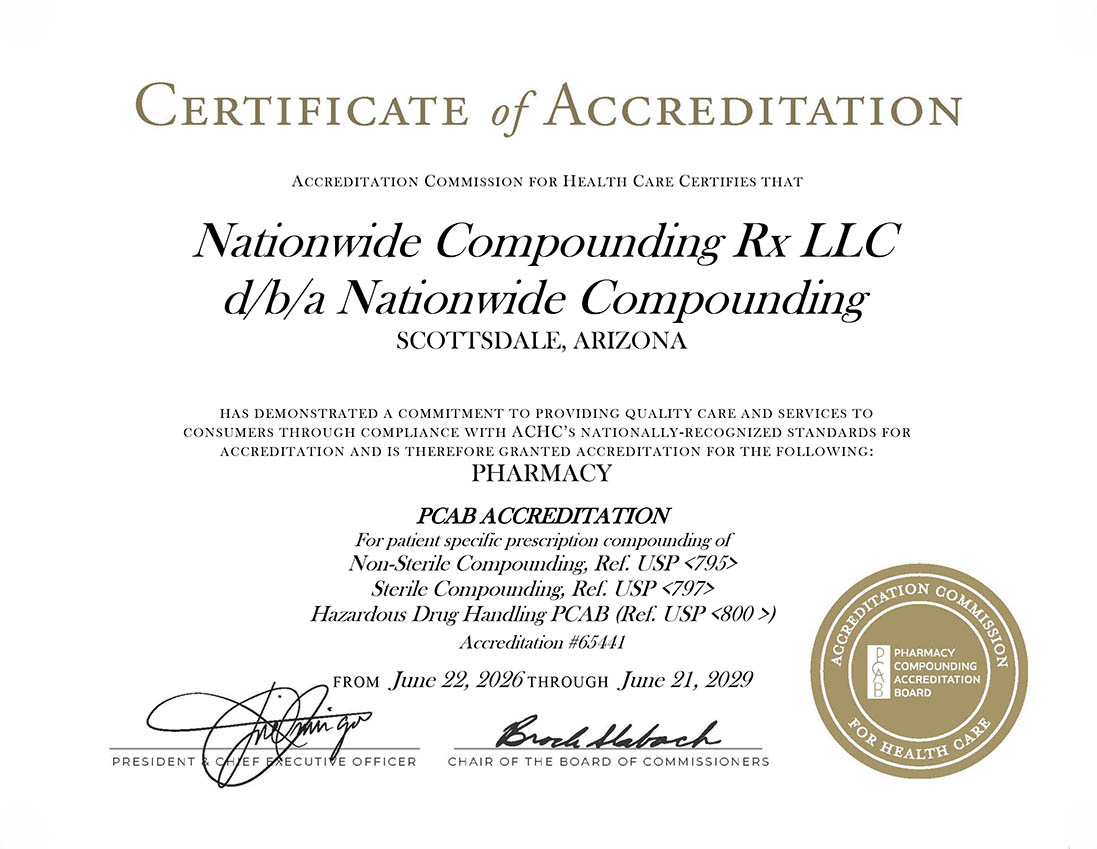
Nationwide Compounding Rx® is PCAB accredited and USP 800 compliant, the baseline trust signals described in the checklist. It sources high-grade chemicals exclusively from FDA-inspected and cleared vendors and uses independent third-party testing to verify quality and consistency. Its team brings more than 40 years of combined experience.
Built for GLP-1, BHRT, and Pediatric Compounding
The pharmacy offers GLP-1 and peptide support within current legal compounding limits, which matters given the tirzepatide shortage-list change discussed above. Its BHRT formulas can be adjusted at each refill based on updated lab results. Its pediatric formulations are dosed by age and weight and come in child-friendly forms such as flavored liquids, popsicles, and suckers.
It can also make allergen-free formulations, free of dyes, fillers, and preservatives, for patients who cannot tolerate commercial products.
Multi-State Shipping vs. a Single-Location Model
SureCare operates from one El Paso location and delivers within the city. Nationwide Compounding Rx® ships nationwide under a three-tier state licensing system: fully licensed states, states licensed for non-sterile products only (with sterile licensing pending), and states where licensing is pending or not held. Availability depends on the medication type and state rules.
It offers a 1 to 2 business day turnaround, same-day pickup for some medications, and secure provider and patient portals for managing prescriptions from any location.
Conclusion: Separating the Navigational Facts from the Trust Decision
SureCare Specialty Pharmacy is a real, independently owned 503A compounding pharmacy operating in El Paso, and the contact information above is accurate as reported. The 2026 controversy and mixed reviews do not need to be dismissed or sensationalized. They are verifiable facts that patients can weigh using the PCAB, USP, oversight, sourcing, and licensing checklist.
The main takeaway is not “avoid SureCare.” It is “verify any compounding pharmacy” against objective accreditation and oversight standards before trusting it with a GLP-1, BHRT, or pediatric prescription.
Ready to Compare? Talk to a PCAB-Accredited Compounding Pharmacy
Patients and providers considering compounding options for GLP-1, BHRT, or pediatric prescriptions can contact Nationwide Compounding Rx® to discuss its accreditation, sourcing, and shipping availability in their state.
- Phone: (480) 499-8379
- Website: nationwidecompounding.com
- Portals: Secure Provider Portal and Patient Portal access
- Hours: Monday through Friday, 7:00 AM to 3:30 PM
The pharmacy’s approach follows four steps: Connect, Collaborate, Create, Care. For anyone weighing a switch or starting a compounded prescription, the first step is simply a conversation.
Related Posts

When OptumRx Specialty Pharmacy denies, delays, or refuses to fill a prescription, patients are often left without clear next steps. This guide breaks down how routing and prior authorization actually work, how to spot an appealable denial, and explores credentialed compounding pharmacies as a 2026 alternative when OptumRx structurally can't help.
The Woodlands compounding pharmacy patients rely on for BHRT, GLP-1, and specialty prescriptions now face a major regulatory shift. Learn what Texas's 2026 sterile compounding rule change means and how to verify any pharmacy's legal qualifications in minutes.

Not every badge on a compounding pharmacy online means the same thing. This 2026 guide breaks down PCAB accreditation, state licensure, and NABP/LegitScript verification so you can confirm legitimacy before trusting a prescription to the mail.
NYU Langone Specialty Pharmacy is built to dispense FDA-approved, manufacturer-supplied drugs, but that leaves a gap for patients needing compounded, custom-dose, or allergen-free medications. This article explains why the fixed formulary falls short in 2026 and how NYU patients can access patient-specific compounding alongside their existing care team.