
Compounding Pharmacy Online: The 2026 Legitimacy Checklist
Introduction: One Prescription, Three Questions That Need Answers First
A patient leaves a provider’s office with a compounded prescription. It might be a bioidentical hormone formulation, a GLP-1 preparation, a flavored liquid for a toddler who refuses pills, or a topical pain cream designed to avoid systemic side effects. The local pharmacy cannot fill it, so the patient starts searching for a compounding pharmacy online.
Within minutes, the search results fill with websites displaying logos: PCAB, NABP, LegitScript. Many patients assume that any pharmacy showing one of these badges has been “verified.” That assumption is understandable, but it is wrong. Each badge answers a completely different question, and a pharmacy that passes one test may fail another.
This article uses a three-layer framework to separate those questions:
- PCAB/ACHC accreditation confirms compounding-process quality.
- State Board of Pharmacy non-resident licensure confirms legal authority to ship to a specific state.
- NABP/LegitScript verification confirms general online-pharmacy legitimacy.
In 2026, this process matters more than ever. The FDA’s crackdown on compounded GLP-1 marketing, combined with widespread confusion about 503A and 503B pharmacies, has made the online compounding landscape harder to navigate. The framework itself exists because of a tragedy: the 2012 New England Compounding Center outbreak.
The stakes are real. Sending a prescription and payment to an unverified online pharmacy is not a customer-service inconvenience. It is a health risk and, in some cases, a legal one.
Why Treating PCAB, NABP, and LegitScript as Interchangeable Is a Mistake
Accreditation and licensure are not the same thing. PCAB verifies how a pharmacy compounds medications: its procedures, staff training, equipment, and quality controls. State licensure and NABP/LegitScript verification confirm that a pharmacy is legally and appropriately operating, including online.
Most “trust checklist” content on compounding pharmacy websites lists all three badges side by side without explaining what each one certifies. That leaves searchers unable to answer the questions that actually matter:
- Is this medication being made safely? (A quality question)
- Is this pharmacy allowed to send it to my state? (A legal question)
- Is this website a real pharmacy or a rogue seller? (An online fraud question)
A credible online compounding pharmacy should be able to demonstrate all three layers. A patient who checks only one remains only partially protected.
The NECC Case: Why This Verification Process Exists
In 2012, the New England Compounding Center (NECC) in Framingham, Massachusetts, shipped contaminated methylprednisolone steroid injections to healthcare facilities across the country. The result was a fungal meningitis outbreak that sickened more than 750 people in 20 states, with at least 64 deaths in the initial count, and later tallies of related deaths exceeded 100.
The root failure was structural. NECC was licensed as a pharmacy, yet it functioned as an unregistered mass manufacturer. It produced large batches of sterile injectables for broad distribution while presenting itself as a pharmacy filling patient-specific prescriptions, a posture that helped shield its operations from FDA oversight. Its compounding processes went largely unchecked until people began dying. In 2024, NECC’s co-founder pleaded no contest to involuntary manslaughter charges in Michigan, more than a decade after the outbreak.
Congress responded with the 2013 Drug Quality and Security Act (DQSA), which formalized the distinction between Section 503A traditional compounding pharmacies and Section 503B outsourcing facilities. That distinction still defines the industry in 2026.
NECC is the reason PCAB accreditation, state licensure, and online verification are not bureaucratic checkboxes. They are precisely the safeguards NECC lacked.
Layer 1: PCAB/ACHC Accreditation (Proof of Compounding-Process Quality)
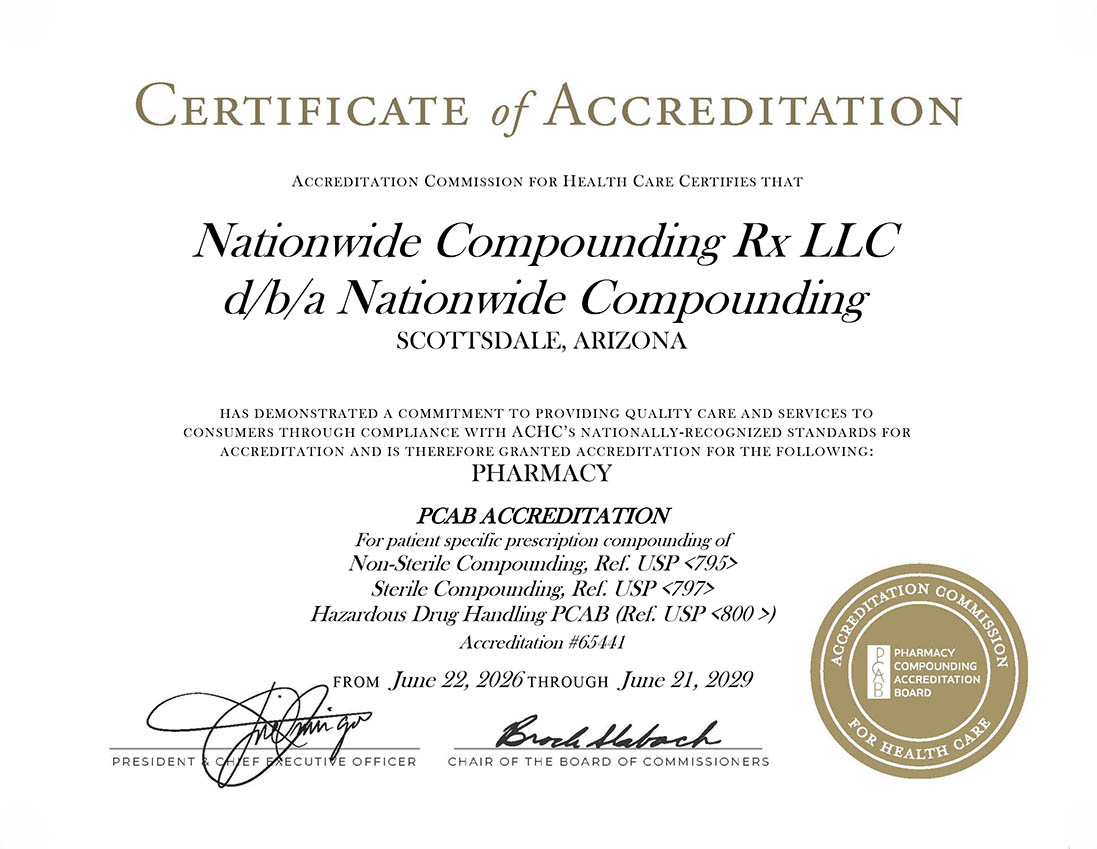
The Pharmacy Compounding Accreditation Board (PCAB), now administered by the Accreditation Commission for Health Care (ACHC), is widely regarded as the gold-standard accreditation specific to compounding. It is also rare: fewer than 1% of U.S. compounding pharmacies hold PCAB accreditation.
PCAB is entirely voluntary. No federal law requires it. That is exactly why it functions as a meaningful differentiator rather than a baseline requirement. A pharmacy that pursues PCAB accreditation has chosen to submit to scrutiny beyond what the law demands.
Accreditation is earned through on-site surveyor audits that examine:
- Written compounding procedures and adherence to them
- Staff training and competency documentation
- Equipment calibration and facility design
- Quality assurance systems, including testing and recordkeeping
The USP Standards Behind PCAB Accreditation
PCAB evaluation is grounded in the United States Pharmacopeia (USP) General Chapters that govern compounding quality:
- USP <795>: Standards for non-sterile preparations such as capsules, creams, troches, and oral liquids.
- USP <797>: Standards for sterile preparations, including injectables, where contamination risk is highest (the category at the center of the NECC disaster).
- USP <800>: Standards for handling hazardous drugs, enforceable since November 2023.
Revisions to these chapters that took effect in 2023 added stricter requirements for personnel training, environmental monitoring, and beyond-use dating (how long a compounded preparation remains safe to use).
USP <800> compliance deserves particular attention. It requires specific facility engineering controls, containment strategies, protective equipment, and handling protocols for hazardous compounds, including certain hormones. A pharmacy that is USP <800> compliant has invested in protecting both its staff and the integrity of its preparations, which signals a mature safety culture.
How to Verify PCAB/ACHC Status Independently
A logo on a homepage is not proof. Patients and providers should:
- Search the public ACHC accreditation directory to confirm the pharmacy’s status independently.
- Look for a specific accreditation number or certificate, not just a badge image.
- Confirm the accreditation covers the relevant service type, since sterile and non-sterile compounding may be evaluated separately.
PCAB accreditation has a limit, too. It says nothing about whether a pharmacy is licensed to ship to a particular state. That is Layer 2.
Layer 2: State Board of Pharmacy Non-Resident Licensure (Proof of Legal Authority to Ship to a Specific State)
There is no federal “nationwide” pharmacy license. A 503A compounding pharmacy must independently obtain a non-resident pharmacy license in every state it ships into. Coverage is built one state at a time, each with its own application, fees, inspections, and renewal cycles.
This matters more than most searchers realize. A pharmacy can be fully PCAB accredited and still be legally barred from shipping a prescription to a patient in a state where it lacks a non-resident license. The word “nationwide” in marketing copy is not a legal status.
The two layers are also becoming increasingly intertwined. A growing number of states tie non-resident licensure to accreditation status; according to industry legal analyses, Washington and Ohio now require PCAB accreditation as a prerequisite for non-resident licensure. Quality and legal authority, once evaluated separately, are converging.
How to Check Non-Resident Licensure Before Ordering
Before submitting a prescription, patients and providers can:
- Visit their own state Board of Pharmacy website and use its online license lookup tool.
- Search for the pharmacy by name and confirm an active non-resident pharmacy license, not one that is expired, pending, or under disciplinary action.
- Check the pharmacy’s home-state board listing to confirm its resident license is in good standing.
- Look for a published, multi-tier state shipping map that distinguishes fully licensed states, non-sterile-only states, and unlicensed or pending states.
A detailed shipping map is a transparency signal. A vague “we ship nationwide” claim is not. Many online compounding pharmacy sites gloss over state-by-state licensing, leaving patients to discover only after submitting a prescription that the pharmacy cannot legally serve them.
Layer 3: NABP/LegitScript (Proof of General Online-Pharmacy Legitimacy)
The National Association of Boards of Pharmacy (NABP) offers programs including the Verified Pharmacy Program and .pharmacy domain accreditation. LegitScript provides separate certification for healthcare websites. These programs confirm that a website operates as a legitimate, appropriately regulated online pharmacy.
This layer exists because the internet is crowded with rogue pharmacy sites selling counterfeit drugs, dispensing without prescriptions, or shipping from overseas. Those risks have nothing to do with compounding specifically, yet they affect anyone buying medication online.
The FDA’s BeSafeRx program and Harvard Health identify the same core red flags:
- No prescription required
- No verifiable U.S. state pharmacy license
- Shipment from outside the United States
- Prices that seem implausibly discounted
NABP or LegitScript certification has its own limits. It does not confirm whether compounding meets USP standards (Layer 1) or whether the pharmacy may legally ship to a particular state (Layer 2). It screens out bad actors; it does not certify compounding excellence.
The 2026 Flashpoint: GLP-1s, 503A vs. 503B, and Why the Rules Are Shifting
Understanding the two federal compounding pathways is essential in 2026:
| Category | 503A Compounding Pharmacy | 503B Outsourcing Facility |
|---|---|---|
| Prescription basis | Patient-specific prescriptions | Can produce in bulk without patient-specific prescriptions |
| Primary regulator | State Board of Pharmacy | FDA registration required |
| Quality standard | USP <795>, <797>, <800> | Current Good Manufacturing Practice (cGMP), 21 CFR Parts 210/211 |
GLP-1 medications have placed this distinction under intense scrutiny. The FDA declared the tirzepatide shortage resolved in October 2024 and the semaglutide shortage resolved in February 2025. Those decisions ended the enforcement discretion that had allowed widespread compounding of these drugs, outside narrow exceptions.
Enforcement accelerated in 2026. On March 3, 2026, the FDA announced 30 warning letters to telehealth companies over compounded GLP-1 marketing claims, following an earlier round in September 2025. In April 2026, the FDA proposed permanently excluding semaglutide and tirzepatide from the 503B bulk drug list.
For patients, the takeaway connects directly to the three-layer framework. A legitimate pharmacy compounding a GLP-1 preparation in 2026 must be able to justify patient-specific, clinically necessary compounding under 503A rules, such as a documented allergy to an inactive ingredient or a needed dosage form, rather than mass-producing standardized doses. That justification comes on top of, not instead of, all three verification layers.
Aggressive GLP-1 marketing from unverified online sources (“no prescription needed,” “same as brand name,” “lowest price guaranteed”) should be treated as an immediate red flag.
The 2026 Compounding Pharmacy Legitimacy Checklist
Complete these steps before submitting any prescription to an online compounding pharmacy:
Step 1: Confirm compounding quality.
Search the ACHC directory for active PCAB accreditation. Ask the pharmacy directly about compliance with USP <795>, <797>, and <800>.
Step 2: Confirm legal authority to ship.
Check the pharmacy’s home-state board listing, then use the relevant state Board of Pharmacy’s lookup tool to confirm an active non-resident license.
Step 3: Confirm online legitimacy.
Look for NABP Verified Pharmacy Program, .pharmacy, or LegitScript certification. Screen for FDA BeSafeRx red flags: no prescription required, overseas shipping, or suspiciously low prices.
Step 4: Scrutinize high-risk medications.
For GLP-1s and other medications under heightened FDA attention, confirm the pharmacy compounds under valid, patient-specific 503A authority rather than mass-marketing standardized doses.
Step 5: Look for transparency markers.
Favor pharmacies that publish accreditation details, maintain a clear state shipping map, and describe their sourcing and testing practices. Logos alone are not enough. For a deeper list of what to ask before choosing a provider, see these questions to ask a compounding pharmacy.
What a Verifiable Online Compounding Pharmacy Looks Like in Practice: Nationwide Compounding Rx®
Checklists are easier to apply with a concrete example. Nationwide Compounding Rx®, based in Scottsdale, Arizona, illustrates what the framework looks like on a real pharmacy website.
Layer 1 in practice. The pharmacy is PCAB accredited and USP <800> compliant. It supports that accreditation with independent third-party testing and sources high-grade chemicals exclusively from FDA-inspected and cleared vendors. These are specific, checkable claims, and readers can confirm accreditation status through the ACHC directory.
Layer 2 in practice. Rather than a blanket “we ship everywhere” promise, Nationwide Compounding Rx® publishes a multi-tier state shipping map that distinguishes three categories: fully licensed states, non-sterile-only states (with sterile licensure pending), and states where licensure is pending or not held. That gives patients a transparent answer to “will this pharmacy ship to me?” that they can cross-check against their own state board’s lookup tool.
Supporting operational signals. Several features reflect a legitimate, prescription-based model rather than a transactional one:
- A 1 to 2 business day turnaround, with same-day pickup available for some medications
- Separate secure Provider and Patient Portals for prescription submission, order tracking, and refill requests
- A collaborative provider partnership process (Connect, Collaborate, Create, Care) built around working with prescribers instead of dispensing on demand
- Customization across capsules, liquids, topicals, troches, tablets, suppositories, and pediatric forms, including allergen-free preparations
For Layer 3, readers can apply the same scrutiny they would to any online pharmacy: confirm a prescription is required and verify licensure independently. The point is not that this pharmacy is the only option. It is that “passing” the framework looks like specific, verifiable information rather than a row of logos.
Conclusion: Verify Before You Ship Your Prescription
PCAB accreditation, state non-resident licensure, and NABP/LegitScript verification are not interchangeable trust badges. Each closes a different gap: compounding quality, legal authority to ship, and online legitimacy. All three matter.
NECC demonstrated what happens when a pharmacy operates without meaningful oversight of its compounding processes. The 2026 wave of FDA action on compounded GLP-1s shows that regulators are still drawing hard lines between legitimate patient-specific compounding and mass-market shortcuts.
Whichever pharmacy a patient or provider chooses, the five-step checklist above should come first. A few minutes with the ACHC directory and a state board lookup tool can prevent serious harm.
Next Steps: Partnering With a Transparent, Accredited Compounding Pharmacy
Patients and healthcare providers can review Nationwide Compounding Rx®’s PCAB accreditation, USP <800> compliance, and state shipping map directly on the pharmacy’s website before submitting a prescription.
- Providers can use the Provider Portal to submit and manage prescriptions, track orders, and collaborate with the pharmacy team.
- Patients can use the Patient Portal to access account information and manage refills and support requests.
Questions about accreditation, licensure, or whether a specific medication can ship to a particular state can be answered before ordering. Contact Nationwide Compounding Rx® at (480) 499-8379 (Monday through Friday, 7:00 AM to 3:30 PM Arizona time) or through the website contact form, with email inquiries answered within one business day.
Related Posts

SureCare Specialty Pharmacy serves two kinds of searchers: those needing basic contact details and those questioning its safety record after 2026 news coverage. This guide covers both, explaining why SureCare is a small 503A compounding pharmacy, not an accredited specialty pharmacy, and how patients can evaluate it accordingly.
NYU Langone Specialty Pharmacy is built to dispense FDA-approved, manufacturer-supplied drugs, but that leaves a gap for patients needing compounded, custom-dose, or allergen-free medications. This article explains why the fixed formulary falls short in 2026 and how NYU patients can access patient-specific compounding alongside their existing care team.

Wondering if CVS is a compounding pharmacy? This 2026 guide clears up the confusion around CVS's limited compounding services versus true 503A custom formulations. Learn what CVS can and can't provide, and where to turn for specialized medication needs.

Personalized medicine bioinformatics has transformed how clinicians interpret gene-drug interactions, but the journey doesn't end at the lab report. This article explores the 'compounding bridge'—the critical operational step where genomic insight becomes a dose-adjusted, patient-specific prescription in 2026.