
Semaglutide Compounding Pharmacy: What’s Still Legal in 2026
Introduction: The Compounded Semaglutide Landscape in Mid-2026
The market for compounded semaglutide looks dramatically different in mid-2026 than it did just eighteen months ago. When the FDA officially declared the semaglutide drug shortage resolved in February 2025, it removed the primary legal foundation that had allowed compounding pharmacies to produce the medication at scale. For the millions of patients who turned to compounded semaglutide as a more affordable alternative, the legal window has narrowed considerably.
The stakes are real. Compounded semaglutide has typically cost patients between $150 and $400 per month, compared to $935 to $1,349 per month for brand-name Ozempic or Wegovy without insurance. That cost difference drove enormous demand. But the regulatory environment that made it possible has fundamentally shifted, and patients who relied on those savings now face difficult decisions about access and continuity of care.
This article does more than rehash the familiar 503A versus 503B distinction. It provides a complete enforcement timeline and a clear map of what remains legally available in mid-2026. Two audiences need this clarity most: patients navigating their access options, and healthcare providers managing their compliance obligations. The central takeaway is this: a narrow but legitimate legal pathway still exists under Section 503A for documented, patient-specific medical necessity. Understanding that pathway requires understanding how the landscape arrived here.
The Regulatory Timeline: From Shortage Declaration to 2026 Enforcement
Most coverage of compounded semaglutide treats the regulatory history in fragments. To understand where things stand today, it helps to trace the full arc from the original shortage through the enforcement actions now reshaping the market.
2022–2024: The Shortage Era and the Legal Basis for Compounding
When the FDA added semaglutide to its drug shortage list, it created the legal foundation for widespread compounding under both Section 503A and Section 503B of the Federal Food, Drug, and Cosmetic Act (FD&C Act). Ordinarily, compounding a drug that is “essentially a copy” of a commercially available product is prohibited. The shortage-list designation suspended that prohibition, allowing compounding pharmacies to legally produce semaglutide to meet demand the manufacturer could not.
The result was explosive market growth. Legitimate compounders entered the space alongside bad actors, and the lack of uniform oversight created openings for problems. Early safety signals began to surface: unapproved salt forms such as semaglutide sodium and semaglutide acetate, non-sterile compounding environments, and growing reports of dosing confusion.
February 2025: FDA Resolves the Shortage and the Clock Starts
In February 2025, the FDA officially declared the semaglutide shortage resolved. Novo Nordisk’s expanded manufacturing capacity and the approval of Wegovy HD (7.2 mg) had restored supply. With the shortage gone, so was the primary legal basis for widespread compounding.
The agency set two firm enforcement deadlines: April 22, 2025 for 503A state-licensed pharmacies, and May 22, 2025 for 503B outsourcing facilities, both to cease compounding products that were “essentially a copy” of semaglutide. That legal standard is the dividing line between prohibited bulk production and permissible patient-specific compounding. By April 30, 2025, the FDA had already received 520 adverse event reports related to compounded semaglutide, underscoring the urgency behind the enforcement timeline.
Mid-2025: Court Injunctions and Legal Uncertainty
Compounding industry groups did not accept the enforcement deadlines quietly. They filed legal challenges against the FDA’s 503B enforcement, securing injunctions that temporarily prevented a complete shutdown. The result was a complex and uneven landscape: some 503B facilities continued operating under legal protection while others wound down.
This uncertainty bred patient confusion and continued market activity that the FDA regarded as non-compliant. Importantly, the injunctions did not touch the 503A enforcement deadline, so state-licensed pharmacies remained bound by the April 2025 cutoff. The FDA’s September 2025 warning letter to Hims & Hers Health signaled that enforcement against telehealth platforms was escalating.
March 2026: The Largest Enforcement Wave in GLP-1 Compounding History
In March 2026, the FDA issued more than 50 warning letters to telehealth firms and compounding pharmacies in a single coordinated wave, described as the largest action against GLP-1 compounders in U.S. history. The cited violations included unauthorized compounding after the shortage resolution, misleading marketing claims, and improper manufacturing practices.
A documented example came earlier, on February 20, 2026, when the FDA issued a warning letter to Join Josie citing false or misleading claims under sections 502(a) and 502(bb) of the FD&C Act. Major telehealth platforms, including Hims and Ro, exited compounded semaglutide entirely following enforcement attention and a Department of Justice (DOJ) referral in early 2026. By coordinating with the DOJ on enforcement referrals, the FDA raised the stakes beyond warning letters to potential criminal liability.
April–June 2026: The Proposed 503B Ban and What Comes Next
On April 30, 2026, the FDA formally proposed removing semaglutide and tirzepatide from the 503B Bulk Drug Substances List, opening a public comment period through June 29, 2026. Industry analysts widely expect the ban to be finalized by the third quarter of 2026, which would effectively end all 503B outsourcing facility production of compounded semaglutide.
The agency’s April 1, 2026 policy clarification on compounding exemptions reinforced this direction. As legal analysts have noted, the clarification does not carry the force and effect of law, but it clearly signals the FDA’s enforcement intent. The public comment period represents the industry’s last formal opportunity to influence the final rule, though the outcome is widely expected to result in a complete 503B ban. Critically, the proposed 503B ban does not eliminate the 503A pathway, a distinction patients and providers must understand.
Understanding the Two Legal Frameworks: 503A vs. 503B
The difference between these two frameworks is no longer academic. One pathway is being eliminated; the other remains available under specific conditions.
503B Outsourcing Facilities: Why This Pathway Is Effectively Closed
503B facilities are registered with the FDA, subject to current Good Manufacturing Practice (cGMP) standards, and able to produce large batches for distribution without patient-specific prescriptions. That capacity made them central to the high-volume compounded semaglutide market.
The April 2026 proposal to remove semaglutide from the 503B Bulk Drug Substances List, if finalized in the third quarter of 2026, will constitute a near-total ban on 503B semaglutide compounding. Even before finalization, the March 2026 enforcement wave drove most legitimate 503B operators out of the market. The court injunctions that once offered temporary protection are unlikely to survive the formal rulemaking process. For patients and providers, any compounded semaglutide sourced from a 503B facility after the final rule is published will carry significant legal and safety risk.
503A State-Licensed Pharmacies: The Narrow but Legitimate Pathway That Remains
503A pharmacies are state-licensed, operate under state board of pharmacy oversight, and compound medications based on individual patient prescriptions. This is where the remaining legal pathway lives.
A 503A pharmacy can compound semaglutide for an individual patient with a documented clinical need (such as an allergy to inactive ingredients in the brand-name product or a need for a different dosage form), but it cannot produce the drug “regularly or in inordinate amounts” as an essentially identical copy. Legal analysts have emphasized that this patient-specific medical necessity standard is not a loophole. It requires genuine clinical documentation from a licensed prescriber.
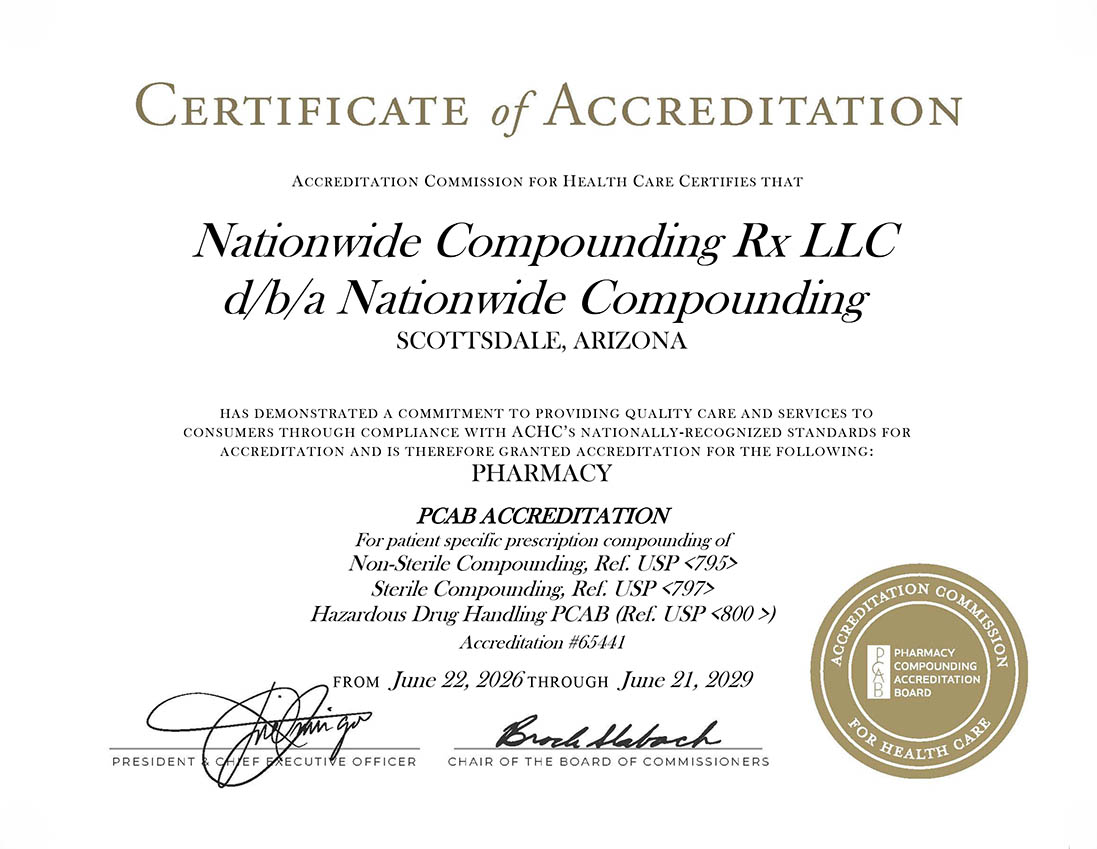
PCAB accreditation is a meaningful quality signal for 503A pharmacies, providing third-party validation of safety and quality compliance standards that state licensing alone does not guarantee.
What Qualifies as Patient-Specific Medical Necessity Under 503A
The most common question from both patients and providers is what documentation and clinical rationale actually satisfy the 503A medical necessity standard. This is a clinical and legal determination made by the prescribing provider, not the pharmacy. The pharmacy’s role is to verify and fulfill a valid prescription.
Clinically Recognized Grounds for 503A Compounding
Several scenarios are commonly recognized as legitimate grounds:
- Allergy or hypersensitivity to one or more inactive ingredients (excipients) in FDA-approved semaglutide products such as Ozempic, Wegovy, or Rybelsus, documented in the patient’s medical record.
- A clinical need for a dosage form not commercially available, for example, a patient who cannot self-administer subcutaneous injections and requires an alternative delivery mechanism.
- A need for a specific dose not available in any commercially approved strength, with documentation explaining why titration using available strengths is clinically insufficient.
Cost alone is not a recognized basis for 503A compounding. The medical necessity must be clinical, not economic. The prescriber bears legal and professional responsibility for the accuracy and completeness of that documentation.
What Providers Must Document and Why It Matters
Prescribers should document the specific clinical rationale in the patient’s chart before transmitting a compounding prescription. The prescription itself should reference the patient-specific need rather than simply requesting “compounded semaglutide” without clinical context.
Medical spas, weight loss clinics, and telehealth operators face heightened scrutiny. The FDA and DOJ have specifically targeted platforms that issued compounding prescriptions without individualized clinical assessment. Providers should audit their prescribing practices and confirm that any compounding pharmacy partner is 503A-compliant, PCAB-accredited, and sourcing only FDA-approved semaglutide base rather than unapproved salt forms. Thorough documentation protects both patient and provider in the event of an FDA inspection or adverse event investigation.
Critical Safety Risks: What the FDA’s Adverse Event Data Reveals
Safety is central to understanding why the regulatory crackdown occurred and why the remaining 503A pathway demands rigorous pharmacy standards. As of April 30, 2025, the FDA had received 520 adverse event reports related to compounded semaglutide, a figure that reflects only reported incidents and likely undercounts actual harm.
Dosing Errors: The Unit vs. mg/mL Confusion Problem
One of the most frequently reported adverse events involves patients administering 5 to 20 times their intended dose due to confusion between units and mg/mL concentrations. Compounded semaglutide is often supplied in multi-dose vials at varying concentrations, unlike the fixed-dose auto-injector pens used for Ozempic and Wegovy.
Without standardized labeling and patient counseling, concentration confusion is both predictable and preventable. Reputable 503A pharmacies provide detailed dosing instructions, concentration-specific labeling, and pharmacist consultation. Patients transitioning between compounded and brand-name products are at particular risk during the adjustment period.
Unapproved Salt Forms: Semaglutide Sodium and Semaglutide Acetate
Only semaglutide base is FDA-approved. Salt forms such as semaglutide sodium and semaglutide acetate are unapproved and have not been evaluated for safety or effectiveness. Some compounders, particularly those operating outside the 503A framework or sourcing from unverified suppliers, have used these salt forms, sometimes without disclosing this to patients or prescribers.
The pharmacological equivalence of salt forms to semaglutide base has not been established. Patients and providers should explicitly ask any compounding pharmacy to confirm that its formulation uses semaglutide base and to provide documentation of the active pharmaceutical ingredient (API) source. Pharmacies that source APIs from FDA-inspected and cleared vendors, as Nationwide Compounding Rx® does, provide a critical safeguard against unapproved ingredient substitution. Our commitment to high-quality chemicals and sourcing standards is a direct response to the risks documented in FDA enforcement actions.
Contamination and Quality Control Failures
Bacterial contamination from non-sterile compounding environments has been documented in FDA adverse event reports and enforcement actions. Injectable medications, including semaglutide, require sterile compounding conditions that not all pharmacies are equipped to provide. USP 800 compliance and PCAB accreditation are meaningful indicators that a pharmacy has invested in the facility standards necessary for safe sterile compounding.
Counterfeit products sold through unverified online channels represent a separate but related risk. Patients purchasing from non-pharmacy sources have no assurance of ingredient identity, sterility, or potency. The FDA’s enforcement actions have specifically targeted pharmacies with documented quality control failures, not just those making misleading marketing claims.
The Evolving Cost Landscape: Is Compounded Semaglutide Still the Affordable Option?
The cost advantage that drove patients to compounded semaglutide is narrowing significantly in 2026. New brand-name access pathways have emerged that did not exist when most patients first sought compounded alternatives.
Updated Cost Comparison: Compounded vs. Brand-Name in 2026
- Compounded semaglutide from a compliant 503A pharmacy: roughly $150 to $400 per month, with insurance rarely covering it.
- Brand-name Ozempic or Wegovy at full list price without insurance: $935 to $1,349 per month.
- Oral Wegovy (newly launched): $149 to $299 per month, a dramatically lower entry point for brand-name access.
- NovoCare Direct self-pay program: Wegovy at $499 per month for eligible patients.
- Medicare GLP-1 Bridge program (beginning July 2026): Wegovy and Zepbound at a $50 per month copay under Part D, effectively eliminating the cost advantage of compounded semaglutide for Medicare-eligible patients.
For patients without Medicare and without insurance coverage, the 503A pathway may still offer a meaningful cost difference. But that gap is narrowing, and the legal and safety requirements are more stringent than ever.
What These Changes Mean for Patients Currently on Compounded Semaglutide
Weight regain occurs within 8 to 12 weeks of GLP-1 discontinuation, making supply continuity a genuine clinical concern. Abrupt transitions carry real health risks, so patients should not discontinue compounded semaglutide without consulting their prescriber and establishing a transition plan.
Options include transitioning to brand-name Ozempic or Wegovy through insurance or manufacturer programs, switching to oral Wegovy, or continuing on compounded semaglutide through a verified 503A pharmacy when medical necessity is documented. Medicare patients should proactively ask their provider about the July 2026 GLP-1 Bridge program. The most important step is ensuring that any continued use of compounded semaglutide comes through a pharmacy that is verifiably 503A-compliant, PCAB-accredited, and sourcing FDA-approved semaglutide base.
How to Identify a Legally Compliant Compounding Pharmacy in 2026
With dozens of enforcement actions, warning letters, and shuttered telehealth platforms in the recent record, patients and providers need a practical checklist for evaluating compounding pharmacy partners.
Five Verification Criteria for 503A Compliance
- State pharmacy board licensure. Verify the pharmacy holds an active license in the state where it operates and in the patient’s state of residence, using the relevant state pharmacy board’s public license lookup tool.
- PCAB accreditation. This third-party validation of safety and quality compliance is publicly verifiable and signals commitment beyond minimum state licensing.
- API sourcing documentation. Ask whether the pharmacy sources semaglutide API from FDA-inspected and cleared vendors and uses semaglutide base rather than sodium or acetate salt forms. A compliant pharmacy can provide this information.
- Sterile compounding facility standards. For injectable semaglutide, confirm the pharmacy operates a USP 797-compliant sterile environment. USP 800 compliance is an additional indicator of facility quality.
- Prescription requirement. A compliant 503A pharmacy requires a valid, patient-specific prescription from a licensed prescriber. It does not offer compounded semaglutide through a direct-to-consumer model without documented clinical rationale.
Red Flags That Signal Non-Compliance
- Marketing compounded semaglutide as “equivalent to Ozempic” or making efficacy claims that imply FDA approval, specifically cited in FDA warning letters as a violation of sections 502(a) and 502(bb) of the FD&C Act.
- Offering compounded semaglutide without a prescription or through a telehealth consultation lacking a genuine individualized clinical assessment.
- Inability or unwillingness to disclose API source, salt form, or facility accreditation status.
- Pricing that seems implausibly low, which may indicate use of research-use-only (RUO) semaglutide or sourcing from unverified international suppliers.
- Operating through platforms that have received FDA warning letters or DOJ referrals.
Nationwide Compounding Rx®: A 503A-Compliant Partner in a Complex Regulatory Environment
In a post-enforcement landscape, patients and providers benefit from working with a responsible, legally grounded pharmacy. Nationwide Compounding Rx® grounds its position in verifiable compliance credentials and operational practices rather than marketing language.
How Nationwide Compounding Rx® Meets the 503A Standard
- PCAB accreditation maintained since the pharmacy’s early days of operation, providing continuous third-party validation of safety and quality compliance standards.
- A USP 800-compliant facility in Scottsdale, Arizona, eliminating cross-contamination risks and meeting the standards required for safe compounding.
- API sourcing exclusively from FDA-inspected and cleared vendors, a direct safeguard against unapproved salt forms and counterfeit ingredients.
- Operation as a 503A state-licensed pharmacy, compounding based on individual patient prescriptions with documented clinical rationale rather than bulk production for general distribution.
- 40 years of combined staff experience in pharmaceutical compounding, with a patient-centered philosophy that rejects one-size-fits-all approaches.
- Nationwide shipping to 47 states plus Washington, D.C., with 1 to 2 business day turnaround.
What Providers and Patients Can Expect When Working with a Compliant 503A Pharmacy
A compliant 503A pharmacy requires a valid prescription with documented patient-specific medical necessity before dispensing compounded semaglutide. This is a feature, not a barrier. Pharmacist collaboration with prescribers is standard practice, so providers can expect consultation on formulation, dosing, and patient counseling rather than transactional order fulfillment.
Patients receive detailed dosing instructions and concentration-specific labeling, directly addressing the dosing error risks documented in FDA reports. Because Nationwide Compounding Rx® focuses on business-to-business relationships, it is experienced in working with medical practices, weight loss clinics, and healthcare providers reviewing their compounding relationships. Transparency about what the pharmacy can and cannot compound under current regulations is a hallmark of a compliant operation.
Conclusion: Regulatory Clarity Is the Foundation of Safe Access
The regulatory arc is now clear. The 2022 shortage declaration opened the compounding market; the February 2025 resolution and enforcement deadlines began closing it; the March 2026 enforcement wave accelerated the shift; and the expected third-quarter 2026 finalization of the 503B ban will complete it. The 503B pathway is effectively closed. The 503A pathway remains available, but only for documented patient-specific medical necessity through a verifiably compliant pharmacy.
The concerns that drove patients to compounded semaglutide (including cost, access, and supply continuity) were legitimate. But the legal and safety landscape has fundamentally changed. The narrowing of the legal pathway is not the end of access for patients with genuine clinical needs. It is a clarification that ensures the remaining access is safe, legal, and clinically appropriate. The patients and providers who navigate this environment successfully will be those who prioritize regulatory compliance and pharmacy quality over cost alone.
Work with a Compounding Pharmacy That Meets the 2026 Standard
Patients and healthcare providers can contact Nationwide Compounding Rx® to learn whether a specific clinical situation may qualify for 503A compounding under current regulations.
- Phone: 1-833-650-9836
- Website: NationwideCompounding.com
- Location: 14000 N. Hayden Rd., Suite 104, Scottsdale, AZ 85260
Pharmacists are available to discuss options under current 503A regulations. Nationwide Compounding Rx® works directly with healthcare providers and medical practices; providers seeking a compliant compounding pharmacy partner are encouraged to reach out to discuss their patient population’s needs. All compounding requires a valid prescription from a licensed prescriber and documented patient-specific medical necessity. The pharmacy’s role is to serve as a knowledgeable, compliant partner in that process.
Related Posts
Searching for Marty's Compounding Pharmacy but not sure if a local Mississippi storefront fits your needs? This guide compares Marty's Pharmacy & Compounding Center to nationwide compounding options using a five-point credential checklist covering accreditation, testing, and shipping licenses in 2026.

The term 'board of specialty pharmacy' actually refers to four distinct organizations, each serving a different purpose. This article breaks down BPS, SPCB, state boards, and PCAB to reveal which body truly governs compounding pharmacy quality in 2026.

Many patients assume CVS Pharmacy Specialty Services can compound custom medications simply because it holds PCAB accreditation—but the reality is more nuanced. This article breaks down what the accreditation actually covers, how the FDA's 503A/503B rules apply, and what it means for prior authorizations on oncology, MS, and RA prescriptions in 2026.

Many patients land on Accredo after a physician, insurer, or PBM directs them there. This guide breaks down what specialty pharmacy Accredo actually does—and the critical compounding limitations you need to know about in 2026.