
When Your Child Can’t Swallow Pills: Compounded Medication Solutions That Work
Introduction: The Daily Battle No Parent Should Have to Fight Alone
The scene plays out in countless homes every morning. A parent holds out a small tablet while their child’s eyes fill with tears. The gagging starts before the pill even reaches the mouth. Minutes tick by as the school bus approaches, and the medication remains untaken. This struggle is exhausting, frustrating, and far more common than many families realize.
The scale of this challenge is significant. An estimated 10% of children between the ages of 6 and 11 cannot swallow a pill, even with training from a pharmacist or practitioner. For children managing chronic illness, the situation becomes even more concerning: between 30% and 70% of these young patients are non-adherent to their medication regimens, with pill-swallowing difficulty serving as a major contributing factor.
The structural problem compounds this individual challenge. Half of all medicines in the United States lack pediatric labeling, meaning the pharmaceutical system itself was not designed with children in mind. This gap leaves families searching for solutions that work for their specific child.
This article explores why children struggle with pills, identifies which children face the greatest challenges, and presents compounded medication solutions that actually work. When a child cannot swallow pills, compounded medication offers a clinically sound, pharmacist-crafted alternative. The following sections cover root causes, special populations, available compounded dosage forms, safety considerations, and guidance on accessing a reputable compounding pharmacy.
Why Children Struggle to Swallow Pills: Root Causes Beyond ‘Just Being Difficult’
Pill-swallowing difficulty is not defiance or bad behavior. It has developmental, sensory, psychological, and in some cases clinical roots. Understanding the cause is the first step toward choosing the right solution.
Developmental Stage and Physical Readiness
Tablets and capsules are generally not suitable for children under age 4 due to underdeveloped swallowing coordination. Even older children may lack the neuromuscular coordination required to manage a solid dosage form without choking.
The gag reflex is naturally more sensitive in younger children and does not simply turn off on command. Developmental readiness varies widely, and chronological age is not always a reliable predictor of pill-swallowing ability. A seven-year-old may struggle with what a five-year-old manages easily, depending on individual development.
Fear, Anxiety, and Psychological Conditioning
A single negative experience with gagging, choking, or vomiting can create lasting fear and anticipatory anxiety around pill-taking. This anxiety activates the gag reflex, creating a self-reinforcing cycle: fear causes gagging, and gagging reinforces fear.
For children already managing health anxiety or illness-related stress, medication time can become a significant emotional trigger. Parents should also recognize that their own anxiety during medication administration can inadvertently amplify the child’s distress. This dynamic deserves acknowledgment and compassion rather than blame.
Sensory Aversion: Taste, Texture, and Smell
Many commercially manufactured pills have bitter, chalky, or chemically unpleasant tastes that are intolerable to children’s more sensitive palates. The texture of a tablet or capsule, including its size, coating, and the sensation of it sitting on the tongue, can trigger immediate rejection.
Smell also plays a role. Some medications have strong odors that signal danger to a child’s sensory system before the pill even reaches the mouth. Palatability is not a minor inconvenience. Research has found that prescriptions for liquid antibiotics with poor taste were 2.4 times more likely to be switched to a broader-spectrum antibiotic, illustrating the real-world clinical consequences of taste aversion.
Clinical Dysphagia: When Swallowing Is a Medical Issue
In a smaller subset of children, difficulty swallowing is not psychological but physiological. Clinical dysphagia involves impaired swallowing function and can be associated with neurological conditions, structural abnormalities, or certain chronic illnesses.
These children require medical evaluation and may need formulations that entirely bypass the oral-solid route. Parents should distinguish dysphagia from behavioral pill refusal and seek evaluation from a speech-language pathologist or specialist when appropriate.
Children Who Face the Greatest Challenges: ASD, ADHD, and Sensory Processing Disorders
While any child can struggle with pills, certain populations face compounded challenges that are often underrecognized. Children with autism spectrum disorder (ASD) and ADHD are disproportionately affected by pill-swallowing difficulty due to the intersection of sensory sensitivities, anxiety, and rigidity around routines.
Sensory processing disorders amplify every aspect of the pill-swallowing experience. The texture, taste, smell, and even the visual appearance of a medication can trigger a full sensory meltdown. These children are also among the most likely to be prescribed medications requiring consistent daily adherence, making the stakes particularly high.
According to Autism Speaks, compounding pharmacists have expertise in mixing drugs to meet special needs, and many children with autism refuse medication due to sensitivities to tastes or textures. Standard pill-swallowing training programs, while helpful for neurotypical children, may be insufficient or inappropriate for children with ASD or severe sensory processing disorders.
Caregivers of children with ASD or ADHD often describe medication administration as one of the most stressful parts of their daily routine. For these children especially, compounded medication is not a convenience; it is often a clinical necessity.
The Structural Gap: Why the Pharmaceutical System Fails Children
The problem extends beyond individual children to represent a systemic failure in pediatric drug development. Half of all medicines in the United States are not labeled for use in children, meaning they lack pediatric dosing guidance, safety data, or appropriate formulations.
The FDA’s Best Pharmaceuticals for Children Act (BPCA) and Pediatric Research Equity Act (PREA) were designed to close this gap. Yet a 2025 PLOS Medicine study found that just over half of required pediatric labeling additions were completed even 10 years after drug approval.
As of March 2025, the American Society of Health-System Pharmacists (ASHP) reported 270 active drug shortages nationwide, further reducing the availability of commercially manufactured pediatric formulations. Many medications that do exist in pediatric-appropriate forms have been discontinued by large manufacturers due to low profitability.
The result is clear: prescribers frequently must prescribe off-label, and pharmacists must compound. This is not a workaround but often the only responsible path forward. Compounding pharmacies serve as essential infrastructure in the pediatric healthcare system, filling gaps that commercial manufacturing leaves behind.
Compounded Medication Solutions: Dosage Forms That Work for Children
Once the root cause is understood, the right compounded formulation can be matched to the child’s specific barrier. Compounding is not one-size-fits-all; it is precisely the opposite, tailoring the medication to the child’s developmental stage, sensory profile, and medical needs.
Flavored Oral Suspensions and Solutions
The most common compounded alternative for children who cannot swallow pills involves suspending or dissolving medications in a liquid base and flavoring them with child-friendly options such as cherry, grape, strawberry, raspberry, banana crème, tutti frutti, or vanilla butternut.
These formulations allow for precise weight-based dosing, which is critical for pediatric patients whose dose requirements differ significantly from adults. Specialized compounding bases can be preservative-free and can mix easily with juices or flavored liquids for additional palatability.
Parents should always use the measuring device provided by the pharmacy and confirm the concentration with the pharmacist.
Gummies, Lollipops, and Medicated Treats
Gummy formulations are among the most accepted by children because the familiar format removes the psychological barrier associated with taking medicine. Medicated lollipops and freezer pops can transform medication time into something a child may actually anticipate positively.
These formats are particularly effective for children with ASD or sensory processing disorders who respond well to familiar textures and flavors. Gummies and lollipops can be compounded in precise doses and flavored to mask unpleasant medication tastes entirely.
Important caveat: these formulations must be stored safely out of reach of children to prevent accidental overconsumption.
Orally Disintegrating Tablets and Oral Films
Orally disintegrating tablets (ODTs) dissolve on the tongue within seconds, eliminating the need to swallow a solid form. Oral films, which are thin strips that dissolve rapidly, represent a newer formulation option that can be flavored for improved acceptance.
Both formats are particularly useful for children who have a strong gag reflex or fear of choking but can tolerate something placed on the tongue. They offer a middle ground between liquid and solid, useful for school settings where measuring liquid is impractical.
Transdermal Gels and Creams
Transdermal formulations allow medication to be absorbed through the skin, most commonly applied to the inner wrist, entirely bypassing oral administration. This approach is transformative for children with severe oral aversions, clinical dysphagia, or extreme sensory sensitivities.
Transdermal delivery eliminates the daily struggle entirely: no taste, no texture, no swallowing required. However, not all medications are appropriate for transdermal delivery. Bioavailability varies, and the prescriber and compounding pharmacist should evaluate suitability together.
Troches, Lozenges, and Sublingual Formulations
Troches, which are medicated lozenges, dissolve slowly in the mouth, allowing medication to be absorbed through the oral mucosa. Sublingual solutions are placed under the tongue for rapid absorption, requiring no swallowing of a solid form.
These options work well for children who can tolerate something in their mouth but cannot manage the act of swallowing a pill. Both can be flavored to improve acceptance.
Suppositories: When Oral Administration Is Not an Option
For children who are vomiting, unconscious, or have severe oral aversions that make any oral formulation impossible, suppositories offer a reliable alternative. Rectal administration bypasses the gastrointestinal tract and can provide reliable drug absorption.
This route is commonly used for fever management, anti-nausea medications, and certain anticonvulsants in emergency situations. While not preferred by most families, it remains a critical option when others fail.
Safety First: What Parents Need to Know About Compounded Pediatric Medications
Compounded medications carry real risks that parents deserve to understand. These medications are not FDA-approved; they are prepared individually by a pharmacist and have not undergone the same clinical testing as commercially manufactured drugs.
Between 14% and 31% of pediatric medication errors involve compounded drugs, according to the Institute for Safe Medication Practices. The majority are dosing mistakes, and most are preventable. Concentration inconsistencies between pharmacies can lead to medication administration errors.
A 2026 BMJ Paediatrics Open scoping review emphasized the critical importance of verifying active ingredients and concentrations when compounding pediatric formulations. The FDA’s guidance is clear: compounding should not be used when an FDA-approved version of the medication exists.
Key safety practices for parents include: always use the measuring device provided with the compounded liquid; confirm the concentration with the pharmacist; store medications as directed; never split or crush commercially manufactured tablets without pharmacist guidance; and report any unexpected reactions to the prescriber immediately.
The risks are real but manageable when families work with accredited, quality-focused compounding pharmacies.
How to Choose a Compounding Pharmacy You Can Trust
Not all compounding pharmacies are equal. Quality, safety standards, and regulatory compliance vary significantly. Parents seeking pediatric compounding will typically work with a 503A pharmacy, which prepares patient-specific medications requiring a prescription.
The single most important quality marker is PCAB (Pharmacy Compounding Accreditation Board) accreditation. PCAB-accredited pharmacies have been independently evaluated for safety, quality, and compliance with USP standards.
USP 800 compliance indicates that a facility meets rigorous standards for handling hazardous drugs and preventing cross-contamination. Reputable compounding pharmacies purchase active pharmaceutical ingredients only from FDA-inspected and cleared vendors.
Questions parents should ask include: Are you PCAB-accredited? Do you follow USP standards? What is your beyond-use dating policy? Can you provide a certificate of analysis for the compounded medication? What flavoring options are available for my child?
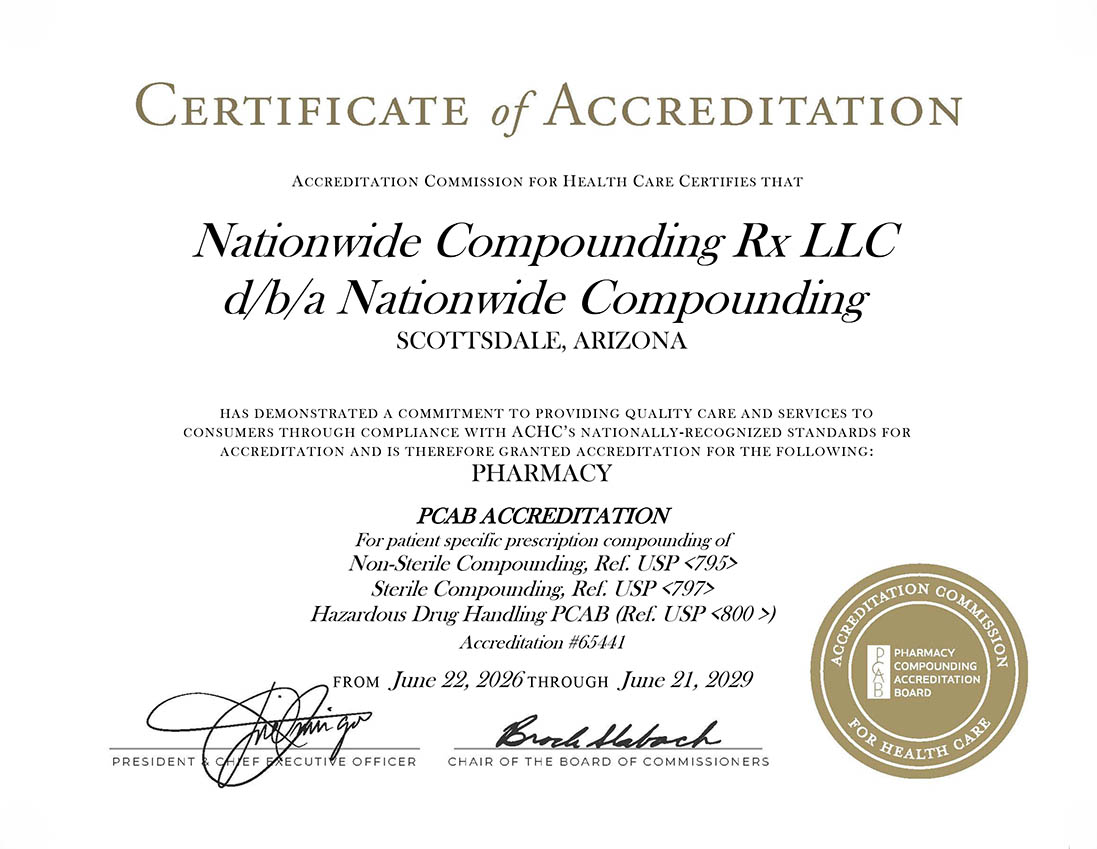
Nationwide Compounding Rx® exemplifies these quality standards as a PCAB-accredited, USP 800-compliant pharmacy with 40 years of combined staff experience.
How Nationwide Compounding Rx® Supports Children Who Can’t Swallow Pills
Nationwide Compounding Rx® explicitly rejects the one-size-fits-all approach. Every compounded medication is customized on a patient-by-patient basis to improve adherence.
Pediatric dosage forms available include flavored oral suspensions and solutions, gummies, troches and lozenges, transdermal creams and gels, capsules, and suppositories. Flavoring options that make medication time easier for children include banana crème, cherry, grape, peppermint, raspberry, strawberry, tutti frutti, and vanilla butternut.
The pharmacy can formulate medications without common allergens and intolerances, offering lactose-free, dye-free, gluten-free, and sugar-free options for children with dietary restrictions or sensitivities.
With a one to two business day turnaround on all medications and same-day pickup available for some formulations, families managing acute illness can access help quickly. Nationwide shipping reaches 47 states plus Washington, D.C. (not available in Alabama, California, North Carolina, or South Carolina).
All active pharmaceutical ingredients are sourced exclusively from FDA-inspected and cleared vendors. A valid prescription from the child’s healthcare provider is required.
The Step-by-Step Process: Getting a Compounded Medication for Your Child
Step 1: Talk to the child’s prescriber. Explain the pill-swallowing difficulty in detail, including any sensory issues, anxiety, or previous failed attempts. Ask whether a compounded formulation is medically appropriate.
Step 2: Get a prescription. Compounded medications require a valid prescription from a licensed healthcare provider specifying the medication, dose, dosage form, flavoring preferences, and quantity.
Step 3: Choose an accredited compounding pharmacy. Confirm the pharmacy is PCAB-accredited, ships to the family’s state, and has experience with pediatric formulations.
Step 4: Communicate with the pharmacist. Share the child’s specific needs, including flavor preferences, sensory sensitivities, allergies or intolerances, and age and weight for dose verification.
Step 5: Understand beyond-use dates and storage requirements. Compounded medications have shorter shelf lives than commercially manufactured drugs.
Step 6: Administer consistently and monitor. Track adherence and report any concerns to the pharmacist or prescriber promptly.
Families should check with their insurer about coverage, as compounded medications are not always covered by insurance.
Conclusion: Your Child Deserves Medication That Works for Them
Pill-swallowing difficulty is a real, multifaceted challenge rooted in developmental, sensory, and psychological factors. It is not a parenting failure or a child’s stubbornness. The pharmaceutical system was not designed with every child in mind, but compounding pharmacies exist precisely to fill that gap.
Flavored liquids, gummies, lollipops, transdermal gels, orally disintegrating tablets, troches, and more offer solutions matched to each child’s specific barrier. Children with ASD, ADHD, and sensory processing disorders face special challenges, and compounded medications can be a meaningful part of their care plan.
Working with an accredited, quality-focused compounding pharmacy and maintaining open communication with the prescriber significantly reduces risk. Parents are not alone in this challenge, and with the right compounding partner, medication adherence is achievable.
Ready to Find a Solution for Your Child? Contact Nationwide Compounding Rx® Today
If a child is struggling to take medication, Nationwide Compounding Rx® can help create a formulation they will actually accept. Parents should start the conversation with their child’s prescriber today to obtain the necessary prescription.
Contact Nationwide Compounding Rx® at 1-833-650-9836 (toll-free) or 480-499-8379, or visit NationwideCompounding.com. With a one to two business day turnaround, help is fast.
Trust signals matter: PCAB-accredited, USP 800-compliant, 40 years of combined experience, shipping to 47 states.
Healthcare providers and prescribers are also welcome to reach out directly to discuss pediatric compounding options for their patients.
Every child deserves medication that works for them, and Nationwide Compounding Rx® is here to make that possible.
Related Posts

Searching for Marty's Compounding Pharmacy but not sure if a local Mississippi storefront fits your needs? This guide compares Marty's Pharmacy & Compounding Center to nationwide compounding options using a five-point credential checklist covering accreditation, testing, and shipping licenses in 2026.

The term 'board of specialty pharmacy' actually refers to four distinct organizations, each serving a different purpose. This article breaks down BPS, SPCB, state boards, and PCAB to reveal which body truly governs compounding pharmacy quality in 2026.

Many patients assume CVS Pharmacy Specialty Services can compound custom medications simply because it holds PCAB accreditation—but the reality is more nuanced. This article breaks down what the accreditation actually covers, how the FDA's 503A/503B rules apply, and what it means for prior authorizations on oncology, MS, and RA prescriptions in 2026.

Many patients land on Accredo after a physician, insurer, or PBM directs them there. This guide breaks down what specialty pharmacy Accredo actually does—and the critical compounding limitations you need to know about in 2026.