Compounding Pharmacy Austin Texas: How TSBP Oversight Works
Introduction: The Credential Everyone Cites, and the System Nobody Explains
An Austin patient searching “compounding pharmacy Austin Texas” for a bioidentical hormone prescription, a GLP-1 formulation, a child’s flavored liquid, or a sterile injectable will quickly notice a pattern. Most pharmacy pages lean heavily on a single trust signal: “PCAB accredited.” Few explain what that badge covers, or what legal framework sits beneath it.
That gap matters. PCAB accreditation is voluntary. It verifies a pharmacy’s processes against USP <795>, <797>, and <800> at the time of survey, but it does not guarantee immunity from a PBM audit, an FDA inspection, or a state board complaint. The real backbone of oversight for any pharmacy operating in Texas is the Texas State Board of Pharmacy (TSBP), its license classes, and its sterile compounding rule, §291.133.
This article decodes TSBP license classes, explains what sterile compounding rules require in practice, examines the 2026 FDA warning letter issued to Houston-based Empower Pharmacy as an in-state cautionary case, and closes with a practical document-request checklist.
The stakes are plain: compounded drugs are not FDA-approved through the standard drug approval process. For patients and prescribers, regulatory literacy is the primary tool for vetting safety and legitimacy.
Understanding TSBP: Texas’s Actual Regulatory Machinery
TSBP, not PCAB or NABP, is the legal authority that licenses and disciplines every pharmacy dispensing to Texas patients, including those serving Austin. A pharmacy without an active TSBP license in the appropriate class has no legal basis to fill a Texas prescription, regardless of how many accreditation logos appear on its website.
The Board’s inspection role is documented. A 2015 Texas State Auditor’s Office report found that TSBP has processes to help ensure the inspection of compounding pharmacies, and that since 2013 Texas has required out-of-state pharmacies seeking a new or renewed sterile compounding license to be inspected first.
Accreditation bodies operate as a separate layer. PCAB, now administered by ACHC, and NABP’s Compounding Pharmacy Accreditation are voluntary, third-party overlays. They can signal a strong quality culture, but TSBP licensure is the non-negotiable legal baseline.
Decoding TSBP License Classes: A, A-S, C, C-S, E, E-S
TSBP rules organize pharmacies into license classes based on setting and scope:
- Class A: Community (retail) pharmacies, including most neighborhood compounding pharmacies.
- Class C: Institutional pharmacies, such as those located in hospitals.
- Class E: Nonresident pharmacies located outside Texas that dispense or ship medications to Texas patients.
Each class can carry an “-S” sterile designation (A-S, C-S, E-S), which authorizes sterile compounding under the requirements of Rule §291.133.
The compliance principle is straightforward: a pharmacy compounding sterile preparations without the matching sterile designation is operating outside its license class. That is a licensing violation, not a minor quality nuance.
This distinction matters most for sterile injectables, including injectable hormone therapies, pellets, and GLP-1 formulations. A pharmacy may be fully licensed for non-sterile creams and capsules yet have no legal authority to prepare an injectable vial for a Texas patient.
Inside Rule §291.133: What Sterile Compounding Actually Requires
Rule §291.133 is the operational heart of Texas sterile compounding oversight. Its requirements are technical, but the core ideas translate into plain language.
ISO Class 5 Engineering Controls
Sterile compounding must take place inside a primary engineering control (PEC), a device capable of maintaining at least ISO Class 5 air quality for particles 0.5 microns and larger.
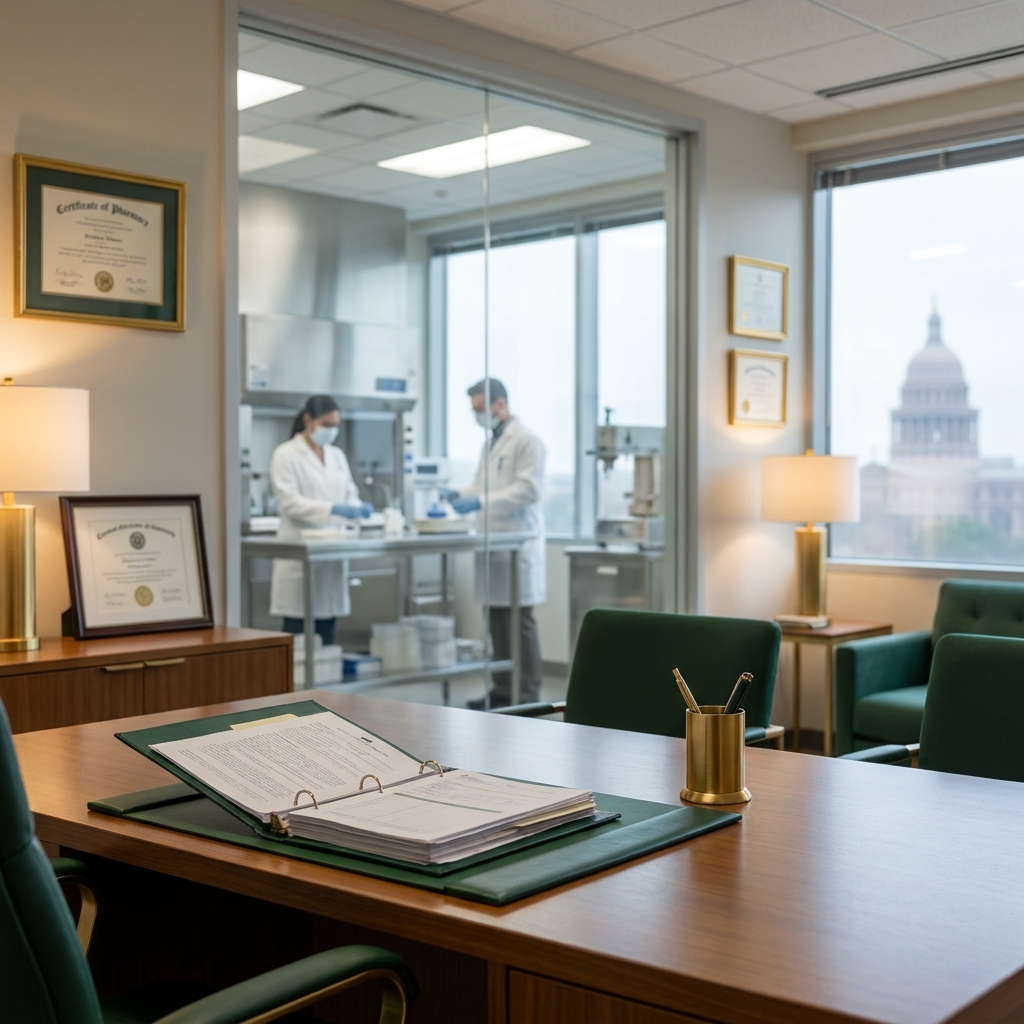
In practical terms, this is a specialized hood or controlled workspace, typically housed within a cleanroom suite, where filtered airflow continuously sweeps particles away from the preparation. Because injectable products bypass the body’s natural barriers, any microbial or particulate contamination introduced during compounding can reach the bloodstream directly. The ISO Class 5 requirement exists to reduce that risk.
Gloved Fingertip and Thumb Sampling
Texas rules require gloved fingertip and thumb sampling for all compounding personnel and anyone who directly oversees compounders, with documentation maintained by the pharmacy. The test checks whether a person’s aseptic technique keeps gloves free of microbial contamination.
This is an enforced checkpoint. TSBP has taken disciplinary action against Texas pharmacies for failing to complete gloved fingertip and thumb sampling before sterile compounding, alongside violations involving improper supervision of personnel and failure to report controlled substance dispensing to the Texas Prescription Monitoring Program.
USP <795>, <797>, and <800>: The Technical Foundation
Three USP chapters form the technical foundation for compounding:
- USP <795>: Non-sterile compounding (capsules, creams, troches, oral liquids).
- USP <797>: Sterile compounding (injectables and other sterile preparations).
- USP <800>: Handling of hazardous drugs to protect patients, staff, and the environment.
USP <795> and <797> received significant revisions in 2023. Under the revised <795>, beyond-use dates are assigned based on dosage form and specific compounding conditions rather than primarily on professional judgment. Both chapters also require documented initial training and ongoing competency assessments.
These are the same chapters PCAB and NABP evaluate. Accreditation is a snapshot audit against these standards, not a replacement for continuous daily compliance.
503A vs. 503B: The Federal Layer Behind Texas Licensure
Federal law divides compounders into two categories:
| Feature | 503A Pharmacy | 503B Outsourcing Facility |
|---|---|---|
| Primary regulator | State board (TSBP in Texas) | FDA registration |
| Prescription requirement | Patient-specific prescription before compounding | Can compound without a prescription in hand |
| Manufacturing standard | USP chapters and state rules | Stricter cGMP standards |
| FDA-approved product? | No | No |
Neither category produces an FDA-approved drug, since compounded medications fall outside the standard drug approval pathway entirely.
503A pharmacies represent roughly 65% of pharmacy-type compounding sales in 2026, meaning most local, patient-facing compounding in Austin operates under the 503A, TSBP-regulated model described throughout this article. The International Academy of Compounding Pharmacists estimates that over 56 million Americans use compounded medications annually, even though compounded prescriptions account for only about 1 to 3 percent of all U.S. prescriptions. A small share of prescriptions still reaches a very large population, which is why oversight literacy matters.
Case Study: The 2026 Empower Pharmacy Warning Letter
On September 18, 2026, the FDA issued warning letter #738238 to Houston-based Empower Clinic Services LLC dba Empower Pharmacy, one of the largest compounders in the country, following an inspection in November 2025.
The letter cited two categories of violations:
- “Essentially copies” violations involving tirzepatide/niacinamide and semaglutide/cyanocobalamin GLP-1 products.
- Insanitary sterile-compounding conditions, including inadequate smoke studies, media fills, and environmental monitoring.
This was reportedly Empower’s third warning letter, showing that even large, established Texas compounders face recurring federal scrutiny while holding valid state licenses.
The regulatory backdrop explains the “essentially copies” findings. The FDA determined the tirzepatide shortage resolved in December 2024 and the semaglutide shortage resolved in February 2025. That closed the shortage-based window that had allowed widespread compounding of GLP-1 copies. In 2026, compounding these drugs is permitted only for documented, patient-specific clinical differences.
The safety stakes are real. As of May 31, 2026, the FDA had received 990 adverse event reports linked to compounded semaglutide and more than 730 linked to compounded tirzepatide.
The lesson for Austin readers is direct: a large, seemingly reputable compounder operating under valid licensure can still fall short on sterile compounding and copying rules. Licensure and accreditation are starting points, not guarantees.
What This Means for Austin Patients and Prescribers Right Now
For anyone seeking compounded GLP-1s, hormones, pediatric formulations, or sterile injectables in Austin, three implications stand out.
First, GLP-1 compounding in 2026 is legally narrower than many patients assume. A legitimate pharmacy should be able to point to a documented, patient-specific clinical justification, such as an allergy to an excipient in the commercial product or a medically necessary dose unavailable commercially, rather than producing shortage-era copies at volume.
Second, sterile formulations carry the highest regulatory bar. Injectables and certain hormone preparations depend on ISO Class 5 engineering controls, gloved fingertip testing, and ongoing environmental monitoring. These products deserve the most scrutiny before use.
Third, verification is ongoing. A pharmacy that was compliant during its last survey may not be compliant today, and patients benefit from asking current questions.
The Document-Request Checklist: How to Verify Any Compounding Pharmacy
The following checklist converts regulatory literacy into an actionable tool. It applies equally to a local Austin storefront and a nationwide pharmacy shipping into Texas.
Step 1: Verify TSBP License Status and Class
- Use TSBP’s free public license-verification search to confirm the pharmacy holds an active Texas license.
- Confirm the license class matches the service. Before accepting a sterile injectable or hormone pellet prescription, ask explicitly whether the pharmacy holds an A-S, C-S, or E-S designation.
- Request written confirmation of the license class rather than relying on a verbal assurance.
Step 2: Request Sterile Compounding Documentation (If Applicable)
- Evidence of current ISO Class 5 PEC certification or validation.
- Documentation of current gloved fingertip and thumb sampling for compounding personnel and supervisors.
- Recent environmental monitoring, smoke study, and media fill results. These are exactly the areas cited as deficient in the Empower warning letter, so solid records here are a meaningful signal.
Step 3: Clarify 503A vs. 503B Status and Prescription Requirements
- Ask whether the pharmacy operates as a 503A pharmacy (patient-specific prescription required) or a 503B outsourcing facility (cGMP-regulated).
- For 503B facilities, request the FDA registration number.
- For GLP-1 prescriptions, ask the pharmacy to explain the documented patient-specific clinical justification for compounding instead of dispensing a commercial product.
Step 4: Check Voluntary Accreditation as a Secondary (Not Primary) Signal
PCAB (administered by ACHC) and NABP’s Compounding Pharmacy Accreditation are both tied to USP <795>, <797>, and <800>. NABP’s credential runs for three years and also demonstrates alignment with FDA 503A requirements. Some states now go further: Washington and Ohio require verifiable PCAB accreditation for nonresident compounding pharmacy licensure.
In Austin, credential-forward positioning is already emerging, with at least one local pharmacy prominently marketing NABP accreditation and USP <797>/<800> compliance. That is a useful differentiator, but it does not substitute for license and document verification.
Step 5: Ask About Training, Competency, and Beyond-Use Dating Practices
- Ask whether staff training and competency assessments are documented per the 2023 USP <795>/<797> revisions.
- Ask how beyond-use dates are assigned for the specific dosage form prescribed, confirming the pharmacy follows the updated, condition-based rules rather than professional judgment alone.
Applying the Checklist: What a Properly Vetted Pharmacy Looks Like
The checklist works the same whether a reader is choosing a brick-and-mortar Austin pharmacy or a nationwide 503A compounder shipping into Texas. For an out-of-state pharmacy, the key Texas question becomes whether it holds a Class E license, and an E-S designation for any sterile product.
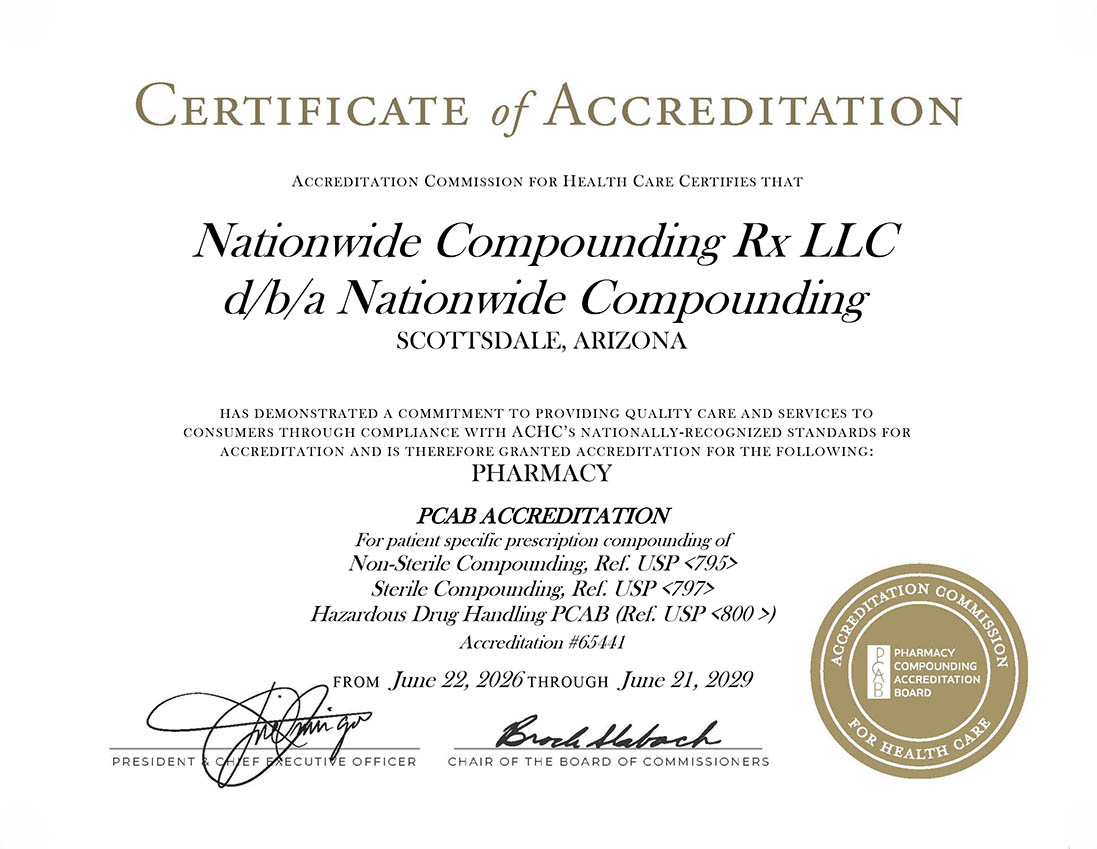
Nationwide Compounding Rx®, based in Scottsdale, Arizona, illustrates the kind of publicly stated credentials patients and prescribers should expect to see and be able to request in writing: PCAB accreditation, USP 800 compliance, independent third-party testing, and sourcing of high-grade chemicals from FDA-inspected and cleared vendors. The pharmacy prepares both sterile and non-sterile formulations across BHRT, GLP-1 and peptide support, pain management, dermatology, pediatrics, and sports medicine.
A structured provider partnership also supports transparency. Nationwide Compounding Rx® describes its process as “Connect, Collaborate, Create, Care,” with separate secure Provider and Patient Portals for submitting prescriptions, tracking orders, and managing refills. Documented, portal-based communication makes it easier for prescribers and patients to keep a clear record of what was ordered, why, and how it was prepared.
Finally, state licensing disclosures deserve attention. Nationwide Compounding Rx® publishes a multi-tier shipping map that separates fully licensed states, states licensed for non-sterile only (sterile pending), and pending or unlicensed states. That kind of disclosure is exactly what Austin patients should check, and confirm against the TSBP search, before placing a hormone, GLP-1, pediatric, or sterile injectable order with any compounder.
Conclusion: Regulatory Literacy as the Real Safeguard
Accreditation badges alone do not tell the full story. The substantive layer behind any credential is the TSBP license class, compliance with Rule §291.133, and documented sterile compounding controls such as ISO Class 5 engineering, gloved fingertip sampling, and environmental monitoring.
The 2026 Empower Pharmacy warning letter shows that even high-volume, licensed Texas compounders can fall short, which makes independent verification essential rather than optional. Austin patients and prescribers now have a concrete, document-based method for vetting any compounding pharmacy, not merely a credential to trust on sight.
Verify Before You Trust: Next Steps
Before the next compounded prescription is filled, readers can take two simple actions: run the pharmacy through TSBP’s public license search, and work through the document-request checklist above.
Prescribers and patients evaluating Nationwide Compounding Rx® are welcome to request current PCAB accreditation documentation, USP 800 compliance details, and state-by-state licensing status, including Texas availability for sterile and non-sterile preparations, as part of their own due diligence. Providers can reach the team through the secure Provider Portal, patients through the Patient Portal, or anyone can call (480) 499-8379, Monday through Friday, 7:00 AM to 3:30 PM (Arizona time). Email inquiries submitted through the website receive a response within one business day, making it straightforward to begin a collaborative, transparent compounding relationship grounded in verified credentials.
Related Posts

Searching for CareFirst Specialty Pharmacy can lead to three unrelated businesses: CareFirst BlueCross's ESPN network, an independent New Jersey compounder, and a Charlotte community pharmacy. This guide explains how to tell them apart and navigate BHRT coverage gaps in 2026.

Choosing a compounding pharmacy in Asheville NC requires more than hometown branding—it demands legal verification. This 2026 guide walks through North Carolina's pharmacy statutes, USP <797>/<800> enforcement, and how to use the NCBOP's online portal to confirm a pharmacy's license before trusting it with your prescription.
Choosing between BHRT pellets, creams, troches, and capsules can feel overwhelming without clear facts. This 2026 guide compares how each delivery method works, what the FDA and NASEM research says, and why pharmacy quality matters most when evaluating BHRT pellets.

The Woodlands Compounding Pharmacy has served the area since 2008, offering customized medications from hormone therapy to pediatrics. This 2026 trust check breaks down the credentialing and regulatory questions patients should ask before choosing a compounder.