The Woodlands Compounding Pharmacy: The 2026 Trust Check
Looking for The Woodlands Compounding Pharmacy? Here’s What to Know First
The Woodlands Compounding Pharmacy (TWCP) is a real, long-operating local business. According to its own company history, founder Jasper opened TWCP as an independent, compounding-only pharmacy in September 2008. It now serves The Woodlands area from locations in Shenandoah and Spring, Texas.
TWCP prepares customized medications in several areas:
- Bio-identical hormone replacement
- Pain management
- Pediatric needs
- Weight loss
- Veterinary applications
Many people searching for TWCP simply want a phone number, store hours, or instructions for transferring a prescription. Those needs are valid, and TWCP’s own website is the best source for current contact details.
This article goes further. Compounding decisions in Texas now carry higher regulatory and clinical stakes than they did even two years ago. Before choosing any compounder, whether TWCP or another provider, Woodlands patients should understand the credentialing questions that now define pharmacy trust in 2026.
Why The Woodlands Is a Unique Market for Compounded Medications
The Woodlands has one of the most distinctive patient profiles in the Houston region. World Population Review data puts the community at roughly 122,240 residents in 2026, with a median household income of $140,701 and a median age of 40.6. More than 30% of households earn over $200,000 a year.
That profile matters for compounding. Affluent adults in their 40s and 50s are the demographic driving national interest in premium therapies such as:
- Bioidentical hormone replacement therapy (BHRT) for menopause and andropause
- GLP-1 and weight-loss protocols
- Peptide therapy for recovery and wellness
National trends reinforce this. Market research from Mordor Intelligence reports that estrogen-based hormone therapy prescriptions among women aged 45 to 54 nearly doubled between 2023 and early 2026, reaching 5% of that demographic. Growth is attributed to greater awareness of hormone imbalance, the spread of specialty hormone clinics, and the availability of compounding pharmacy services. With its concentration of high-earning residents in exactly this age bracket, The Woodlands is positioned to over-index on that trend.
This affluence and health-consciousness also shape how patients shop. Woodlands residents are more likely to ask sophisticated questions about ingredient sourcing, sterility, and accreditation, not just price or convenience. A pharmacy serving this market should be ready to answer them.
A Closer Look at TWCP’s Public Trust Signals
Public review data offers one window into patient experience. TWCP’s Yelp listings for its two locations show ratings of 2.7 stars (44 reviews) and 2.8 stars (44 reviews). For a pharmacy handling sensitive hormone and specialty medication needs, those are thin, middling signals.
TWCP’s public messaging is largely legacy-focused. Its online presence emphasizes its 2008 founding, its tenure in the community, and its long-standing staff relationships. Visible emphasis on third-party credentialing, such as PCAB accreditation or USP compliance, is limited in its search listings and directory profiles.
This is not an accusation of wrongdoing; it is a transparency gap. Patients researching in 2026 increasingly expect to see accreditation badges, licensing details, and sterile-compliance information up front, alongside founding-year history.
The takeaway is straightforward: longevity and local reputation matter, but in today’s regulatory climate they are no longer sufficient on their own to establish trust, particularly for sterile or higher-risk formulations.
The 2026 Credentialing Questions Every Woodlands Patient Should Ask
The following checklist is the practical core of this trust check. Patients can apply it to any compounding pharmacy, local storefront or national provider.
Is the Pharmacy PCAB Accredited?
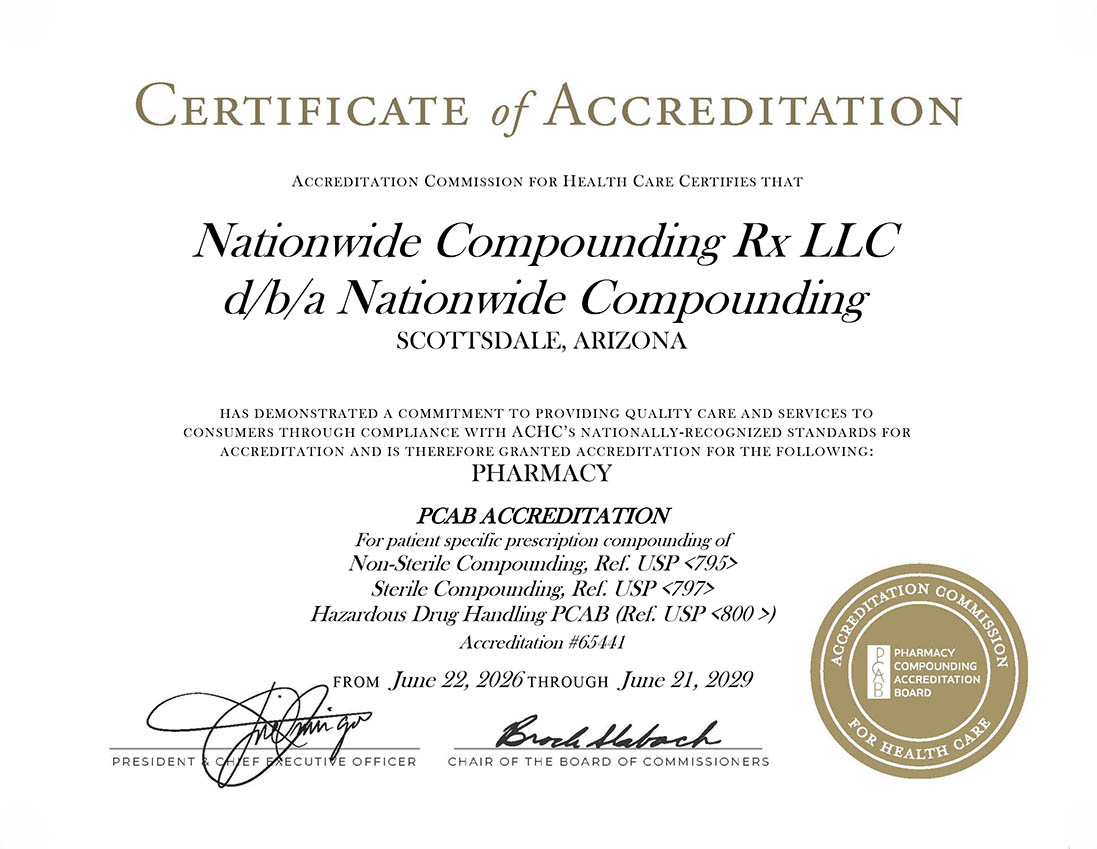
PCAB, the Pharmacy Compounding Accreditation Board, is a voluntary quality standard for compounding pharmacies operated by the Accreditation Commission for Health Care (ACHC). Because it is voluntary, it signals a pharmacy’s willingness to submit to outside scrutiny.
PCAB accreditation verifies full compliance with three core standards:
- USP 795 for non-sterile compounding
- USP 797 for sterile compounding
- USP 800 for hazardous drug handling
Compliance is confirmed through onsite inspections, not self-reporting. Patients should ask directly whether a pharmacy is PCAB accredited and request documentation rather than relying on a website claim alone.
Does It Hold the Correct Texas TSBP License Class?
Texas is one of the strictest enforcement states for compounding in 2026, alongside California, Florida, and New York. Each requires out-of-state pharmacies to register with its state board before shipping compounded medications to residents.
The Texas State Board of Pharmacy (TSBP) licenses pharmacies by class, and each class defines what a pharmacy may legally compound. This applies to in-state pharmacies and nonresident pharmacies alike. A pharmacy shipping from another state must hold the appropriate Texas license for the specific medication type, sterile or non-sterile.
Two nonresident classes are especially relevant:
- Class E: Non-resident pharmacies
- Class E-S: Non-resident pharmacies engaged in sterile compounding
Patients requesting an injectable or other sterile preparation should confirm that the pharmacy’s license class actually covers it.
Is It USP 800 Compliant for Hazardous Drug Handling?
USP 800 governs the safe handling of hazardous drugs throughout receipt, storage, compounding, and dispensing. It protects pharmacy staff, patients, and the environment from exposure.
This standard is particularly relevant for BHRT patients. Certain hormone compounds are classified as hazardous, so a pharmacy preparing estrogen, testosterone, or progesterone formulations should be able to explain how its facility, equipment, and procedures meet USP 800 requirements.
What Does March 2026’s TSBP Sterile Compounding Rule Update Mean for Patients?
On March 1, 2026, the TSBP’s updated sterile compounding rules took effect in Texas. These changes matter to anyone receiving sterile injectables, IV preparations, or hormone pellets, all common delivery methods for BHRT and peptide therapy.
Patients should ask their pharmacy two direct questions:
- How has the pharmacy adapted its sterile operations to the updated rules?
- For nonresident sterile compounders, has the pharmacy undergone the Board inspection required under Rule 291.106? That rule stipulates that TSBP may not renew a Class E-S license unless the pharmacy has been inspected by the Board or its designee.
Is a GLP-1 Compound Still Legally Justified?
The legal landscape for compounded GLP-1 medications has narrowed significantly:
- The FDA removed tirzepatide from the drug shortage list in December 2024 and semaglutide in February 2025.
- FDA Commissioner Marty Makary has stated that when FDA-approved drugs are available, outsourcing facilities cannot lawfully compound using bulk drug substances unless there is a clear clinical need.
- The U.S. Court of Appeals for the Fifth Circuit upheld the FDA’s decisions removing semaglutide and tirzepatide injection products from the shortage list.
- In May 2026, the FDA proposed ending most compounding of semaglutide, tirzepatide, and liraglutide, including prohibiting copies of these medications under the 503B section of the Food, Drug, and Cosmetic Act.
A legitimate path still exists. IQVIA reported that in October 2026, more than 80% of compounded semaglutide and tirzepatide prescriptions included supplemental ingredients such as vitamins B6, B12, B3, or levocarnitine. Such personalization may serve as a rationale for continued compounding, but only when properly formulated, prescribed, and documented for a patient-specific clinical need.
Patients should ask explicitly how their pharmacy justifies continued GLP-1 compounding under current FDA rules. A confident, specific answer is a good sign. A vague one is not.
The Empower Pharmacy Warning Letter: A Houston-Area Cautionary Tale
On September 18, 2026, the FDA issued a warning letter to Empower Pharmacy, a large Houston-based compounder. The agency cited mass production of unapproved new drugs that were essentially copies of commercially available semaglutide and tirzepatide products, including tirzepatide with niacinamide and semaglutide with vitamin B12.
For Woodlands readers, this is a regional example, not an abstract one. It shows that even large, established Texas-area compounders with strong name recognition can fall out of regulatory compliance.
The lesson is clear: proximity and regional familiarity are not substitutes for verified accreditation and compliant practices. Adding a vitamin to a GLP-1 formula does not automatically make it a legitimate, individualized compound. This is exactly why the credentialing questions above matter more than brand familiarity when choosing a compounder in 2026.
Nationwide Compounding Rx®: The PCAB-Accredited Alternative for Woodlands Patients
Nationwide Compounding Rx® is a PCAB-accredited and USP 800 compliant compounding pharmacy. For Woodlands patients who want verified credentials rather than legacy reputation alone, it offers a documented alternative.
Licensing model. Nationwide Compounding Rx® operates from a facility in Scottsdale, Arizona, and serves Texas patients under the state’s Class E and Class E-S nonresident licensing framework. This cross-state model is common and legally sound in compounding.
Reach and transparency. The pharmacy ships to patients across multiple licensed states, with availability depending on medication type and state regulations. Its state licensing map uses three clear tiers: fully licensed states, non-sterile only (sterile pending), and pending or unlicensed states. Patients can see what the pharmacy may legally ship to them before placing an order.
Service lines aligned with the Woodlands demographic:
- BHRT: Customized formulas for menopause, andropause, and hormonal imbalance, adjustable at each refill based on updated lab results
- GLP-1 and peptide support
- Pain management: Topical creams, gels, and ointments that localize treatment and reduce systemic side effects
- Dermatology: Custom formulations for acne, rosacea, eczema, psoriasis, scarring, and aging skin
Operational trust factors:
- Independent third-party testing to verify quality and consistency
- High-grade chemicals sourced from FDA-inspected and cleared vendors
- 1 to 2 business day turnaround
- Secure provider and patient portals for prescription submission, order tracking, and refill requests
The pharmacy’s provider partnership framework, Connect, Collaborate, Create, Care, reflects a clinically grounded approach. Formulations are developed with prescribers for individual patients, which stands in direct contrast to the mass-production model the FDA has targeted.
TWCP vs. Nationwide Compounding Rx®: A Side-by-Side Trust Comparison
The comparison below focuses on what patients should verify, based on publicly visible information. It is not a judgment of TWCP’s legitimacy; items marked “verify directly” simply are not prominently displayed online.
| Trust Factor | The Woodlands Compounding Pharmacy | Nationwide Compounding Rx® |
|---|---|---|
| PCAB accreditation | Not prominently displayed online; verify directly | PCAB accredited |
| USP 795/797/800 compliance | Not prominently displayed online; verify directly | PCAB accredited; USP 800 compliant |
| TSBP license class transparency | In-state Texas pharmacy; confirm class for sterile needs | Class E/E-S nonresident framework; tiered state map published |
| Public review signals | 2.7 and 2.8 stars on Yelp (44 reviews each) | Verify on current review platforms |
| GLP-1 compliance messaging | Weight-loss services listed; ask about 2026 FDA justification | Ask for clinical-need documentation |
| Sterile readiness post-March 2026 | Ask about updated TSBP rule adaptation | Ask about Rule 291.106 inspection status |
| Sourcing and testing | Verify directly | FDA-inspected/cleared vendors; independent third-party testing |
This framework applies to any Woodlands-area or Houston-market compounder, not just the two named here.
How to Vet Any Compounding Pharmacy Before Filling a Prescription
Before filling a compounded prescription, patients should work through this checklist:
- Verify PCAB accreditation and request documentation.
- Confirm the correct TSBP license class for the medication type, especially Class E-S for sterile preparations shipped from out of state.
- Ask about USP 800 compliance, particularly for hormone therapies.
- Request sourcing and testing documentation, including whether ingredients come from FDA-inspected vendors and whether batches undergo third-party testing.
- Ask how GLP-1 compounding is justified under current FDA rules and what clinical-need documentation supports it.
This checklist works whether a patient is choosing a local storefront in Spring or Shenandoah or a nationwide provider like Nationwide Compounding Rx®.
Conclusion: Trust Should Be Verified, Not Assumed
The Woodlands Compounding Pharmacy is a legitimate, long-standing local option that has served the community since 2008. However, 2026’s regulatory environment, shaped by tightened TSBP sterile rules, narrowing FDA restrictions on GLP-1 compounding, and the Empower Pharmacy warning letter, has raised the bar for what “trustworthy” means.
Affluent, health-conscious Woodlands patients deserve a compounder that can answer every credentialing question confidently and transparently. Nationwide Compounding Rx® offers that profile: PCAB accredited, USP 800 compliant, operating within Texas’s nonresident licensing framework, and built around collaboration with prescribers. For patients who want more than legacy name recognition, verified credentials are the standard worth insisting on.
Ready for a Pharmacy That Welcomes the Hard Questions?
Woodlands-area patients and providers can connect with Nationwide Compounding Rx® to verify credentials, discuss BHRT, GLP-1, or peptide needs, or begin the provider partnership process.
- Phone: (480) 499-8379
- Fax: 480-699-5341
- Hours: Monday through Friday, 7:00 AM to 3:30 PM (Arizona time)
- Online: Provider and patient portals at nationwidecompounding.com
- Email: Inquiries submitted through the website contact form receive a response within one business day
Patients and prescribers are invited to request accreditation and licensing documentation and compare it directly against any other compounder they are considering. A pharmacy that is confident in its credentials should welcome that comparison.
Related Posts

Searching for CareFirst Specialty Pharmacy can lead to three unrelated businesses: CareFirst BlueCross's ESPN network, an independent New Jersey compounder, and a Charlotte community pharmacy. This guide explains how to tell them apart and navigate BHRT coverage gaps in 2026.

Choosing a compounding pharmacy in Asheville NC requires more than hometown branding—it demands legal verification. This 2026 guide walks through North Carolina's pharmacy statutes, USP <797>/<800> enforcement, and how to use the NCBOP's online portal to confirm a pharmacy's license before trusting it with your prescription.
Choosing between BHRT pellets, creams, troches, and capsules can feel overwhelming without clear facts. This 2026 guide compares how each delivery method works, what the FDA and NASEM research says, and why pharmacy quality matters most when evaluating BHRT pellets.
Most compounding pharmacy Austin Texas searches turn up PCAB badges but skip the real regulatory backbone: the Texas State Board of Pharmacy. This guide breaks down TSBP license classes, sterile compounding rule §291.133, and a 2026 FDA warning letter case, plus a document checklist for vetting any pharmacy.