
Compounding Pharmacy in Houston: 7 Questions Patients Ask in 2026
Introduction: Why Houston Patients Are Asking These Questions in 2026
Houston holds an unusual place in American pharmacy. According to the Houston Chronicle, Texas is home to 13 of the more than 80 registered 503B outsourcing facilities in the U.S., second only to Florida. The city also hosts Empower Pharmacy, a 503B outsourcing facility that has faced increasing regulatory and legal scrutiny. That concentration makes Houston both a hub for compounding and a focus of scrutiny.
Patients have plenty of options. As of July 2025, Texas State Board of Pharmacy (TSBP) licensing data showed 891 Class A, B, C, and E pharmacies in Texas performing sterile compounding. More choice also means more unknowns, and 2026 has added new reasons for caution:
- An overhaul of Texas sterile compounding rules (§291.133) took effect on March 1, 2026.
- Compounded GLP-1 production was largely shut down in 2025.
- Eli Lilly has pursued high-profile litigation against Houston-based Empower Pharmacy.
This article answers the seven questions Houston residents most often search before calling a pharmacy. Each answer is written in plain language and explains how patients can verify a claim themselves instead of trusting a badge or a sales pitch. Each section also explains how Nationwide Compounding Rx® addresses the concern. Its model of nationwide shipping, PCAB accreditation, and a transparent state-by-state licensing map serves patients who may not live near a Houston storefront.
Safety is not a hypothetical concern. In the New England Compounding Center case, which came to national attention in 2013, contaminated steroid injections triggered a multi-state fungal meningitis outbreak. More than 700 people were sickened and 64 died. That tragedy explains why every question below matters.
1. Is This Compounding Pharmacy Actually Licensed to Serve Houston Patients?
Any pharmacy that dispenses medication to a Texas patient must hold a valid, current license recognized by the Texas State Board of Pharmacy. This applies whether the pharmacy sits on Westheimer Road or ships from another state. In-state pharmacies hold resident licenses. Out-of-state pharmacies need non-resident licensure.
How to verify: Patients should search the TSBP license lookup tool directly rather than relying on the word “licensed” on a website. The lookup shows whether a license is active, what class it is, and whether disciplinary actions exist.
Patients should also understand two separate layers of credentials:
- State pharmacy license: a mandatory legal baseline. Without it, the pharmacy cannot legally dispense to Texas patients.
- Specialty accreditation (such as PCAB): voluntary. It signals that the pharmacy has chosen to meet a higher quality standard.
Many Houston pharmacies point to their history as a trust signal. Village Compounding Pharmacy cites more than 38 years of service, and Greenpark Compounding Pharmacy was founded by Ken and Nancy Hughes in 1992. Tenure reflects experience, but it does not confirm that a pharmacy’s license is current today.
Nationwide Compounding Rx publishes a state-by-state licensing map with three tiers: fully licensed states, non-sterile-only states (sterile pending), and pending or unlicensed states. Houston patients can check Texas status on that map before submitting a prescription, then confirm it independently through TSBP.
2. Will My Insurance Cover a Compounded Prescription?
Patients should generally expect to pay cash. According to the Alliance for Pharmacy Compounding, roughly 57% of compounding pharmacies nationwide are cash-only and accept no insurance at all.
The reason is structural. Compounded drugs are not individually FDA-approved, so many insurers and pharmacy benefit managers (PBMs) exclude them from standard formularies. This is especially true for bioidentical hormone replacement therapy (BHRT), pain creams, and GLP-1 formulations.
Before filling a prescription, patients should ask three questions:
- Does the pharmacy bill insurance directly?
- Can the patient submit a claim for reimbursement on their own?
- What is the self-pay price, regardless of coverage?
Cost context for budgeting:
| Medication Type | Typical Cash Price |
|---|---|
| Brand-name Wegovy/Zepbound | About $1,200 to $1,400 per month |
| Compounded semaglutide/tirzepatide via telehealth (shortage-era) | About $297 to $495 per month |
| BHRT (standard formulary) | About $2.00 per unit (minimum around $60) |
| BHRT (non-formulary) | About $2.50 per unit |
| Higher-dose testosterone formulations | About $3.00 per unit |
Nationwide Compounding Rx encourages patients to confirm payment expectations before a prescription is filled. Patients can do this through the secure Patient Portal or by calling the pharmacy directly, which helps avoid surprises at checkout.
3. Can a Compounding Pharmacy Ship My Prescription If I’m Not Near a Houston Storefront?
The Houston metro stretches from Katy to Baytown and from The Woodlands to Pearland. Many residents in the suburbs and exurbs have no specialty compounder nearby, so they look for shipping options instead of driving across the metro.
Many competitors skip an important legal point. Under Section 503A, interstate shipping requires the dispensing pharmacy to hold non-resident pharmacy licensure in the patient’s state. A “ships nationwide” claim means little without that license.
Several Houston-area pharmacy websites advertise “free shipping nationwide” or “Texas and nationwide shipping” without explaining this requirement. That leaves patients unable to tell whether a shipment is legal.
How to verify a shipping pharmacy:
- Search the pharmacy’s name in the TSBP license lookup and confirm an active non-resident license.
- Ask the pharmacy for its Texas license number and check it independently.
- Confirm whether the license covers the specific type of preparation (sterile or non-sterile) being prescribed.
Nationwide Compounding Rx’s published shipping map is tiered by fully licensed, non-sterile-only, and pending states. Houston patients can see whether their specific medication type can legally ship to their location, which turns a vague promise into a fact they can check.
4. Is Compounded Semaglutide or Tirzepatide Still Legal in 2026?
For mass-produced copies, the answer is largely no. Tirzepatide came off the FDA drug shortage list in December 2024, and semaglutide followed in February 2025. Once that happened, the legal pathway for copies closed:
- 503A pharmacies had to stop compounding copies by April 22, 2025.
- 503B outsourcing facilities had to stop by May 22, 2025.
On April 30, 2026, the FDA proposed permanently excluding semaglutide, tirzepatide, and liraglutide from the 503B Bulks List. That list names the ingredients large-scale compounding facilities may legally use, so the proposal would effectively end large-scale compounding of these drugs.
Regulators are actively enforcing these rules. In late 2025, the FDA issued more than 100 warning letters to telehealth providers and compounders over “false and misleading” GLP-1 advertising.
Houston has its own example of the legal risk. Eli Lilly sued Empower Pharmacy, alleging it sold “knockoff” versions of Mounjaro and Zepbound. A federal judge dismissed the federal trademark and Texas unfair-competition claims but allowed unfair-competition allegations in other states to proceed. The case shows that legal exposure in this category is ongoing.
Red flags for patients in 2026:
- A pharmacy or telehealth service broadly marketing compounded GLP-1 “copies”
- No clear, patient-specific clinical justification, such as an allergy to an inactive ingredient or a need for a dose or form that is not commercially available
- Pricing pitches that resemble shortage-era advertising
Nationwide Compounding Rx aligns its GLP-1 and peptide support offerings with current FDA guidance rather than shortage-era marketing. Patients can be confident they are not being sold a legally exposed product.
5. How Do I Actually Verify PCAB/USP 800 Credentials Instead of Just Trusting a Badge Logo?
A badge image on a website proves nothing by itself. Logos can be copied, and they can stay on a site after an accreditation lapses. Verification requires an independent check.
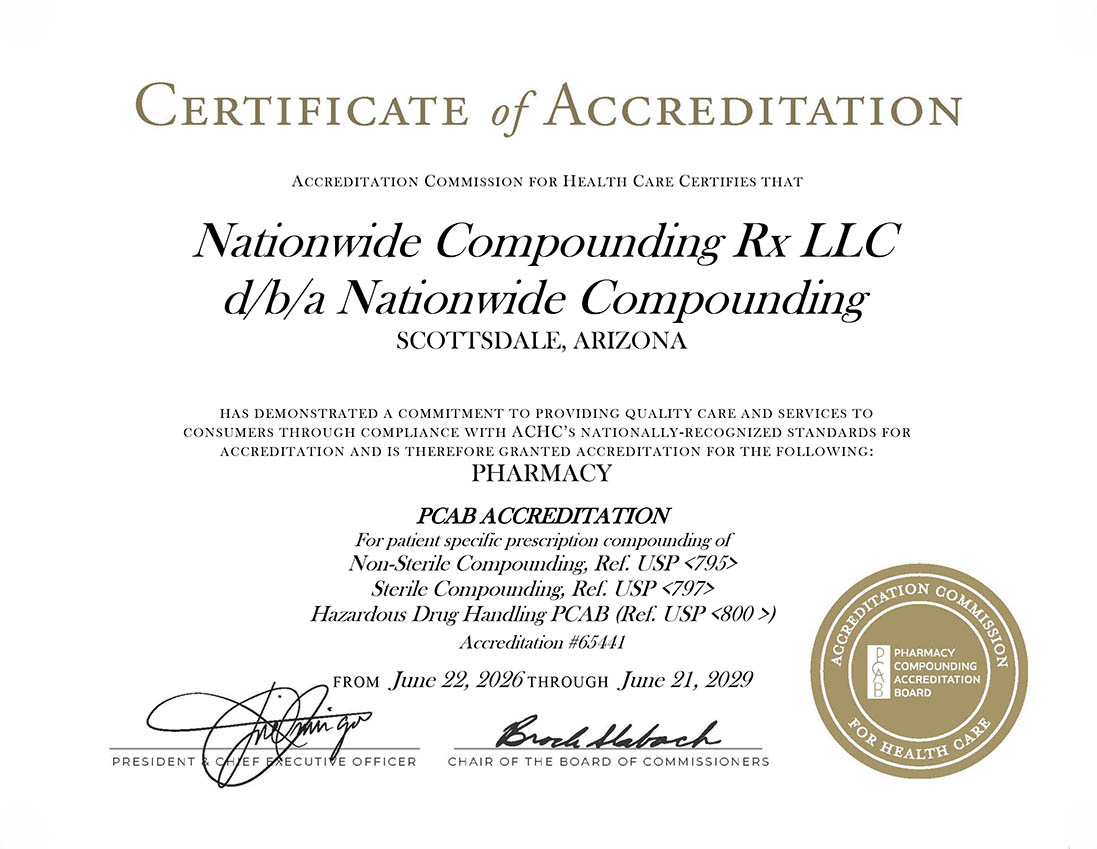
The stakes are significant. Of the roughly 3,000 U.S. pharmacies that compound, fewer than 200 are PCAB accredited, representing less than 7% of the field. That makes PCAB accreditation a meaningful differentiator.
Background on PCAB: Eight national pharmacy organizations, including APhA, NABP, and USP, established the Pharmacy Compounding Accreditation Board in 2007. Today it operates as a service of the Accreditation Commission for Health Care (ACHC). The credential has deep roots in the Houston market. Physicians Preference Pharmacy (formerly Hotze Pharmacy) in nearby Katy was among the first pharmacies in the nation to earn PCAB accreditation in 2007.
How to verify: Patients should search the ACHC/PCAB accredited pharmacy directory by the pharmacy’s name. A badge screenshot on a website is not a substitute.
USP 800 in plain terms: This standard governs the safe handling of hazardous drugs, including many hormone and sterile preparations. It protects both patients and pharmacy staff. Patients can ask a pharmacy how it shows compliance, for example through dedicated hazardous drug handling areas and staff protective equipment protocols.
Nationwide Compounding Rx is PCAB accredited and USP 800 compliant, and it encourages patients to confirm the accreditation through the ACHC directory themselves.
The pharmacy also adds a third layer of quality control that few competitors mention:
- Independent third-party testing of finished preparations
- High-grade chemicals sourced exclusively from FDA-inspected and cleared vendors
These practices confirm quality on an ongoing basis, rather than relying on a single certification.
6. What’s the Difference Between a 503A Pharmacy and a 503B Outsourcing Facility, and Does It Matter for Me?
According to the FDA, the difference comes down to scale and purpose:
- Section 503A: A licensed pharmacist compounds a medication for an individual patient’s prescription within a state-licensed pharmacy.
- Section 503B: An FDA-registered outsourcing facility produces larger batches, often for clinics and hospitals rather than individual patients.
Houston is a relevant backdrop for this distinction. The nation’s largest 503B outsourcing facility is headquartered there, and Texas hosts 13 of the 80+ registered 503B facilities nationwide.
Which model fits most patients? Patients with a doctor’s prescription for a personalized dose, flavor, or strength are usually served under 503A. The 503B model matters more for bulk, clinic-level purchasing.
The March 1, 2026 Texas rule changes: The updated §291.133 sterile compounding rule includes:
- An increased allowable batch size of up to 750 units, compared with the 250-unit maximum in USP <797>
- Clearer environmental monitoring requirements
- Updated beyond-use dating standards
These changes mainly affect sterile compounders. They are worth knowing about for patients prescribed injectable or other sterile preparations.
Nationwide Compounding Rx fills patient-specific prescriptions that are customized at the individual level, which is the personalized care model that 503A was designed for. The pathway determines the regulatory framework, not personal safety by itself. A properly licensed and accredited pharmacy under either model can deliver safe care.
7. How Fast Can I Get My Prescription, and Can Houston Patients Get Specialty Formulations (BHRT, Pediatric, Pain, Dermatology)?
Turnaround matters most for time-sensitive needs, such as a child who needs a liquid antibiotic or a patient waiting on a pain topical. In compounding, 1 to 2 business days counts as fast. Same-day pickup is sometimes available for certain medications at brick-and-mortar locations.
Houston patients commonly search for these specialty categories:
- BHRT: Formulas for menopause, andropause, and hormonal imbalances, adjustable at each refill based on lab results
- Pain management: Topical creams, gels, and ointments that target the affected area and reduce systemic side effects, including addiction risk
- Pediatrics: Age- and weight-specific dosing for newborns through teens, with dye-free and allergen-free options
- Dermatology: Custom topicals for acne, rosacea, eczema, psoriasis, atopic dermatitis, scarring, stretch marks, dark spots, and aging
- Sports medicine: Formulations that support recovery and reduce inflammation
Format and flavor can make a real difference, especially for children and patients who refuse to take medicine. Available options include capsules, liquids, troches, lozenges, sublingual tablets, suppositories, and pediatric forms such as popsicles and suckers. Flavors include cherry, bubblegum, piña colada, tutti frutti, and marshmallow, along with animal-friendly flavors.
Nationwide Compounding Rx offers a 1 to 2 business day turnaround, same-day pickup for some medications, and nationwide shipping. Patients across Houston’s suburbs can get specialty formulations without searching for a nearby compounder that happens to offer their specific need.
Quick-Reference: How Nationwide Compounding Rx Answers All 7 Houston Patient Concerns
| Patient Question | Common Risk | Nationwide Compounding Rx Approach |
|---|---|---|
| 1. Licensing | “Licensed” claims with no proof | Public state-by-state licensing map, verifiable through TSBP |
| 2. Insurance | Surprises at cash-only checkout | Payment expectations clarified through the portal or by phone before filling |
| 3. Shipping | “Ships nationwide” with no license detail | Tiered map showing fully licensed, non-sterile-only, and pending states |
| 4. GLP-1 legality | Shortage-era “copy” marketing | Offerings aligned with current FDA guidance |
| 5. Credentials | Badge-only trust signals | PCAB accredited, USP 800 compliant, third-party tested, verifiable via ACHC |
| 6. 503A vs. 503B | Confusion about the regulatory pathway | Patient-specific, prescription-based customization |
| 7. Speed and specialties | Long waits, limited local options | 1 to 2 business day turnaround, broad specialty and dosage form range |
Many Houston patients do not live near a single brick-and-mortar compounder, or prefer not to depend on one. For them, verifiable nationwide infrastructure answers the same concerns a local storefront would, without the geographic limit.
Conclusion: Making a Confident, Verified Choice in Houston’s Compounding Market
Houston’s compounding landscape is large and reputable, but it is also complex. The city is home to major national players, Texas rules changed significantly in 2026, and the Empower/Lilly litigation shows that the legal risks are real. Due diligence is essential.
The best habit is independent verification:
- Check licensing through the TSBP lookup.
- Check accreditation in the ACHC/PCAB directory.
- Ask directly about insurance coverage and the legality of shipping to Texas.
The seven questions in this article work as a repeatable checklist for any Houston-area pharmacy. Nationwide Compounding Rx was built to pass this checklist, with PCAB accreditation, USP 800 compliance, transparent state-by-state licensing, and nationwide shipping that reaches patients throughout the Houston metro and beyond.
Ready to Get Your Compounded Prescription Filled With Confidence?
Houston-area patients can take these steps:
- Verify first. Check Nationwide Compounding Rx’s Texas licensing status on the state-by-state shipping map before submitting a prescription.
- Talk with a prescriber. Discuss whether the specific need (BHRT, pediatric, pain, dermatology, sports medicine, or GLP-1/peptide support under current FDA guidance) is a good fit for compounding.
- Submit securely. Patients can use the secure Patient Portal, or their provider can start the request through the Provider Portal.
Questions? Call (480) 499-8379, Monday through Friday, 7:00 AM to 3:30 PM (Arizona time), or use the website contact form. The pharmacy responds within one business day.
No nearby storefront is required. Nationwide Compounding Rx delivers accredited, verifiable compounding to Houston patients wherever they live.
Related Posts

This 2026 guide breaks down bioidentical hormone replacement therapy in Delaware, covering FDA-approved options versus compounded alternatives. Learn about the latest regulatory updates, state compounding laws, and how to verify a legitimate provider. A clear, science-based resource for Delaware patients exploring BHRT.

Confused by conflicting listings for the CVS Specialty Pharmacy phone number? This guide provides a complete, verified 2026 directory of every official line, organized by department. It also explains what to do when calls lead to long holds or unresolved issues.

Before trusting Greens Compounding Pharmacy with a prescription, learn the key safety and accreditation checks every patient should make in 2026. This guide offers a repeatable verification checklist that goes beyond directory listings like Yelp or Healthgrades. It works for any compounding pharmacy, local or nationwide.

Searching for Avera Specialty Pharmacy's phone number or fax line? This guide offers verified 2026 contact details and explains what happens when insurance mandates or drug restrictions route a prescription elsewhere. Learn your options when the network says no.