
Greens Compounding Pharmacy: What to Verify Before Switching in 2026
Introduction: A Pharmacy Name Search Should Trigger Due Diligence, Not Just Confirmation
Someone searching for “Greens Compounding Pharmacy” has most likely found Compounding Pharmacy of Green, a locally owned pharmacy in the Uniontown/Green area of Ohio. That person is probably deciding whether to trust it with a prescription. The search itself is a reasonable first step. What comes next matters more.
Current search results for this pharmacy consist almost entirely of directory and listing sites: Healthgrades, Yelp, the Better Business Bureau, MapQuest, and the local Chamber of Commerce. These pages confirm an address and a phone number. None of them explain how to evaluate whether a compounding pharmacy meets modern quality and safety standards.
This article takes a different approach. Rather than answering “Is this the right pharmacy?”, it provides a repeatable verification checklist built entirely on publicly checkable information, using Compounding Pharmacy of Green as a real-world worked example. The same checklist applies to any compounder, whether a small local independent or a nationwide operation, and this piece applies it to both.
Why Switching Compounding Pharmacies Deserves the Same Scrutiny as Switching Doctors
Compounded medications are prepared for individual patients and are not individually approved by the FDA. A commercial drug goes through a formal approval process before reaching the shelf. A compounded preparation does not, which shifts much more of the verification burden onto the patient and the prescriber.
The scale of this market makes the issue significant. An estimated 30 to 40 million compounded prescriptions are filled in the United States each year. Industry analysts estimate the overall U.S. compounding market at roughly $15 to $24 billion in 2026, depending on methodology, with IBISWorld projecting about $20.2 billion. Future Market Insights expects 503A (patient-specific) pharmacies to represent about 65% of the pharmacy-type segment this year.
2026 has also been a year of unusually intense regulatory scrutiny:
- April 30, 2026: The FDA proposed excluding semaglutide, tirzepatide, and liraglutide from the 503B Bulks List, a move Stanford Medicine described as a sweeping step against large-scale GLP-1 compounding.
- June 2026: The FDA sent warning letters to 25 telehealth and compounding companies over misleading marketing claims.
- January 2026: The FDA issued a warning letter to Boothwyn Pharmacy citing sterility failures in semaglutide.
- April 2026: The FDA issued a warning letter and recall against ProRx LLC for critical sterility failures in compounded tirzepatide and semaglutide.
Earlier history offers an even starker warning. In 2021, the FDA issued a MedWatch alert about Greenpark Compounding Pharmacy in Houston after inspectors observed conditions that could cause compounded drugs to become contaminated. The result was a sterile-production recall, followed later by a California cease-and-desist for operating unlicensed. (The similar name to “Greens” is coincidental; the two pharmacies are unrelated.) Greenpark illustrates what can happen when verification checkpoints are skipped entirely.
The 2026 Compounding Pharmacy Verification Checklist
The following six checkpoints form the practical core of this guide. Each is explained in general terms and then applied to Compounding Pharmacy of Green as a case study. None of these checks require insider access. Every one is available to any patient or provider willing to spend a few minutes looking.
Checkpoint 1: License Status and Expiration Dates
Every state maintains a Board of Pharmacy with an online license lookup tool. Searching by pharmacy name or license number shows whether a license is active, when it expires, and whether disciplinary actions have been filed.
Case study: Compounding Pharmacy of Green holds Ohio Board of Pharmacy license 0232000218, which expires 3/31/2027. The pharmacy was established in 2004.
Red flags to watch for:
- Lapsed or expired licenses
- “Pending” status
- Disciplinary actions attached to the license number
An active license confirms that a pharmacy is legally operating. It does not, on its own, confirm anything about compounding quality or sterility compliance.
Checkpoint 2: BBB Accreditation Status
BBB accreditation reflects business practices and complaint resolution. It does not evaluate pharmaceutical quality, sterility, or ingredient sourcing. Still, it adds a layer of third-party accountability regarding how a business treats its customers.
Case study: Compounding Pharmacy of Green is not BBB accredited.
To pull a BBB profile, search the pharmacy name on the BBB website and review three items: the letter rating, the number and type of complaints, and whether the business responded to and resolved them. A lack of accreditation is not disqualifying by itself. It simply removes one layer of independent verification a patient would otherwise have.
Checkpoint 3: Review Volume and Depth
Review count matters as much as review score. A strong rating built on a handful of reviews is a thin trust signal, and a middling rating built on very few reviews leaves even more uncertainty.
Case study: Compounding Pharmacy of Green carries a 3.4/5 Yelp rating from only 5 reviews.
General satisfaction comments are less useful than specific ones. The most informative reviews mention:
- Potency consistency from one refill to the next
- Communication with patients and prescribers
- Refill accuracy and timeliness
- Adverse reactions or unexpected side effects
Patients should cross-check reviews across Google, Yelp, and Healthgrades rather than relying on a single platform.
Checkpoint 4: Designated Person (DP) Documentation
Updated USP standards, reflected in revised PCAB requirements, call for a named Designated Person responsible for overseeing compounding operations. This individual is accountable for training, procedures, and compliance.
This requirement is one of the most commonly failed elements in accreditation reviews. An absent or improperly documented DP is cited in 31% of PCAB citations.
Patients and providers should ask any pharmacy, local or national, for the name and credentials of its Designated Person. A pharmacy that cannot provide a clear answer is signaling a meaningful gap, regardless of how it performs on other checkpoints.
Checkpoint 5: API and Ingredient Sourcing Risk
Compounded medications begin with raw active pharmaceutical ingredients (APIs). Where those ingredients come from is a hidden but critical safety factor.
According to the Partnership for Safe Medicines, facilities that supply only compounding pharmacies represent just 18% of registered API manufacturers but accounted for 72% of warning letters, import alerts, and regulatory meetings over a five-year period.
A direct question cuts through the uncertainty: Does the pharmacy source exclusively from FDA-inspected and cleared vendors, and will it disclose supplier information on request? This question carries extra weight in 2026, as sourcing and sterility failures have driven the high-profile GLP-1 warning letters described above.
Checkpoint 6: USP Compliance and Sterility Track Record
Three USP chapters govern modern compounding:
- USP <795>: Non-sterile compounding
- USP <797>: Sterile compounding
- USP <800>: Hazardous drug handling
All three became simultaneously enforceable on November 1, 2023, and revised PCAB standards incorporating these updates took effect June 1, 2024.
To check a pharmacy’s track record, search the FDA warning letter database and the relevant state board’s disciplinary records. The Boothwyn and ProRx letters from earlier this year show what a sterility-failure record looks like, and they demonstrate that such failures can occur even among established operators.
This checkpoint is the hardest to verify for a small independent pharmacy that does not publish an accreditation page. In that situation, third-party accreditation such as PCAB becomes a meaningful shortcut to confidence.
Case Study Recap: Running the Checklist Against Compounding Pharmacy of Green
In plain terms, the public record shows:
- More than 20 years serving Northeast Ohio
- An active Ohio license through 3/31/2027
- No BBB accreditation
- A thin review base (5 reviews on Yelp)
- No publicly disclosed PCAB accreditation, Designated Person documentation, or sourcing information
This is not a condemnation. Longevity and an active license are genuine positive signals, and many small compounders simply do not publish detailed credentials online. The case study illustrates how much remains unverifiable through public channels alone for a small independent pharmacy.
The gap between what can be checked and what has actually been disclosed is exactly where patients need to ask direct questions before switching. The same six checkpoints apply to any pharmacy under consideration. The next section shows what a fully verifiable answer looks like.
The National Benchmark: What Passing Every Checkpoint Looks Like
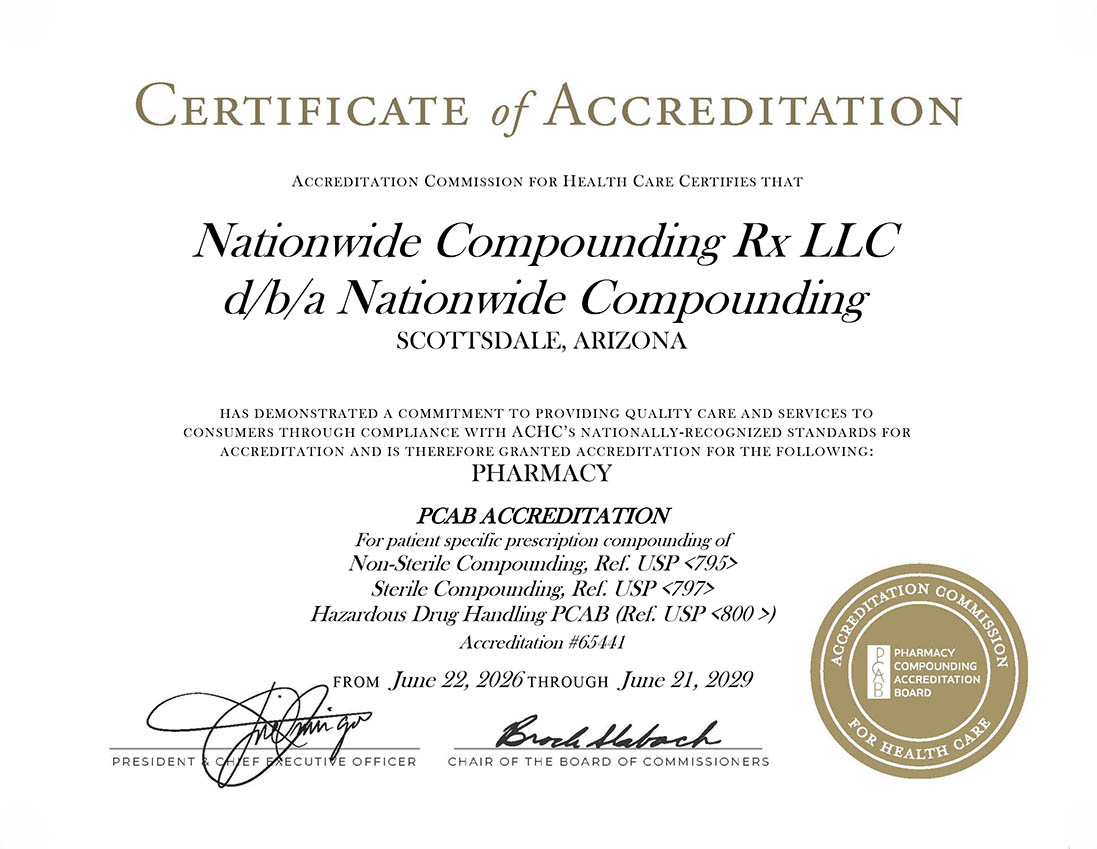
Nationwide Compounding Rx®, a Scottsdale, Arizona, pharmacy, offers a case study in the opposite direction: a compounder built to make each checkpoint publicly verifiable and documented.
PCAB Accreditation: A Rare, Independently Verified Credential
The Pharmacy Compounding Accreditation Board was established in 2007 by eight national pharmacy organizations, including the American Pharmacists Association, the National Association of Boards of Pharmacy, and the United States Pharmacopeia. It now operates as a service of the Accreditation Commission for Health Care (ACHC) and is the only compounding accreditation backed by a formal American Medical Association recommendation.
PCAB accreditation is rare. Industry sources estimate that fewer than 1% of the roughly 3,000 to 7,500 U.S. compounding pharmacies hold it, with figures ranging from under 200 accredited pharmacies to as few as 68 nationally.
Nationwide Compounding Rx® holds PCAB accreditation. Those evaluating any pharmacy should ask whether its PCAB accreditation is current and verifiable, not merely claimed.
USP 795/797/800 Compliance as a Documented Standard, Not a Claim
The three USP chapters and their 2023 to 2024 enforcement timeline represent the current regulatory floor for every compounder. Nationwide Compounding Rx® operates with USP 800 compliance and both sterile and non-sterile compounding capability.
That documented compliance stands in contrast to the difficulty of confirming equivalent standards for a small independent pharmacy through public channels alone.
FDA-Cleared Sourcing and Independent Testing
The API sourcing data (18% of manufacturers, 72% of regulatory actions) describes the problem this checkpoint is meant to address. Nationwide Compounding Rx® sources high-grade chemicals exclusively from FDA-inspected and cleared vendors and conducts independent third-party testing.
The combination matters. Vetted sourcing reduces the chance that a compromised ingredient enters the process, and independent testing verifies the finished preparation. Together, they answer the sourcing-risk question in a way patients and providers can ask to see documented.
Operational Transparency and Track Record
Several operational markers support the pharmacy’s documented credentials:
- 40+ years of combined team experience
- 1-2 business day turnaround, with same-day pickup available for some medications
- Separate Provider and Patient portals, providing documented, trackable processes for prescription submission and refill management rather than informal handling
How to Apply This Checklist Before Switching in 2026
The full checklist can be completed in a short session:
- Check the state Board of Pharmacy license lookup for active status, expiration date, and disciplinary actions.
- Search the BBB profile for rating, complaints, and resolution history.
- Read reviews across multiple platforms (Google, Yelp, Healthgrades), focusing on potency, communication, refill accuracy, and adverse reactions.
- Ask for the Designated Person’s name and credentials directly.
- Ask about API sourcing and whether vendors are FDA-inspected and cleared.
- Search the FDA warning letter database and state disciplinary records.
These steps are especially relevant for anyone currently using or considering compounded GLP-1 medications such as semaglutide, tirzepatide, or liraglutide, given the 2026 Bulks List proposal and related warning letters.
Providers evaluating a compounding partner should request PCAB accreditation documentation and USP compliance status in writing before referring patients.
The checklist takes under 15 minutes to run on any pharmacy. It should be treated as a standard pre-switch habit, not a one-time exception.
Conclusion: Verification, Not Brand Recognition, Should Drive the Decision
Compounded medications operate outside the standard FDA drug approval process. Independent verification is therefore the responsibility of patients and providers, not something to assume.
A legitimate, long-operating local pharmacy like Compounding Pharmacy of Green passes some checkpoints, including an active license and two decades of service, while leaving others thin or undisclosed, including BBB status, review depth, and PCAB, DP, and sourcing transparency. Nationwide Compounding Rx® shows what fully answering all six checkpoints looks like in practice: PCAB accreditation, USP 800 compliance, FDA-cleared sourcing with independent testing, and documented operational transparency.
A pharmacy’s name recognition or search ranking should not decide where a prescription is trusted. The checklist should.
Verify Before Switching: Talk to Nationwide Compounding Rx®
Patients and healthcare providers are invited to apply this checklist directly to Nationwide Compounding Rx® by requesting PCAB accreditation and USP compliance documentation.
For prescription submission, refill management, or provider partnership inquiries, the Provider Portal and Patient Portal are the next step.
Contact Nationwide Compounding Rx®:
- Phone: (480) 499-8379
- Website: nationwidecompounding.com
- Location: 14000 N. Hayden Rd., Suite 104, Scottsdale, AZ 85260
- Hours: Monday to Friday, 7:00 AM to 3:30 PM
- Email inquiries: Answered within one business day via the website contact form
Patients and providers considering a switch in 2026 should run the six-point checklist and see how Nationwide Compounding Rx® measures up.
Related Posts

This 2026 guide breaks down bioidentical hormone replacement therapy in Delaware, covering FDA-approved options versus compounded alternatives. Learn about the latest regulatory updates, state compounding laws, and how to verify a legitimate provider. A clear, science-based resource for Delaware patients exploring BHRT.

Confused by conflicting listings for the CVS Specialty Pharmacy phone number? This guide provides a complete, verified 2026 directory of every official line, organized by department. It also explains what to do when calls lead to long holds or unresolved issues.

Choosing a compounding pharmacy in Houston means navigating new 2026 state regulations, GLP-1 restrictions, and ongoing litigation involving local providers. This guide answers the 7 questions Houston patients ask most, helping them verify safety and licensing before they fill a prescription.

Searching for Avera Specialty Pharmacy's phone number or fax line? This guide offers verified 2026 contact details and explains what happens when insurance mandates or drug restrictions route a prescription elsewhere. Learn your options when the network says no.