
Compounding Pharmacy Turnaround Time: What Really Affects How Fast You Get Your Medication
Introduction: Why “One to Two Business Days” Doesn’t Tell the Whole Story
A patient reads that their compounded medication will be ready in “one to two business days.” They mentally circle a date on the calendar. Then five days pass. Then six. The medication finally arrives, and no one ever explained the gap between what was promised and what actually happened.
This scenario plays out constantly, and it usually stems from a simple misunderstanding. Most compounding pharmacies, including Nationwide Compounding Rx®, cite an industry-standard preparation window of one to two business days. That number is accurate, but it describes only part of the journey.
The core distinction this article unpacks is the difference between preparation time and total delivery time. These are two very different numbers that are routinely conflated in pharmacy marketing and patient conversations. Understanding the gap between them is the difference between waiting anxiously and planning confidently.
Several variables can compress or extend a turnaround: whether the formulation is sterile or non-sterile, whether the necessary ingredients are in stock, whether insurance authorization is pending, how busy the pharmacy is, and which shipping method is selected. This article breaks down each of these factors and introduces a practical refill planning calendar that patients and providers can use to stay ahead of any gaps in their medication supply.
Understanding the Two Phases of Compounding Pharmacy Turnaround Time
Every compounded prescription moves through two distinct phases.
Phase 1: Preparation Time is the window from when a valid prescription is received to when the medication is ready to leave the pharmacy. This is the “one to two business day” figure most pharmacies advertise.
Phase 2: Delivery Time is the shipping window from dispatch to the patient’s door. This varies by carrier, service level, and geography.
Most pharmacy marketing refers only to Phase 1, which is where confusion begins. A realistic total for a mail-order compounding pharmacy looks like this: one to two days of preparation plus two to three days of shipping, for a combined three to seven business days total.
For local patients, same-day or next-day pickup options (available at some pharmacies like Nationwide Compounding Rx® for select medications) eliminate Phase 2 entirely. Understanding both phases is essential for anyone managing chronic conditions, hormone therapy, or medications with no commercial alternative.
The 5 Variables That Most Affect How Fast Your Compounded Medication Is Prepared
The preparation window is not a fixed number. It is shaped by five interacting variables that most pharmacies never fully explain. These variables compound on one another: a sterile formulation with a backordered ingredient and a pending insurance authorization can push preparation well beyond the standard window. Here is what actually drives the timeline.
Variable 1: Sterile vs. Non-Sterile Formulations
The single biggest driver of preparation time is whether a compound is sterile or non-sterile.
Non-sterile compounds, such as creams, capsules, oral liquids, troches, and gummies, are prepared in standard compounding environments. Sterile compounds, including injectables, IV preparations, and ophthalmic solutions, require certified cleanrooms and aseptic technique. Under USP <797> requirements, sterile compounding involves additional quality checks, environmental monitoring, and personnel garbing protocols that add time to every batch.
This matters in 2026 because two of the highest-demand compound categories, GLP-1 injectables and hormone therapy injections, are sterile formulations. They carry longer preparation windows than topical creams or capsules. By contrast, non-sterile compounds like transdermal pain creams, BHRT troches, or pediatric oral suspensions can typically be prepared more quickly.
Nationwide Compounding Rx® operates a USP 800 compliant facility, which ensures that sterile and hazardous drug handling meets federal safety standards. This rigor adds process steps, but those steps are non-negotiable for patient safety.
Variable 2: Raw Material and Ingredient Availability
Compounding pharmacies source active pharmaceutical ingredients (APIs) from FDA-inspected vendors. When supply chains are disrupted, preparation can stall even when the pharmacy is fully staffed and ready to compound.
The current drug shortage landscape intensifies this risk. According to the APC’s 2025-2026 Snapshot of Pharmacy Compounding in America, more than half of compounding pharmacies are now compounding copies of FDA-approved drugs during active shortages. This increases demand for certain APIs and can create backorder situations.
Nationwide Compounding Rx® sources only the highest-grade chemicals from FDA-inspected and cleared vendors, which supports consistent availability but cannot fully insulate any pharmacy against industry-wide shortages. Patients and providers should ask about ingredient stock status when ordering medications that use commonly backordered APIs. Combination therapies with multiple active ingredients are especially vulnerable, since a delay in even one component holds up the entire formulation.
Variable 3: Prescription Verification and Payer Authorization
The preparation clock does not start until a valid, verified prescription is received. Incomplete or unclear prescriptions require follow-up with the prescriber, adding time before compounding even begins.
Payer authorization is a frequently overlooked delay factor. Some pharmacies cite a 48 to 72 hour turnaround “upon payer approval,” meaning insurance authorization delays can extend the total wait independently of the pharmacy’s own workflow. Common bottlenecks include prior authorization requirements, formulary exceptions, and back-and-forth coordination between the prescriber’s office and the payer.
Cash-pay or direct-pay patients bypass the payer authorization step entirely, which can meaningfully compress total turnaround time. Providers can reduce verification delays by submitting complete clinical documentation, and patients should confirm their payment method and coverage status before the prescription is sent.
Variable 4: Pharmacy Workload and Staffing
Even the most efficient pharmacy operates within real-world capacity constraints. The median 503A compounding pharmacy dispenses approximately 350 compounded prescriptions per week, according to the APC’s 2025-2026 Snapshot. High-volume periods, such as the end of the month, post-holiday windows, or drug shortage surges, can extend preparation queues beyond the standard one to two day window.
Technology is helping to address this challenge. Pharmacies using AI-driven backend workflows have reportedly doubled medication production without adding staff, and robotic compounding systems are increasingly common. Peer-reviewed research has also shown that technology-assisted sterile compounding workflows can increase safety checks while decreasing pharmacist review time.
PCAB-accredited pharmacies like Nationwide Compounding Rx® maintain standardized workflows that support consistent turnaround times even during busy periods. Patients and providers should submit prescriptions early ahead of anticipated high-demand windows, such as major holidays or known shortage periods.
Variable 5: Formulation Complexity and Dosage Form
Not all non-sterile compounds are created equal. A simple flavored oral suspension for a pediatric patient takes less time than a multi-ingredient transdermal gel or a suppository requiring precise temperature control.
A rough hierarchy of complexity looks like this:
- Relatively straightforward: capsules and oral liquids
- Moderate: troches and transdermal creams
- More complex: suppositories and multi-drug combination formulations
First-time or novel formulations, especially those customized to a patient’s specific lab results as with BHRT, may require additional pharmacist review compared to repeat refills of established formulas. Nationwide Compounding Rx® offers a wide range of dosage forms, including troches, creams, gels, capsules, gummies, oral liquids, and suppositories, with preparation time varying by form. These complexity-driven delays are a quality safeguard, not a failure; they reflect the pharmacist’s commitment to getting the formulation right for that specific patient.
503A vs. 503B: Why Your Pharmacy’s Designation Affects Turnaround Time
A pharmacy’s regulatory designation has a direct impact on how quickly it can deliver.
503A pharmacies are traditional compounding pharmacies that prepare medications based on individual patient prescriptions. They are subject to state pharmacy board oversight but not FDA Current Good Manufacturing Practice (CGMP) requirements.
503B outsourcing facilities are large-batch compounders that produce medications without patient-specific prescriptions. They are subject to full FDA CGMP requirements, including batch validation, stability testing, and sterility testing before product release.
The turnaround implication is significant. According to guidance from The FDA Group, 503B facilities must produce multiple batches and submit them for testing and stability before a new product can be brought to market, which leads to inherently longer lead times than 503A pharmacies. The FDA’s own compounding guidance confirms that quality standards differ depending on the compounding setting.
Nationwide Compounding Rx® operates as a 503A pharmacy, meaning medications are prepared in response to individual prescriptions with a one to two business day preparation window, not subject to the extended batch-release timelines of 503B facilities. Providers ordering from 503B outsourcing facilities for office use, such as hospital or clinic stock, should build longer lead times into their procurement planning.
Compounding Pharmacy vs. Retail Pharmacy: A Meaningful Speed Comparison
Retail pharmacies fill standard, commercially manufactured prescriptions in minutes because the drug is already on the shelf; no preparation is required.
Retail speed is irrelevant, however, if the medication a patient needs does not exist in commercial form, requires a dose not available off the shelf, or contains an allergen the patient cannot tolerate. A compounded medication takes one to two days to prepare because it is being made specifically for one person: their dose, their delivery form, their allergen profile, their lab results. Patients who need to understand when to use a compounding pharmacy can find that personalization is often the deciding factor.
For context, a peer-reviewed study found that average waiting times for compounded prescriptions in hospital settings ranged from 36 minutes in private hospitals to 80 minutes in public hospitals. That is faster than mail-order, but it still reflects the reality that preparation is fundamentally different from dispensing.
The takeaway is clear: the one to two day preparation window is not a limitation of compounding pharmacies. It is the cost of personalization, and it is worth planning for.
The Refill Planning Calendar: A Practical Framework for Patients and Providers
The single most effective way to avoid a medication gap is a proactive refill planning calendar. The core principle is simple: patients managing ongoing compounded medications should never wait until they are out of medication to reorder.
The recommended planning window: initiate a refill request at least 7 to 10 days before the current supply runs out. This accounts for one to two days of preparation, two to three days of shipping, and a two-day buffer for unexpected delays.
Here is a sample scenario. If a patient’s 30-day supply runs out on Day 30, they should submit their refill request by Day 20 to 23 at the latest. If insurance authorization is required, an additional two to three business days should be added to the planning window, pushing the reorder trigger back to Day 17 to 20.
Providers managing multiple patients on compounded medications can benefit from batching prescription renewals on a fixed schedule, such as reviewing refill needs every Monday morning, rather than responding reactively to patient calls.
Timing details matter as well. Nationwide Compounding Rx® operates Monday through Friday, 7:00 a.m. to 3:30 p.m., and prescriptions submitted before the daily cutoff are processed the same business day. Patients should save the pharmacy’s toll-free number (1-833-650-9836) and fax number (480-699-5341) for their prescriber, so refill requests can be transmitted quickly and without friction.
How to Evaluate a Compounding Pharmacy’s Turnaround Reliability
Patients and providers should not take turnaround claims at face value. A few specific questions reveal a pharmacy’s true reliability:
- Does the quoted turnaround time include payer verification, or does it start after approval?
- Is the quoted time for preparation only, or does it include shipping?
- Are the ingredients for this specific formulation currently in stock?
Accreditation offers another reliable signal. PCAB-accredited pharmacies maintain standardized, audited workflows that directly correlate with consistent turnaround times. Accreditation reflects operational discipline, not just a marketing credential. Similarly, a pharmacy operating in a USP 800 compliant facility has invested in infrastructure that supports both safety and operational consistency.
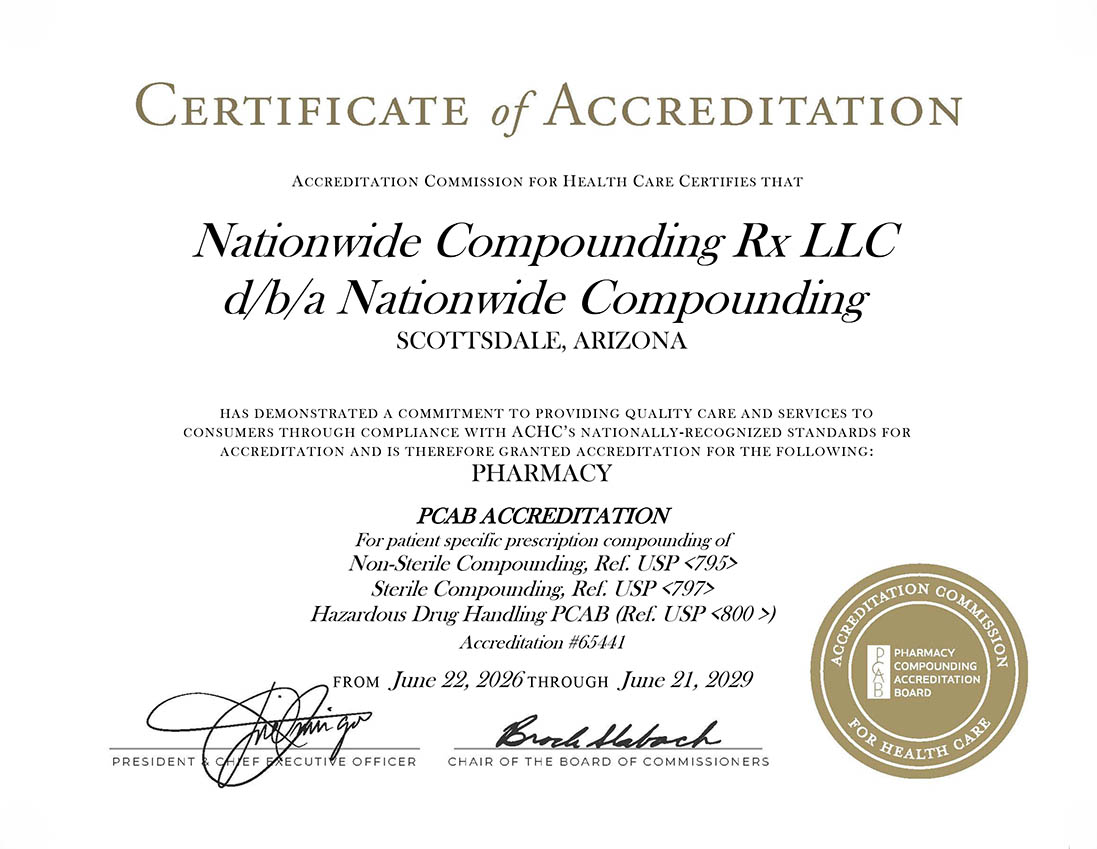
Nationwide Compounding Rx® has maintained PCAB accreditation since its early days of operation and operates a USP 800 compliant facility. Both support the reliability of its one to two business day preparation commitment. Providers building compounding into patient care plans should establish a direct relationship with the pharmacy’s clinical team, which enables faster processing and proactive communication about any delays.
What Nationwide Compounding Rx® Does to Keep Turnaround Times Consistent
Nationwide Compounding Rx® applies several concrete practices to keep turnaround times dependable.
The pharmacy’s core speed commitment is a one to two business day preparation turnaround, with same-day pickup available for select medications. PCAB accreditation and USP 800 compliance support workflow standardization and reduce the variability that causes delays at less-regulated pharmacies.
On sourcing, the pharmacy purchases only the highest-grade chemicals from FDA-inspected and cleared vendors, which supports ingredient availability and reduces supply chain delays. Its staff brings 40 years of combined experience, a meaningful factor in efficient, accurate formulation, since experienced compounders make fewer errors that require re-preparation.
Geographically, the pharmacy ships to 47 states plus Washington, D.C., and patients can factor distance into their delivery expectations. Because business hours run Monday through Friday, 7:00 a.m. to 3:30 p.m., prescriptions received early in the business day are more likely to enter the preparation queue the same day. The pharmacy also offers a broad range of dosage forms, including troches, creams, capsules, gummies, oral liquids, and suppositories, with preparation time varying by formulation complexity. Providers interested in outsourcing compounding for their medical practice can work directly with the pharmacy’s clinical team to streamline ordering and reduce turnaround variability.
Conclusion: Plan for Turnaround Time, Don’t React to It
Compounding pharmacy turnaround time is not a fixed number. It is a range shaped by formulation type, ingredient availability, payer authorization, pharmacy workload, and shipping method.
The “one to two business day” window most pharmacies advertise reflects preparation time only. For mail-order patients, total delivery time typically runs three to seven business days. The most reliable safeguard is the refill planning calendar: reorder 7 to 10 days before running out, add buffer for payer authorization if applicable, and build the pharmacy’s business hours into the submission timeline.
That preparation window reflects the inherent value of compounded medications. Personalization takes time, and that time is an investment in a medication that is precisely right for the patient. As AI, automation, and telehealth-integrated compounding continue to evolve in 2026 and beyond, turnaround times are expected to compress further, but proactive planning will always be the most reliable strategy.
Ready to Get Started? Contact Nationwide Compounding Rx® Today
Patients and providers with compounding needs are invited to reach out to Nationwide Compounding Rx® for a realistic turnaround estimate on their specific medication.
- Toll-Free: 1-833-650-9836
- Main Line: 480-499-8379
- Fax: 480-699-5341
- Website: www.NationwideCompounding.com
Business hours are Monday through Friday, 7:00 a.m. to 3:30 p.m., and early-day prescription submissions are more likely to enter the same-day queue. Nationwide Compounding Rx® ships to 47 states plus Washington, D.C., and out-of-state patients are encouraged to confirm their state’s eligibility.
As the pharmacy’s philosophy puts it: “We do not believe in a one size fits all approach. Every medication is prepared with your specific needs in mind.”
For providers: contact the pharmacy’s clinical team to establish a direct working relationship that streamlines prescription processing and supports consistent turnaround times for your patients.
Related Posts

Searching for Las Colinas Pharmacy Compounding & Wellness in Irving, TX? This 2026 guide gives you the address, hours, and phone number up front, then breaks down the accreditation and safety standards DFW patients should check before trusting any compounding pharmacy with hormone, peptide, or custom medication needs.

Searching for Jefferson Specialty Pharmacy turns up two unrelated organizations—one in Pennsylvania, one in Washington State. This guide clarifies which is which and explains what to do in 2026 when a prescribed medication can't be filled by either.

Searching for Marty's Compounding Pharmacy but not sure if a local Mississippi storefront fits your needs? This guide compares Marty's Pharmacy & Compounding Center to nationwide compounding options using a five-point credential checklist covering accreditation, testing, and shipping licenses in 2026.

The term 'board of specialty pharmacy' actually refers to four distinct organizations, each serving a different purpose. This article breaks down BPS, SPCB, state boards, and PCAB to reveal which body truly governs compounding pharmacy quality in 2026.