
Lexington KY Compounding Pharmacy: The 2026 Verification Guide
Introduction: The One Question Lexington Searches Never Ask
Most searches for a “lexington ky compounding pharmacy” end the same way: a name, an address, a phone number, and perhaps a star rating. Very few searchers take the next step and ask whether that pharmacy can prove it compounds safely.
That question matters. In 2024, the Kentucky Board of Pharmacy placed a compounding pharmacy on five-year probation after a medication error hospitalized three children. Proximity did not protect those families, and licensure alone did not either.
In 2026, “nearby” is not a trust signal. Proof is. This guide provides a practical verification framework built on the Kentucky Board of Pharmacy license lookup, PCAB accreditation (including its stricter June 2024 standards), and USP 795/797/800 compliance. It then applies that framework to Lexington’s three named independent compounders. Throughout, the guide examines Nationwide Compounding Rx®, a PCAB-accredited pharmacy that leads with credentials, as a point of comparison.
Why “Nearby” Is No Longer Enough: The Lexington Compounding Safety Wake-Up Call
On August 26, 2024, the Kentucky Board of Pharmacy received reports of medication errors that sent three children to the hospital with serious complications. The Board’s investigation found significant non-compliance with state laws and regulations governing compounding. The outcome was a five-year compounding probation for the pharmacy and suspension of the pharmacist’s license.
The violations tied back to two specific regulations:
- 201 KAR 2:076, which requires compounding to follow USP standards.
- 201 KAR 2:205, which requires a designated pharmacist-in-charge.
These rules are not abstract. They are the baseline safeguards that separate a controlled compounding process from a dangerous one.
The stakes are especially high in Lexington. The region’s healthcare sector employs more than 40,000 people, anchored by UK HealthCare, Baptist Health Lexington, and CHI Saint Joseph Health. UK HealthCare’s Chandler Hospital includes the only Level 1 Trauma Center for adult patients in Central and Eastern Kentucky, and licensed inpatient beds in Lexington have grown from 463 to 1,150 since 2003. A medical market of this scale deserves equally serious scrutiny of the pharmacies that serve it.
The Five-Step Verification Framework for Any Lexington Compounding Pharmacy
The following method is repeatable. Patients and prescribers can apply it to any pharmacy, local or national, before trusting it with a prescription.
Step 1: Confirm the Pharmacist-in-Charge and State License
Under KRS 315.020(1) and 315.0351(1)(g), implemented through 201 KAR 2:205, every Kentucky pharmacy must designate a pharmacist-in-charge before compounding and dispensing privileges are granted. This person is legally accountable for the pharmacy’s operations.
The Kentucky Board of Pharmacy maintains an online license lookup tool and recommends that both patients and pharmacies use it. When searching, check for:
- Active license status for both the pharmacy and its pharmacists
- A named pharmacist-in-charge
- Disciplinary history, including probation, suspension, or other flags
For out-of-state pharmacies shipping into Kentucky, confirm that the pharmacy holds the appropriate Kentucky nonresident permit.
Step 2: Check USP 795/797/800/825 Compliance
201 KAR 2:076 requires Kentucky compounding to follow specific USP chapters:
- USP 795 governs non-sterile compounding (creams, capsules, oral liquids), focusing on ingredient quality, contamination control, and accurate formulation.
- USP 797 governs sterile compounding (injectables and similar preparations), focusing on sterility assurance, cleanroom standards, and aseptic technique.
- USP 800 governs handling of hazardous drugs, protecting patients, staff, and the environment from exposure.
- USP 825 governs radiopharmaceuticals.
Patients and prescribers should ask any pharmacy directly how it documents USP compliance. A credible pharmacy can describe its testing, environmental monitoring, and training. Vague or evasive answers are a red flag.
Step 3: Verify PCAB Accreditation vs. NABP-Only Claims
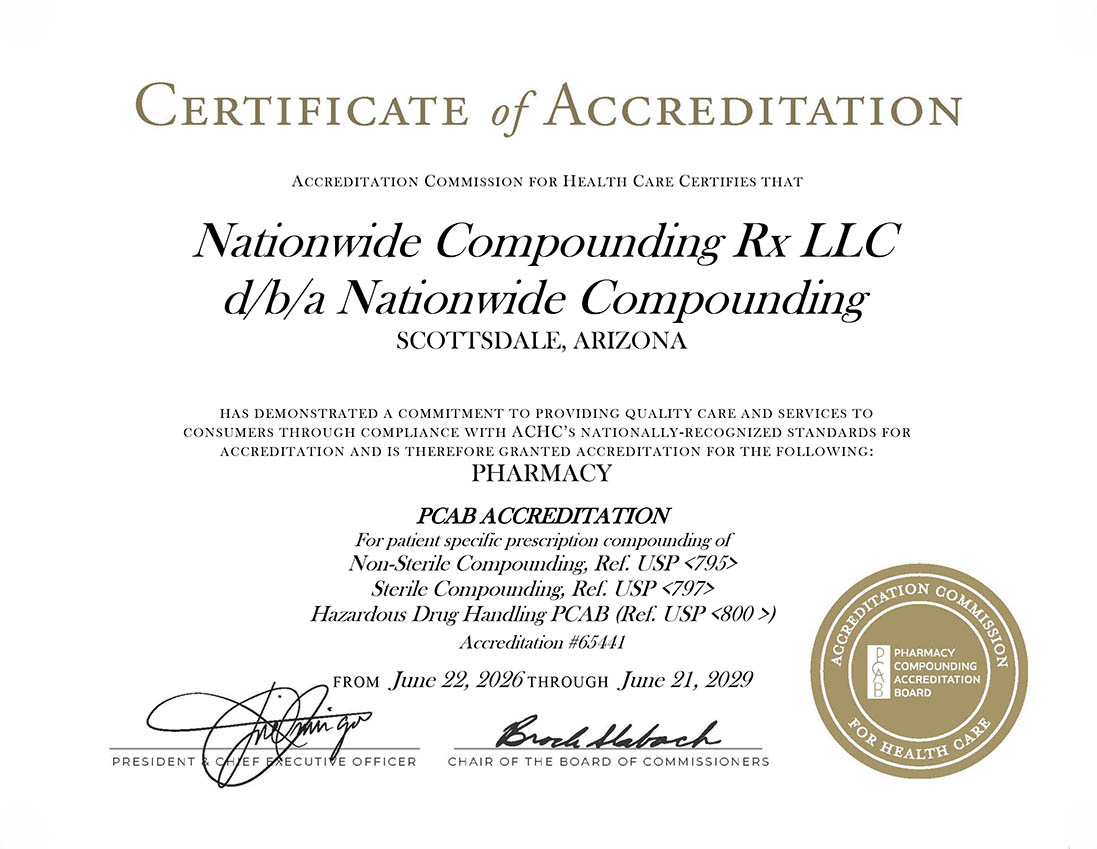
The Pharmacy Compounding Accreditation Board (PCAB) was established in 2007 by eight leading pharmacy organizations and now operates as a service of the Accreditation Commission for Health Care (ACHC). It is rare: only about 68 pharmacies nationwide hold PCAB accreditation out of roughly 7,500 compounding pharmacies.
The American Medical Association formally recommends that physicians use only PCAB-accredited compounding pharmacies, making PCAB the only compounding-specific quality accreditation with AMA endorsement. PCAB also tightened its standards on June 1, 2024, widening the quality gap between accredited and non-accredited pharmacies.
The critical distinction: NABP primarily verifies state licensure status, while PCAB is a dedicated compounding-quality accreditation. The two are not interchangeable.
Step 4: Identify Reseller or White-Label Relationships
A reseller or white-label storefront is a local-facing website that sources from, or partners with, a large national 503A or 503B compounder rather than compounding in-house. Warning signs include:
- Identical product catalogs or templated copy across multiple “independent” pharmacy sites
- Disclosed or undisclosed partnerships with outsourcing facilities
- Little information about the physical facility where compounding occurs
Patients deserve to know who is physically compounding their medication, because that entity carries the real safety and accountability burden.
Step 5: Review Recent FDA and State Enforcement Actions
Before choosing a pharmacy, it is worth searching the FDA’s public warning letter database and state board disciplinary records. On September 18, 2026, the FDA issued a warning letter to Empower Pharmacy citing mass production of unapproved drugs that were essentially copies of commercial semaglutide and tirzepatide products. Enforcement history like this matters, and it extends beyond the storefront: if a pharmacy’s suppliers or partners have unresolved actions, that risk can flow downstream to patients.
Case Study: Applying the Framework to Lexington’s Three Named Independents
The following is an evidence-based application of the framework to the three local independents that most Lexington searches surface, based on their public materials.
Lexington Compounding Pharmacy (399 Waller Ave)
This pharmacy brands itself as family-owned and operated, with a personal, custom-tailored approach integrating pharmacist, patient, and physician. Its current website describes itself as “NABP-accredited” rather than PCAB-accredited.
An earlier version of the business’s site showed a direct partnership with Empower Pharmacy, a large national 503A/503B compounder. That history is relevant to anyone seeking GLP-1 compounding, given the September 2026 FDA warning letter to Empower. In addition, templated copy and an identical product catalog (hair, B12, NAD+, tirzepatide, and semaglutide SKUs) appear verbatim across multiple domains tied to the business, which suggests a reseller storefront structure rather than independent in-house compounding.
Wheeler’s Custom Compounding (327 Romany Rd)
Wheeler’s positions itself as a long-standing, independently owned pharmacy blending the tradition of compounding with modern technology. Its service range is broad: bio-identical hormones, pain management, allergy compounding (dye-free, sugar-free, gluten-free), autism, dermatology, pediatric, veterinary, wound care, podiatry, and unavailable medications.
What is absent from its public materials is notable. There is no visible disclosure of PCAB accreditation, USP 795/797/800 compliance documentation, or AMA-recognized credentials.
Lexington Professional Pharmacy (3050 Harrodsburg Rd)
Operating since 1981, Lexington Professional Pharmacy describes a “triad relationship” in which prescriber, patient, and pharmacist work together. Pharmacist Brenda Edelen is a 1989 graduate of the University of Kentucky College of Pharmacy, which serves as a meaningful legacy trust signal. However, tenure and relationships, while valuable, are not a substitute for documented third-party accreditation or published compliance standards.
What This Comparison Reveals
None of the three named Lexington independents publicly discloses PCAB accreditation, AMA guidance on compounding pharmacy selection, or 2026-specific GLP-1 regulatory compliance. Their trust narratives rest on legacy, family ownership, and relationships. Those qualities matter, but they are not verifiable credentials. That gap is the opening for a credential-first alternative.
2026 Regulatory Context No Lexington Pharmacy Site Is Discussing
The GLP-1 Compounding Rules Have Changed
The FDA determined the semaglutide shortage was resolved on February 21, 2025, closing the compounding exemption that 503A pharmacies and 503B outsourcing facilities had relied on for nearly three years. On April 30, 2026, the FDA proposed permanently excluding semaglutide, tirzepatide, and liraglutide from the 503B bulk-drug list. As of October 22, 2026, that rule was not yet final.
Patient-specific 503A compounding remains possible but legally narrow. It requires prescriber documentation of a clinically significant difference from the commercial drug, and the FDA has indicated it will not pursue pharmacies filling four or fewer prescriptions of a formulation per month. Lexington patients seeking GLP-1 compounding should ask any pharmacy exactly how it complies with these rules before proceeding.
FDA Enforcement Is Intensifying Nationally
The September 18, 2026 warning letter to Empower Pharmacy marked a significant escalation, citing mass production of unapproved new drugs that copied commercially available semaglutide and tirzepatide. Because at least one local compounding brand has publicly partnered with Empower, this is directly relevant to Lexington. Checking the FDA’s warning letter database should be standard due diligence, not an afterthought.
PCAB Accreditation vs. NABP-Only Claims: A Side-by-Side Comparison
| Factor | PCAB Accreditation | NABP Verification |
|---|---|---|
| Primary purpose | Compounding-specific quality accreditation | Licensure and credentialing verification |
| What it evaluates | Facility standards, compounding processes, quality audits | State license status and credentials |
| AMA endorsement | Yes, for compounding pharmacy selection | No compounding-specific endorsement |
| Rarity | About 68 of 7,500 U.S. compounders | Far more common |
| Recent tightening | Stricter standards effective June 1, 2024 | Not a compounding-quality standard |
PCAB’s June 2024 update raised the bar on process controls and documentation, so the distance between accredited and non-accredited operations is now wider than at any point in its history. The simplest question any Lexington patient can ask: “Are you PCAB accredited, or only NABP-verified?”
How Nationwide Compounding Rx Meets the Verification Standard
Measured against the five-step framework, Nationwide Compounding Rx® presents its credentials openly:
- PCAB accredited, the AMA-endorsed compounding quality standard
- USP 800 compliant for hazardous drug handling
- Independent third-party testing to verify quality and consistency
- High-grade chemicals sourced from FDA-inspected and cleared vendors
Instead of a white-label storefront, the pharmacy operates as a direct compounder producing both sterile and non-sterile formulations under accredited standards. Its provider partnership model, Connect → Collaborate → Create → Care, gives prescribers a transparent, collaborative working relationship with the people actually making the medication.
Services relevant to Lexington patients and prescribers include GLP-1/peptide support, bioidentical hormone replacement therapy (with formulas adjustable at each refill based on lab results), pain management topicals, dermatology, pediatrics (with kid-friendly flavors and dosage forms), and sports medicine.
Practical differentiators include a 1 to 2 business day turnaround, same-day pickup for some medications at its Scottsdale, Arizona location, and nationwide shipping supported by a transparent three-tier state licensing map (fully licensed, non-sterile only with sterile pending, and pending or unlicensed). Lexington patients should confirm Kentucky’s current tier for their specific medication type. Secure Provider and Patient Portals streamline prescriptions, order tracking, and refills.
A Practical Checklist: Verifying Any Compounding Pharmacy Before Trusting It With a Prescription
For patients:
- License lookup: Confirm active status, a named pharmacist-in-charge, and clean disciplinary history with the Kentucky Board of Pharmacy.
- USP compliance: Ask how the pharmacy documents USP 795, 797, 800, and 825 compliance as applicable.
- PCAB vs. NABP: Confirm PCAB accreditation through the ACHC directory; do not accept NABP claims as a substitute.
- Reseller check: Ask who physically compounds the medication and whether the pharmacy partners with an outside compounder.
- Enforcement history: Search FDA warning letters and state board records for the pharmacy and its partners.
For prescribers: Referring a patient to a compounding pharmacy carries patient-safety and liability implications. Following the AMA’s PCAB recommendation, documenting clinical rationale (especially for GLP-1s under 503A rules), and confirming the pharmacy’s sourcing and testing practices all help protect both patient and practice.
When local still makes sense: A walk-in Lexington pharmacy may be reasonable for veterinary compounding or urgent pediatric needs where same-day local access is critical. For GLP-1 therapy, BHRT, and complex or higher-risk formulations, an accredited option with documented standards is the safer choice.
Conclusion
Lexington’s healthcare market, anchored by UK HealthCare, a Level 1 Trauma Center, and more than 40,000 healthcare jobs, is too significant to leave pharmacy selection to proximity alone. The 2024 probation case is clear evidence that “nearby” and “licensed” are not synonymous with “safe.”
Neither generic directories nor Lexington’s three named independents currently offer the credential transparency that patients and prescribers need in 2026. Nationwide Compounding Rx® sets a credential-first standard: PCAB accredited, USP 800 compliant, and transparent about sourcing, testing, and regulatory compliance.
Verify First, Then Choose: Next Steps for Lexington Patients and Prescribers
Before filling any compounded prescription, run the pharmacy through the Kentucky Board of Pharmacy license lookup and the PCAB/ACHC accreditation directory. It takes minutes and can prevent serious harm.
Patients can begin with Nationwide Compounding Rx® through its secure Patient Portal. Prescribers can start the Connect → Collaborate → Create → Care partnership through the Provider Portal.
Contact Nationwide Compounding Rx®:
- Phone: (480) 499-8379
- Hours: Monday to Friday, 7:00 AM to 3:30 PM
- Online: Website contact form and secure portals at nationwidecompounding.com (email inquiries answered within one business day)
A search for a “lexington ky compounding pharmacy” is only the first step. Verification is what should follow.
Related Posts

Central Ohio's booming population, aging demographics, and billion-dollar health system investments are driving unprecedented demand for personalized medication. This article explores what's fueling the rise in central Ohio compounding pharmacy needs in 2026 and how new regulations are reshaping access to quality care.

NYU Specialty Pharmacy offers strong outpatient care, but strict eligibility, in-network, and disease-state rules can block certain prescriptions. Discover the three key limitations and where New Yorkers can turn next in 2026.

Partell Specialty Pharmacy officially became National Health Rx after a 2025 ownership change approved by the Nevada State Board of Pharmacy. This guide helps patients and prescribers decide whether to stay or transfer, with a capability checklist and a clear five-step pathway to a PCAB-accredited compounding pharmacy.
BioPlus Specialty Pharmacy has long been known for high-touch specialty infusion services, but its 2026 status under Carelon ownership raises new questions for patients and providers. This guide breaks down what changed, what stayed the same, and how BioPlus's dispensing model compares to specialty compounding pharmacies.