
Tirzepatide Compounding Pharmacy: The 2026 Legal Status Guide
Introduction: Cutting Through the Tirzepatide Compounding Confusion
Two narratives dominate online discussion of compounded tirzepatide, and both are out of date. The first claims tirzepatide is still on the federal shortage list, so any pharmacy can make it. The second claims compounding tirzepatide is now banned outright.
As of November 2026, neither claim is accurate. Compounded tirzepatide occupies a narrow, legally defined lane, and most published articles have not kept pace with how that lane has changed.
This guide offers three things:
- A dated regulatory timeline showing exactly how the current rules came to be.
- A plain-language translation of the “essentially a copy” and “significant difference” legal test.
- A quality-assurance framework that patients can apply to any pharmacy or prescription.
The stakes are real. Many patients pursue compounded tirzepatide for cost reasons but hesitate because of FDA crackdown headlines, Eli Lilly lawsuits, and conflicting legal commentary. This guide aims to resolve that hesitation with facts rather than reassurance.
The 2026 Legal Status at a Glance
The short answer: Compounded tirzepatide is legal in 2026, but only under specific conditions. A state-licensed 503A pharmacy must prepare it, and the prescriber must document a patient-specific “significant difference” that justifies the compounded version. Mass “copycat” compounding is no longer permitted.
Key points:
- 503B outsourcing facilities can no longer legally compound tirzepatide from bulk drug substance, because tirzepatide is on neither the FDA drug shortage list nor the 503B Bulks List.
- A further tightening is pending. On April 30, 2026, the FDA proposed formally excluding tirzepatide from the 503B Bulks List. As of this writing, that proposal has not been finalized.
The sections below explain how this status developed and what it means for evaluating a specific prescription.
The Regulatory Timeline: How We Got Here
Most confusion about compounded tirzepatide comes from undated or misdated information. The following chronology anchors each regulatory change to its actual date.
December 2022: The Shortage Begins
Surging demand pushed tirzepatide onto the federal drug shortage list in December 2022. Shortage status legally opened the door for both 503A pharmacies and 503B outsourcing facilities to compound versions that were “essentially a copy” of the FDA-approved products, Mounjaro and Zepbound.
December 19, 2024: FDA Declares the Shortage Resolved
On December 19, 2024, the FDA affirmed that the tirzepatide injection shortage was resolved. That decision legally ended the shortage-based exemption that had permitted mass copycat compounding.
This date is the hinge point. Articles that still describe tirzepatide as “on the shortage list” are describing a legal environment that ended nearly two years ago.
Early 2025: Wind-Down Deadlines
The FDA gave compounders grace periods to stop producing essentially-copy tirzepatide:
- 503A pharmacies: February 18, 2025, effectively extended to March 5, 2025, after a failed court challenge.
- 503B outsourcing facilities: March 19, 2025.
After these dates, continued compounding became lawful only under the patient-specific “significant difference” exception, not as blanket copying.
April 30, 2026: The Proposal to Strip Tirzepatide from the 503B Bulks List
On April 30, 2026, the FDA formally proposed excluding semaglutide, tirzepatide, and liraglutide from the 503B Bulks List. If finalized, the rule would permanently close the 503B bulk-compounding pathway for these drugs.
The public comment period ran into summer 2026, with deadlines cited as June 29 and July 30, 2026. In practical terms, the 503B pathway is already closed because tirzepatide sits on neither qualifying list. The proposal would make that closure explicit and permanent rather than dependent on shortage status.
As of publication, no final rule has been issued. This is a development to watch, not settled law.
Where Things Stand Now: November 2026
The current legal reality:
- 503B bulk compounding of tirzepatide is already effectively dead.
- 503A patient-specific compounding is the sole legal pathway.
- The April 2026 proposal, if finalized, would formalize the 503B closure but would not change today’s practical status quo.
The Legal Test Explained in Plain Language
Knowing when the rules changed is only half the picture. The other half is understanding what the law actually permits. The governing provision is 21 U.S.C. § 353a(b)(2), and it can be translated into consumer-friendly terms.
What “Essentially a Copy” Means
A compounded product is treated as “essentially a copy” of an FDA-approved drug by default when it has:
- The same active ingredient (tirzepatide),
- The same route of administration (subcutaneous injection), and
- A strength within 10% of the approved product.
The test exists to prevent compounders from mass-producing what amount to unapproved generic versions of an approved drug outside of FDA review.
The “Significant Difference” Exception
A prescriber can lawfully order a compounded version only by documenting a patient-specific clinical reason that produces a significant difference for that patient. Examples include:
- An allergy or sensitivity to an inactive ingredient in the commercial product
- A medical need for a different dosage form
- A required dose that falls outside commercially available strengths
The key phrase is patient-specific. The justification must be tied to an identified individual’s documented medical need. A generic cost or convenience rationale does not qualify.
The Four-Prescription-Per-Month Enforcement Note
The FDA has stated it does not generally intend to take action against a 503A pharmacy that fills four or fewer essentially-copy prescriptions per calendar month. This is narrow enforcement discretion, not a legal green light for scale. A pharmacy compounding tirzepatide in volume while relying on this allowance alone would be operating well outside its intended scope.
Why Templated Justification Letters Are a Problem
The FDA has specifically criticized templated “significant difference” statements used at scale, describing them as pretextual. A canned letter copied across hundreds of patients undermines the individualized justification the law requires, and it exposes both the prescriber and the pharmacy to legal risk.
A Plain-Language Checklist to Evaluate a Prescription
Patients can ask the following questions:
- [ ] Is the pharmacy a state-licensed 503A facility?
- [ ] Did the prescriber document a specific, individualized clinical reason for the compounded version?
- [ ] Is the reasoning specific to the patient, or does it read like boilerplate?
- [ ] Is the product coming from a 503B facility? In 2026, that is a legal red flag.
Patients are encouraged to ask their prescriber or pharmacy directly for the documented significant-difference rationale. A compliant provider should be able to explain it clearly.
503A vs. 503B: Why 503A Is Now the Only Legal Pathway
The two compounding categories differ structurally:
| Feature | 503A Pharmacy | 503B Outsourcing Facility |
|---|---|---|
| Oversight | Primarily state boards of pharmacy | FDA-registered |
| Basis for compounding | Patient-specific prescriptions | Bulk compounding, often without individual prescriptions |
| Tirzepatide status in 2026 | Permitted under significant-difference framework | Not permitted from bulk substance |
Because tirzepatide is on neither the shortage list nor the bulks list, 503B facilities cannot legally compound it from bulk drug substance. The pending April 2026 proposal would make that exclusion permanent and explicit, removing any remaining ambiguity.
The practical implication is straightforward. If a compounded tirzepatide product is coming from a 503B facility in late 2026, that alone is a significant legal red flag. Essentially all lawfully compounded tirzepatide today originates from 503A pharmacies operating under the significant-difference framework.
Beyond Legality: The Quality-Assurance Layer Most Guides Skip
Legality and quality are separate questions. A prescription can be legally justified yet prepared by a pharmacy with weak quality controls, and a well-run pharmacy can still fill a prescription that lacks proper justification. Patients should evaluate both independently.
What PCAB Accreditation Actually Verifies
The Pharmacy Compounding Accreditation Board (PCAB), operated under ACHC, offers a voluntary third-party accreditation. It is not a baseline legal requirement, and fewer than an estimated 3% of U.S. compounding pharmacies hold it, making it a genuine differentiator.
PCAB accreditation requires:
- USP-grade ingredient sourcing from FDA-registered facilities
- HEPA-filtered sterile compounding environments
- Ongoing staff training and audits
- Continuous compliance monitoring beyond minimum state licensure
What PCAB Accreditation Does NOT Verify
PCAB accreditation is not equivalent to FDA approval, and it does not make an otherwise illegal “essentially a copy” preparation legal. It signals process quality and safety systems, not the regulatory legality of a specific formulation or prescription.
Patients still need to confirm both the legal basis (significant-difference documentation) and the quality credentials (PCAB, USP standards). One does not substitute for the other.
What USP <800> Compliance Covers
USP <800> is the standard governing safe handling of hazardous drugs in healthcare settings. Sterile injectable compounding itself is governed by companion standards such as USP <797>, but USP <800> compliance indicates that a pharmacy maintains proper containment, ventilation, and handling protocols. Those systems protect compounding staff and support product integrity, and they reflect a broader culture of rigorous environmental control.
Red Flags: How to Screen a Pharmacy or Prescription
The following warning signs form a practical due-diligence list.
Templated “Significant Difference” Letters Issued at Scale
Boilerplate justification letters used across many patients are, in the FDA’s view, a sign of non-compliant, pretextual practice. If a justification could apply to anyone, it likely does not satisfy the law.
Unreported or Underreported Adverse Events
As of May 31, 2026, the FDA had received more than 730 adverse event reports associated with compounded tirzepatide and 990 for compounded semaglutide, more than 1,700 combined. The agency notes these figures are likely undercounted because 503A pharmacies are not required to report adverse events. A low count reflects a structural reporting gap, not necessarily low risk.
Multidose Vial Dosing Errors
The FDA has flagged dosing errors as a leading safety concern. Documented cases include patients self-administering 10 to 20 times the prescribed dose from multidose vials, with some requiring hospitalization, as documented in reporting from Stanford Medicine.
Inspections have also found potency problems:
- A product labeled 1.25 mg actually contained 1.75 mg, a 40% potency error.
- A compounded semaglutide product tested at roughly 80% of labeled potency.
Vial-based dosing introduces measurement risk that pre-filled, FDA-approved pens largely avoid. Patients should ask their pharmacy how it mitigates that risk through labeling, syringe guidance, and dosing instructions.
Misleading Marketing from Telehealth Platforms
In 2026, the FDA sent waves of warning letters, roughly 30 in March and 25 in June, to telehealth companies over false or misleading claims equating compounded GLP-1s with FDA-approved drugs. Marketing that implies equivalence to Mounjaro or Zepbound without acknowledging that the compounded product is unapproved deserves skepticism.
Price-Only Shopping
Brand-name Mounjaro and Zepbound run roughly $1,060 to $1,350 per month at cash prices, while compounded tirzepatide typically costs $150 to $600 per month depending on provider and dose. Price alone indicates nothing about legality or quality. The cheapest option may be the one skipping documentation, accreditation, or quality controls.
Why This Matters Now: Enforcement and Litigation Climate
2026 is a period of heightened scrutiny. Eli Lilly has sued numerous compounders and telehealth platforms, including several compounding pharmacies and telehealth entities such as Mochi and Fella. The suits allege marketing of unapproved tirzepatide combinations (with additives such as B12, glycine, niacinamide, and L-arginine) as safe and effective without clinical trial support.
A federal court declined to block the FDA’s enforcement determination, and litigation continues. That includes a 2026 antitrust countersuit by a compounding pharmacy against Lilly and Novo Nordisk alleging exclusionary telehealth agreements. Lilly’s own 2026 SEC filings note that while the FDA has required compounders to cease mass production, the company cannot guarantee adequate regulation or compliance.
For patients, this climate means choosing a compliant, properly documented pharmacy is more than a legal formality. It is a practical safeguard against disrupted supply, legal exposure, and product recalls.
What a Legally and Clinically Sound Prescription Looks Like
A compliant compounded tirzepatide prescription typically includes:
- Individualized prescriber documentation, not mass templates
- Preparation by a state-licensed 503A pharmacy
- Transparent communication about why a compounded version, rather than the FDA-approved branded drug, is appropriate for that specific patient
Tirzepatide is chemically the same active molecule found in Mounjaro and Zepbound. However, only the FDA-approved products went through the full battery of clinical trials, premarket review, GMP manufacturing inspection, and mandatory adverse-event reporting. Compounded versions lack that oversight by design, which is exactly why the legal and quality safeguards described above matter.
Cost savings are a legitimate reason patients seek compounding. Those savings should never come at the expense of verifying legality and quality.
How Nationwide Compounding Rx Meets This Bar
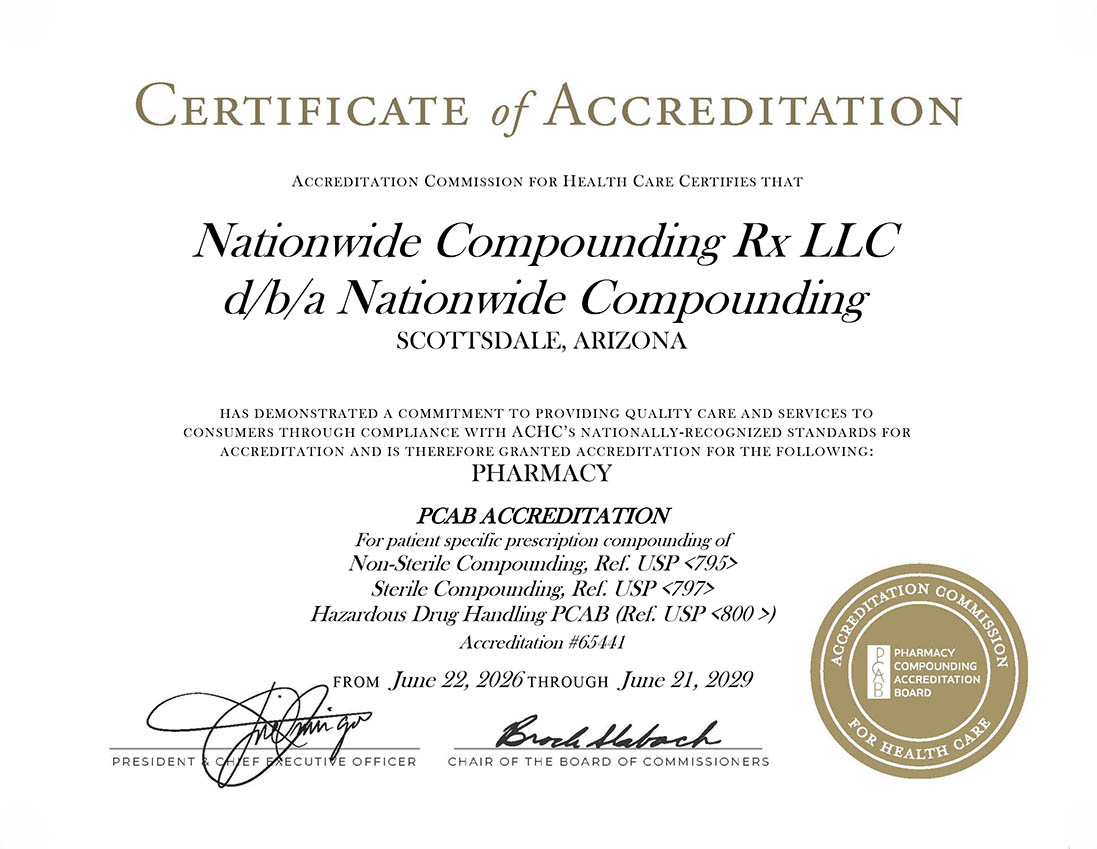
Nationwide Compounding Rx® offers a concrete illustration of what patients and prescribers can look for. The pharmacy is a PCAB-accredited, USP <800>-compliant 503A pharmacy based in Scottsdale, Arizona, with nationwide shipping governed by a tiered state licensing system that distinguishes fully licensed states from those where sterile licensing is pending.
Its provider partnership model is summarized as “Connect, Collaborate, Create, Care,” and its GLP-1 and peptide support is offered within that same provider-collaborative framework. Formulations are tied to prescriber documentation and individual patient needs rather than mass production.
Supporting quality infrastructure includes:
- Independent third-party testing
- High-grade chemicals sourced exclusively from FDA-inspected and cleared vendors
- More than 40 years of combined team experience
- Secure provider and patient portals for prescription submission and refill management
These features map directly onto the criteria outlined in this guide: 503A status, individualized documentation, and verified quality systems.
Conclusion: Where Tirzepatide Compounding Stands as of Late 2026
Compounded tirzepatide is neither broadly legal under outdated shortage-list rules nor categorically banned. As of November 2026, it occupies a narrow, patient-specific 503A pathway.
The key dates:
- December 19, 2024: Shortage declared resolved
- Early 2025: Wind-down deadlines for 503A and 503B compounders
- Now: 503B bulk pathway effectively closed
- April 30, 2026: Proposal pending to make that closure permanent
Legality (the “essentially a copy” and “significant difference” test) and quality (PCAB accreditation, USP standards) are two separate questions. Patients who apply the checklists and red flags in this guide can make informed decisions rather than relying on outdated headlines.
Next Steps: Verifying a Compounded Tirzepatide Prescription
Before proceeding, patients should:
- Ask the prescriber for the documented, patient-specific significant-difference rationale.
- Confirm the pharmacy’s 503A licensing in the patient’s state.
- Verify PCAB accreditation and USP <800> compliance.
Patients and providers considering or currently using compounded tirzepatide can contact Nationwide Compounding Rx® to discuss whether a compliant, individualized formulation is appropriate:
- Phone: (480) 499-8379
- Online: Contact form at nationwidecompounding.com, or the secure Provider and Patient Portals
- Hours: Monday through Friday, 7:00 AM to 3:30 PM
- Response time: Email inquiries typically answered within one business day
Related Posts

Patients searching for a compounding pharmacy in Asheville need clarity on GLP-1 rules in 2026. This guide breaks down North Carolina's regulations on compounded semaglutide and tirzepatide, plus how to verify a legitimate pharmacy before filling a prescription.

Searches for Anasa Personalized Medicine reviews turn up thin directory listings that miss the practice's 2026 closure. This article verifies what's known about the shutdown and offers a due-diligence framework for vetting personalized medicine providers and their compounding pharmacies.

Austin's compounding pharmacy market is crowded with long-standing local names, but proximity and reputation don't guarantee quality or safety. This guide breaks down the regulatory credentials—PCAB accreditation, TSBP licensing, USP compliance, and 503A status—that truly set an Austin compounding pharmacy apart.

Integrity Rx Specialty Pharmacy has a corporate history most patients never see. This article traces its journey from founder Jeffrey Karp to BelHealth Investment Partners and VFP Pharmacy Group's 2026 ownership structure, explaining what the consolidation means for patients filling fertility prescriptions.