
Anasa Personalized Medicine Reviews: The 2026 Closure Update
Introduction: The Search for Anasa Personalized Medicine Reviews Comes Up Empty
Anyone searching for “Anasa Personalized Medicine reviews” in late 2026 runs into the same wall. The results consist mostly of thin directory listings on Healthgrades, the Better Business Bureau (BBB), Facebook, and Nextdoor, none of which offer substantive patient feedback.
These listings also leave out the most important recent development. None of the auto-generated profiles mention Anasa’s 2026 closure or its stated “limited capacity” status. A searcher relying on them would reasonably assume the Providence practice is active and fully staffed, which is no longer the case.
This article has two goals. First, it sets out what can actually be verified about Anasa’s closure, using credible reporting and public records. Second, it addresses the more pressing question that displaced patients and researchers now face: how to vet any personalized or naturopathic medicine provider, along with the compounding pharmacy that fills their prescriptions. Most guidance treats these as separate topics. This article treats clinical credentialing and pharmacy credentialing (PCAB accreditation and USP 800 compliance) as two parts of the same due-diligence process.
What’s Actually Verifiable About Anasa Personalized Medicine
Before looking at the closure, it helps to establish what Anasa was.
Background: Who Anasa Personalized Medicine Was
Anasa Personalized Medicine was founded in 2021 in Providence, Rhode Island, by Dr. Chrysanthi Kazantzis, ND, MS, known to patients as “Dr. Kaz.” Healthgrades describes it as a medical group practice specializing in naturopathy. The practice described its approach as naturopathic medicine “personalized to you with the ultimate goal of achieving optimal health.”
Dr. Kaz’s professional profile includes several leadership roles:
- President of the Rhode Island Association of Naturopathic Physicians (RIANP). In written testimony to the Rhode Island legislature, she identified herself as both RIANP president and owner and founder of Anasa.
- Member of the American Association of Naturopathic Physicians (AANP).
Anasa offered a wide range of services:
- Naturopathic medicine
- Clinical nutrition
- Functional lab testing
- Nutrigenomics
- Reiki
- Craniosacral therapy
- Body composition analysis
- Infrared sauna
The practice says it served more than 6,000 patients over five years of operation.
The 2026 Closure: What Reporting Confirms
The only substantive news coverage of the closure comes from GoLocalProv, which reported that the East Side healthcare office had closed “with little explanation” amid what was described as an “emergency situation.”
According to that reporting, four physicians and three administrative staff members were no longer with the practice. For a boutique clinic, losing that many people at once points to a serious operational disruption.
Anasa’s own statement said the practice was “operating in a limited capacity,” was actively processing patient record requests, and would provide further updates. It gave no confirmed reopening timeline.
The situation is still ambiguous. The available evidence describes a closure or limited-capacity status, not a confirmed permanent shutdown. Patients should therefore check the practice’s current status directly and not rely on static directory snapshots that may be months out of date.
Why Online Reviews for Anasa Are So Thin
Each major directory shows how little review data exists:
- Healthgrades: “No reviews yet.”
- BBB: Lists Anasa as not BBB accredited, with only one employee on file and a file opened on April 22, 2024.
- Facebook: “Not yet rated (1 Review).”
- Nextdoor: One total review, alongside vague, apparently AI-generated neighborhood content with no real local insight.
A small review footprint is common for boutique naturopathic practices. Many patients find these clinics through referrals and word of mouth rather than review platforms, so low review volume does not by itself indicate low quality. It does mean that directory sites cannot support meaningful due diligence.
These platforms are also not designed to track changes in practice status. A closure, a staffing collapse, or a shift to limited operations rarely updates an aggregated profile. That is why outdated impressions linger in search results long after the facts have changed.
The Bigger Problem: Directory Listings Weren’t Built to Answer the Question You’re Actually Asking
Whether or not Anasa reopens, most searchers have practical, forward-looking needs. They want to find a trustworthy personalized medicine provider, and they want their existing prescriptions to continue being filled without interruption.
Directory content cannot help with either need. These platforms collect static business data such as addresses, phone numbers, and specialty labels. They do not assess how deep a provider’s credentials go, how a practice is actually operating, or the quality of the pharmacies that fulfill its prescriptions.
A better approach is a structured vetting framework that works for any provider and does not depend on whether a directory happens to have current information.
How to Vet Any Personalized or Naturopathic Medicine Provider Going Forward
The following framework is meant for displaced Anasa patients and for anyone researching a new personalized or naturopathic medicine provider in 2026.
Step 1: Verify Clinical License Type and Standing
Start by confirming what kind of license the provider holds: MD (Doctor of Medicine), DO (Doctor of Osteopathic Medicine), NP (Nurse Practitioner), or ND (Naturopathic Doctor). Each license carries different legal permissions, and those permissions depend on the state.
Patients should check state licensing board records directly instead of relying on credentials listed on a clinic’s website or marketing materials. Board records confirm whether a license is active and whether any disciplinary actions are on file.
This step matters especially for naturopathic care, because naturopathic licensure and scope of practice vary widely by state. In some states, licensed NDs can diagnose, order labs, and prescribe certain medications. In others, their scope is much narrower, or they are not licensed at all. That difference directly affects what a provider can legally do for a patient.
Step 2: Look for Functional Medicine Training Depth (IFM/IFMCP)
Branding language such as “functional,” “integrative,” or “root-cause” says little about a provider’s training. The IFM Certified Practitioner (IFMCP) credential from the Institute for Functional Medicine is widely regarded as the gold standard for functional medicine training.
Completion of IFM’s AFMCP (Applying Functional Medicine in Clinical Practice) course is a reasonable minimum. Providers without either credential may still be skilled, but patients should ask directly what training supports the provider’s protocols and should not assume credibility from a polished website.
Step 3: Assess Consultation Length and Intake Depth
A genuine root-cause intake in functional or naturopathic medicine typically takes 60 to 90 minutes. If a practice cannot allow that much time, its evaluation will necessarily be limited.
Shorter visits make it hard to assess complex, individualized health histories, which is exactly the kind of work personalized medicine claims to do. Before booking, patients should ask what a first visit includes, for example:
- A comprehensive health history review
- Lab planning and the reasons for each recommended test
- Goal-setting and an outline of next steps
Step 4: Watch for Red Flags
Several warning signs deserve attention:
- One-size-fits-all “programs.” Identical packages sold to every patient conflict with the basic premise of a field built on personalization.
- Vague or evasive answers. A provider should be able to explain clearly why a specific lab test or supplement is being recommended.
- Administrative instability. Staff turnover, unanswered messages, and inconsistent communication are operational signals that review directories rarely show. They matter a great deal for continuity of care, as the Anasa situation demonstrates.
The Overlooked Half of the Equation: Vetting the Pharmacy Behind Your Prescription
Evaluating a provider is only half of the job. Personalized medicine protocols, including bioidentical hormones, custom-strength dosages, and specialized topical compounds, are only as reliable as the pharmacy that prepares them.
Naturopathic clinics like Anasa are not pharmacies. They diagnose and prescribe, but they do not compound or dispense medications. The pharmacy that fills those prescriptions has its own set of credentials, and patients should check them.
What PCAB Accreditation Actually Verifies
PCAB (Pharmacy Compounding Accreditation Board) accreditation is a voluntary program run by the Accreditation Commission for Health Care (ACHC). It audits compounding pharmacies against standards for quality, sterility, and process.
It is also uncommon. Of the more than 7,500 compounding pharmacies operating in the United States, fewer than 68 hold PCAB accreditation. Because it is not mandatory, earning it reflects a deliberate commitment to outside scrutiny.
PCAB also has limits. It is a quality-process credential. It does not determine which drugs a pharmacy compounds, and it does not guarantee that every compounded substance is legally approved or compliant with Section 503A. Patients and prescribers still need to confirm what is being compounded and whether it is appropriate.
USP 800 Compliance: The Safety-Handling Equivalent
USP 800 is the standard for safe handling of hazardous drugs. It applies to both sterile and non-sterile compounding environments, and it covers facility design, personnel protection, and handling protocols.
USP 800 compliance and PCAB accreditation together form a second layer of credentialing. They work much like checking a clinician’s license, except they apply to the pharmacy’s facility and procedures instead of an individual practitioner.
Why This Matters More in 2026: The Regulatory Trend Toward Mandatory Accreditation
Regulators are moving in a clear direction. Washington and Ohio now legally require PCAB accreditation for nonresident compounding pharmacy licensure, and Kentucky began enforcing revised USP standards on January 1, 2026.
Taken together, these changes show accreditation shifting from an optional extra to an expected baseline. In compounding, accreditation is becoming the practical minimum for legitimacy, much as board certification is for clinicians.
Connecting the Dots: Clinic Credentialing and Pharmacy Credentialing Are the Same Due-Diligence Exercise
Patients who check a provider’s license, training, and consultation practices should apply the same scrutiny to the pharmacy. That means confirming PCAB accreditation, USP 800 compliance, ingredient sourcing, and independent testing practices.
A personalized medicine plan is only as trustworthy as its weakest link. A well-credentialed provider working with an unaccredited, opaque pharmacy still leaves the patient exposed to risk. Directory sites and general functional medicine guides tend to address only the clinical side, even though both checks are necessary.
What Displaced Anasa Patients Should Do Now
Former Anasa patients can take the following steps.
Request and Secure Patient Records
Anasa has said it is actively processing patient record requests while it operates in a limited capacity. Given the uncertainty about the practice’s long-term status, patients should request their complete records promptly, including:
- Lab results and functional testing panels
- Treatment history and clinical notes
- Current prescriptions and supplement protocols
Personal copies of these records are especially important in functional medicine. Plans are highly individualized and difficult to reconstruct without documentation.
Find a New Provider Using the Vetting Framework Above
When evaluating replacement providers, patients should work through the four checks above: license type and standing, depth of training, consultation length, and red flags. They should also favor providers who can clearly explain their compounding pharmacy relationships in addition to their clinical protocols.
Keep Existing Personalized Prescriptions Filled Without Interruption
Patients do not necessarily have to pause bioidentical hormone, pain management, or other compounded protocols because their prescribing clinic is in transition. An accredited pharmacy can often continue filling valid existing prescriptions while the patient establishes care with a new provider. A nationwide-licensed, PCAB-accredited pharmacy is particularly useful when the original provider cannot be reached or when the patient is moving to a new provider in another location.
Why Nationwide Compounding Rx® Is Built for This Exact Transition
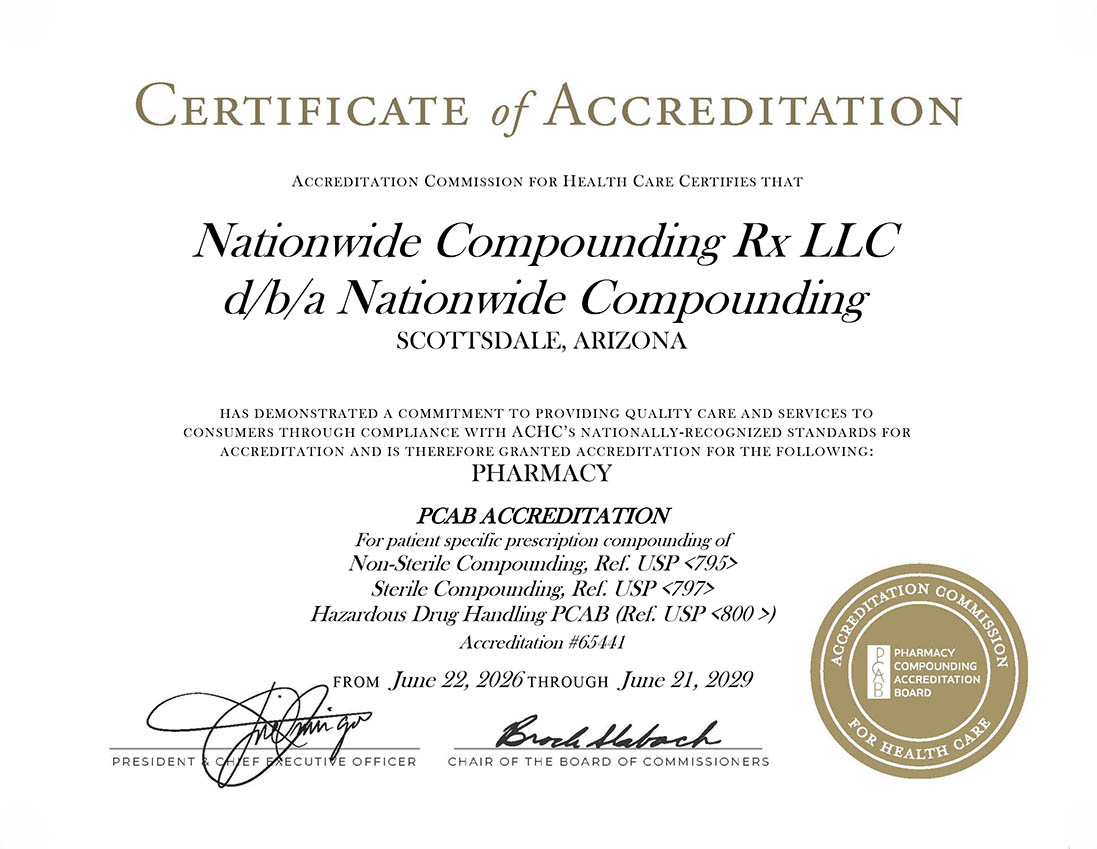
Nationwide Compounding Rx®, based in Scottsdale, Arizona, is a PCAB-accredited and USP 800-compliant compounding pharmacy. It meets the pharmacy-side credentialing standards outlined in this article.
Its relevant service features include:
- Nationwide shipping across licensed states, using a three-tier state licensing system (fully licensed, non-sterile only, and pending or unlicensed)
- 1 to 2 business day turnaround, with same-day pickup available for some medications
- Independent third-party testing to verify quality and consistency
- High-grade chemicals sourced from FDA-inspected and cleared vendors
- More than 40 years of combined team experience in compounding
Several of its specialties match the needs typical of naturopathic and functional medicine patients. Its bioidentical hormone replacement therapy (BHRT) formulas can be adjusted at each refill based on updated lab results. Its pain management topicals are designed to localize treatment and reduce systemic side effects. It also offers allergen-free and custom dosage forms, free of dyes, fillers, and preservatives, in capsules, troches, sublingual tablets, and other formats.
The pharmacy runs two secure portals. The Provider Portal lets new prescribers submit, manage, and track prescriptions. The Patient Portal lets patients access account information and manage refill requests. For patients moving between clinics, these portals offer a structured way to keep care organized.
The pharmacy describes its approach as “Connect, Collaborate, Create, Care,” a provider-partnership model that works directly with prescribers and healthcare teams. That model suits patients rebuilding their care around a new provider.
Conclusion: Verify First, Then Move Forward
This update reaches two main findings. First, Anasa Personalized Medicine’s 2026 closure and limited-capacity status are real but thinly documented, supported mainly by local news reporting and the practice’s own brief statement. Second, the directory sites that dominate search results do not reflect that change, so searchers get an outdated picture.
The way forward is the same whatever happens with Anasa. Patients should vet any new provider on license type, training depth, consultation length, and red flags, and then apply the same scrutiny to the compounding pharmacy by checking PCAB accreditation and USP 800 compliance. Thin online reviews will remain common for boutique practices. Accreditation-based vetting on both the clinical and pharmacy side gives patients a more reliable basis for decisions than review counts.
Keep a Personalized Medicine Plan on Track
Patients navigating a provider transition can contact Nationwide Compounding Rx® to continue filling existing personalized prescriptions without unnecessary interruption.
- Phone: (480) 499-8379
- Website: nationwidecompounding.com
- Portals: Secure Provider Portal and Patient Portal access through the website
- Hours: Monday through Friday, 7:00 AM to 3:30 PM (Arizona time)
- Address: 14000 N. Hayden Rd., Suite 104, Scottsdale, AZ 85260
Both patients and new prescribers are encouraged to contact the pharmacy team and confirm its PCAB accreditation and USP 800 compliance directly, applying to the pharmacy the same verification steps they would use for any provider.
Related Posts

Patients searching for a compounding pharmacy in Asheville need clarity on GLP-1 rules in 2026. This guide breaks down North Carolina's regulations on compounded semaglutide and tirzepatide, plus how to verify a legitimate pharmacy before filling a prescription.

Compounded tirzepatide remains legal in 2026, but only under strict new rules. This guide breaks down the current regulatory status of tirzepatide compounding pharmacy practices, explains the legal tests pharmacies must meet, and gives patients a clear framework for evaluating safety and compliance.

Austin's compounding pharmacy market is crowded with long-standing local names, but proximity and reputation don't guarantee quality or safety. This guide breaks down the regulatory credentials—PCAB accreditation, TSBP licensing, USP compliance, and 503A status—that truly set an Austin compounding pharmacy apart.

Integrity Rx Specialty Pharmacy has a corporate history most patients never see. This article traces its journey from founder Jeffrey Karp to BelHealth Investment Partners and VFP Pharmacy Group's 2026 ownership structure, explaining what the consolidation means for patients filling fertility prescriptions.