
Bioidentical Hormone Replacement Therapy in Delaware: 2026 Guide
Introduction: The BHRT Question Delaware Patients Aren’t Being Asked
Hormone therapy is no longer a niche topic. According to figures reported by the North American Menopause Society (NAMS), nearly 2 million women enter menopause in the United States each year, and roughly 40% of menopause patients are using bioidentical hormones. For many Delaware residents, the decision to explore hormone therapy is now a mainstream healthcare choice.
Yet the way that choice is presented locally is often misleading. Many Delaware med-spas, BioTE franchise locations, and telehealth brands such as Winona frame the decision as “bioidentical vs. synthetic.” That framing is outdated, and in many cases it is a false comparison.
The decision that actually matters is FDA-approved bioidentical hormones vs. compounded bioidentical hormones. This is a regulatory distinction, not a chemistry distinction. It determines whether a product has been reviewed for safety, effectiveness, and quality before it reaches the patient.
This guide covers the science behind BHRT, the February 2026 FDA boxed-warning update, guidance from NAMS, ACOG, and the National Academies, Delaware’s compounding laws, and how to verify that a pharmacy is legally permitted to ship into the state. Understanding BHRT in Delaware means looking at both the hormone itself and the regulatory pathway behind it.
What Is Bioidentical Hormone Replacement Therapy, Really?
Bioidentical hormone replacement therapy (BHRT) is the use of hormones that are molecularly identical to the hormones the body produces naturally (endogenous hormones). In clinical practice, the term most commonly refers to 17β-estradiol, the primary estrogen produced by the ovaries before menopause.
There is, however, no single universal definition. The term is used inconsistently to describe:
- FDA-approved estradiol and progesterone products
- Plant-derived estrogen preparations
- Compounded blends that combine multiple hormones in one preparation
The most important point is this: “bioidentical” describes molecular structure. It does not describe regulatory status or safety. A hormone can be bioidentical and FDA-approved, or bioidentical and compounded without any FDA review.
Why “Bioidentical vs. Synthetic” Is the Wrong Question
Much of the BHRT marketing seen by Delaware residents relies on statements such as “we solely prescribe bioidentical, never synthetic.” This language implies that bioidentical hormones are inherently safer or more effective. That claim is not supported by the evidence.
Many FDA-approved hormone products are themselves bioidentical. Estradiol patches, gels, and pills, along with micronized progesterone capsules, are FDA-approved and molecularly identical to human hormones. Presenting “bioidentical” and “FDA-approved” as opposites creates a false dichotomy that serves marketing more than patients.
The factor that actually affects safety and oversight is the regulatory pathway a product followed, not whether its molecules came from a plant or a laboratory.
The Real Decision: FDA-Approved vs. Compounded Bioidentical Hormones
Bioidentical hormones fall into two distinct regulatory categories. Patients benefit from understanding both before choosing a provider or pharmacy.
FDA-Approved Bioidentical Hormones
FDA-approved bioidentical hormones are available in standardized doses as pills, capsules, patches, gels, and creams. These products have undergone FDA review for safety, effectiveness, and manufacturing quality, and they carry standardized labeling that outlines known risks.
The American College of Obstetricians and Gynecologists (ACOG) recommends FDA-approved products as the first-line option for most patients considering menopausal hormone therapy.
Compounded Bioidentical Hormones
Compounded bioidentical hormones are custom-mixed by a pharmacy for an individual prescription. They are not FDA-approved, and the lack of FDA oversight for compounded hormones generates additional risks regarding purity and safety.
The FDA states plainly that it does not have evidence that compounded “bioidentical hormones” are safe and effective, or that they are safer or more effective than FDA-approved hormone therapy.
That does not mean compounding has no role. According to ACOG, legitimate reasons for compounded hormone therapy include:
- An allergy to an ingredient in an FDA-approved product (such as a dye, filler, or adhesive)
- A dose, strength, or combination that is not commercially available
- Inability to tolerate an available FDA-approved formulation
The February 2026 FDA Boxed-Warning Update: What Changed and What Didn’t
On February 12, 2026, the FDA confirmed that risk statements related to cardiovascular disease, breast cancer, and probable dementia were removed from the boxed warning on FDA-approved hormone therapy products. The boxed warning is the agency’s most prominent safety-related warning, so this represents a major shift in how hormone therapy risk is communicated to patients and providers.
What the Label Change Means for FDA-Approved Products
FDA-approved hormone products, including FDA-approved bioidentical estradiol and progesterone, now carry updated risk language that reflects a more current review of the evidence. For years, the previous boxed warning discouraged many patients and clinicians from considering hormone therapy at all.
This update may increase provider and patient comfort with FDA-approved options going forward. Patients who previously avoided hormone therapy because of alarming label language may want to revisit the conversation with their clinician.
Why Compounded Hormones Weren’t Included
The boxed-warning change does not apply to compounded hormone preparations. Compounded products have never gone through FDA approval, so there is no FDA label to amend.
This gap illustrates exactly why regulatory status, not molecular identity, is the deciding factor Delaware patients need to understand. Two products containing the same estradiol molecule can carry entirely different levels of oversight, evidence, and labeling.
What Medical Societies Say: NAMS, ACOG, and the National Academies
Independent, non-commercial medical guidance is largely absent from local BHRT marketing. The positions below represent the clinical consensus.
NAMS (The Menopause Society) Position
In its 2022 hormone therapy position statement, NAMS identifies several safety concerns with compounded bioidentical hormone therapy:
- Minimal government regulation and monitoring
- Risk of overdosing or underdosing
- Possible impurities or lack of sterility
- Lack of scientific efficacy and safety data
- Absence of a standardized label outlining risks
The Menopause Society’s patient education materials state directly that custom-compounded hormones are not safer or more effective than approved bioidentical hormones and are not tested for safety and effectiveness.
ACOG Clinical Consensus
ACOG’s 2023 clinical consensus on compounded bioidentical menopausal hormone therapy recommends FDA-approved hormone therapy over compounded preparations for most patients. ACOG reserves compounding for narrow exceptions, such as a documented ingredient allergy or the need for a dose or formulation that is not commercially available.
The 2020 National Academies Findings
A 2020 report from the National Academies of Sciences, Engineering, and Medicine was commissioned by the FDA itself. It concluded that the evidence does not support the clinical utility of compounded bioidentical hormones for most patients.
The report recommended limiting compounded bioidentical hormone use to patients who cannot use an FDA-approved product for a documented medical reason.
Why This Matters for Delaware Residents Specifically
National guidance carries particular weight in a state with Delaware’s demographic profile.
Delaware’s Aging Population and Rising BHRT Demand
Delaware’s population skews older than the national average. The state’s median age is 41.1, compared with 38.8 nationwide, and Census data shows residents aged 65 and over make up 22.8% of the population.
KFF data on Delaware women ages 19 to 64 shows that 43% are between 35 and 54, and another 25% are between 55 and 64. A large share of Delaware women therefore falls within the perimenopausal and menopausal window when hormone therapy questions typically arise. Many Delaware men are also in the age range associated with andropause.
With this many residents in the BHRT candidate window, accurate, Delaware-specific education is a public health priority rather than simply a marketing opportunity.
How Local Med-Spas and Telehealth Brands Frame BHRT (and What They Leave Out)
A review of regional BHRT marketing reveals consistent gaps:
- Newark-area BioTE franchise pages focus on symptom relief (brain fog, low mood, sleeplessness, irritability) and pellet therapy booking, with little or no FDA, NAMS, or ACOG context.
- Telehealth brands like Winona promote a “bioidentical-only, never synthetic” promise that omits the FDA-approved vs. compounded distinction entirely.
- Regional clinics frequently use “natural” or “plant-derived” language, suggesting the body “recognizes” these hormones more easily. Plant-derived does not mean FDA-reviewed, and “natural” does not mean inherently safer.
This guide aims to close that gap with the regulatory nuance Delaware patients need to make informed decisions.
Delaware’s Compounding Pharmacy Regulations: What Changed
Delaware’s legal framework for compounding is the backbone of patient safety in the state, yet it is rarely discussed in consumer-facing content.
The Nonresident Pharmacy Permit Requirement
Under Delaware Code Title 24 § 2537, any pharmacy located outside Delaware must hold a Delaware Non-Resident Pharmacy permit to ship, mail, or deliver, in any manner, any controlled substance into the state.
The statute also requires the nonresident pharmacy to maintain, at all times, a valid license, permit, or registration that complies with the laws of the state where it is physically located.
The Delaware Division of Professional Regulation administers these permits through its DELPROS portal, which serves as the official verification channel.
Delaware’s New Compounding Law and Penalties
Delaware recently tightened its rules by formally defining “compounding” and “outsourcing facility” in state law. These definitions create clearer guardrails for both practice and enforcement.
Under the updated framework, non-resident pharmacies and outsourcing facilities that ship into Delaware without proper licensing face penalties of up to $10,000 per day. For consumers, this is a strong signal: unlicensed online or out-of-state compounding sources carry real legal and safety risks.
USP 795/797/800 Standards in Delaware Code
Delaware Administrative Code Title 24, 2500 (Board of Pharmacy) requires that compounded nonsterile or sterile preparations comply with USP 795 or USP 797, or any updated versions, as applicable, along with applicable federal law. These standards govern:
- USP 795: Nonsterile compounding, such as creams, capsules, and troches
- USP 797: Sterile compounding, such as injectable preparations
- USP 800: Safe handling of hazardous drugs, protecting both patients and pharmacy personnel
How to Verify a Compounding Pharmacy Is Licensed to Ship to Delaware
The following checklist gives Delaware patients a practical way to evaluate any compounding pharmacy.
Step 1: Check for a Delaware Non-Resident Pharmacy Permit
Patients can ask any out-of-state pharmacy directly for its Delaware non-resident permit number, or verify licensure through the Delaware Board of Pharmacy’s DELPROS lookup.
A pharmacy shipping into Delaware without the required permit is operating illegally in the state, regardless of its home-state licensing.
Step 2: Confirm PCAB Accreditation
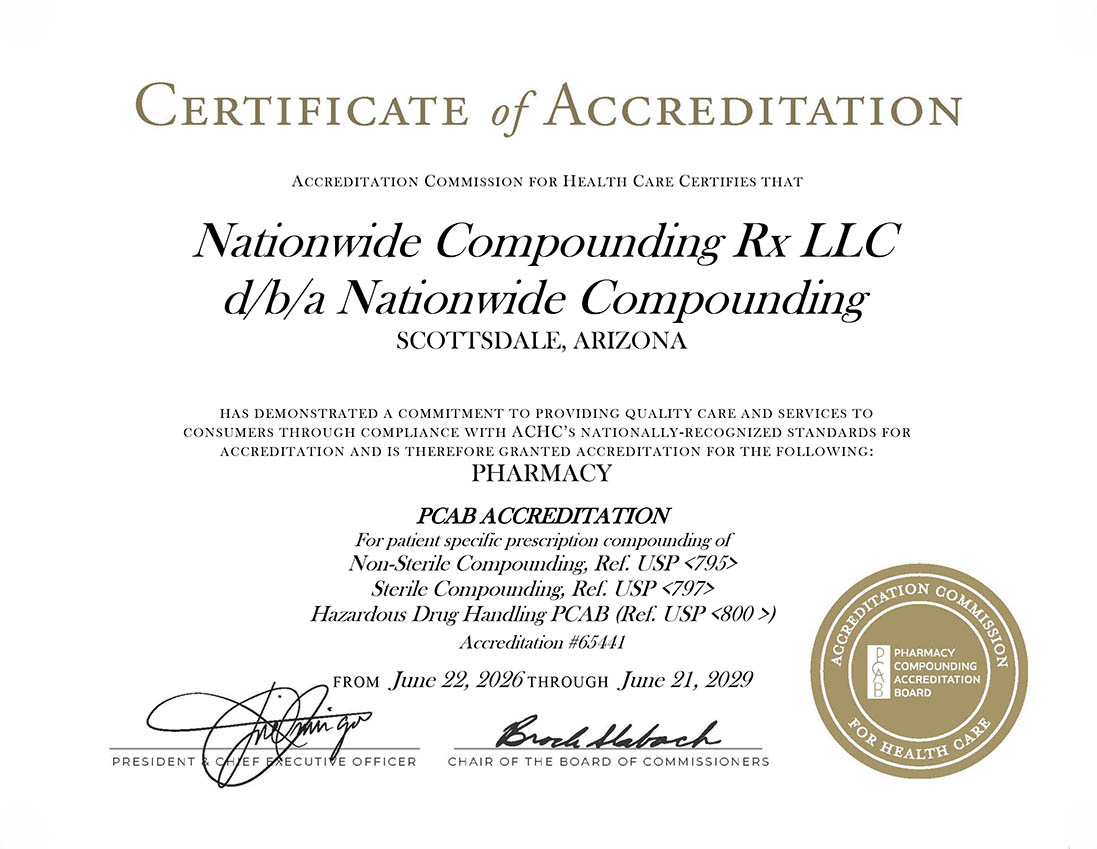
The Pharmacy Compounding Accreditation Board (PCAB) was founded by a coalition of eight national pharmacy organizations and has been administered as a service of ACHC since 2007. PCAB accreditation requires demonstrated, independently verified adherence to USP 795, 797, and 800 requirements.
Fewer than 1% of U.S. pharmacies hold PCAB accreditation, which makes it a meaningful trust marker rather than a decorative badge.
Step 3: Confirm USP 800 Compliance
USP 800 governs the safe handling of hazardous drugs, a category that includes certain hormones used in compounding. Patients can ask pharmacies directly whether they are USP 800 compliant and whether that compliance is independently verified.
Red Flags That Signal an Unverified or Non-Compliant Pharmacy
Patients should be cautious if a pharmacy shows any of the following:
- No visible licensing information
- Inability or unwillingness to confirm Delaware non-resident permit status
- No disclosed PCAB accreditation
- Vague claims about ingredient sourcing
- Refusal to share testing or quality-control information
Delaware does have local compounding infrastructure, including single-location pharmacies such as Atlantic Apothecary in Middletown and SaveWay in Newark. Regardless of a pharmacy’s size or location, patients should still verify credentials before filling a compounded prescription.
Nationwide Compounding Rx: A Verified, Accessible BHRT Option for Delaware
For patients whose providers determine that compounded BHRT is clinically appropriate, Nationwide Compounding Rx® aligns with the verification criteria outlined above.
PCAB Accreditation and USP 800 Compliance
Nationwide Compounding Rx is PCAB accredited and USP 800 compliant, placing it among the small fraction of U.S. compounding pharmacies that meet this independently verified standard. The pharmacy sources high-grade chemicals exclusively from FDA-inspected and cleared vendors and uses independent third-party testing to verify quality and consistency.
Personalized, Adjustable BHRT Formulations
The pharmacy’s BHRT formulations are customized for menopause, andropause, and other hormonal imbalances, and they can be adjusted at each refill based on updated lab results ordered by the patient’s provider. Dosage forms relevant to hormone therapy include:
- Capsules
- Topical creams and gels
- Troches and lozenges
- Sublingual tablets
Formulations can also be prepared free of dyes, fillers, preservatives, and common allergens, which directly supports the allergy-based use case recognized by ACOG.
Nationwide Shipping With Delaware-Specific Licensing
Nationwide Compounding Rx serves patients and providers across multiple states through a tiered licensing system, with availability depending on medication type and state regulations. Delaware patients and providers should confirm current Delaware licensing status directly with the pharmacy before starting treatment.
This model complements, rather than replaces, a patient’s local care. Prescriptions come from the patient’s own Delaware provider and are filled through the pharmacy’s secure Provider and Patient Portals, with a typical turnaround of 1 to 2 business days.
Is BHRT Right for Delaware Patients? Questions to Ask a Provider
Before starting any form of BHRT, patients can bring these questions to their clinician:
- Could an FDA-approved bioidentical product meet my needs? This should be the starting point for most patients.
- If compounded therapy is recommended, what is the documented clinical reason? Examples include an allergy, an unavailable dose, or intolerance of approved products.
- Is the compounding pharmacy licensed and accredited? Patients should confirm Delaware non-resident licensing, PCAB accreditation, and USP compliance before filling a prescription.
- How does the February 2026 boxed-warning update affect my options? Updated labeling on FDA-approved products may change the risk-benefit conversation.
Conclusion
The meaningful choice for Delaware patients is not bioidentical vs. synthetic. It is FDA-approved vs. compounded bioidentical hormones.
The February 2026 FDA label update, guidance from NAMS and ACOG, and the 2020 National Academies report all point in the same direction: FDA-approved products are the first-line option, and compounding should be reserved for specific, documented clinical needs.
Delaware’s tightened compounding laws, including formal definitions and penalties of up to $10,000 per day for unlicensed shippers, make verifying a pharmacy’s licensure and accreditation non-negotiable. Informed patients who verify credentials can access compounded BHRT responsibly when it is genuinely appropriate for their situation.
Take the Next Step With a Verified Compounding Partner
Delaware patients and their healthcare providers can contact Nationwide Compounding Rx® to confirm Delaware licensing status, PCAB accreditation, and USP 800 compliance before starting compounded BHRT.
- Providers can use the secure Provider Portal to submit prescriptions, track orders, and collaborate with the pharmacy team through its Connect, Collaborate, Create, Care framework.
- Patients can use the Patient Portal to manage refills and ask questions about personalized, lab-adjusted BHRT formulations.
Contact Nationwide Compounding Rx:
- Phone: (480) 499-8379
- Website: nationwidecompounding.com
- Hours: Monday to Friday, 7:00 AM to 3:30 PM
Related Posts

Confused by conflicting listings for the CVS Specialty Pharmacy phone number? This guide provides a complete, verified 2026 directory of every official line, organized by department. It also explains what to do when calls lead to long holds or unresolved issues.

Choosing a compounding pharmacy in Houston means navigating new 2026 state regulations, GLP-1 restrictions, and ongoing litigation involving local providers. This guide answers the 7 questions Houston patients ask most, helping them verify safety and licensing before they fill a prescription.

Before trusting Greens Compounding Pharmacy with a prescription, learn the key safety and accreditation checks every patient should make in 2026. This guide offers a repeatable verification checklist that goes beyond directory listings like Yelp or Healthgrades. It works for any compounding pharmacy, local or nationwide.

Searching for Avera Specialty Pharmacy's phone number or fax line? This guide offers verified 2026 contact details and explains what happens when insurance mandates or drug restrictions route a prescription elsewhere. Learn your options when the network says no.