
Compound Medication Meaning: The 2026 Definition & Safety Guide
Introduction: Why “Compound Medication” Means More Than a Dictionary Definition
A compounded medication works much like a cake made from a recipe rather than bought off a shelf. Instead of dispensing a mass-produced pill, a pharmacist combines one or more active ingredients, each at a specified amount, to create a medication designed for one specific person. The result might be easier to take, free of a problematic ingredient, or prepared at a dose no manufacturer sells.
Most explainers stop at that dictionary-level definition. This guide goes further by examining the split between the FDA’s narrow legal definition of compounding and the United States Pharmacopeia’s (USP) broader clinical definition, and by showing how that split shapes the entire regulatory system patients encounter today.
The guide covers the definition split, the legality of copying commercial drugs, the difference between 503A and 503B pharmacies, the 2012 NECC outbreak that created modern oversight, and a current 2026 look at compounded GLP-1 medications.
Compounding is not a fringe practice. The U.S. compounding pharmacy market is valued at roughly $6.82 billion in 2026, according to Precedence Research, and an estimated 30 to 40 million compounded prescriptions are filled each year. It is a regulated niche that most patients will encounter at some point.
The Basic Definition: What “Compound Medication” Means
In plain language, compounding is the practice of combining, mixing, or altering drug ingredients to create a medication tailored to an individual patient’s needs.
Not just anyone may do this. According to the FDA’s Office of Compounding Quality and Compliance, compounding is performed by:
- Licensed pharmacists
- Licensed physicians
- Individuals working under the supervision of a licensed pharmacist (such as trained technicians)
Patients typically encounter compounded medications for practical reasons, including:
- Ingredient allergies: Removing dyes, gluten, lactose, or other inactive ingredients that trigger reactions
- Swallowing difficulties: Converting tablets or capsules into liquids, suspensions, or topical forms
- Non-standard dosing: Preparing exact strengths not commercially available, especially for children
- Palatability: Adding flavoring so a medication is easier to take
- Shortages or discontinuations: Recreating a prescribed medication that is unavailable
- Combination formulas: Blending ingredients into a single preparation not sold commercially
This definition is accurate, but it is incomplete. It hides a legal distinction that determines whether a given act of compounding is actually permitted.
The Critical Split: FDA’s Legal Definition vs. USP’s Clinical Definition
There is no single definition of compounding; there are two, and they serve different purposes. One supports legal enforcement, and the other sets clinical practice standards. Most consumer content treats “compounding” as a single concept, which obscures how the system actually works.
FDA’s Narrow, Legal Definition
The FDA defines compounding as combining, mixing, or altering ingredients to create a medication tailored to an individual patient, but the agency applies this label only when a pharmacist deviates from a drug’s approved labeling.
For example, if a pharmacist reconstitutes a powdered antibiotic strictly according to the package instructions, the FDA does not consider that compounding; it is simply “preparation.” If the pharmacist changes the concentration, adds flavoring beyond the label’s directions, or alters the formula in any way, the FDA considers the activity compounding.
This distinction matters because the FDA’s compounding guidance documents, along with the exemptions and restrictions attached to them, apply only once this narrow legal threshold is crossed.
USP’s Broader, Clinical Definition
The USP defines compounding more broadly. Its definition covers a wider range of pharmacy preparation activities, including some the FDA would classify as routine preparation. Under USP’s definition, preparing a medication according to package instructions can still count as compounding.
USP’s definition drives day-to-day pharmacy standards, including facility design, personnel training, equipment, and quality assurance. These standards apply regardless of whether the FDA’s legal label is triggered. As a result, a pharmacist can be “compounding” in the clinical sense without ever entering the FDA’s compounding-specific legal framework.
Why the Split Actually Matters to Patients
Whether an activity counts as compounding under the FDA’s definition determines which laws, exemptions, and oversight rules apply to the medication a patient receives.
Separately, USP’s enforceable quality chapters govern how safely a pharmacy prepares that medication:
- USP <795>: Minimum standards for non-sterile compounding (most oral and topical medications)
- USP <797>: Minimum standards for sterile compounding (such as injectables)
- USP <800>: Handling of hazardous drugs, including many hormones and certain dermatology ingredients, to protect staff and patients from unintended exposure
The bottom line is that a medication can be well made under USP clinical standards and still be legally restricted under FDA rules, or the reverse. Evaluating safety and legality requires understanding both lenses.
The Legal Line: When Compounding Is (and Isn’t) Allowed
A common misconception holds that any pharmacy can compound any drug for any reason. That is not the case.
As a general rule, compounding is appropriate when a patient cannot be treated with an FDA-approved drug, or when an FDA-approved medicine is unavailable during a documented shortage. Clinical literature published through the National Institutes of Health echoes this point: compounded medications should be prescribed only when an approved medication cannot be used and the benefits outweigh the risks.
The key restriction is the “essentially a copy” prohibition. It is generally illegal to compound a copy of a commercially available FDA-approved drug unless the patient has a documented clinical need for a difference (such as removing an allergen) or there is an active shortage.
The FDA also looks at patterns. Under its 503A guidance, the agency evaluates whether a pharmacy compounded a drug “regularly or in inordinate amounts” relative to the valid, patient-specific prescriptions it received. A pattern like that suggests unauthorized mass production rather than individualized care.
Compounded vs. Generic vs. Brand-Name Drugs: Why They’re Not the Same Category
Many people assume compounded drugs are simply unbranded generics. They are a legally distinct category, a point Cedars-Sinai emphasizes in its patient education.
- Brand-name drugs are developed by manufacturers and approved by the FDA after clinical trials.
- Generic drugs are FDA-approved versions of brand-name drugs. They pass formal FDA review and meet strict standards for safety, efficacy, and purity.
- Compounded drugs are made from FDA-approved ingredients, but the finished products are not FDA-approved. They are not reviewed by the FDA for safety, efficacy, or manufacturing quality before reaching a patient.
This gap exists by design. Compounded drugs qualify for exemptions from certain provisions of the Federal Food, Drug, and Cosmetic Act precisely because they are intended to meet individual patient needs, not to be distributed commercially at scale.
The Regulatory Framework: 503A vs. 503B Compounding Pharmacies
Federal law created two legal pathways to govern compounding differently depending on scale and purpose. This framework is the practical consequence of the definitional split described above.
503A: Patient-Specific Compounding
A 503A pharmacy compounds only in response to a valid prescription for an identified individual patient. These pharmacies follow USP compounding standards and are regulated primarily by state boards of pharmacy.
503A is the dominant model. According to Precedence Research, the 503A segment accounted for more than 72.99% of U.S. compounding revenue in 2025, reflecting its role as the standard pathway for individualized prescriptions.
503B: Outsourcing Facilities and Batch Production
503B outsourcing facilities compound in larger batches, often without a patient-specific prescription in hand, to supply hospitals, clinics, and providers. Because the scale and risk are greater, the requirements are stricter:
- cGMP compliance: 503B facilities must follow Current Good Manufacturing Practices, the same framework used in pharmaceutical manufacturing.
- Direct FDA oversight: They are regulated by the FDA rather than primarily by states.
- Stability studies: They must complete full stability studies on their products, a requirement 503A pharmacies do not have.
- Drug eligibility: A 503B facility may only compound a drug that is not essentially a copy of one or more FDA-approved drugs, subject to shortage exceptions.
How We Got Here: The NECC Outbreak That Rewrote Compounding Law
Consumer content rarely mentions the safety history behind today’s rules, yet that history is the direct origin of the 503A/503B system. Understanding the worst-case failure is what makes current oversight make sense.
What Happened in 2012
The New England Compounding Center (NECC) distributed contaminated preservative-free methylprednisolone acetate (MPA) injections. According to the U.S. Department of Justice, 753 patients across 20 states were diagnosed with fungal infections, and the CDC reported 64 deaths across nine states. It was the largest public health crisis ever caused by a pharmaceutical product.
The root cause was a breakdown of the patient-specific model. NECC distributed large batches of medication without first receiving a prescription for each individual patient, violating the terms of its pharmacy license.
This Wasn’t an Isolated Incident
Research published in PubMed Central found that between 2000 and the 2012 outbreak, 11 separate infectious outbreaks from contaminated compounded drugs had already been reported. They involved 207 patients and 17 deaths, an 8.2% case-fatality rate. Oversight gaps were a recognized, recurring risk well before NECC reached national headlines.
The Legal Response: The Drug Quality and Security Act of 2013
The NECC outbreak led Congress to pass the Drug Quality and Security Act (DQSA) of 2013. The law created the modern framework that separates small-scale, patient-specific compounding (503A) from large-scale, cGMP-regulated outsourcing facilities (503B). Its explicit aim was to prevent a repeat of NECC’s unauthorized batch distribution.
Today’s two-tier system is not arbitrary bureaucracy; it is a traceable response to a real patient-safety failure.
Compounded GLP-1s in 2026: A Live Case Study in How These Rules Actually Work
GLP-1 medications offer the clearest current example of the framework in action. Much online content on this topic is outdated; the information below reflects the status as of late 2026.
How the Shortage Pathway Closed
As Stanford Medicine has reported, tirzepatide came off the FDA’s official drug shortage list in December 2024, and semaglutide followed in February 2025. That ended the shortage-based legal pathway that had allowed pharmacies to produce copies of these drugs.
With the shortages resolved, the “essentially a copy” rule applies in full. Compounding pharmacies no longer have a legal basis for producing identical copies of these GLP-1 medications.
The 2026 Crackdown: Proposed Permanent Bulk List Exclusion
On April 30, 2026, the FDA proposed permanently excluding semaglutide, tirzepatide, and liraglutide from the 503B Bulks List, the list of ingredients outsourcing facilities are permitted to use. If finalized, the change would close the last remaining legal pathway for most compounded GLP-1 products.
The safety stakes are significant. As of May 31, 2026, the FDA had logged 990 adverse event reports tied to compounded semaglutide and more than 730 tied to compounded tirzepatide.
FDA Is Also Policing “Fake Personalization”
In a September 18, 2026 warning letter, the FDA told Texas-based Empower Pharmacy that adding niacinamide to tirzepatide or vitamin B12 to semaglutide did not create a clinically distinct formulation. The agency determined these products were still “essentially copies” of the approved drugs.
The practical takeaway: a GLP-1 product labeled “personalized” or “custom” is not automatically legal or exempt from FDA scrutiny.
How to Evaluate Whether a Compounded Medication Is Safe and Legitimate
The regulatory and historical context translates into a practical checklist:
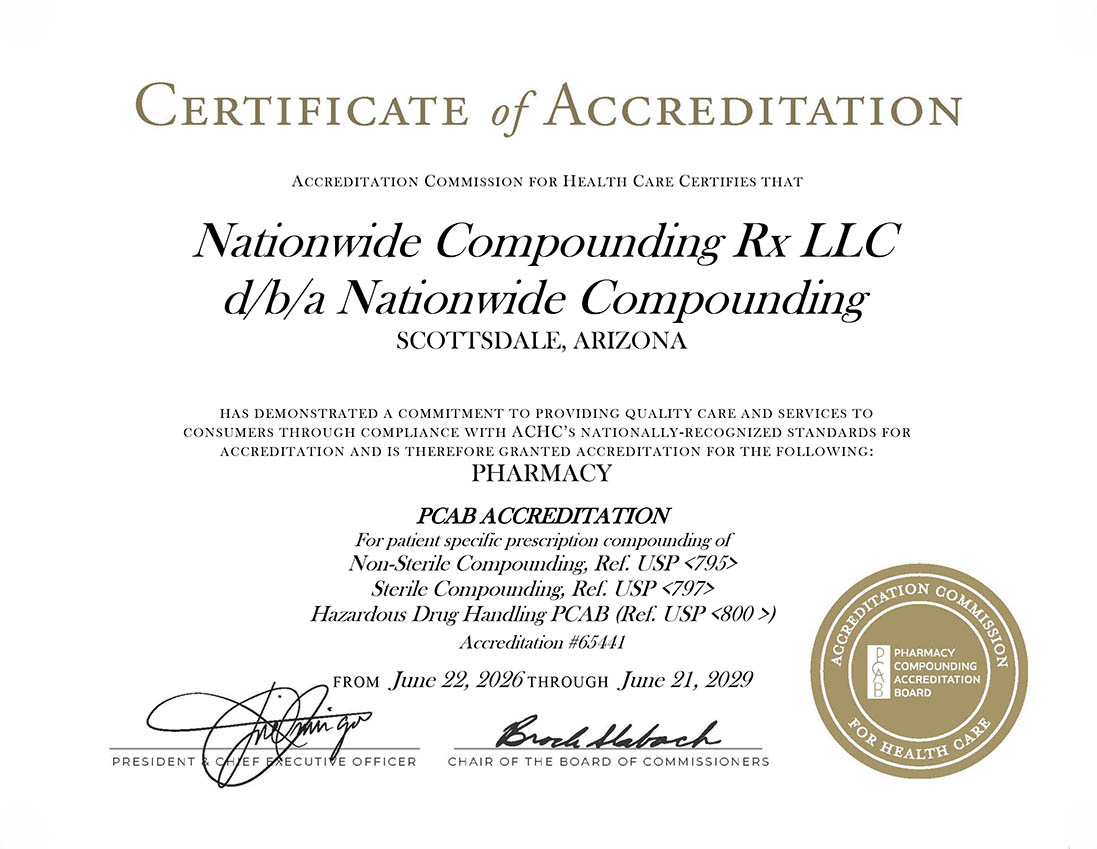
- Look for PCAB accreditation. Accreditation from the Pharmacy Compounding Accreditation Board signals that a pharmacy has been independently vetted against quality standards.
- Confirm USP <800> compliance. This is essential for pharmacies handling hazardous drugs, including many hormones and dermatology ingredients.
- Ask about ingredient sourcing and testing. Ingredients should come from FDA-inspected and cleared vendors, and independent third-party testing should verify potency and purity.
- Verify a patient-specific prescription. In the 503A context, each medication should be compounded against a valid prescription for an identified patient. Mass distribution without individualized orders was the exact failure point behind NECC.
- Check cGMP and stability data for 503B products. Outsourced products should come from facilities that meet cGMP standards and have completed stability studies.
- Confirm insurance coverage in advance. Coverage for compounded medications is inconsistent and often depends on documented medical necessity, such as an ingredient allergy or inability to swallow standard forms.
Conclusion: A More Precise Way to Think About Compounding in 2026
“Compound medication” is not one fixed definition. It is a legal and clinical split between the FDA and USP that determines which rules, protections, and oversight apply to a given medication.
Today’s 503A/503B framework, USP safety standards, and current GLP-1 restrictions all trace back to real events: the NECC outbreak of 2012 and active FDA enforcement in 2026.
Compounding remains a legitimate, valuable, and heavily regulated part of modern healthcare. It is appropriate for documented allergies, swallowing difficulties, pediatric dosing, and genuine shortages when provided through properly licensed, accredited pharmacies. Rather than asking whether compounding is simply “safe” or “unsafe,” patients and providers are better served by asking specific questions about licensing, accreditation, and prescription basis.
Work With a Compounding Pharmacy Built on Accreditation and Collaboration
Nationwide Compounding Rx® operates within the standards described throughout this guide. The Scottsdale, Arizona pharmacy is PCAB accredited, USP 800 compliant, sources high-grade chemicals from FDA-inspected and cleared vendors, and uses independent third-party testing to verify quality and consistency.
Its provider partnership model, Connect, Collaborate, Create, Care, reflects the patient-specific approach at the heart of 503A compounding: medications built around individualized, valid prescriptions rather than mass batch production. The team brings more than 40 years of combined experience and offers a 1 to 2 business day turnaround, with same-day pickup available for some medications and nationwide shipping where state licensing allows.
Service areas include:
- Bioidentical Hormone Replacement Therapy (BHRT), with formulas adjustable at each refill based on lab results
- Pain management topicals designed to localize treatment
- Dermatology formulations
- Pediatric medications in kid-friendly forms and flavors
- Sports medicine formulations
- GLP-1 and peptide support
Healthcare providers can use the secure Provider Portal to submit and manage prescriptions, while patients can reach out through the Patient Portal or contact form to discuss whether a compounded medication fits their needs.
Contact Nationwide Compounding Rx® at (480) 499-8379 or visit nationwidecompounding.com. The team responds to inquiries within one business day.
Related Posts

Fairview Specialty Pharmacy and Fairview Compounding Pharmacy share a brand but operate very differently, with distinct accreditations and regulatory histories. This 2026 guide breaks down the split, highlights key FDA inspection findings, and explains what patients needing custom formulations should do before Fairview's 2027 network changes take effect.

Confirm you've found the real Marty's Compounding Pharmacy in Flowood, MS, and learn a simple four-step process to verify its licensing and accreditation. This 2026 guide also clears up a common mix-up with a similarly named Brooklyn pharmacy and offers a credentialed nationwide-shipping alternative.

This 2026 guide breaks down bioidentical hormone replacement therapy testosterone for women, covering safe dosing caps, preferred delivery methods, and essential lab-monitoring timelines. It also examines emerging FDA developments that may finally bring an approved option to market.

OptumRx Specialty Pharmacy's own formulary documents reveal a strange contradiction in how certain high-cost drugs are covered. This article breaks down the 2026 formulary mechanics, regulatory backdrop, and what patients should do to protect their access to specialty medications.