
Partell Specialty Pharmacy Patients: A 2026 Rx Transfer Guide
Introduction: The Name Change Is Known. What Comes Next?
Most readers who arrive at this guide already know the headline: Partell Specialty Pharmacy, legally operating as One Way Drug LLC, became National Health Rx after the Nevada State Board of Pharmacy approved an ownership and name change in October 2025. The harder question is what that change means for an individual prescription.
This article does not retell the regulatory history in full. It is a practical guide for patients and prescribers deciding whether to keep a prescription where it is or transfer it elsewhere. It covers three things:
- Service-line mapping: which categories of compounded medication are most affected by the pharmacy’s documented compliance history.
- A capability-gap checklist: specific questions to ask before authorizing any refill.
- A five-step transfer pathway: a clear process for moving a prescription to a PCAB-accredited compounding pharmacy.
Searches for “Partell Specialty Pharmacy” in 2026 increasingly come from patients trying to answer one question: Can this specific prescription still be filled safely? The sections below are organized to answer it.
Quick Status Check: Where Things Stand in 2026
A brief recap provides context:
- Legal identity: Partell Specialty Pharmacy has operated as One Way Drug LLC since April 24, 2006, with two Las Vegas locations (5835 S. Eastern Ave., Suite 101, and 8751 W. Charleston Blvd., Suite 120), managed by Robert A. Seik, PharmD.
- Ownership transition: In October 2025, the Nevada State Board of Pharmacy approved the ownership and name change to National Health Rx. The approval came with conditions, including monthly inspections for the first six months, intended to keep the pharmacy compliant during the transition.
- Regulatory characterization: During the approval hearing, Nevada regulators described Partell as a “distressed” pharmacy. Representatives for National Health Rx appeared and answered Board questions before approval was granted.
- FDA tracking: As of this writing, One Way Drug LLC (dba Partell Specialty Pharmacy) still appears as a listed 503A facility on the FDA’s “Compounding: Inspections, Recalls, and other Actions” page. Patients and prescribers should verify this independently on the FDA’s website, since listings can change.
Mapping Current Service Lines Against the 2018 Sterile-Compounding Halt
This section is the core of the guide. Partell/National Health Rx markets a wide range of services, including hormone replacement therapy, pain management, pediatric care, veterinary medicine, and weight-loss compounds such as semaglutide and tirzepatide. The key question is which of these service lines intersect with the pharmacy’s sterile-compounding history.
That history is documented. The FDA issued two warning letters tied to sterile compounding. The first followed an inspection that ended May 30, 2014, and cited serious deficiencies in sterile drug production. The second, dated February 4, 2019, followed 2017 to 2018 inspections and cited, among other issues, the use of non-sterile cleaning agents in aseptic processing areas.
In its own March 29, 2018 letter to the FDA, Partell stated that it had “ceased all sterile compounding activities…and is no longer filling any prescriptions for sterile compounded medications,” and that it had initiated a voluntary recall of sterile compounded prescriptions. This limitation was disclosed by the pharmacy itself, not inferred or speculated.
The practical implication is straightforward: non-sterile preparations and sterile preparations carry very different levels of concern.
BHRT (Bioidentical Hormone Replacement Therapy)
Most BHRT formulations, including capsules, troches, and topical creams or gels, are non-sterile and may fall within the pharmacy’s current operating capability. Injectable hormones, such as testosterone injections, are a different matter. They are sterile products and require separate verification.
Patients should confirm the exact dosage form on their prescription before assuming any BHRT order is automatically covered.
Pain Management
Topical pain creams, gels, and ointments are typically non-sterile. From a compliance-history standpoint, they represent lower risk. However, any compounded injectable pain therapy falls under the same sterile-compounding scrutiny as other injectables.
Pediatrics
Pediatric compounding usually involves non-sterile oral liquids, flavored suspensions, and dye-free or allergen-free requirements. Even so, the stakes are higher for children. Dosing accuracy, palatability, and ingredient purity all matter more for small bodies, and they deserve independent verification no matter what a pharmacy’s overall compliance status is.
Parents and caregivers should ask specifically whether pediatric formulations are tested for stability and accurate pediatric dosing at the pharmacy that will dispense them.
Veterinary Compounding
Veterinary formulations, such as flavored liquids and chews, are generally non-sterile and may be less directly affected by the 2018 sterile halt. That said, service lines do not automatically carry over through an ownership and name transition. Pet owners and veterinarians should confirm current veterinary compounding capacity directly.
Weight-Loss / GLP-1 Compounds (Semaglutide, Tirzepatide)
This is the highest-scrutiny category. Compounded GLP-1 medications such as semaglutide and tirzepatide are injectable sterile products.
Any pharmacy with a documented sterile-compounding violation history and no confirmed resumption of sterile operations since 2018 warrants direct, specific verification before a patient accepts a GLP-1 fill. Patients should ask explicitly:
“Is this specific injectable compounded in a sterile, USP <797>-compliant environment, and can you provide documentation?”
A vague or general answer is not sufficient for an injectable medication.
The Capability-Gap Checklist: What to Verify Before Authorizing a Refill
The following checklist is designed for a phone call or secure portal message before any refill is authorized. It applies to the current pharmacy and to any pharmacy under consideration.
Three USP standards govern compounding quality:
- USP <795>: non-sterile compounding
- USP <797>: sterile compounding
- USP <800>: handling of hazardous drugs
The revised <795> and <797> chapters have been official since November 1, 2023. Any compounding pharmacy should be able to explain how it meets the standards relevant to a patient’s prescription.
Sterile Injectables
- Does the pharmacy currently operate a USP <797>-compliant sterile compounding facility?
- Can it provide documentation or confirmation that sterile operations have resumed since the 2018 cessation? Continuity should not be assumed.
- This question applies to BHRT injectables, GLP-1 and weight-loss injectables, and compounded injectable pain therapies.
Specialized Beyond-Use Date (BUD) and Stability Needs
A beyond-use date (BUD) is the date after which a compounded preparation should not be used. It is based on stability data for that preparation.
- Does the pharmacy have current stability data supporting the BUD assigned to the specific formulation?
- Extended-stability or complex formulations, such as certain hormone combinations, require more rigorous testing than simple preparations. Patients with these prescriptions should ask how the BUD was determined.
Pediatric Flavoring and Dosing Accuracy
- Can the pharmacy provide true age- and weight-specific dosing, rather than adult formulations scaled down informally?
- What flavor options are available, and are dye-free or preservative-free versions offered for sensitive patients?
Allergen-Free and Dye/Filler-Free Requirements
- Can formulations be made free of dyes, fillers, preservatives, and known allergens such as gluten, lactose, and common dyes?
- Patients with documented allergies or sensitivities should get this confirmation in writing, through a patient portal or email, and keep it on file.
A Note for Department of Energy (EEOICPA) Patients
Partell/National Health Rx has historically marketed itself as a preferred provider for Department of Energy workers under the EEOICPA “White Card” program, shipping compounded treatments nationwide at no additional cost to these patients.
The federal landscape for this group changed materially in late 2024. Effective November 4, 2024, the Division of Energy Employees Occupational Illness Compensation (DEEOIC) began requiring prior authorization for compounded drugs using Form OWCP-26. The authorization must include a physician opinion explaining why the compounded drug is needed instead of a commercially available alternative.
EEOICPA patients should confirm with any pharmacy, current or new, that this prior authorization paperwork is being handled correctly. Missing or incomplete forms can lead to claim denials or delays. Because the requirement applies regardless of which pharmacy fills the prescription, it belongs on every White Card patient’s checklist.
Step-by-Step: How to Transfer a Prescription to a PCAB-Accredited Pharmacy
For patients and prescribers who decide a move is warranted, transferring a prescription is a routine, non-adversarial pharmacy task that is rarely complicated.
Step 1: Gather the Current Prescription Details
Collect the following:
- Prescriber’s name and contact information
- Exact medication name, strength, and dosage form
- Current pharmacy’s name, phone, and fax number
Also note any special requirements identified in the checklist above, such as sterile preparation, allergen-free ingredients, or pediatric flavoring.
Step 2: Verify the New Pharmacy’s Accreditation
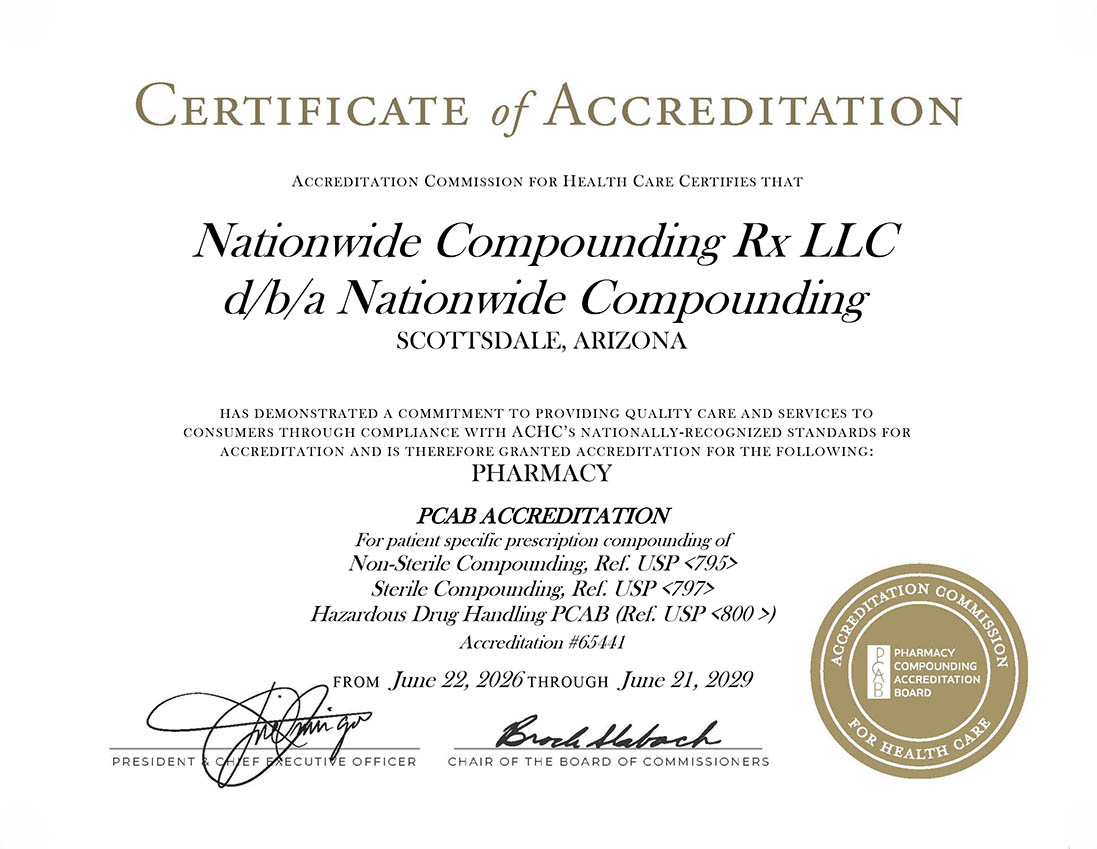
Before transferring, confirm that the receiving pharmacy holds PCAB accreditation and is USP 800 compliant. Patients should also ask about independent third-party testing and whether ingredients are sourced from FDA-inspected and cleared vendors.
Step 3: Contact the Prescriber for a New or Transferred Prescription
Prescribers can send a new prescription directly to the chosen compounding pharmacy by provider portal, fax, or phone. Pharmacies with a structured provider intake process tend to move this step along much faster, since the prescriber knows exactly what information to submit and where.
Step 4: Confirm State Licensing and Shipping Availability
Compounding pharmacies often operate under tiered state licensing:
- Fully licensed for sterile and non-sterile preparations
- Non-sterile only, with sterile licensing pending
- Pending or unlicensed
Patients should confirm their state’s tier for the specific formulation they need, particularly sterile injectables, before finalizing the transfer.
Step 5: Set Up Ongoing Refill and Monitoring Processes
BHRT patients should confirm that the new pharmacy can adjust formulas at each refill based on updated lab results. All patients should ask about turnaround time (for example, 1 to 2 business days, with same-day pickup where available) and how nationwide shipping works for their medication.
Why Nationwide Compounding Rx Fits the Gaps Identified Above
Nationwide Compounding Rx®, based in Scottsdale, Arizona, maps directly onto the checklist items described in this guide:
| Checklist Concern | Nationwide Compounding Rx Credential |
|---|---|
| Quality standards | PCAB accredited; USP 800 compliant |
| Testing and verification | Independent third-party testing |
| Ingredient sourcing | High-grade chemicals from FDA-inspected and cleared vendors |
| Sterile injectables | Dual sterile and non-sterile compounding capability |
| Allergen sensitivities | Formulations free of dyes, fillers, preservatives, and allergens |
| Pediatric needs | Age- and weight-specific dosing; flavored liquids, popsicles, and suckers |
| BHRT monitoring | Formulas adjustable at each refill based on lab results |
| Turnaround | 1 to 2 business days; same-day pickup for some medications |
The pharmacy’s service lines also overlap with the categories patients most need to re-verify: BHRT, pain management, pediatrics, and GLP-1/peptide support. Its pediatric flavor library includes cherry, peppermint, raspberry, strawberry, tutti frutti, marshmallow, orange, bubblegum, and piña colada, with animal-friendly flavors also available.
For prescribers, the pharmacy uses a structured partnership framework: Connect → Collaborate → Create → Care. This gives clinics and physicians a predictable, low-friction way to initiate a transfer. Shipping availability follows a three-tier state licensing map, so patients can confirm in advance whether their specific formulation can be shipped to their state.
Conclusion
Knowing that Partell Specialty Pharmacy became National Health Rx is only the first step. The necessary next step is verifying the pharmacy’s capability against the exact type of prescription involved.
Sterile injectables, including GLP-1 and weight-loss medications, deserve the closest scrutiny, given the pharmacy’s self-disclosed 2018 halt of sterile compounding and its FDA warning-letter history. Specialized stability, pediatric, and allergen-free needs also warrant direct questions. EEOICPA patients should add prior authorization paperwork to their list.
For patients and prescribers who conclude that a move makes sense, the five-step transfer process is routine and straightforward.
Ready to Verify or Transfer a Prescription?
Patients and prescribers can contact Nationwide Compounding Rx® directly to confirm whether a specific medication can be prepared and shipped:
- Phone: (480) 499-8379
- Fax: 480-699-5341
- Hours: Monday through Friday, 7:00 AM to 3:30 PM (Arizona time)
- Address: 14000 N. Hayden Rd., Suite 104, Scottsdale, AZ 85260
Prescribers can use the secure Provider Portal to submit a new or transferred prescription and begin the Connect → Collaborate → Create → Care process. Patients can use the Patient Portal to manage refills and support requests.
The pharmacy team can answer specific questions about sterile compounding, BUD and stability data, pediatric dosing, and allergen-free formulations before any commitment is made.
Related Posts

Choosing a Lexington KY compounding pharmacy takes more than proximity and a star rating. This 2026 guide shows you how to verify Kentucky Board licensure, PCAB accreditation, and USP 795/797/800 compliance before trusting a provider with your prescription.

Central Ohio's booming population, aging demographics, and billion-dollar health system investments are driving unprecedented demand for personalized medication. This article explores what's fueling the rise in central Ohio compounding pharmacy needs in 2026 and how new regulations are reshaping access to quality care.

NYU Specialty Pharmacy offers strong outpatient care, but strict eligibility, in-network, and disease-state rules can block certain prescriptions. Discover the three key limitations and where New Yorkers can turn next in 2026.

BioPlus Specialty Pharmacy has long been known for high-touch specialty infusion services, but its 2026 status under Carelon ownership raises new questions for patients and providers. This guide breaks down what changed, what stayed the same, and how BioPlus's dispensing model compares to specialty compounding pharmacies.