
Lexington KY Compounding Pharmacy: Navigating the 2026 Peptide Ban
Introduction: A Regulatory Shift Lexington Patients Need to Know About
Anyone searching for a Lexington KY compounding pharmacy in late 2026 is doing so during a significant regulatory shift. The Kentucky Board of Pharmacy has moved to enforce 201 KAR 2:076, the state’s existing compounding regulation. It has declined to grant waivers for six popular compounded peptides and has offered no grace period. For patients who relied on these formulations for recovery, gut health, or cognitive support, the change took effect immediately.
The rules around compounded semaglutide have also tightened. The FDA declared the semaglutide injection shortage resolved in February 2025, and federal enforcement has grown stronger since then. In March 2026, the FDA sent a new wave of 30 warning letters to telehealth companies over their marketing of compounded GLP-1 products.
These changes leave patients with a practical problem. A search for local compounding options mostly returns service lists, hours, and star ratings. It does not answer the questions people actually have: what is still legal, what documentation a prescriber needs to provide, and which pharmacy can fill a compliant prescription.
This guide covers what changed, what it means for current prescriptions, and how a PCAB-accredited pharmacy with nationwide shipping, such as Nationwide Compounding Rx®, can legally fill compliant formulations for Lexington patients.
What Changed: Kentucky’s 2026 Peptide Compounding Ban Explained
Kentucky’s compounding pharmacies operate under 201 KAR 2:076. This regulation is not new. What is new is how the Kentucky Board of Pharmacy chose to apply it.
At the federal level, the U.S. Department of Health and Human Services (HHS) introduced enforcement flexibility for certain peptide bulk drug substances. That flexibility could have opened a path for these compounds. The Kentucky Board of Pharmacy instead voted to enforce its existing regulation and to refuse waivers for six peptides.
This was a deliberate decision, not an oversight. Kentucky is holding a stricter line than federal guidance currently requires. The National Law Review covered the decision under the headline “Not So Fast: Kentucky Holds the Line on Peptide Compounding.” The American Med Spa Association also reported that Kentucky’s rules do not allow compounding of the six peptides despite the HHS enforcement policy.
The most consequential detail is that there was no grace period. Pharmacies had no transition window to wind down production, and patients had no time to work with their prescribers on alternatives. Anyone using one of these compounds faces an immediate gap in therapy.
The Six Peptides Now Off-Limits for Kentucky Compounding
The Board’s decision applies to these six bulk drug substances:
- BPC-157: Often used for tissue repair, injury recovery, and gut health support.
- TB-500: Commonly used in sports medicine and recovery settings for soft tissue healing.
- Epitalon: Typically associated with anti-aging and longevity protocols.
- Semax: Used for cognitive support and focus.
- KPV: A peptide often used for inflammation and gut-related concerns.
- MOTS-c: Associated with metabolic health and energy regulation.
Patients who received recovery, anti-aging, cognitive, or gut health protocols that included any of these compounds are likely affected.
The restriction applies broadly. Under 201 KAR 2:076, it covers Kentucky-licensed pharmacies and nonresident pharmacies shipping into Kentucky. Ordering from a pharmacy in another state does not get around the rule.
These six bulk drug substances cannot currently be compounded legally for Kentucky patients, regardless of what the prescriber intends.
Compounded Semaglutide and GLP-1s: The Rules Just Got Tighter
Compounded semaglutide became widely available because of a shortage. Federal law allows broader compounding of copies of commercial drugs while a shortage is in effect. On February 21, 2025, the FDA issued a Declaratory Order finding that the semaglutide injection shortage was resolved and removed the product from the shortage list. That ruling removed the legal basis for broad compounding.
Kentucky’s current exception is narrow. Compounded semaglutide is permissible only when:
- A patient-specific prescription is written by a licensed prescriber.
- The prescriber determines and documents that a formulation change produces a significant difference for that individual patient.
- The prescription is filled by a 503A pharmacy.
The Kentucky Board of Pharmacy described these expectations in its November 14, 2025 Compound Compliance Alert on GLP-1 and GIP products, which covers both semaglutide and tirzepatide.
Federal enforcement is increasing rather than easing. The FDA’s March 3, 2026 warning letters to 30 telehealth companies show that regulators are paying close attention to how compounded GLP-1s are marketed and dispensed.
Why Lexington’s Local Compounding Pharmacies Haven’t Addressed This
Lexington has two established independent compounding pharmacies, and both are well regarded.
- Lexington Compounding Pharmacy (399 Waller Ave, Ste 110) is a family-owned pharmacy that focuses on hormone replacement, pain management, and pet medications.
- Wheeler’s Custom Compounding (327 Romany Rd) is independently owned and serves bio-identical hormones, pain management, allergy compounding, autism, dermatology, pediatrics, veterinary, wound care, podiatry, and unavailable medications. It holds a 4.6-star rating across 54 reviews on Birdeye.
Both pharmacies offer a wide range of services. However, based on a review of their public websites at the time of writing, neither has published an update for patients about the peptide ban or the tighter GLP-1 rules.
This has a real effect on patients. Many learn about the changes only after a prescription is rejected, delayed, or quietly substituted. This is not a judgment of either pharmacy’s competence; it is a communication gap, and this article aims to help close it.
Understanding Pharmacy Credentials: NABP vs. PCAB and Why It Matters Now
When rules tighten, it becomes more important to know what a pharmacy’s credentials actually verify.
Lexington Compounding Pharmacy describes itself as NABP Accredited, LegitScript certified, and .Pharmacy-verified. These are legitimate credentials, but they are not the same as PCAB accreditation, which focuses specifically on compounding quality.
What PCAB Accreditation Verifies
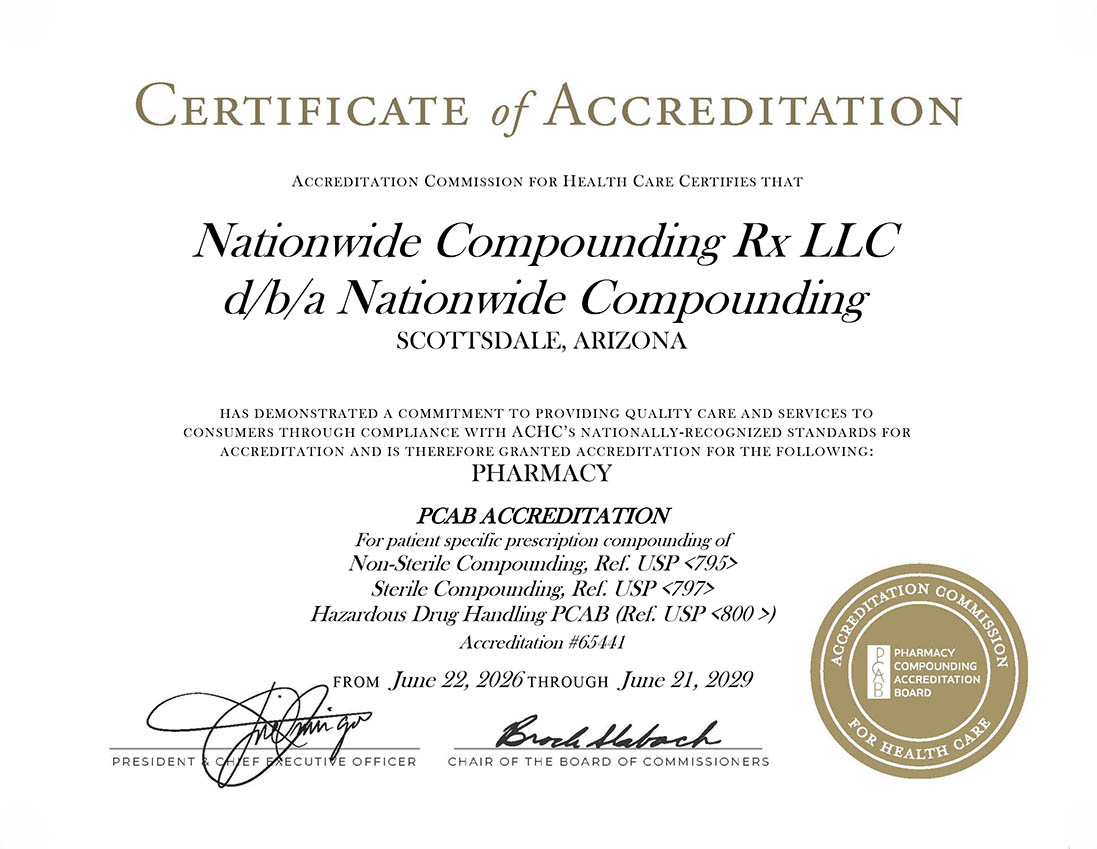
The Pharmacy Compounding Accreditation Board (PCAB) is administered by ACHC. Compounding pharmacists develop its standards, and those standards align directly with the United States Pharmacopeia (USP):
- USP <795>: Non-sterile compounding
- USP <797>: Sterile compounding
- USP <800>: Hazardous drug handling
PCAB accreditation is voluntary. To earn it, a pharmacy must agree to the PCAB Principles of Compounding, submit documented proof that it meets PCAB standards, and allow a physical inspection.
Why the Credential Is Rare and Respected
- PCAB accreditation is held by fewer than 1% of U.S. pharmacies. Sources cite roughly 68 verified, actively accredited pharmacies nationwide.
- The American Medical Association recommends that physicians work with PCAB-accredited compounding pharmacies, and it identifies dual sterile and non-sterile accreditation as the highest standard.
- Revised PCAB standards that incorporate the updated USP <795> and <797> chapters took effect June 1, 2024.
- Some states now require PCAB accreditation for nonresident pharmacy licensure. Washington and Ohio are examples.
Why It Matters in 2026
There are an estimated 7,500 compounding pharmacies in the United States, and IBISWorld projects the industry will reach $20.2 billion in 2026. In a market that size, credentials help patients separate pharmacies that meet a high standard from those that meet only the minimum. While state enforcement is tightening, a deep credential is a practical safeguard, not just a marketing point.
What’s Still Legal: A Practical Guide for Lexington Patients and Prescribers
The peptide ban and the GLP-1 restrictions are narrow. Most compounding categories remain fully legal and available, including:
- Bioidentical hormone replacement therapy (BHRT) for menopause, andropause, and hormonal imbalances
- Pain management topicals such as creams, gels, and ointments
- Dermatology formulations for acne, rosacea, eczema, psoriasis, scarring, and aging skin
- Pediatric preparations in kid-friendly dosage forms and flavors
- Non-peptide sports medicine formulations for recovery and inflammation
- Allergen-free versions of medications, and recreations of discontinued strengths
Documentation Checklist for GLP-1 Compounding Requests
A prescriber who requests compounded semaglutide or tirzepatide for a Kentucky patient should have the following in place:
- A patient-specific prescription written for one identified individual. Office stock and bulk orders do not qualify.
- A documented clinical rationale explaining why a formulation change makes a significant difference for that patient. Examples include an allergy to an excipient or a dosing need that a commercial product cannot meet.
- Dispensing through a 503A pharmacy that operates under the patient-specific compounding framework.
Without this documentation, a compliant pharmacy should decline to fill the prescription.
Nationwide Compounding Rx®: A Compliant, Credentialed Option for Lexington Patients
Nationwide Compounding Rx® is based in Scottsdale, Arizona. It is PCAB-accredited and USP 800 compliant, and it is set up to handle regulatory complexity like Kentucky’s.
State-by-state regulatory awareness. Kentucky’s 2026 decision shows that a single national approach to compounding regulation no longer works. Nationwide Compounding Rx® follows a three-tier state licensing and shipping system:
- Fully licensed states
- Non-sterile only states (sterile licensure pending)
- Pending or unlicensed states
This structure lets the pharmacy track and comply with state-specific rules instead of assuming that federal flexibility applies everywhere.
Sourcing and testing. The pharmacy sources high-grade chemicals exclusively from FDA-inspected and cleared vendors and uses independent third-party testing to confirm quality and consistency.
Speed and flexibility. It offers a 1 to 2 business day turnaround, sterile and non-sterile capabilities, and a wide range of dosage forms, including capsules, troches, topicals, sublingual tablets, suppositories, and flavored liquids.
A partnership model for prescribers. Kentucky’s documentation requirements put more responsibility on prescribers. The pharmacy’s “Connect, Collaborate, Create, Care” model is designed to support that work. Prescribers can work directly with the pharmacy team through a secure Provider Portal to submit prescriptions, confirm that documentation is complete, and track orders.
Frequently Asked Questions
Can I still get BPC-157 or TB-500 compounded in Kentucky?
No. The Kentucky Board of Pharmacy declined waivers for BPC-157, TB-500, Epitalon, Semax, KPV, and MOTS-c under 201 KAR 2:076, and it provided no grace period. The restriction applies to Kentucky-licensed pharmacies and to nonresident pharmacies shipping into the state.
Is compounded semaglutide completely banned in Kentucky?
No. It is permitted only in narrow circumstances. The prescription must be patient-specific, the prescriber must document that a formulation change makes a significant difference for that individual, and the prescription must be filled by a 503A pharmacy.
What’s the difference between NABP accreditation and PCAB accreditation?
NABP credentials focus on general pharmacy legitimacy and practice standards. PCAB accreditation, administered by ACHC, focuses on compounding quality and aligns with USP <795>, <797>, and <800>. Fewer than 1% of U.S. pharmacies hold PCAB accreditation, and the AMA recommends it to physicians.
Does Nationwide Compounding Rx® ship to Lexington, KY?
The pharmacy ships nationwide, but availability depends on the medication type, state regulations, and prescription requirements. Patients and prescribers should call (480) 499-8379 or check the state licensing map at nationwidecompounding.com to confirm Kentucky availability for a specific formulation.
What should I do if my current prescription included a now-restricted peptide?
Contact the prescriber promptly to discuss legal alternatives. Do not look for the peptide from unregulated sources. A prescriber can review the treatment goals and work with a compliant compounding pharmacy on formulations that remain legal in Kentucky.
Conclusion: Navigating Change with a Compliant, Credentialed Partner
Kentucky’s enforcement of 201 KAR 2:076 and its tighter GLP-1 rules have changed compounding access for Lexington patients immediately, with no transition period. Six peptides can no longer be compounded for Kentucky patients, and compounded semaglutide now requires careful, patient-specific documentation.
Most compounding needs are unaffected. BHRT, pain management, dermatology, pediatrics, and many sports medicine formulations remain fully legal. Because the rules are tightening, it matters more than ever to verify credentials such as PCAB accreditation and USP 800 compliance. Nationwide Compounding Rx® is built to handle this kind of state-specific complexity for Lexington patients and prescribers.
Get Compliant, Custom Compounding for Your Lexington Prescription
Patients and prescribers should not wait for a rejected prescription to find out whether a formulation is still compliant. Nationwide Compounding Rx® can help confirm compliance and fill legal prescriptions quickly.
- Prescribers: Start the Connect, Collaborate, Create, Care partnership through the secure Provider Portal.
- Patients: Use the secure Patient Portal to manage refills and support requests.
- Phone: (480) 499-8379
- Website: nationwidecompounding.com
- Hours: Monday through Friday, 7:00 AM to 3:30 PM
The regulations have changed, but a PCAB-accredited pharmacy can still help patients get high-quality, compliant care.
Related Posts

Wondering if CVS is a compounding pharmacy? This 2026 guide clears up the confusion around CVS's limited compounding services versus true 503A custom formulations. Learn what CVS can and can't provide, and where to turn for specialized medication needs.

Personalized medicine bioinformatics has transformed how clinicians interpret gene-drug interactions, but the journey doesn't end at the lab report. This article explores the 'compounding bridge'—the critical operational step where genomic insight becomes a dose-adjusted, patient-specific prescription in 2026.

Lumicera Specialty Pharmacy markets transparent, cost-plus drug pricing, but that promise only applies to select conditions and stocked drugs. This article examines the data behind Lumicera's coverage limits, prior authorization denials, and what patients can do when they fall outside the model.

Searching for the right Optum Specialty Pharmacy phone number can lead to outdated or conflicting results. This 2026 verified list breaks down each legitimate contact line, what it's used for, and why the old BriovaRx name still causes confusion today.