
Compounding Pharmacy for Nursing Homes: Solving the 2026 LTC Crisis
Introduction: The 2026 LTC Pharmacy Crisis Is Not a Temporary Disruption
Two simultaneous shocks have converged on America’s nursing homes in 2026, and neither will fade on its own. The first is the Chapter 11 bankruptcy of Omnicare, filed in September 2025 and resolved through a court-approved $250 million sale to GenieRx Holdings in May 2026. The second is the arrival of Medicare price negotiation reimbursement cuts under the Inflation Reduction Act (IRA), which took effect January 1, 2026. These are not cyclical bumps in a familiar road. They are structural disruptions to the entire long-term care (LTC) pharmacy supply chain.
The scale is staggering. Omnicare served more than 800,000 patients across 4,000-plus facilities in 47 states. Its sale leaves facility administrators in a procurement limbo with no guarantee of seamless service continuity. Meanwhile, IRA cuts are forcing pharmacies to absorb losses of roughly $15 per prescription on affected drugs, contributing to a 20 to 25 percent overall revenue decline. According to Skilled Nursing News, 84 percent of LTC pharmacies now plan to reduce services or stop serving certain facilities or regions entirely.
This article is a decision-making framework for LTC administrators and directors of nursing who need to understand how a specialized compounding pharmacy can function as a strategic operational solution, not merely a clinical nicety or a stopgap vendor. It covers three topics rarely addressed together: the dual clinical driver of polypharmacy plus dysphagia, the 503A versus 503B regulatory procurement framework, and compliance packaging requirements. Because nursing homes are legally required to provide pharmacy services, the loss of LTC pharmacy access is not just a clinical problem. It is a regulatory compliance and facility survival issue.
Understanding the Dual Crisis: What Omnicare’s Collapse and IRA Cuts Mean for Your Facility
Omnicare, a CVS Health subsidiary, filed for Chapter 11 protection following a $948.8 million False Claims Act judgment. As detailed in its SEC filing, the company cited both its litigation burden and the broader financial pressures facing the entire LTC pharmacy industry.
The market concentration problem makes this collapse uniquely dangerous. National LTC pharmacies control more than 90 percent of market share, so the failure of a single dominant player creates a near-monopoly vacuum that no single successor can immediately fill. As Framework LTC notes, the transition to GenieRx Holdings does not guarantee uninterrupted service for the facilities Omnicare once served.
Layered on top is the IRA reimbursement crisis. Medicare “maximum fair prices” reduced reimbursement for selected drugs by 38 to 79 percent, and eight of the 10 drugs in the first negotiation round are brand-name medications heavily prescribed to nursing home residents. Because 75 percent of LTC pharmacy revenues come from Medicare Part D, these changes are existential rather than merely inconvenient.
The downstream risk is severe. The Senior Care Pharmacy Coalition reports that more than 80 percent of nursing home residents face loss of access to essential pharmacy services, 78 percent of LTC pharmacies expect to lay off staff, and closures could cost taxpayers up to $4.8 billion over the next decade due to increased hospitalizations. Rural facilities face the steepest danger: nearly half of surveyed LTC pharmacies serve rural communities, and these are the most likely to withdraw entirely.
This crisis creates an urgent opening for specialized compounding pharmacies to fill service gaps that consolidated LTC chains can no longer reliably cover.
The Clinical Case for Compounding in Nursing Homes: Polypharmacy and Dysphagia as Dual Drivers
The clinical baseline is sobering. Nursing home residents take between 4 and 17 medications on average. Polypharmacy (five or more drugs) occurs in roughly 69 percent of residents, and extensive polypharmacy (10 or more drugs) in 18 to 40 percent depending on the study.
These numbers translate directly into harm. Research published in PMC found that residents with escalations in medication usage face a 61 percent higher risk of hospitalization, and over 80 percent of residents carry at least one potentially inappropriate medication (PIM) prescription.
Dysphagia is the compounding catalyst. Approximately 15 percent of nursing home residents have difficulty swallowing tablets and capsules, and research in the Journal of Clinical Pharmacy and Therapeutics found that 61.3 percent of nursing staff report crushing or opening medications before administration, an unlicensed practice that creates significant facility liability.
Dysphagia and polypharmacy intersect dangerously. Residents with Alzheimer’s disease, Parkinson’s disease, and other neurodegenerative conditions frequently face both challenges simultaneously, making standard commercial formulations clinically inadequate. Compounding addresses both problems: medications can be converted to liquid suspensions, transdermal gels, orodispersible films, sprinkle capsules, or lozenges for dysphagia, and multiple drugs can be combined into a single formulation to reduce pill burden for polypharmacy management. Compounding pharmacies can also formulate medications free of lactose, dyes, gluten, sugar, and common preservatives for residents with excipient sensitivities.
The business case follows naturally. Fewer medication errors, fewer adverse drug events, lower hospitalization rates, and reduced staff administration burden all carry direct financial and regulatory benefits.
Polypharmacy Management Through Compounding
A compounding pharmacist can work with prescribers to evaluate a resident’s full medication list and identify opportunities for combination formulations. The practical concept, often called a polypill, involves a single oral liquid or transdermal preparation combining two or three medications taken at the same time of day. This reduces the number of administration events per shift, which directly cuts medication pass time, a critical operational metric for directors of nursing. The staff at Nationwide Compounding Rx® bring 40 years of combined compounding experience and collaborate directly with prescribers to design personalized formulations, functioning as a clinical partner rather than a simple supplier.
Dysphagia-Specific Formulation Options
Several alternative dosage forms serve dysphagic residents directly:
- Oral liquids and suspensions for residents who cannot manage solid forms
- Transdermal creams and gels for those who cannot tolerate oral medications at all
- Troches and sublingual lozenges that dissolve in the mouth
- Sprinkle capsules that can be opened over soft food
- Orodispersible films that dissolve rapidly on the tongue
Each option is preferable to crushing tablets, which alters pharmacokinetics, can destroy extended-release mechanisms, and exposes staff to hazardous drug particles. Nationwide Compounding Rx® operates a USP 800 compliant facility built specifically to handle hazardous drug compounding safely, providing direct liability protection for partner facilities. Its 1 to 2 business day turnaround is operationally critical: when a resident’s swallowing ability changes acutely, facilities cannot wait weeks for a commercial manufacturer to respond.
The 503A vs. 503B Framework: A Procurement Decision Guide for LTC Administrators
This regulatory distinction determines how a nursing home can legally procure compounded medications, in what quantities, and under what documentation requirements.
According to the FDA, 503A pharmacies provide patient-specific compounding, are state-regulated, require individual prescriptions for each resident, and cannot produce large batches for general facility stock. 503B outsourcing facilities are FDA-regulated, subject to Current Good Manufacturing Practice (CGMP) requirements, can produce large batches without patient-specific prescriptions, and offer longer beyond-use dating. As the Congressional Research Service explains, 503B facilities were created specifically to compound drugs in bulk for institutional use.
The practical implication is clear. A facility with 100-plus residents needing a specific liquid formulation cannot manage 100 individual 503A prescriptions for routine restocking; a 503B relationship enables facility-level bulk ordering. Facilities must verify that their pharmacy partner holds the appropriate designation, because mismatched procurement creates regulatory exposure during CMS and state DOH inspections.
The regulatory environment is shifting. The SAFE Drugs Act (HR 6509), introduced in December 2025, would tighten compounding rules and impose new reporting obligations on both 503A and 503B entities. Meanwhile, the Drug Shortage Compounding Patient Access Act of 2025 (H.R. 5316) codifies FDA guidance allowing compounding during drug shortages, directly relevant to facilities facing Omnicare-related disruptions.
The simple decision framework: use 503A for resident-specific custom formulations (unique dosage, allergen-free, or flavor-modified) and 503B for bulk sterile preparations, high-volume non-sterile formulations, and facility-level stock replenishment.
Questions to Ask a Compounding Pharmacy Partner About Their Regulatory Status
- Are you a 503A pharmacy, a 503B outsourcing facility, or both? Clarify how that designation affects how orders can legally be placed.
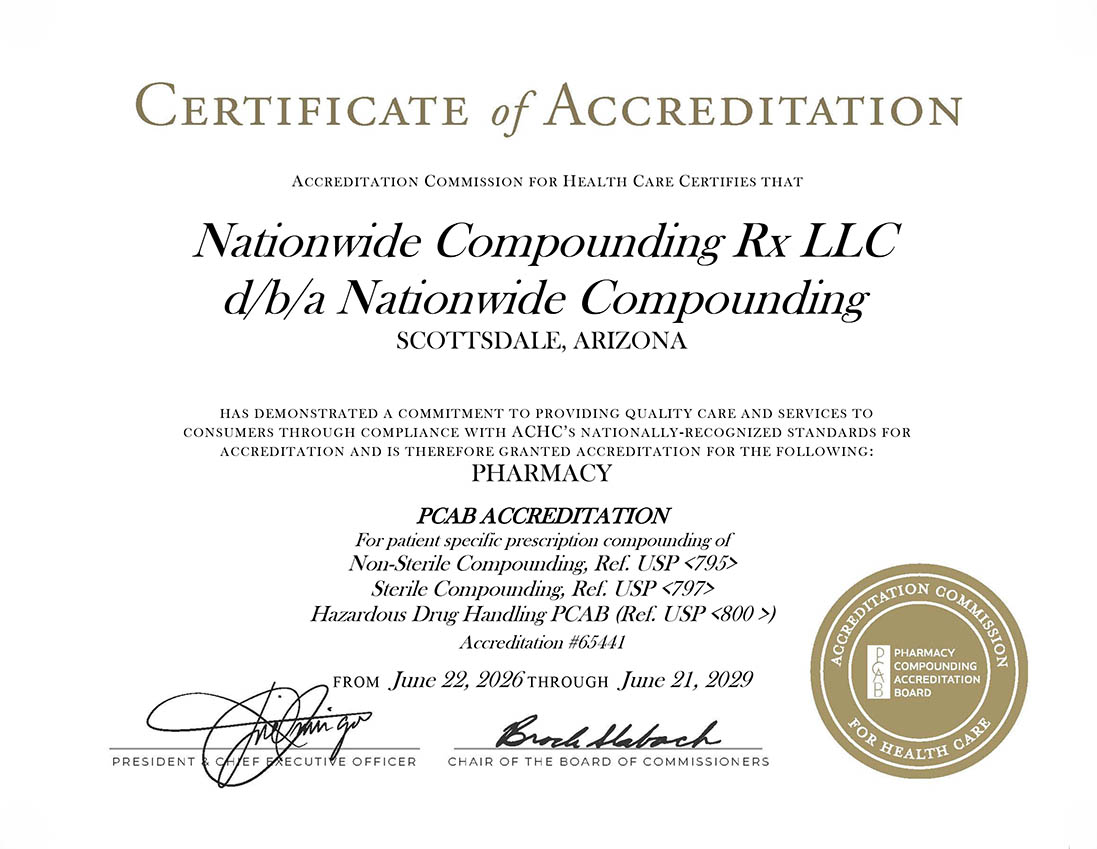
- Are you PCAB accredited? This provides independent third-party validation of safety and quality. Nationwide Compounding Rx® has maintained PCAB accreditation since its early days of operation.
- Is your facility USP 800 compliant for hazardous drug handling? This is non-negotiable for chemotherapy agents, certain hormones, and other hazardous compounds.
- How are you preparing for the SAFE Drugs Act requirements? A pharmacy that cannot answer clearly is a compliance liability.
- Do you source APIs exclusively from FDA-inspected and cleared vendors? Nationwide Compounding Rx® confirms this practice explicitly.
- What is your beyond-use dating policy, and how does it align with the facility’s inventory cycle?
Compliance Packaging: The Federally Mandated Requirement Most Facilities Overlook
Unlike retail pharmacies, LTC pharmacies are federally mandated to dispense drugs in special compliance packaging as part of CMS-required medication management protocols. As the Senior Care Pharmacy Coalition emphasizes, these are services standard retail pharmacies cannot replicate.
This matters acutely during a transition. If a facility switches from Omnicare to a retail pharmacy or an unqualified compounding pharmacy that cannot provide compliance packaging, it is immediately out of CMS compliance, a surveyable deficiency. The relevant packaging types include:
- Unit-dose blister packs with each dose labeled by drug name, strength, and administration time
- Multi-dose blister cards organizing medications by time of day across a week or month
- Strip packaging offering continuous rolls of individually sealed doses for high-volume medication passes
These systems reduce wrong-dose and wrong-patient errors, providing a direct liability benefit and a quality metric for CMS star ratings. Compounded medications, especially liquids and combination formulations, require specialized labeling that not all pharmacies can provide. Facilities must verify packaging capability for every formulation type a partner supplies. CMS also mandates 24/7 pharmacist availability for emergency needs, which not all compounding pharmacies are structured to offer. Administrators should confirm compliance packaging, labeling standards, unit-dose availability, and emergency dispensing protocols before signing any service agreement.
Drug Shortage Management: A Hidden Compounding Pharmacy Advantage
The FDA reported 113 active drug shortages in 2024, and the Omnicare bankruptcy combined with IRA cuts is compounding supply chain fragility for facilities that relied on a single dominant partner. When a commercially manufactured drug appears on the FDA shortage list, compounding pharmacies are authorized to produce it. H.R. 5316 codifies this authority and provides a 60-day transition period after a drug leaves the shortage list.
For administrators, the benefit is concrete: a compounding pharmacy partner can serve as a backup supply source, preventing the clinical disruption of abrupt medication discontinuation for residents on stable, long-term regimens. Compounding pharmacies can also replicate medications that manufacturers have discontinued due to low profitability, a scenario increasingly common as IRA cuts make certain brand-name drugs commercially unviable. Diversifying pharmacy partnerships to include a qualified compounding pharmacy is a business continuity and risk management imperative, not merely a clinical decision.
How Nationwide Compounding Rx® Addresses the 2026 LTC Crisis
Nationwide Compounding Rx® is a specialized compounding pharmacy with deep expertise in personalized medication management, not a retail operation treating nursing homes as a secondary market.
The company ships to 47 states plus Washington, D.C., directly addressing the geographic coverage gap created by Omnicare’s bankruptcy and the rural access crisis. For transparency, it does not currently serve Alabama, California, North Carolina, or South Carolina. Its PCAB accreditation and USP 800 compliance serve as baseline quality and safety credentials that facilities can cite in CMS compliance documentation and state DOH inspection responses.
Its formulation capabilities map directly to LTC needs: oral liquids and suspensions for dysphagia, transdermal gels for residents who cannot tolerate oral medications, troches and sublingual lozenges, allergen-free capsules, and combination formulations for polypharmacy management. The 1 to 2 business day turnaround is a genuine operational differentiator. When a facility loses its primary pharmacy partner, receiving custom compounded medications within 48 hours is a patient safety necessity. With 40 years of combined staff experience and FDA-inspected vendor sourcing, the pharmacy functions as a clinical extension of the facility’s care team.
Building a Compounding Pharmacy Partnership: A Step-by-Step Framework
- Conduct a resident medication audit. Identify the percentage of residents with dysphagia, polypharmacy, allergen sensitivities, and medications on the FDA shortage list to quantify clinical need.
- Assess current pharmacy partner stability. Evaluate whether the current partner is financially stable and regionally committed under IRA pressure. If not, begin diversifying immediately.
- Determine procurement model needs. Decide whether a 503A partner, a 503B partner, or both are required, using the framework above.
- Verify compliance credentials. Confirm PCAB accreditation, USP 800 compliance, state licensure, FDA-inspected API sourcing, and 24/7 pharmacist availability.
- Confirm compliance packaging capabilities for every formulation type the pharmacy will supply.
- Pilot with a defined cohort. Identify 10 to 20 residents with the highest compounding need and measure error rates, administration time, and outcomes over 30 to 60 days.
- Integrate into the emergency preparedness plan. Document the partner as a named backup supply source to satisfy CMS emergency preparedness requirements.
The Financial Case: How Compounding Reduces Costs and Liability
The upfront cost of compounded medications must be weighed against the downstream costs of errors, adverse events, hospitalizations, and CMS citations. The math favors compounding. Residents with escalations in inappropriate medication use face a 61 percent higher risk of hospitalization, and the average nursing home hospitalization costs $15,000 to $25,000. Preventing even one hospitalization per month more than offsets the cost of compounding services.
Medication error liability is equally significant. The 61.3 percent of nursing staff who crush or open medications are engaged in an unlicensed practice; compounded alternative formulations eliminate that risk entirely. Medication management quality also factors into the CMS Five-Star Quality Rating System, directly affecting census and reimbursement. Combination formulations reduce medication pass time, a measurable labor savings in a sector facing severe staffing shortages. At the macro level, pharmacy closures could cost taxpayers up to $4.8 billion over the next decade, and the same cost-avoidance logic applies at the facility level.
Conclusion: The 2026 LTC Crisis Demands a Strategic Pharmacy Response
The convergence of the Omnicare bankruptcy, IRA reimbursement cuts, and a 90-percent-consolidated LTC pharmacy market has created an urgent need for nursing homes to diversify their pharmacy partnerships. Specialized compounding pharmacies are uniquely positioned to fill the gap.
The three-part framework is complete: polypharmacy and dysphagia create a quantifiable clinical need, the 503A versus 503B distinction provides a procurement decision structure, and compliance packaging requirements ensure a partner can meet federal LTC standards. Together, they form a full decision-making model. A compounding partnership is not a luxury; it is a risk management, compliance, and cost-avoidance strategy.
The urgency is real. The Omnicare transition is ongoing, IRA cuts are already in effect, and 84 percent of LTC pharmacies are actively reducing services. With the LTC pharmacy market projected to grow from $20.5 billion in 2025 to $33.7 billion by 2032, facilities that establish diversified, compounding-capable partnerships now will be best positioned to serve an aging population and weather future disruptions.
Partner With Nationwide Compounding Rx® to Protect Your Residents and Your Facility
LTC administrators and directors of nursing facing pharmacy uncertainty should contact Nationwide Compounding Rx® to discuss how a specialized compounding partnership can address their facility’s specific medication management challenges.
Contact information:
- Toll-Free: 1-833-650-9836
- Main Line: 480-499-8379
- Fax: 480-699-5341
- Website: www.NationwideCompounding.com
Nationwide Compounding Rx® offers PCAB-accredited, USP 800 compliant compounding with 1 to 2 business day turnaround, nationwide shipping to 47 states plus Washington, D.C., and 40 years of combined staff experience, all purpose-built for the complexity of long-term care medication management. Its reach extends into the rural communities facing the steepest service reductions.
A practical first step is to call and request a facility medication audit consultation, a low-commitment way to demonstrate clinical value before any formal agreement. In a regulatory environment where pharmacy access is a federally mandated requirement and CMS scrutiny is intensifying, partnering with an accredited, compliant compounding pharmacy is not just a clinical decision. It is a facility protection strategy.
Related Posts

Searching for Marty's Compounding Pharmacy but not sure if a local Mississippi storefront fits your needs? This guide compares Marty's Pharmacy & Compounding Center to nationwide compounding options using a five-point credential checklist covering accreditation, testing, and shipping licenses in 2026.

The term 'board of specialty pharmacy' actually refers to four distinct organizations, each serving a different purpose. This article breaks down BPS, SPCB, state boards, and PCAB to reveal which body truly governs compounding pharmacy quality in 2026.

Many patients assume CVS Pharmacy Specialty Services can compound custom medications simply because it holds PCAB accreditation—but the reality is more nuanced. This article breaks down what the accreditation actually covers, how the FDA's 503A/503B rules apply, and what it means for prior authorizations on oncology, MS, and RA prescriptions in 2026.

Many patients land on Accredo after a physician, insurer, or PBM directs them there. This guide breaks down what specialty pharmacy Accredo actually does—and the critical compounding limitations you need to know about in 2026.