Is Compounding Pharmacy Safe? The 2026 Patient’s Honest Answer
Is Compounding Pharmacy Safe? The Honest Answer Depends on Which Pharmacy You’re Asking About
The most honest answer to “Is compounding pharmacy safe?” is that safety is not a simple yes or no. It is a spectrum, and where a specific pharmacy falls on that spectrum depends entirely on its credentials, its oversight, and the practices it follows behind the scenes.
Here is a fact that surprises most patients: compounded drugs are not FDA-approved for safety, effectiveness, or quality. The FDA conducts no pre-market review of compounded preparations, regardless of where they are made. That does not mean compounded medications are dangerous. It means the assurance a patient gets from an FDA-approved product simply does not transfer automatically to a compounded one.
This matters because compounding is not a niche corner of medicine. An estimated 30 to 40 million compounded prescriptions are filled annually in the United States, within a market valued at roughly $6.98 to $7.42 billion in 2025 and 2026. Yet fewer than 1% of U.S. compounding pharmacies hold PCAB accreditation, the leading third-party quality credential. In other words, the overwhelming majority of compounding volume occurs without independent quality verification.
The promise of this article is straightforward: by the end, readers will have a concrete, five-step verification framework to determine whether a specific pharmacy is safe before filling any compounded prescription. Along the way, the article covers the safety layers that actually matter: the 503A/503B classification, PCAB accreditation, USP <795>/<797>/<800> compliance, and FDA-inspected ingredient sourcing.
What Happened in 2012 and Why It Changed Everything
In 2012, the New England Compounding Center (NECC) triggered the deadliest pharmaceutical disaster in modern U.S. history. Contaminated methylprednisolone acetate injections caused a nationwide fungal meningitis outbreak that killed 64 people and sickened 751 more.
What went wrong was not a freak accident. NECC was functioning as a large-scale drug manufacturer while operating under the label of a compounding pharmacy. It produced injectable steroids in non-sterile conditions and shipped them across the country, bypassing the manufacturing oversight that a true drug maker would face.
The regulatory gap that allowed this was real. At the time, compounding pharmacies were primarily regulated by state boards of pharmacy, and federal oversight was limited and ambiguous. NECC exploited that ambiguity to operate at industrial scale without industrial-grade scrutiny.
Congress responded in 2013 with the Drug Quality and Security Act (DQSA), which created the modern 503A/503B regulatory framework specifically to close the gap NECC exposed. For patients today, this history is not trivia. The current regulatory structure exists because of this tragedy, and understanding it helps patients recognize which safeguards are meaningful and which gaps still remain.
The 503A vs. 503B Distinction: Why It Matters for Patient Safety
The DQSA divided compounding into two categories. Understanding them is the single most useful thing a patient can learn about compounding oversight.
503A pharmacies compound medications for specific patients based on individual prescriptions. They are primarily regulated by state boards of pharmacy. The FDA conducts only surveillance or for-cause inspections, not routine ones.
503B outsourcing facilities produce compounded drugs in bulk, without patient-specific prescriptions. They are subject to direct FDA inspection on a risk-based schedule and must comply with Current Good Manufacturing Practice (CGMP) regulations, the same standards applied to commercial drug manufacturers.
The practical implication is significant. A 503A pharmacy may be excellent or poorly run, because state oversight quality varies considerably from one jurisdiction to the next. Patients cannot assume federal-level scrutiny applies to a 503A pharmacy the way it does to a 503B facility.
The framework improved safety, but it did not eliminate risk. Between 2013 and 2018 alone, the FDA issued more than 180 warning letters to compounding pharmacies, resulting in roughly 140 recalls. The smart question for any patient to ask directly is: “Are you a 503A pharmacy or a 503B outsourcing facility?” Each answer carries a different level of built-in assurance.
PCAB Accreditation: The Gold Standard That Fewer Than 1% of Pharmacies Hold
PCAB, the Pharmacy Compounding Accreditation Board, is a voluntary third-party credential developed by eight leading pharmacy organizations. It verifies compliance with USP <795>, <797>, and <800> standards through rigorous on-site evaluation.
This is not a paper review. A PCAB evaluation includes physical inspection of cleanroom environments and equipment, personnel competency testing, environmental monitoring review, and a documentation audit. Accreditors show up and confirm that the pharmacy does what it claims.
The 1% statistic is the clearest patient-safety signal in this discussion. With 30 to 40 million compounded prescriptions filled every year, the vast majority are dispensed by pharmacies that have never undergone this level of independent scrutiny.
Regulatory momentum is reinforcing PCAB’s importance. Washington and Ohio now require verifiable PCAB accreditation for nonresident compounding pharmacy licensure as of 2026. Patients can check for themselves: PCAB accreditation is publicly searchable through the ACHC website. No one has to take a pharmacy’s word for it.
The distinction is simple. Any pharmacy can claim to follow USP standards. Only PCAB-accredited pharmacies have had those claims independently verified.
USP Standards Explained: What <795>, <797>, and <800> Actually Mean for Patients
USP standards are written for pharmacy professionals, but patients deserve a plain-language translation of what they mean for personal safety.
USP <795>: Non-Sterile Compounding Standards
USP <795> governs non-sterile preparations: creams, capsules, oral liquids, troches, and topicals, the forms patients encounter most often. It sets requirements for beyond-use dating, ingredient quality, equipment calibration, and documentation. Kentucky began active enforcement of revised USP <795> standards on January 1, 2026, a sign that state-level enforcement is tightening.
Patient implication: If a compounded medication is a cream, capsule, or liquid, patients should ask whether the pharmacy follows USP <795> and whether that compliance has been independently verified.
USP <797>: Sterile Compounding Standards
USP <797> governs sterile preparations: injectables, eye drops, and inhalation solutions. This is the highest-risk category because contamination can enter the bloodstream or sensitive tissues directly. It requires ISO 5 (Class 100) cleanroom environments, with air quality equivalent to the inside of a surgical suite.
Sterile compounded medications represent roughly 58 to 60% of the U.S. compounding market, making this the most critical safety variable for most patients. The NECC meningitis outbreak was, at its core, a sterile compounding failure.
Patient implication: If a prescription is injectable or ophthalmic, sterility testing and cleanroom certification are non-negotiable.
USP <800>: Hazardous Drug Handling Standards
USP <800> became compendially enforceable on November 1, 2023. It requires a formally named Designated Person (DP) accountable for compliance, bi-annual environmental wipe sampling for hazardous drug residue, ISO 7 or better buffer areas for hazardous drug compounding, and documented staff training.
Notably, failure to formally name a Designated Person is one of the most frequently cited deficiencies in USP <800> inspections as of May 2026. The standard protects both patients (from cross-contamination) and pharmacy staff (from hazardous drug exposure).
Patient implication: If a compounded medication involves hormones, chemotherapy agents, or other hazardous drugs, patients should ask whether the pharmacy is USP <800> compliant and whether that compliance is documented.
The Ingredient Problem: Where a Medication Starts Matters
A compounded drug is only as safe as its raw materials. Compounding pharmacies are required by federal law to source active pharmaceutical ingredients (APIs) from FDA-registered manufacturers, and each batch must be accompanied by a valid Certificate of Analysis (CoA).
A Certificate of Analysis should contain the potency percentage (confirming the drug is at labeled strength), sterility pass/fail results, endotoxin testing results, and identification of the manufacturer. These are the facts that confirm what a patient is actually receiving.
The real-world risk is not hypothetical. FDA warning letters in 2024 and 2025 cited subpotent semaglutide at 79.9% of labeled potency at one facility, meaning patients received significantly less active ingredient than prescribed. In February 2025, 38 State Attorneys General signed a letter to the FDA warning that counterfeit GLP-1 drugs had infiltrated the U.S. supply chain from China, Turkey, India, and other foreign sources.
To assist patients and providers, the FDA maintains a publicly available “green list” of approved foreign API manufacturers. The single most powerful question a patient can ask is: “Can you provide the Certificate of Analysis for my medication, and is your API sourced from an FDA-registered, GMP-compliant manufacturer?” A legitimate pharmacy answers yes to both.
Real-World Risk Data: What the Evidence Actually Shows
The goal here is calibrated risk awareness, not fear.
A 2020 systematic review in the Journal of Medical Toxicology, screening 2,155 reports, identified 63 compounding errors: 27 contamination errors that harmed 1,119 patients and 21 concentration errors that harmed 36 patients. These are documented harms, not theoretical ones.
More recently, as of early 2025, the FDA had logged more than 455 adverse event reports tied to compounded semaglutide and more than 320 tied to compounded tirzepatide, many linked to dosing errors from multi-dose vials.
Context matters. The risk-benefit ratio of compounded medications is considered favorable for patients who genuinely need specialized medications unavailable commercially, such as pediatric dose adjustments, allergen-free formulations, or discontinued drugs. Risk increases significantly when compounded products are used as substitutes for commercially available ones.
FDA enforcement has escalated in step with the GLP-1 surge: more than 55 warning letters to telehealth companies in September 2025, 30 more on February 20, 2026, and a third wave of 25 additional letters during the week of June 15, 2026. The SAFE Drugs Act of 2025 (H.R. 6509) proposes mandatory FDA reporting for interstate compounding, pre-market inspections of outsourcing facilities, and limits on compounding copies of FDA-approved drugs, a clear signal that Congress recognizes the framework still has gaps.
Who Actually Needs Compounded Medications and Who Does Not
Compounding exists to serve patients with genuine unmet medical needs that commercial manufacturing cannot address. The legitimate use cases are compelling:
- Pediatric patients requiring age- and weight-specific dosing in kid-friendly forms and flavors
- Patients with allergies to dyes, fillers, or preservatives in commercial formulations
- Patients needing discontinued drug strengths no longer manufactured commercially
- Hormone therapy patients whose needs require individualized dosing, adjustable at each refill based on lab results
- Pain management patients who benefit from localized topical delivery that reduces systemic side effects
Risk rises when compounded medications are chosen simply because they are cheaper or easier to obtain than FDA-approved alternatives, particularly for drugs like semaglutide and tirzepatide where FDA-approved versions exist.
The market reflects who is reading this article. Pain management accounts for 31.23% of the compounding pharmacy market, and hormone replacement therapy is the fastest-growing segment at a projected 7.86% CAGR from 2026 to 2031. For any patient, the right conversation with a prescriber is: “Is there a commercially available alternative, and if not, why is compounding the right choice for my specific situation?”
The Telehealth-Compounding Intersection: A Hidden Patient Safety Risk
A newer, systemic risk deserves attention. Patients who order compounded medications through telehealth platforms often have no idea which pharmacy is filling their prescription or whether it holds any accreditation.
The disconnect is structural. A telehealth provider prescribes, a compounding pharmacy fulfills, and the patient sits in the middle with no visibility into the pharmacy’s credentials, cleanroom standards, or API sourcing. This is exactly the intersection the FDA targeted with more than 55 warning letters to telehealth companies in September 2025, primarily for compounded GLP-1 distribution.
Patients using telehealth should always ask the platform or prescriber for the name of the fulfilling pharmacy, then independently verify that pharmacy’s credentials. The SAFE Drugs Act of 2025 targets this gap directly by requiring any pharmacy shipping more than 20 out-of-state prescriptions of a drug to report to the FDA, an acknowledgment that the current system lacks adequate visibility.
A 5-Step Verification Framework: How to Confirm a Compounding Pharmacy Is Safe Before Filling
This is the actionable core. Each step is a specific, verifiable action.
Step 1: Confirm Active State Pharmacy Board Licensure
Every compounding pharmacy must hold an active license from the state board of pharmacy where it operates. For pharmacies that ship across state lines, licensure should be verified in both the pharmacy’s home state and the patient’s state. State board license lookup tools are publicly available online. A pharmacy that cannot provide its license number, or whose license is expired or on probation, is an immediate red flag.
Step 2: Verify PCAB or NABP Accreditation
PCAB accreditation is searchable through the ACHC website, so patients should verify it directly rather than relying on a pharmacy’s own claims. The NABP (National Association of Boards of Pharmacy) also offers a .pharmacy domain verification program for online pharmacies. Fewer than 1% of compounding pharmacies hold PCAB accreditation, and Washington and Ohio now require it for nonresident pharmacy licensure, making it increasingly a legal requirement rather than just a best practice.
Step 3: Check the FDA Enforcement and Warning Letter Record
The FDA publishes all warning letters publicly on FDA.gov. Patients should search the pharmacy’s name and any parent company names. Between 2013 and 2018 alone, the FDA issued more than 180 warning letters to compounding pharmacies, so this database is actively populated. A warning letter does not automatically mean a pharmacy is unsafe today, but it warrants follow-up: patients should ask what corrective actions were taken and whether a subsequent inspection confirmed resolution.
Step 4: Request a Certificate of Analysis (CoA) for the Medication
A CoA is a batch-specific document from an independent third-party laboratory confirming potency, sterility, and purity. Patients should look for a potency percentage at or near 100% of labeled strength (recalling the 79.9% subpotent semaglutide case), sterility pass/fail results for injectables, and endotoxin testing for sterile products. A quality-focused pharmacy provides this without hesitation. Refusal or inability to provide one is a serious concern.
Step 5: Confirm API Sourcing from FDA-Registered, GMP-Compliant Manufacturers
Patients should ask directly: “Where do you source your active pharmaceutical ingredients, and are those manufacturers FDA-registered?” Federal law requires APIs from FDA-registered manufacturers. For GLP-1 medications specifically, patients can reference the FDA’s “green list” of approved foreign API manufacturers. Sourcing exclusively from FDA-inspected and cleared vendors is a verifiable differentiator that separates quality pharmacies from those cutting corners.
What a Trustworthy Compounding Pharmacy Looks Like in Practice
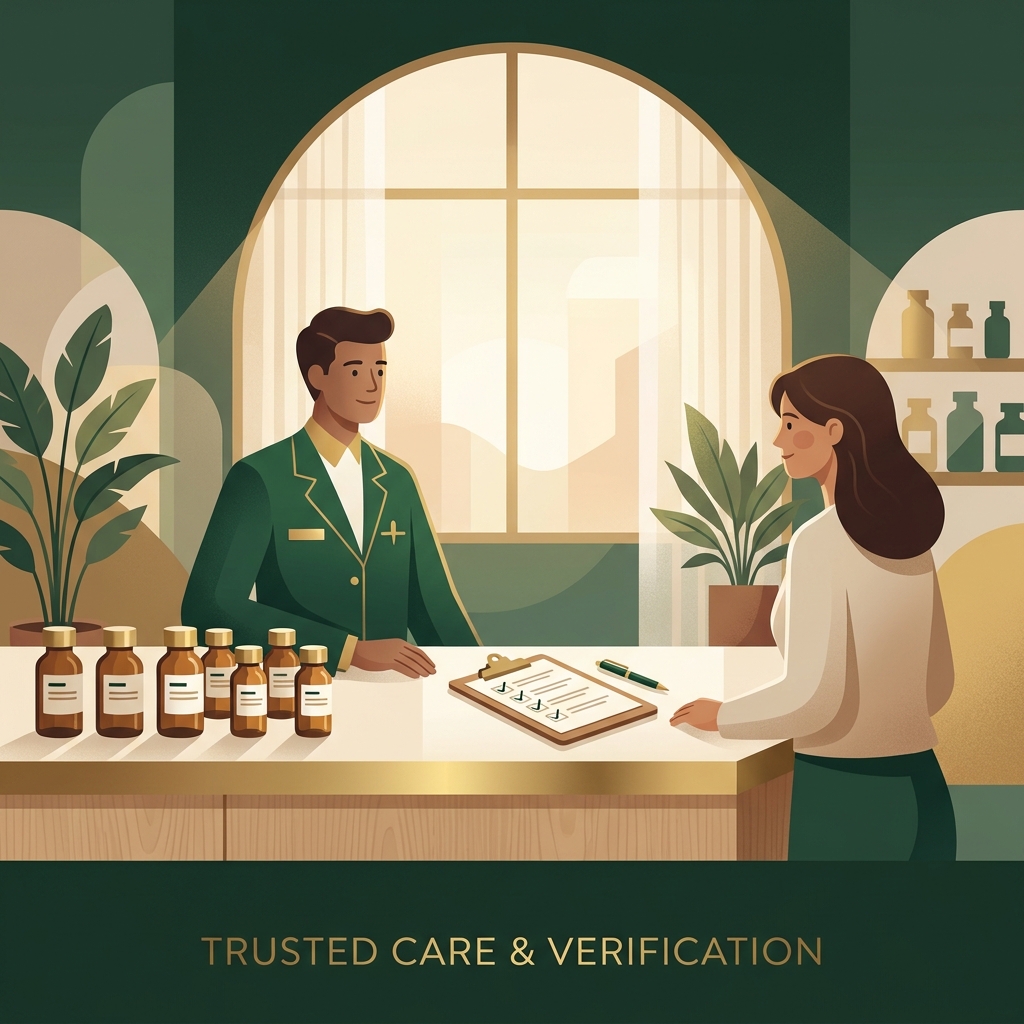
Taken together, the framework produces a clear picture. A genuinely safe compounding pharmacy combines PCAB accreditation, documented USP <795>/<797>/<800> compliance, API sourcing from FDA-registered manufacturers, independent third-party testing with CoAs available on request, and active state licensure with a clean enforcement record.
Nationwide Compounding Rx® exemplifies this standard. The pharmacy is PCAB accredited and USP <800> compliant, sources high-grade chemicals exclusively from FDA-inspected and cleared vendors, and relies on independent third-party testing, backed by more than 40 years of combined team experience.
The combination is what matters. A pharmacy might hold one credential while lacking others, so patients should look for the full picture rather than a single checkbox. Quality and convenience are not mutually exclusive: a one- to two-business-day turnaround and nationwide shipping are achievable without sacrificing standards when the underlying infrastructure is built correctly.
The clearest signal of all is culture. A pharmacy that is transparent about its compounding pharmacy safety standards, willing to provide documentation, and proactive about patient education demonstrates the culture of quality that safety requires.
Conclusion: Safety Is Earned, Not Assumed
Compounding pharmacy is neither inherently safe nor inherently unsafe. Safety is a function of a specific pharmacy’s credentials, oversight, practices, and transparency.
Compounding offers real, sometimes irreplaceable value: pediatric dosing, allergen-free formulations, discontinued drugs, individualized hormone therapy, and localized pain management. At the same time, the 2012 NECC outbreak, the 455-plus adverse events tied to compounded semaglutide, and ongoing FDA enforcement waves are documented harms, not hypotheticals. They occurred at pharmacies that lacked the safeguards described in this article.
The five-step verification framework is a permanent tool: confirm state licensure, verify PCAB or NABP accreditation, check the FDA enforcement record, request a Certificate of Analysis, and confirm FDA-registered API sourcing. The fact that fewer than 1% of pharmacies hold PCAB accreditation means finding one is worth the extra step, and the search itself is an act of informed patient advocacy.
The landscape is tightening. The SAFE Drugs Act of 2025, state-level PCAB requirements, and active USP <800> enforcement all point in the same direction. Patients who understand these standards today are far better positioned to navigate the evolving compounding landscape tomorrow.
Ready to Fill a Compounded Prescription with Confidence?
Patients are encouraged to verify Nationwide Compounding Rx®’s credentials directly. PCAB accreditation is publicly verifiable, and the pharmacy welcomes questions about its USP compliance, API sourcing, and third-party testing.
For patients: Contact Nationwide Compounding Rx® at (480) 499-8379 or through the secure patient portal at nationwidecompounding.com to discuss prescription needs and ask the verification questions outlined in this article.
For healthcare providers: Use the Provider Portal to submit prescriptions, track orders, and connect directly with the pharmacy team. The Connect, Collaborate, Create, and Care framework ensures patients receive personalized, quality-verified compounded medications.
The value proposition is concrete: PCAB accredited, USP <800> compliant, FDA-inspected ingredient sourcing, independent third-party testing, one- to two-business-day turnaround, and nationwide shipping. The credentials that matter, verified and available.
Patients and providers deserve a compounding pharmacy that can answer every question in the five-step verification framework without hesitation. That is the standard Nationwide Compounding Rx® holds itself to.
Related Posts
Fairview Specialty Pharmacy will be out-of-network for UnitedHealthcare Medicare Advantage starting January 1, 2027, affecting up to 125,000 Minnesota patients. This guide breaks down what specialty medication users need to know before the enrollment deadline and how to build a backup plan.

Searching for University Compounding Pharmacy San Diego? This 2026 guide confirms UCP's location, specialties, and PCAB status while showing how to verify any compounding pharmacy's credentials. It also compares UCP to alternatives like Nationwide Compounding Rx for specific patient needs.
Senderra Specialty Pharmacy is a major player in dispensing biologic therapies for dermatology, rheumatology, and oncology patients. This article breaks down what Senderra does well, where patients often hit friction, and how PCAB-accredited compounding pharmacies can complement—not replace—biologic treatment plans in 2026.

Ever wondered what are bioidentical hormones made from? This 2026 guide goes beyond 'soy or wild yam' to explain the biochemistry, the Marker degradation process, and the regulated supply chain behind every prescription. Learn how plant compounds become identical to human hormones.