
Personalized Medicine Pharmacy: What It Is, Why It’s Growing, and How Compounding Makes It Real in 2026
Introduction: Medicine Is Getting Personal, And That’s a Big Deal
Consider a patient who has cycled through three different medications for the same condition. The first caused nausea. The second came in a pill too large to swallow comfortably. The third contained a dye that triggered an allergic reaction. Each time, the treatment failed, not because the underlying science was wrong, but because the medication was built for an “average” patient who does not actually exist. This is the gap that personalized medicine pharmacy is designed to close.
The scale of this shift is enormous. The global personalized medicine market was valued at USD 393.9 billion in 2025 and is projected to reach USD 779.4 billion by 2036, according to Future Market Insights. Yet for most people, precision medicine still sounds like something confined to gene therapy labs and cutting-edge oncology trials. The truth is that a far more accessible version of personalized medicine already exists and is available today.
That practical delivery mechanism is compounding pharmacy. It is the real-world engine that turns the promise of individualized care into medications patients can actually use. This article explains what personalized medicine pharmacy means, why it is growing so rapidly in 2026, how compounding makes it real, and what patients and prescribers should know. Throughout, Nationwide Compounding Rx® serves as a working example of a pharmacy that rejects the one-size-fits-all approach in favor of patient-by-patient customization.
What Is Personalized Medicine Pharmacy?
Personalized medicine pharmacy is an approach to pharmaceutical care that tailors medications, dosages, delivery methods, and treatment protocols to the unique biology, genetics, lifestyle, and preferences of an individual patient. Instead of forcing the patient to fit the medication, the medication is built to fit the patient.
This stands in contrast to standard pharmacy practice, where mass-manufactured drugs are produced in fixed doses and formulations designed for a statistical average. That model works well for many people, but it leaves millions underserved, including those with allergies to common ingredients, those who cannot swallow pills, and those who need a dose that is simply not commercially available.
Personalized medicine exists on a spectrum. At one end are advanced genomic therapies such as gene editing and cell therapies. At the other end are accessible compounding pharmacy solutions. Both are legitimate expressions of the same paradigm. This is not fringe science: according to the Personalized Medicine Coalition, over 25% of new FDA-authorized drugs are now tailored or personalized medicines. For most patients, however, this care is reached not through a biotech trial but through a compounding pharmacy. Compounding, in effect, democratizes personalized medicine.
The Precision Medicine Movement: A Multi-Trillion-Dollar Paradigm Shift
The broader precision medicine movement encompasses genomics, biomarkers, pharmacogenomics, AI diagnostics, and individualized treatment protocols. The financial scale conveys its momentum. The hyper-personalized medicine market was estimated at USD 3.24 trillion in 2025 and is predicted to reach approximately USD 12.59 trillion by 2035, expanding at a CAGR of 14.55%, according to Towards Healthcare.
A major driver has been the collapse in whole-genome sequencing costs, which dropped from over $100 million to under $1,000, dramatically widening the patient population that can benefit from genomically informed care. Within this landscape, pharmacogenomics holds the largest technology segment share at 30.2%. In accessible terms, pharmacogenomics studies how genetic variants affect the way individuals metabolize drugs, which directly influences which medication and dose will work.
The clinical payoff is real. A JAMA study found that pharmacogenomics-guided treatment reduced adverse drug events by 30% compared to standard treatment. While cutting-edge options continue to expand, with 46 cell and gene therapies FDA-approved as of October 2025 and more than 500 in the pipeline, these represent the frontier rather than everyday reality. The practical question for most patients remains: how does personalized medicine translate into something they can access at a pharmacy today?
How Compounding Pharmacy Bridges the Gap Between Concept and Care
Pharmaceutical compounding is the practice of preparing customized medications tailored to an individual patient’s specific needs, adjusting the dose, strength, delivery form, flavor, or ingredient profile. Compounding pharmacy is the practical bridge between the abstract promise of personalized medicine and real-world patient care.
Compounding pharmacies fill critical gaps that mass-manufactured drugs cannot. They serve patients with allergies to common excipients, children who cannot swallow pills, patients who require discontinued medications, and individuals needing precise hormone adjustments based on lab results. The impact on adherence is striking: a 2023 survey by the International Academy of Compounding Pharmacists found that over 70% of patients receiving compounded medications reported improved treatment adherence compared to conventional therapies.
The addressable population is vast. The CDC reports that an estimated 129 million Americans have at least one chronic condition. Pharmacies like Nationwide Compounding Rx® work alongside prescribers to develop patient-specific formulations, adjusting medications refill by refill based on lab results and patient response. This is not a workaround or a compromise. It is the art and science of pharmaceutical care applied at the individual level.
The Science Behind Personalization: Pharmacogenomics and Compounding Working Together
Pharmacogenomics is the study of how a person’s genes affect their response to medications, including how quickly they metabolize a drug, whether they experience side effects, and whether a standard dose will be effective. As the Croatian Medical Journal noted in 2025, this data can be used to select the drug and dose, increasing the likelihood that each person receives the optimal dose of the most effective drug on their first treatment.
These findings are common in clinical practice. Real-world data published in Pharmacogenetics and Genomics in March 2026 identified an average of 4.7 actionable genetic variants per patient, resulting in at least one drug-gene interaction in 46% of patients. When a genetic profile reveals that a patient metabolizes a standard drug too quickly or too slowly, a compounding pharmacy can prepare a formulation at the precise dose that aligns with their metabolic reality.
This is mainstream science, not fringe theory: nearly 40 FDA-approved oncology drugs already include pharmacogenomic data in their labels. Additionally, 503A compounding pharmacies can serve as testing grounds for new formulations, offering insights that pharmaceutical companies later commercialize. A useful analogy: a medication dose designed for the “average” person is like a suit tailored for the average body. It fits almost no one perfectly. Compounding is the alteration that makes it fit.
Why Personalized Medicine Pharmacy Is Growing in 2026
2026 represents a genuine inflection point, driven by converging forces in science, regulation, market demand, and patient expectations. The global compounding pharmacies market is projected to grow from USD 14.04 billion in 2026 to USD 29.21 billion by 2036, a CAGR of 7.6%, driven directly by rising demand for personalized medicines, according to Future Market Insights. In the U.S. specifically, the compounding pharmacy market is expected to grow from USD 7.42 billion in 2026 to USD 12.02 billion by 2034.
Several demand drivers converge here: the chronic disease burden of 129 million Americans, an aging population, and rising out-of-pocket costs. Commercial insurance out-of-pocket costs rose 37% over five years, according to the IQVIA Institute, underscoring the need for cost-effective, personalized alternatives. Drug shortages and growing patient awareness add further momentum.
Telehealth acts as a powerful accelerant, expanding access to prescribers who can order compounded medications and removing geographic barriers. North America leads the personalized medicine market with a 44.4% share in 2026. Meanwhile, automated compounding systems can now produce up to 1,000 weight-controlled doses per hour while maintaining pharmaceutical-grade quality, making personalized medicine more scalable and cost-effective than ever before.
Key Therapeutic Areas Where Personalized Compounding Is Making an Impact
The following is a practical overview of where personalized compounding pharmacy is delivering the most meaningful patient outcomes in 2026, each a real-world application of the personalized medicine philosophy.
Hormone Replacement Therapy: Precision Dosing for Every Patient
HRT is the fastest-growing therapeutic area in compounding at a 7.86% CAGR, according to Mordor Intelligence. The reason is straightforward: hormones are highly individual, and standard commercial doses rarely align with a patient’s actual lab values. Bio-identical hormone replacement therapy (BHRT) uses customized formulations that can be adjusted at every refill based on lab results, addressing symptoms like fatigue, mood swings, weight gain, hot flashes, and sexual dysfunction.
A pharmacy like Nationwide Compounding Rx® prepares BHRT in multiple delivery forms, including troches, transdermal creams, gels, and capsules, allowing the prescriber to match the formulation to each patient’s lifestyle and absorption profile. This is a direct application of the principle that treatment should be calibrated to the individual, not the average.
Pain Management: Targeted Relief Without Systemic Trade-Offs
Pain management accounts for 31.23% of the compounding pharmacy market share, making it the largest single therapeutic category. Topical compounded pain formulations deliver medication directly to the site of pain, allowing patients to achieve localized relief while minimizing systemic side effects such as addiction risk, dizziness, nausea, and fatigue associated with oral medications.
The process is collaborative: a prescriber and pharmacist create a formulation combining specific active ingredients at precise concentrations tailored to the patient’s condition, pain type, and tolerance. Because pain is highly subjective and individual, a formulation designed around a patient’s specific pain mechanism is precision care in action.
Pediatric Compounding: Medications Children Will Actually Take
Pediatric compounded preparations are growing at a 7.66% CAGR, driven by demand for dye-free, allergen-free, weight-based formulations that commercial manufacturers do not offer. Most commercial medications are formulated for adults, resulting in incorrect doses, unsuitable forms, and flavors children reject.
Compounding solves this. Nationwide Compounding Rx® can prepare medications in child-appropriate doses, in gummy or liquid form, and in flavors children enjoy such as banana crème, cherry, grape, and tutti frutti. A medication a child refuses provides zero therapeutic benefit; one they accept willingly is personalized medicine at its most practical. Equally important is the ability to eliminate common allergens like lactose, dyes, gluten, and sugar.
Dermatology: Skin-Type-Specific Formulations
Skin conditions such as rosacea, acne, eczema, psoriasis, scarring, and hyperpigmentation respond differently across patients, making one-size-fits-all commercial topicals often ineffective. Compounded dermatology formulations are customized to an individual’s skin type, condition severity, lifestyle, and tolerability, combining active ingredients at concentrations not available commercially. The skin is the body’s largest and one of its most individually variable organs, making personalized topical formulations a natural fit for precision medicine.
Weight Management and Metabolic Health: A Case Study in Personalized Pharmacy
The GLP-1 story illustrates both the power and the regulatory complexity of personalized pharmacy. The FDA resolved the semaglutide shortage in February 2025 and the tirzepatide shortage in December 2024, triggering new enforcement postures against mass-compounded GLP-1 drugs in early 2026. Compliant compounding pharmacies responded by pivoting to patient-specific formulations under 503A guidelines and working closely with prescribers.
Nationwide Compounding Rx® serves as the exclusive provider of RM3® for Red Mountain Weight Loss®, an example of a clinically supervised weight management program built around compounded medications. The broader lesson is that personalized medicine pharmacy is not about circumventing regulation; it is about working within a compliant framework to serve patients whose needs are not met by commercial options. For more on the current regulatory landscape for GLP-1 compounding, see our overview of semaglutide compounding pharmacy legal status in 2026.
The Regulatory Landscape in 2026: What Patients and Prescribers Need to Know
The regulatory environment for compounding pharmacy is evolving rapidly. Understanding two key categories is essential: 503A pharmacies prepare patient-specific compounded medications based on individual prescriptions, while 503B outsourcing facilities produce larger batches for healthcare facilities without patient-specific prescriptions. Both operate under distinct frameworks.
Federal scrutiny is increasing. The SAFE Drugs Act of 2025 (H.R. 6509), introduced in December 2025, proposes new limits on compounding “copies” of FDA-approved drugs, enhanced FDA reporting requirements, and mandatory inspections for large-scale outsourcing facilities, as detailed by Dykema. On the access side, on February 27, 2026, HHS Secretary RFK Jr. announced that approximately 14 of 19 peptides on the FDA’s Category 2 restricted compounding list would be moved back to Category 1, restoring legal compounding pathways for licensed pharmacies, according to Pharmacy Times.
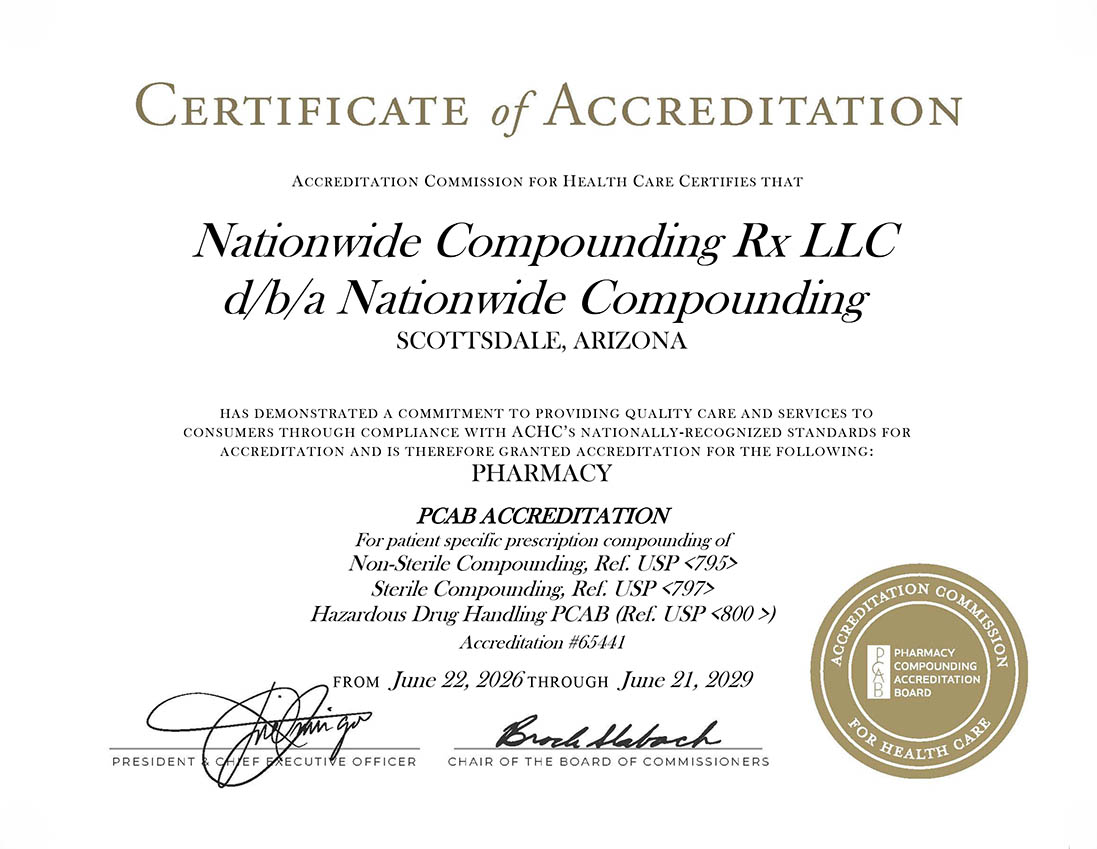
For patients, compliance matters. Working with an accredited pharmacy like Nationwide Compounding Rx®, which holds PCAB accreditation, operates a USP 800 compliant facility, and sources chemicals exclusively from FDA-inspected vendors, provides meaningful protection against substandard products. Regulatory evolution is a sign of a maturing, growing industry, not a reason to avoid compounding pharmacy.
What to Look for in a Personalized Medicine Pharmacy
Patients and prescribers evaluating a compounding pharmacy should apply clear criteria:
- Accreditation: Look for PCAB (Pharmacy Compounding Accreditation Board) accreditation, a third-party validation of safety and quality. Nationwide Compounding Rx® has maintained this since its earliest days.
- Facility standards: USP 800 compliance is a critical safety benchmark that eliminates cross-contamination risks.
- Ingredient sourcing: Active ingredients should come exclusively from FDA-inspected and cleared vendors, never from unverified or offshore suppliers.
- Prescriber collaboration: A quality pharmacy works alongside prescribers, communicating actively to optimize formulations.
- Range of options: The ability to prepare creams, troches, capsules, gummies, liquids, and suppositories, and to eliminate allergens like lactose, dyes, gluten, and sugar, marks genuine personalization capability.
- Turnaround and accessibility: Nationwide Compounding Rx® offers 1-2 business day turnaround on all medications and ships to 47 states plus Washington, D.C.
- Experience: Look for expertise across multiple therapeutic areas. Nationwide Compounding Rx® brings a combined 40 years of experience across BHRT, pain management, dermatology, pediatrics, sports medicine, and weight management.
The Patient Adherence Advantage: Why Personalized Medications Work Better
Adherence is arguably the single most important factor in treatment outcomes, and the evidence favoring personalized medications is compelling. The IACP survey found that over 70% of patients receiving compounded medications reported improved adherence compared to conventional therapies.
Compounding removes concrete barriers: pill size and swallowing difficulty, unpleasant taste, allergens and intolerances, inconvenient delivery methods, and doses that are too high or too low. The financial stakes are significant, as poor medication adherence costs the U.S. healthcare system hundreds of billions annually in preventable hospitalizations and disease progression. Personalized pharmacy is therefore both a clinical tool and a cost-containment strategy.
Pharmacogenomics amplifies this benefit. When a medication is selected and dosed based on a patient’s genetic profile, the likelihood of first-attempt efficacy rises, reducing the discouraging cycle of trial-and-error prescribing. The 30% reduction in adverse drug events from pharmacogenomics-guided treatment is a concrete metric that resonates with patients and payers alike. Ultimately, adherence is the difference between a patient who abandons treatment and one who achieves meaningful health outcomes.
Nationwide Compounding Rx®: Personalized Medicine Pharmacy in Practice
Nationwide Compounding Rx® is a concrete example of how the personalized medicine philosophy operates at the patient level. Its core philosophy is an explicit rejection of the one-size-fits-all approach, with a commitment to customizing medications on a patient-by-patient basis to increase adherence.
The pharmacy serves a broad range of specialties: BHRT, pain management, dermatology, pediatric compounding, sports medicine, and weight management. Its quality and compliance infrastructure includes PCAB accreditation maintained since its earliest days, a USP 800 compliant facility, FDA-inspected ingredient sourcing, and adherence to all state and federal guidelines.
Operational advantages serve patients directly: 1-2 business day turnaround, same-day pickup for select medications, nationwide shipping to 47 states plus Washington, D.C., and a combined 40 years of compounding expertise. Available dosage forms include troches, transdermal creams and gels, capsules, gummies, oral liquids, suppositories, and lip balm, with the ability to eliminate allergens and add patient-preferred flavors. Based in Scottsdale, Arizona, and reachable toll-free at 1-833-650-9836 or at NationwideCompounding.com, the pharmacy functions as a collaborative partner to prescribers and patients, developing formulations that commercial manufacturers cannot or will not provide.
The Future of Personalized Medicine Pharmacy: What’s Coming Next
The near-term evolution of personalized medicine pharmacy is grounded in current data. As whole-genome sequencing approaches sub-$200 per test, pharmacogenomics-guided prescribing will become a standard part of clinical practice, with compounding pharmacies essential in translating genetic insights into individualized formulations. Artificial intelligence is increasingly used to analyze patient data, predict drug responses, and optimize formulation parameters, positioning technology-forward compounders to deliver even more precise medications.
The telehealth-compounding convergence continues to expand access to prescribers and remove geographic barriers. The specialty drug pipeline reinforces the trend: with specialty therapies representing about 75% of the 7,000 drugs under development and the specialty drug market projected to reach nearly $965.5 billion by 2030, according to Trilliant Health, compounding pharmacies will play a growing role in bridging gaps between commercial availability and patient need. As regulation matures, compliant and accredited pharmacies will be increasingly distinguished from non-compliant operators, strengthening patient trust. 2026 is genuinely an inflection point, and the patients who benefit most will be those working with knowledgeable, compliant, experienced pharmacies.
Conclusion: Personalized Medicine Is Here, And It Starts at the Pharmacy
Personalized medicine pharmacy is not a future concept or an elite privilege. It is a present reality, accessible today through compounding pharmacies that tailor medications to individual patients. This is a multi-trillion-dollar global shift toward individualized care, driven by genomics, pharmacogenomics, AI, and decades of clinical evidence that one-size-fits-all medicine fails too many people.
On the human level, this matters enormously. For the 129 million Americans living with chronic conditions, for the child who cannot swallow a pill, and for the patient whose hormones do not respond to a standard dose, personalized medicine pharmacy is not abstract. It is the difference between a medication that works and one that does not. While gene therapies and CRISPR treatments represent the frontier, compounding makes individualized care accessible to everyday patients today. As pharmacogenomics, telehealth, and AI continue to converge, the personalized medicine pharmacy of 2026 is only the beginning, and patients who seek out this model are positioning themselves for better outcomes, fewer side effects, and a healthcare experience built around them.
Ready for a Medication Made for You? Contact Nationwide Compounding Rx® Today
Whether seeking a medication tailored to unique individual needs or a trusted compounding partner for a medical practice, Nationwide Compounding Rx® is equipped to help. The pharmacy is PCAB-accredited and USP 800 compliant, brings 40 years of combined expertise, offers 1-2 business day turnaround, and ships nationwide to 47 states plus Washington, D.C.
To get started, visit NationwideCompounding.com or call toll-free at 1-833-650-9836 to speak with a compounding specialist.
For prescribers: Nationwide Compounding Rx® operates on a collaborative, B2B partnership model, working alongside medical practices to develop patient-specific formulations across BHRT, pain management, dermatology, pediatrics, sports medicine, and weight management.
For patients: Speak with a prescriber about whether a compounded medication may be appropriate for your situation, and ask about Nationwide Compounding Rx® as a pharmacy partner.
Personalized medicine pharmacy is real, it is accessible, and it starts with a conversation.
Related Posts
Searching for Las Colinas Pharmacy Compounding & Wellness in Irving, TX? This 2026 guide gives you the address, hours, and phone number up front, then breaks down the accreditation and safety standards DFW patients should check before trusting any compounding pharmacy with hormone, peptide, or custom medication needs.

Searching for Jefferson Specialty Pharmacy turns up two unrelated organizations—one in Pennsylvania, one in Washington State. This guide clarifies which is which and explains what to do in 2026 when a prescribed medication can't be filled by either.

Searching for Marty's Compounding Pharmacy but not sure if a local Mississippi storefront fits your needs? This guide compares Marty's Pharmacy & Compounding Center to nationwide compounding options using a five-point credential checklist covering accreditation, testing, and shipping licenses in 2026.

The term 'board of specialty pharmacy' actually refers to four distinct organizations, each serving a different purpose. This article breaks down BPS, SPCB, state boards, and PCAB to reveal which body truly governs compounding pharmacy quality in 2026.