
Community Compounding Pharmacy Lake Oswego: 2026 Oregon Guide
Introduction: Beyond the Directory Listing
Most people who search for “community compounding pharmacy lake oswego” want something simple: an address, a phone number, or business hours. That need is valid, and this guide answers it. A growing number of searchers, however, are Oregon patients who cannot realistically drive to Jean Road to pick up a prescription. For them, the more important question is whether a pharmacy can legally compound and ship medication to their address.
This guide explains what Oregon law requires of any compounding pharmacy that ships to a patient, whether that pharmacy sits in Lake Oswego or several states away. The discussion centers on three regulatory pillars:
- Oregon’s nonresident pharmacy rule (OAR 855-041-1060), which governs out-of-state pharmacies serving Oregon residents
- The Oregon Board of Pharmacy’s GLP-1/semaglutide enforcement stance, one of the most closely watched compounding issues in 2026
- USP <795>, <797>, and <800> compliance, the national quality standards Oregon has written into its rules
The timing matters. Since Massachusetts implemented its licensing regime on May 1, 2025, every U.S. state has a formal nonresident pharmacy licensing pathway. Interstate compounding compliance is no longer a niche concern; it is a routine question every patient using a shipped prescription should ask.
Community Compounding Pharmacy, Lake Oswego: The Quick Facts
For readers looking for basic information, here are the essentials:
- Address: 6025 Jean Rd, Lake Oswego, OR 97035
- Phone: (503) 303-7373
- Hours: Monday through Friday, 9:00 AM to 5:00 PM; Saturday, 9:00 AM to 1:00 PM (pickup only); closed Sunday
The pharmacy describes itself as focused on naturopathic and integrative medicine. It compounds for GI disorders, mast cell activation syndrome (MCAS), chronic sinusitis, autoimmune issues, chronic pain syndrome, and hormonal imbalances, and it offers low-dose naltrexone (LDN) in tablet form.
According to its website, the service lines include:
- Compounding
- Dermatology & Skin Therapy
- Hormone Replacement Therapy
- Pain Management
- Pediatric Compounding & Flavored Medicines
- Sinus Pain & Allergy Relief
- Pet Care
Third-party business data from Crunchbase and RocketReach estimates the company at roughly $16.1 million in revenue with about 33 employees. It has served the naturopathic community in the Northwest and beyond for more than a decade.
Its public review profile is mixed. Apple Maps displays a Yelp-sourced rating of 2.8 out of 5 from 42 reviews. Some reviewers mention rushed phone service and order errors, while long-term patients praise the pharmacy for reliably providing specialty compounds. As with any independent pharmacy, individual experiences vary.
This is where most directory content stops. It does not answer what happens when a patient lives outside the practical pickup radius.
The Real Question: When Pickup Isn’t Practical, What Does the Law Require?
One reviewer explained that they needed medication mailed because they lived 175 miles from Lake Oswego. That situation is common. Oregon is a large state, and many rural residents, as well as naturopathic patients who travel to see a Portland-area provider, live hours away from their pharmacy.
Shipping a compounded prescription is not simply a logistics choice. Whether the package crosses state lines or travels within Oregon to a distant patient, it is a regulated pharmacy practice activity. Oregon has specific, enforceable rules for any pharmacy, local or out-of-state, that compounds and ships medication to a resident. Not every pharmacy demonstrates its compliance with those rules transparently, which is why patients benefit from knowing what to look for.
Oregon’s Legal Framework for Compounding Pharmacies That Ship
Before comparing pharmacies, it helps to understand what Oregon law requires in plain language.
Drug Outlet Registration Requirement
Oregon requires any person or business, in-state or out-of-state, that compounds a drug for use or distribution in Oregon to register with the Oregon Board of Pharmacy as a drug outlet.
Location does not matter. If the compounding happens in Arizona, Texas, or Lake Oswego and the finished medication reaches an Oregon patient, Oregon jurisdiction applies.
The Nonresident Pharmacy Rule: OAR 855-041-1060
For pharmacies located outside Oregon, OAR 855-041-1060 sets clear requirements. Every nonresident pharmacy that ships drugs into Oregon must:
- Register with the Oregon Board of Pharmacy
- Remain in good standing with the licensing authority in its home state
- Designate an Oregon-licensed Pharmacist-in-Charge (PIC) who is present at the pharmacy at least 20 hours per week
- Complete an annual self-inspection report, due before July 1
For patients, these requirements create a verifiable credential. A patient can ask a pharmacy whether it holds an Oregon registration and who serves as its Oregon-licensed Pharmacist-in-Charge. A compliant pharmacy should be able to answer both questions.
Oregon has enforced these rules before. In 2008, Dallas-based compounder ApothéCure settled with the Oregon Attorney General after making dozens of unlicensed interstate sales into the state, including 44 sales of injectable colchicine to Oregon health professionals. The company paid $100,000 and faced exposure to a $500,000 penalty for future violations. The case shows that shipping without proper registration has real consequences.
USP <795>, <797>, and <800> Compliance
The United States Pharmacopeia (USP) publishes the quality standards that govern how compounded medications are made:
- USP <795> covers non-sterile compounding, such as capsules, creams, and oral liquids.
- USP <797> covers sterile compounding, such as injectables.
- USP <800> covers the safe handling of hazardous drugs to protect patients, staff, and the environment.
Under OAR 855-045-0200, all drug compounding in Oregon must adhere to the current edition of these USP chapters. These standards apply whether a patient picks up a prescription at the counter or receives it by mail. Compliance concerns the compounding process itself, not the delivery method.
USP <800> deserves special attention. It is particularly relevant for hazardous or potent compounds, including certain hormones, and it serves as a baseline quality marker patients can ask about directly.
Oregon’s GLP-1/Semaglutide Enforcement Stance
Few compounding topics have drawn as much regulatory attention as GLP-1 medications. The Oregon Board of Pharmacy adopted a formal Statement on Semaglutide (v.2, February 2025), which illustrates how seriously the state enforces compounding rules.
The Board warns that compounding or dispensing semaglutide and other GLP-1 drugs in a way that fails to conform with governing law may lead to enforcement action. The statement includes several details patients should understand:
- “Research use only” API is never acceptable. Active pharmaceutical ingredients labeled for research use may never be used for compounding. Patients should treat any sign of research-grade sourcing as a serious red flag.
- Semaglutide is not on the FDA’s bulks list. Semaglutide does not appear in any salt form on the FDA’s bulk drug substance list for compounding, so sourcing and documentation matter enormously.
- Specific sourcing markers are expected. Any API used must be pharmaceutical-grade, accompanied by a certificate of analysis, and sourced from an FDA-registered establishment.
The Oregon Medical Board has also highlighted this guidance for prescribers, reinforcing that responsibility extends across the care team.
The broader point is simple. A pharmacy’s willingness to be transparent about its sourcing and compliance directly indicates how seriously it takes Oregon’s rules. A pharmacy that answers sourcing questions readily is generally a safer choice than one that deflects them.
PCAB Accreditation: The Credential That Signals Real Compliance
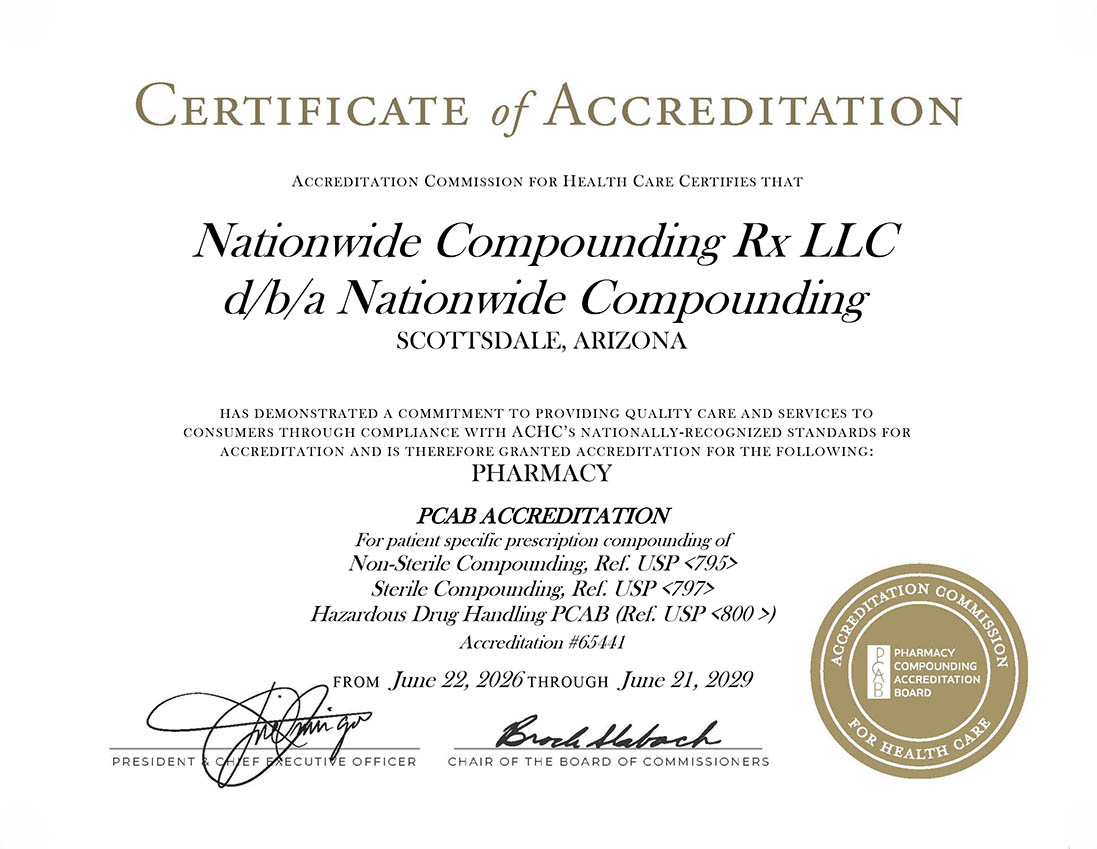
The Pharmacy Compounding Accreditation Board (PCAB), now administered by the Accreditation Commission for Health Care (ACHC), offers a voluntary accreditation widely regarded as the gold standard in compounding.
Several facts make PCAB accreditation significant:
- Fewer than 1% of U.S. compounding pharmacies hold PCAB accreditation.
- The American Medical Association recommends that physicians partner only with PCAB-accredited compounders.
- Washington and Ohio now require verifiable PCAB accreditation as part of nonresident compounding pharmacy licensure, a trend that signals where regulation is heading nationally.
For patients, PCAB accreditation works as a practical shortcut. Most people cannot audit a pharmacy’s USP compliance, cleanroom procedures, or quality systems themselves. PCAB accreditation indicates that an independent body has already evaluated those systems against rigorous standards.
A Verification Checklist for Patients Choosing a Shipped Compounding Pharmacy
Before transferring a prescription to any pharmacy that will ship medication, patients can work through the following checklist:
- Is the pharmacy registered as a drug outlet in Oregon (or in the patient’s home state)?
- Does it designate an Oregon-licensed Pharmacist-in-Charge consistent with nonresident pharmacy rules?
- Is it PCAB-accredited?
- Does it disclose USP <795>, <797>, and <800> compliance?
- Does it publish which states it is licensed to ship to?
Patients seeking GLP-1 or peptide compounds should also ask directly about API sourcing and request confirmation that certificates of analysis accompany the ingredients used.
Shipping transparency is itself a trust signal. A pharmacy that publishes a licensing-state map or clearly defined shipping tiers shows that it has considered where it can and cannot legally serve patients.
Local Pickup vs. Nationwide Shipping: Comparing the Two Models
This comparison is not about which pharmacy is better overall. It is about which model fits a patient’s practical access needs while still meeting Oregon’s legal requirements.
Community Compounding Pharmacy: The Local Lake Oswego Model
Community Compounding Pharmacy’s strength lies in its in-person, naturopathic-integrated approach. It offers Saturday pickup hours and deep specialization in functional medicine compounds, including LDN, MCAS support, and sinus formulations. For patients living near Lake Oswego and working with Portland-area naturopathic providers, that local relationship can be valuable.
The pharmacy’s website states that it offers “Nationwide online service” alongside local pickup. That is why shipping-compliance questions matter even for patients considering this pharmacy. Its site does not prominently publish shipping-eligibility, licensing-state, or accreditation details, so patients may need to ask directly.
Given the mixed review signals (a 2.8 out of 5 rating, with some complaints about rushed service and order errors), patients planning a long-distance relationship with any pharmacy may reasonably want extra verification of shipping compliance and communication practices before committing.
Nationwide Compounding Rx®: The Multi-State-Licensed Shipping Model
Nationwide Compounding Rx® is a PCAB-accredited, USP <800>-compliant compounding pharmacy based in Scottsdale, Arizona. Its model is built around multi-state licensing and transparent shipping, and it produces both sterile and non-sterile formulations.
Its published shipping map uses a three-tier system:
- Fully licensed states
- Non-sterile only (sterile licensing pending)
- Sterile/non-sterile pending or unlicensed states
This structure directly addresses the question many distant patients have: is it legal for this pharmacy to ship to me? Patients can check their state’s status and confirm eligibility for their specific medication before transferring a prescription.
Its services overlap with many Oregon patient needs:
- Bioidentical Hormone Replacement Therapy (BHRT), with formulas adjustable at each refill based on updated lab results
- Pain management topicals, designed to localize treatment and reduce systemic side effects
- Pediatric compounding in kid-friendly forms and flavors such as cherry, bubblegum, and strawberry
- GLP-1/peptide support, with chemicals sourced from FDA-inspected and cleared vendors
Several operational details are relevant for out-of-area patients: a 1 to 2 business day turnaround, independent third-party testing, secure patient and provider portals, and allergen-free formulation options without dyes, fillers, or preservatives.
Nationwide Compounding Rx® is not positioned as a replacement for local naturopathic care. It is a compliance-focused option for patients when Lake Oswego pickup is not geographically practical.
Who This Guide Is For: Common Oregon Patient Scenarios
This guide is especially relevant for:
- Rural or distant Oregon patients, such as those living 175 miles or more from Lake Oswego, who need specialty compounds like thyroid medication mailed reliably.
- Patients seeking GLP-1/semaglutide or peptide compounding who want assurance that a pharmacy follows Oregon’s semaglutide position statement and API sourcing rules.
- Naturopathic and integrative-medicine patients who work with a Lake Oswego-area provider but live outside convenient pickup range.
- Patients relocating out of Oregon or splitting time between states who need a pharmacy licensed across multiple jurisdictions.
Conclusion
In 2026, choosing a compounding pharmacy is no longer only about proximity. When shipping is involved, verifiable legal compliance matters just as much as convenience.
Oregon patients should confirm three pillars:
- Nonresident pharmacy registration and Pharmacist-in-Charge designation under OAR 855-041-1060
- USP <795>, <797>, and <800> compliance, required for all Oregon compounding under OAR 855-045-0200
- Adherence to Board of Pharmacy position statements, including the GLP-1/semaglutide guidance
PCAB accreditation remains one of the clearest and fastest ways for patients to simplify this evaluation. Whether a patient chooses local pickup in Lake Oswego or a nationwide-shipping alternative, the standard for legal, safe compounding should be the same.
Next Steps: Verify Before You Fill
Patients who live outside Lake Oswego’s practical pickup radius should confirm a pharmacy’s Oregon drug outlet registration and shipping-state licensing before transferring a prescription. A few direct questions can prevent delays, compliance problems, and safety concerns later.
Readers interested in a PCAB-accredited, multi-state shipping option can explore Nationwide Compounding Rx® and its state-by-state licensing tiers. To confirm shipping eligibility to an Oregon address, or to discuss GLP-1, BHRT, pain management, or pediatric compounding needs, contact Nationwide Compounding Rx® at (480) 499-8379 (Monday through Friday, 7:00 AM to 3:30 PM Arizona time) or through its secure patient and provider portals.
Related Posts

Louisville providers often struggle to find a compounding pharmacy that explains how true partnerships work. This 2026 guide breaks down the Connect → Collaborate → Create → Care framework, covering BHRT, pediatrics, dermatology, and pain management compounding for local practices.

Choosing a Lexington KY compounding pharmacy takes more than proximity and a star rating. This 2026 guide shows you how to verify Kentucky Board licensure, PCAB accreditation, and USP 795/797/800 compliance before trusting a provider with your prescription.

Central Ohio's booming population, aging demographics, and billion-dollar health system investments are driving unprecedented demand for personalized medication. This article explores what's fueling the rise in central Ohio compounding pharmacy needs in 2026 and how new regulations are reshaping access to quality care.

NYU Specialty Pharmacy offers strong outpatient care, but strict eligibility, in-network, and disease-state rules can block certain prescriptions. Discover the three key limitations and where New Yorkers can turn next in 2026.